by in News

Serbia, North Macedonia seek to build gas interconnector by end-2027

Serbia and North Macedonia aim to complete the construction of a gas interconnector in late 2027 and put it into operation in early 2028, Serbian Minister of Mining and Energy Dubravka Đedović Handanović said following a meeting with North Macedonia’s Minister of Energy, Mining and Mineral Resources Sanja Božinovska. The pipeline’s projected annual capacity is 1.5 billion cubic meters of natural gas.

Following the construction of the interconnector with Bulgaria, Serbia continues to diversify its supply routes, and the gas link with North Macedonia is a priority in that context, according to Đedović Handanović.

Serbia’s portion of the interconnector with North Macedonia will be 144 kilometers long and will cost an estimated EUR 153 million to build, she said. The plan is to obtain a construction permit in mid-2026 and launch works immediately afterward, she added.

Serbia’s portion of the pipeline will cost EUR 153 million

The planned route on Serbia’s territory is Orljane – Leskovac – Vranje – the North Macedonian border, according to her.

Đedović Handanović: Serbia’s goal is a fully diversified gas supply

“The capacity of the gas interconnector with Bulgaria is 1.8 billion cubic meters per year, and with the completion of the interconnector with North Macedonia, as well as the planned interconnector with Romania, whose capacity will be between 1.6 and 2.5 billion cubic meters, we will have a fully diversified gas supply within the next few years,” said Đedović Handanović.

serbia north macedonia gas pipeline interconnection djedovic bozinovska

Photo: Ministry of Mining and Energy/Nenad Kostić

The goal is to have as many supply options as possible, not to depend on a single supplier, and to ensure greater security and a better negotiating position in terms of prices and capacity, she added.

Božinovska, for her part, said the interconnector with Serbia would ensure new gas sources for North Macedonia and strengthen regional energy stability.

Božinovska: The gas link is one of the most important regional infrastructure projects

“This is also one of the most important regional infrastructure projects – important not only for North Macedonia and Serbia, but for all of Europe. With this new energy link, both countries will gain access to alternative sources and routes, and Europe will get a stronger and better connected Balkans,” Božinovska asserted.

The two countries have completed the necessary studies, agreed on the route, ensured the European Union’s support, and defined a clear implementation timeline, according to her.

Joint efforts to secure a postponement of CBAM

The meeting also addressed the coordinated approach to the EU’s Carbon Border Adjustment Mechanism (CBAM), which is scheduled to take effect on January 1, 2026.

According to Đedović Handanović, the two sides agreed to act jointly on this issue and to request a postponement of the mechanism’s implementation.

“Letters from all contracting parties to the Energy Community will be sent next week so that we can continue the dialogue with the European Commission, which is important not only for Serbia and North Macedonia, but also for the other contracting parties,” she said.

The two sides also discussed the possibility of North Macedonia covering part of Serbia’s demand for oil derivatives, primarily in the country’s south, the Serbian Ministry of Mining and Energy said in a statement.
by in News

Serbia, North Macedonia working on gas interconnector project

Serbia’s state gas company Srbijagas and North Macedonia’s gas transmission system operator Nomagas signed a memorandum of understanding expressing their intention to soon build a gas interconnector between the two countries. Srbijagas is also expected to present a plan for a gas interconnection with Romania.

The memorandum, signed by Srbijagas General Manager Dušan Bajatović and Nomagas Executive Director Muhamet Elmazi, confirms the pipeline’s border crossing point, an important step in preparing technical documentation and project implementation, according to a press release from Srbijagas.

The interconnector’s planned two-way capacity is 1.5 billion cubic meters of natural gas per year. The feasibility study, financed through the Western Balkans Investment Framework (WBIF), is expected to be completed soon, according to a statement by Nomagas.

The interconnector’s planned capacity is 1.5 billion cubic meters

In North Macedonia, the interconnector would be connected to the existing Klečovce gas pipeline, and in Serbia, to a pipeline in Vranje that has already been built. Its total length would be approximately 70 kilometers – about 47 kilometers in Serbia and 23 kilometers in North Macedonia.

The memorandum reaffirms the political will expressed in a memorandum signed by the two countries’ relevant ministries in October 2024, particularly the importance of interconnecting energy markets, strengthening the security of gas supply, and diversifying supply routes, according to Srbijagas.

With this document, the two sides also declare their support for increased cooperation between Southeast European countries and the establishment of a regional energy market as part of the European Union’s internal energy market.

Serbia-Romania interconnector project to be presented in September

Srbijagas has also signed a memorandum of understanding with Romania’s national gas transmission system operator SNTGN Transgaz. On the sidelines of a meeting in Bucharest, the two companies’ top executives agreed to present a joint plan in September for a gas interconnection.

The project involves the construction of a new natural gas pipeline to link the BRUA pipeline in Romania with the Mokrin hub in Serbia. The plan is also expected to include the construction of a gas pipeline between Južni Mokrin and Belgrade, via the Banatski Dvor underground gas storage facility and the city of Pančevo, according to a press release from Srbijagas.

The Serbia-Bulgaria gas interconnector was put into trial operation at the end of 2023.

by in News

Greece launches Attica-Crete subsea power interconnector

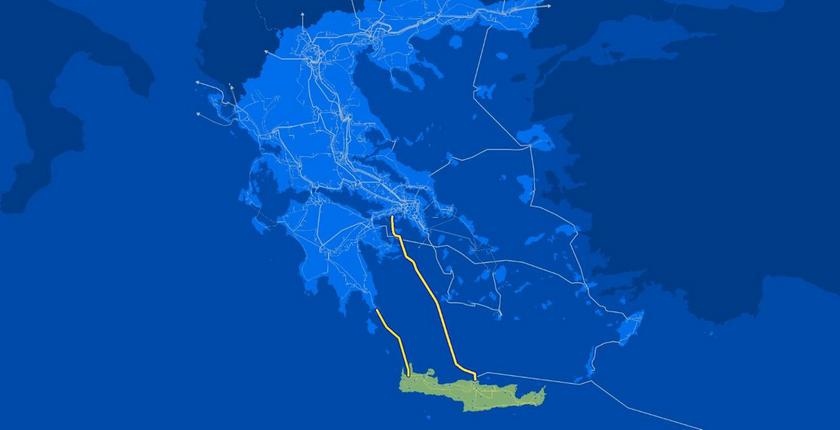
The Attica-Crete subsea power interconnector has been put into trial operation, marking a milestone for Greece’s transmission system. The country now has a high-voltage direct current (HVDC) interconnection, and its largest island is fully integrated into the national electricity system, according to an announcement by the Independent Power Transmission Operator (IPTO or Admie).

The Ariadne subsea power interconnector entered into operation on May 24 with the successful transfer of direct current electricity, said IPTO, whose subsidiary Ariadne implemented the project. The trial operation phase is expected to last throughout the summer, IPTO added.

The two submarine power links have ended Crete’s electrical isolation

Combined with the existing interconnection via the Peloponnese peninsula, the new cable has completely ended Crete’s electrical isolation, making it an energy hub with significant environmental and economic benefits for the country and the local community, according to IPTO.

The first power link between Crete and the mainland is the 174-kilometer alternating current (AC) cable linking the island with the Peloponnese. It was completed in 2021, following an investment of EUR 380 million.

The EUR 1.1 billion Ariadne interconnector is among the deepest in the world

The Ariadne interconnector, which cost over EUR 1.1 billion to build, is one of the deepest subsea power cables in the world. It consists of two 500 kV cables of 500 MW each, laid at depths of up to 1,200 meters. The construction lasted 4.5 years.

Greek Minister of Environment and Energy Stavros Papastavrou stated that the new power link has made Crete a “central pillar in the country’s energy transition,” and IPTO CEO Manos Manousakis claimed it is opening “a new chapter for the island’s energy security.”

The project was co-financed through the National Strategic Reference Framework (NSRF 2014-2020 and NSRF 2021-2027), via the European Union, with up to EUR 535.5 million.

IPTO recalled that the project consisted of many large subprojects, with contractors including Siemens, Terna, Nexans, Prysmian, NKT, and Hellenic Cables.