Montenegro publishes NECP for public consultation – sole coal plant planned for shutdown in 2041
State institutions, companies, organizations, and individuals have until August 6 to deliver their suggestions and comments about the draft National Energy and Climate Plan of Montenegro. It sets the provisional date for taking the Pljevlja coal power plant, the only one in the country, at 2041, but the authors pointed out that it primarily depends on a just transition and the security of electricity supply.
Montenegro’s long-awaited draft National Energy and Climate Plan (NECP) sets out the key 2030 targets for greenhouse gas emission cuts, share of renewable energy sources in gross final energy consumption, and energy efficiency.
The document, also known for its acronym INECP, in which the first letter stands for integrated, was published for the public consultation phase. It lasts until August 6. The Ministry of Energy and Mining called on the interested public – local authorities and other state institutions, the expert and scientific communities, associations, organizations, companies and individuals, to send their comments and suggestions.
“The energy and climate policy isn’t just a task for the government – it is a joint responsibility. That is why I am inviting all stakeholders, and especially nongovernmental organizations, to use this opportunity and contribute to the creation of a realistic, ambitious and just plan,” Minister Admir Šahmanović stated.
Renewables target can be surpassed
National goals match the ones adopted within the Energy Community. The targeted primary energy consumption in 2030 amounts to 0.92 million tons of oil equivalent. Under the business-as-usual scenario (with existing measures – WEM), the benchmark is expected to land at 1.04 million. With additional measures (WEM), the trajectory moves closer to the objective, projected at 0.97 million tons of oil equivalent.
The goal for final energy consumption is 0.73 million tons of oil equivalent. Existing measures result in 0.82 million, and added ones in 0.77 million tons of oil equivalent.
The share of renewable sources in transportation could reach 24.4% instead of only 7.2%
Montenegro fares better with its expected share of renewables in gross final energy consumption, against the 50% target. In the WEM scenario, it reaches 42.5%, and the WAM projection is 53.3%.
Without additional measures, renewable sources have a 66.3% share in electricity production. The document’s authors calculated that it could grow to 79.4%. As for transportation, the range is from 7.2% to 24.4%. In heating and cooling, the possible progress from the results of current measures is only 0.4 percentage points, reaching 49.2%.
The targeted reduction in emissions is 55%, the same as in the European Union. It translates to 2.42 million tons of carbon dioxide equivalent in the final year of the current decade. With existing measures, the curve touches 3.06 million in 2030, and with added ones the result is 2.4 million tons of CO2 equivalent.
Retirement of Pljevlja coal plant depends on socio-economic situation in northern region
Oil derivatives, which are all imported, participated in the 2022 final energy consumption with 47.3%, followed by electricity, 33.3%. Wood fuel is the next item, with 18.7%. The share of coal is only 0.7%, because almost the entire output goes to thermal power plant Pljevlja, the only such facility in Montenegro.
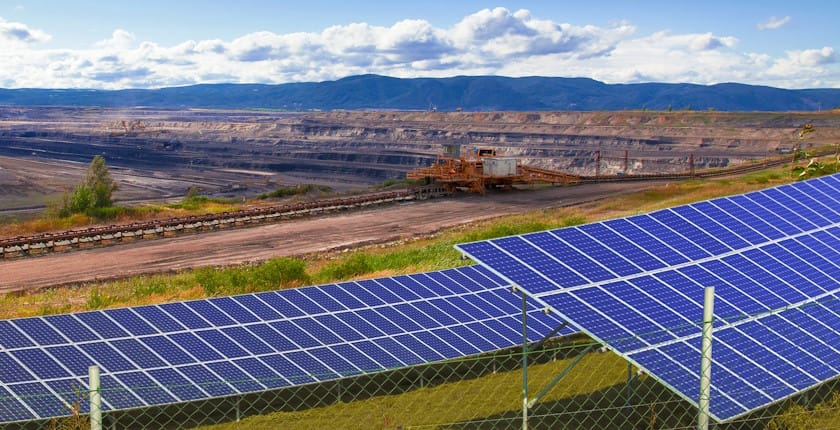
The overall electricity production capacity at the end of 2023 was 1.07 GW. The Pljevlja coal plant, which is currently under reconstruction, has 225 MW.
According to the projection, the Pljevlja coal plant is in cold reserve after 2040
The provisional date for its shutdown is 2041, but it primarily depends on the success of the just transition process and maintaining the security of electricity supply, the NECP reads. It also shows the Pljevlja coal plant in cold reserve after 2040.
In addition, taking it offline requires supplying end consumers under favorable conditions, while minding the overall socio-economic situation in the country’s northern region, where the coal mines and the power plant are, the authors explained. They noted as well that an energy storage pilot project is under consideration for the site of the Pljevlja facility.
Electricity sector’s self-sufficiency varying due to dependence on hydrological conditions
The country’s two large hydropower plants Piva and Perućica have 342 MW and 307 MW in capacity, respectively.
There are 38 other hydroelectric units in Montenegro, of which the smallest one is 200 kW. The biggest facility, Vrbnica (6.75 MW), is owned by a firm with the same name, registered in the capital Podgorica.
The high share of hydropower plants in electricity production, implying dependence on hydrology, is the main reason of the variability of the level of self-sufficiency of the national energy balance year after year, the NECP says.
There are two wind power plants on the grid: Krnovo (72 MW) and Možura (46 MW), while the third one, called Gvozd, is under construction. The project envisages 54.6 MW in the first phase.
There are only five independent solar power plants. The biggest one, Čevo, has 4.4 MW in nominal capacity and a 3.25 MW connection. Nevertheless, units operated by prosumers reached 75 MW altogether, according to one entry, though the numbers are lower in other parts of the NECP.