by in News

Greece adds 340 MW of wind farms in 2025, acceleration seen for this year

New wind capacity came in at 340 MW in Greece last year, with 76 onshore turbines installed, according to the Hellenic Wind Energy Association (HWEA or ELETAEN).

Installations increased by 6.4% on an annual scale and represented EUR 420 million in investment. Total wind capacity reached 5,695 MW in the country, with HWEA expecting a 900 MW rise in 2026.

Papastamatiou: 2 GW await connection

Based on these numbers, the wind sector appears to be going through rebirth, after several years of low to average installations. Currently, 1.1 GW of new projects are under construction or contracted and the majority is expected to come online within the next 18 months.

Added on top are 200 MW from previous auctions, which took place during the period 2018-2022. HWEA said that even though 1,592 MW was awarded, only 852.4 MW managed to connect to the grid by the end of 2025.

“Right now, about 2 GW of wind farms have an installation license, but have not been completed. Half of those are under construction or contracted. There are also 3 GW who have completed environmental licensing and await grid connection terms. Naturally, there are even more projects that go through the licensing jumble. All of them – especially the most efficient – constitute national wealth and can reduce energy costs for consumers,” said HWEA’s General Director, Panagiotis Papastamatiou.

Terna Energy and Vestas top the charts

The top 5 operators by capacity in Greece are Terna Energy (18.2%), MORE (13.6%), Iberdrola Rokas (7.2%), Principia (6.5%) and PPC Renewables (5.6%).

Vestas has the highest share among manufacturers, 44%. Enercon accounts for 25%, followed by Siemens Gamesa with 15.8% and Nordex, which is at 9.2%.

Notably, the day with the highest hourly wind share in power production was April 28, 2025, when wind farms supplied 97.2%. In total, these units covered more than 50% of the demand for 616 hours of the year.

by in News

Greece adds 340 MW of wind farms in 2025, acceleration seen for this year

New wind capacity came in at 340 MW in Greece last year, with 76 onshore turbines installed, according to the Hellenic Wind Energy Association (HWEA or ELETAEN).

Installations increased by 6.4% on an annual scale and represented EUR 420 million in investment. Total wind capacity reached 5,695 MW in the country, with HWEA expecting a 900 MW rise in 2026.

Papastamatiou: 2 GW await connection

Based on these numbers, the wind sector appears to be going through rebirth, after several years of low to average installations. Currently, 1.1 GW of new projects are under construction or contracted and the majority is expected to come online within the next 18 months.

Added on top are 200 MW from previous auctions, which took place during the period 2018-2022. HWEA said that even though 1,592 MW was awarded, only 852.4 MW managed to connect to the grid by the end of 2025.

“Right now, about 2 GW of wind farms have an installation license, but have not been completed. Half of those are under construction or contracted. There are also 3 GW who have completed environmental licensing and await grid connection terms. Naturally, there are even more projects that go through the licensing jumble. All of them – especially the most efficient – constitute national wealth and can reduce energy costs for consumers,” said HWEA’s General Director, Panagiotis Papastamatiou.

Terna Energy and Vestas top the charts

The top 5 operators by capacity in Greece are Terna Energy (18.2%), MORE (13.6%), Iberdrola Rokas (7.2%), Principia (6.5%) and PPC Renewables (5.6%).

Vestas has the highest share among manufacturers, 44%. Enercon accounts for 25%, followed by Siemens Gamesa with 15.8% and Nordex, which is at 9.2%.

Notably, the day with the highest hourly wind share in power production was April 28, 2025, when wind farms supplied 97.2%. In total, these units covered more than 50% of the demand for 616 hours of the year.

by in News

European electricity industry issues Paris Pledge on pumped storage hydropower

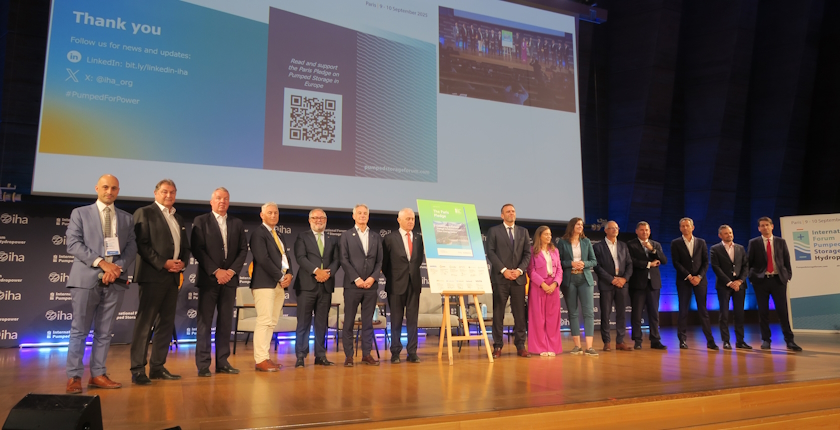
The International Hydropower Association (IHA) and Eurelectric launched the Paris Pledge. It is a collective call to action, aimed at unlocking the potential of pumped storage hydropower in Europe. The signatories urge the European Union and national governments to create the right conditions for long-duration storage to meet clean energy goals.

Over 50 utilities, hydropower suppliers and energy-focused associations have signed the Paris Pledge. The document’s alternative headline is Committing to Pumped Storage to Secure Europe’s Clean Energy Future.

The International Hydropower Association (IHA) and Eurelectric – Union of the Electricity Industry launched the initiative. They warned that Europe faces an urgent and growing need for long-duration electricity storage to secure a reliable, affordable and sustainable energy future.

Amid the transition to a renewables-dominated power system, the ability to store and dispatch electricity over long periods will be critical to balance variable generation from wind and solar, ensure grid stability and resilience, and reduce reliance on imported fossil fuels, the authors stressed. They called pumped storage hydropower or PSH the most important, scalable and cost-effective long-duration electricity storage solution available today. It still provides over 90% of the world’s long-duration electricity storage capacity.

PSH is currently the most important, scalable and cost-effective long-duration electricity storage solution, the industry pointed out

By 2050, around 86% of production capacity in Europe will come from variable sources, according to the material accompanying the Paris Pledge. Encouragingly, 78 pumped storage hydropower projects are under development, for 35 GW overall. The EU accounts for over 32 GW, and the rest is in Switzerland, Norway and Turkey.

The combined pipeline would provide storage capacity in excess of 700 GWh, equivalent to more than 10 hours of consumption of Italy and Spain taken together. There is 3.9 GW in the ready-to-build phase, and 2.8 GW is under construction. Of note, an earlier report showed 52.9 GW of PSH was under development.

The existing capacity amounts to 48 GW, compared to 190 GW globally. In the EU, pumped storage hydropower systems can store 1.2 TWh overall.

Photo: Types of pumped storage (IHA, Eurelectric)

Paris Pledge calls for separate legislation for long-duration energy storage

Among other proposals, the signatories are asking the EU for a dedicated initiative to boost the rollout of electricity storage. They suggested legislation to be separate for long duration, short duration and other solutions.

The Paris Pledge calls on member states to remunerate the provision of system services and security of supply for all time frames. They should eliminate double grid fees on electricity storage technologies and accelerate permitting for PSH, the document reads.

With strong political commitment, Europe can double its pumped storage hydropower capacity in the next 25 years, according to the Paris Pledge. In-person signatories represent EDP, EDF, Iberdrola, Andritz, Enel, Statkraft, Voith, Hydrogrid, Verbund, Landsvirkjun and GE Vernova.

Pumped storage hydropower’s contribution during Iberian Peninsula blackout

During the power blackout in Spain and Portugal on April 28, pumped storage played a pivotal role in balancing and supporting the recovery of the system. In Spain, PSH generated 11 GWh of electricity in the first 12 hours, instead of the planned 12 GWh recharge. Similarly, in Portugal, hydropower and pumped storage covered 80% of the demand in the first ten hours.

Such facilities also made a major contribution to restoring the electricity grid in the entire peninsula, thanks to their so-called black start capability. It allows the power plant to be restarted without relying on external power sources and to reenergise the power system.

“Very few technologies can provide this function. As a result, within a few minutes, the first pumped storage plants were ready for synchronization and awaiting dispatch instruction” from transmission system operators, notes the report published with the Paris Pledge.

by in News

With 152 MW of wind power installed in H1 2025, Greece continues low trajectory

Just 152.2 MW of wind farms were installed in Greece in the first half of 2025, thus continuing the low trajectory of recent years.

According to the Hellenic Wind Energy Association (HWEA or ELETAEN), total wind capacity in the country reached 5,507 MW at the end of June. In the first six months of the year, 37 new wind turbines were installed in Greece, with a capacity of 152.2 MW, representing a total investment of EUR 180 million.

New capacity doubled compared to the same period of 2024, but is not enough to support a more balanced renewable mix, HWEA said. In comparison, photovoltaics consistently add similar capacity in just one month on average.

The association also mentioned that currently there is 1 GW of wind projects under construction, or contracted. The majority are expected to launch operations within the next 18 months. There is another 300 MW selected through auctions for which letters of guarantee were submitted, and it is expected to reach completion. As a result, total capacity is projected to reach 6.5 GW within the period.

HWEA: Red tape is delaying 846 MW of wind projects

HWEA stressed that due to red tape, the construction of over half of the wind power capacity awarded at renewable energy auctions in the period 2018-2022 has been delayed. Namely, 1.592 MW was selected, but just 746 MW is operational today.

“If they had been completed on time, these wind projects, with a total capacity of 846 MW, would have provided more cheap energy and permanent relief to Greek consumers and the national economy,” HWEA pointed out.

Terna Energy and Vestas lead the pack

When it comes to wind energy’s geographical dispersion, Central Greece (Sterea Ellada) leads with 2.427 MW, followed by 709 MW in the Peloponnese and 535 MW in Eastern Thrace.

The top 5 market players are Terna Energy (1,034 MW – 18.8%), owned by Masdar, Motor Oil Hellas’s subsidiary MORE (774 MW – 14.1%), Iberdrola Rokas (409 MW – 7.4%), Principia (368 MW – 6.7%) and PPC Renewables (308 MW – 5.6%), which operates within state-controlled Public Power Corp. or PPC).

The most prominent wind turbine suppliers are Vestas, with 45.1% of the market, followed by Enercon, with 25.7%, and Siemens Gamesa, with 16.4%. They are trailed by Nordex, with 7.6%, GE Renewable Energy (now GE Vernova), with 3.7%, and EWT, Goldwind and Leitwind.