by in News

Celje, Šoštanj among Slovenian municipal authorities pursuing energy independence

The City of Celje in Slovenia plans to install 11 solar power plants on its public buildings, and the Municipality of Šoštanj agreed contracted four such units. The photovoltaic systems would be part of energy communities. Šoštanj expects to save EUR 70,000 per year while Celje is counting on EUR 200,000.

Novo Mesto, another municipality in Slovenia, recently made a similar move toward achieving energy independence.

The total capacity of the solar power plants in Celje and Šoštanj is 1.9 MW. They have signed contracts with ECE, a subsidiary of state-owned power utility Holding Slovenske Elektrarne (HSE). The projects are funded from the National Recovery and Resilience Plan (NRRP) and by the two municipal authorities.

Šoštanj is set to get solar power plants with a capacity of 500 kW altogether, at four locations: the sports hall of the Karel Destovnik Kajuh elementary school, a music school, health center, and the Pilon Center.

The total investment is EUR 500,000, with the local authority receiving a EUR 450,000 grant via the NRRP.

Both municipal authorities now have energy communities

In Celje, approximately 1.4 MW would be installed at several locations including the Z’dežele Stadium, Celje Summer Pool, Celje Health Center, elementary schools and kindergartens.

The City of Celje secured a EUR 1 million grant from NRRP, and the total investment is estimated at EUR 1.4 million.

Sebastijan Roudi and Boris Goličnik (photo: Municipality of Šoštanj)

In addition to building solar power plants, the contract includes five years of maintenance, offtaking surplus electricity production, and supply during insufficient power generation. It also involves managing the energy community.

In Šoštanj, the energy community would involve more than 15 public buildings, and the one in the City of Celje would consist of PV units on more than 40 public buildings.

The two projects are scheduled for completion in December and November, respectively.

Šoštanj aims to produce 70% of the electricity consumed by its public buildings

When the power plants are built, the municipality expects to cover 70% of the consumption of all public buildings, and the third-largest city in Slovenia aims for a 15% share.

The Šoštanj project is envisaged for 500 MWh of clean electricity output per year, reducing electricity costs by about EUR 70,000. Total savings over the entire lifespan of the solar power systems is seen at EUR 2 million.

Celje’s PV plants would produce 1,462 MWh of energy annually and save approximately EUR 200,000, translating to around EUR 5 million throughout their service life.

Investment for the long-term benefit of the community

Mayor of Šoštanj Boris Goličnik said the contract signifies the continuation of the municipality’s vision of energy independence.

“This is an investment in the future, in the green transition, and for a permanent benefit of our community,” he stated.

According to Celje’s Mayor Matija Kovač, it is a strategic decision on managing energy, costs, and the environment in the future. He said the planned PV units are just the beginning.

Sebastijan Roudi, ECE CEO, asserted that as part of the HSE group, the firm places grea t emphasis on demanding energy projects, developing new billing models, and seeking ways to accelerate the green transition.
by in News

Slovenia publishes call for incentives for wind, solar power projects

Solar and wind power projects with or without energy storage that are on Slovenia’s priority list can be submitted for grants from the European Union’s Modernisation Fund. The round is worth EUR 29.5 million and the deadline is January 7. Notably, of the 1,117 projects for renewables and cogeneration approved for state support so far, only 254 were completed by the end of 2024.

The Ministry of the Environment, Climate and Energy launched a public call for cofunding under a mechanism for the modernization of energy systems in Slovenia and improvement of energy efficiency. It is for projects for solar and wind power plants, with or without storage, from the so-called A list of indicative, priority investments.

Eligible companies can receive support from the EU’s Modernisation Fund under the RES Scheme (Part A). It was approved by the European Investment Bank. The list was published in March of last year.

Total planned support amounts to over EUR 84 million and the selected projects must be completed by the end of September 2030. The deadline for submissions in the current round is January 7, 2026.

The grants can cover up to 45% of the costs for photovoltaic and wind power systems and a maximum of 30% of the electricity storage segment, the documentation shows. Storage capacity must be at least 0.75 kWh per kW of the nominal capacity of the power plant.

All five eligible projects are within state-owned HSE Group

There are 21 items on the A list and most are power grid investments. Only five are for renewables, of which Dravske elektrarne Maribor (DEM) is present with its controversial Ojstrica wind farm project, the proposed expansion of the Zlatoličje-Formin solar park, and the ZOOP photovoltaic project for 9.9 MW in peak capacity on the former Pobrežje waste landfill.

The largest priority investment among the ones that can apply in the current round is HSE’s proposed floating PV plant with batteries

The company is part of state-owned Holding Slovenske elektrarne – HSE. Another subsidiary on the list, Soške elektrarne Nova Gorica (SENG), intends to expand its recently commissioned Kanalski Vrh solar power plant.

HSE itself has the largest project – for the Družmirje floating solar power plant, which would include storage. It also plans to produce green hydrogen using electricity from the facility.

Few completed energy production projects among ones selected through public calls

The Energy Agency of Slovenia has so far approved 1,117 renewables and cogeneration projects to enter the support scheme, selected through 13 public calls. The combined planned capacity is 794 MW, of which there were 996 renewable energy projects, for 682 MW.

However, only 254 endeavors, with 112.6 MW altogether, were completed by the end of last year. In the previous round, the agency selected 507 projects, for a total nominal capacity of just over 259 MW, mostly for PV plants.

Of note, lengthy procedures, strict environmental rules and local opposition are keeping Slovenia at the bottom of the European Union’s wind power capacity chart in the European Union. The country hosts just three standalone wind turbines and DEM has contracted the fourth one.

by in News

Slovenia’s sole coal-fired power plant Šoštanj to keep main unit offline until fall

As of this year, Slovenia’s only coal-fired power plant, Termoelektrarna Šoštanj (TEŠ), has shifted its primary focus to supplying heat, with electricity now sold as a byproduct. The ongoing overhaul of its unit 6 is expected to be completed in the coming days, but the 600 MW block will not be restarted until the end of September, when demand for heat is set to rise.

As part of the coal-phaseout process, targeted for completion in 2033, the Government of Slovenia decided last year to set aside EUR 403 million to save TEŠ and coal mine Velenje from bankruptcy and take over both from state-owned power utility Holding Slovenske Elektrarne (HSE).

TEŠ hopes the fall months will drive revenues

TEŠ hopes that the fall months will enable it to meet this year’s revenue target, as the operation of unit 6 is unprofitable in the summer due to low market prices for electricity and reduced demand for heat. This year, the power plant aims to earn EUR 400 million from the sale of heat and electricity.

Apart from unit 6, TEŠ operates only one other coal-fired generator, unit 5, with a capacity of 345 MW, while its first four blocks have been shut down.

The changed circumstances have been challenging for TEŠ, according to its CEO, Branko Debeljak. As HSE no longer sells TEŠ’s electricity, the plant had to set up its own sales department and seek customers on the market. Even so, the first four months of 2025 were quite successful when it comes to electricity sales, says Debeljak. The plant sold 1,045 GWh of electricity, generating revenues of EUR 138 million, or EUR 29 million more than initially planned, according to him.

The overhaul of unit 6 began in April

The overhaul of unit 6 began on April 22 and was expected to be completed by June 20. However, due to delays in the delivery of components, it had to be extended until early July. The completion of the overhaul will be followed by a short trial run, and a restart is planned at the end of September when the need for heat supply is set to rise again.

Slovenia aims at a 55% drop in emissions by 2033, and an early closure of its only coal-fired plant could help achieve that target. It seems likely that TEŠ will be shut down within a few years or operate at minimum capacity.

In June, Ireland’s Moneypoint power plant stopped burning coal, marking the end of coal use in the country. Slovakia and Spain officially intend to exit coal in 2025, followed by Greece (2026), France and Hungary (2027), and Denmark and Italy (2028). However, the dates could be pushed forward, and more countries could join the group in the meantime.

by in News

PV plant built next to Slovenia’s only pumped storage hydropower plant Avče

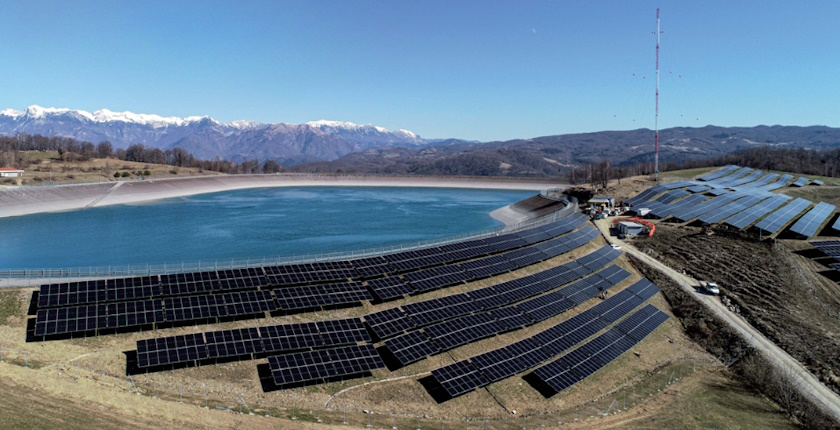
Slovenian company Soške elektrarne Nova Gorica (SENG) commissioned its first solar power plant – Kanalski Vrh. The facility is at its Avče pumped storage hydropower plant, the only one in the country.

Surfaces around large infrastructure such as railways are convenient for photovoltaics as there are very few options for the utilization of such sites. Existing power plants, including hydropower plant reservoirs, are even better locations, as they provide access to strong grid connections and transformers.

With its strict environmental and social regulations and standards, Slovenia is struggling to determine suitable locations for wind turbines, but also larger ground-mounted solar power plants. But state-owned power utility Soške elektrarne Nova Gorica (SENG) managed to fit a photovoltaic system on the banks of the upper reservoir of its Avče pumped storage hydropower plant, in cooperation with the local community.

Kanalski Vrh solar power plant hooked to existing power line

The 2.9 MW solar power plant north of the village of Kanalski Vrh is connected to an existing 20 kV power line. The hydropower operator estimated the annual output at 3.3 GWh. It plans to expand the PV facility to 8 MW by the end of next year.

The first phase was worth EUR 2.2 million. The firm, part of Holding Slovenske elektrarne – HSE Group, used its own funds and won government subsidies.

Area gets natural science park, cycling paths together with PV facility

In the local spatial planning process, Kanalski Vrh got a natural science park and walking and cycling paths. SENG’s first solar power plant spans two hectares and consists of 4,736 modules.

“We have witnessed increasing opposition to the construction of new energy facilities for the production of electricity from renewable sources, but the Kanalski Vrh solar power plant is proof that projects can be successfully completed in an open and transparent dialogue with the local community,” Managing Director of HSE Tomaž Štokelj said.

Avče is the only pumped storage hydroelectric plant in Slovenia. It has 180 MW in pumping mode and 185 MW for production. Avče and four out of five SENG’s hydropower plants on the Soča river are in the municipality of Kanal ob Soči. The first one, Doblar 1, was built in 1939.

Kanal ob Soči is at Slovenia’s western border, with Italy. The firm also operates a group of small hydropower plants.

If the operation of a solar power plant is integrated with a hydroelectric facility, as a hybrid power plant, it can help save water on sunny days.

Slovenia hosts two other PV facilities next to hydropower plants: Brežice and Zlatoličje-Formin.

by in News

Army joins forces with municipality, energy company, road firm to install solar panels in Slovenia

The Sunčana Vipava solar power project has brought together several key stakeholders in Slovenia – state electricity producer Soške Elektrarne Nova Gorica (SENG), the Ministry of Defense of the Republic of Slovenia (MORS), road management firm Družba za Avtoceste v Republiki Sloveniji (DARS), and the Municipality of Vipava.

The Sunčana (Sunny) Vipava project envisages installing solar power plants with a total capacity of 20 MW along highways, near military barracks, and on municipal land.

The initiative is seen as a strategic move towards achieving greater energy independence, enhancing energy supply security, and promoting sustainable development through advanced photovoltaic solutions, in both military and civilian areas, according to SENG.

The company operates 28 hydropower plants, with a combined capacity of 346 MW, on the Soča River and its tributaries, and is part of the Holding Slovenske Elektrarne (HSE) group.

In the Vipava municipality, SENG has identified several potential sites for harnessing solar energy, located adjacent to military barracks, along highways, and on municipal land.

The Vipava municipality intends to establish business zones in the vicinity of the future solar plants

The primary objective for all parties involved in the agreement is to maximize the utilization of solar potential, in conjunction with modern technologies such as hydrogen, SENG underlined.

The estimated potential at these sites is substantial, and it is currently financially viable to install solar panels with a total capacity of 20 MW. Additionally, the Municipality of Vipava plans to develop business zones in the vicinity of the future photovoltaic plants.

SENG and DARS have had a longstanding collaboration, initiated in July 2023, when the two state-owned companies agreed to develop solar power plants next to highways and signed a contract to build the first one in the southern region of Primorska.

SENG stressed the Sunčana Vipava project is one of its several green initiatives. The company plans to open its largest solar power plant at Kanalski Vrh before summer. The plant, located near the Avče pumped storage hydropower plant, will have a total capacity of 8 MW, and its first, 2.9 MW phase is nearing completion.

The official opening of the first phase is scheduled for early June.

Slovenia’s army involved in various energy projects

Photo: SENG

The involvement of the Ministry of Defense of the Republic of Slovenia (MORS) and Slovenian Armed Forces in energy projects is not a surprise.

In April 2023, a public-private partnership was initiated to build photovoltaic plants at the Edvard Peperko military barracks in Slovenia’s capital, Ljubljana. A year later, MORS launched the Defense Resilience Hub Network in Europe (RESHUB) project, which envisages establishing self-sufficient energy hubs.

In addition to highways and military barracks, Slovenia plans to install solar panels along railways, demonstrating its commitment to placing solar energy facilities in degraded or underutilized locations.

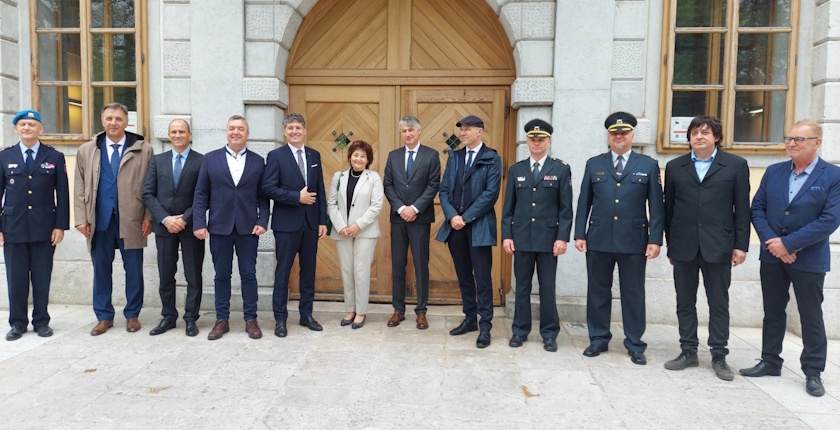
A cooperation agreement for this project was signed by Vipava Mayor Anton Lavrenčič, Slovenian Minister of Defense Borut Sajovic, DARS Board Member David Skornšek, and SENG CEO Mitja Gorjan.

Gorjan explained that SENG’s responsibilities include preparing project and investment documentation for the installation and construction of solar power plants at the Mlake military training ground, along military infrastructure and the highway, and in other locations within the Municipality of Vipava.

According to HSE CEO Tomaž Štokelj, the locations for energy facilities in the Vipava region present excellent opportunities for the multifunctional use of space.

by in News

Episodes of negative power prices in Slovenia, Romania spread to workdays

Romania registered the first negative day-ahead electricity price for a workday. The phenomenon, which only used to occur on holidays and weekends, has emerged in Slovenia as well.

In spring and autumn, most of Europe occasionally faces periods of excessive power grid loads. The rapid rise in solar and wind power production and the lack of accompanying energy storage and flexibility capabilities are straining the system at times when demand is low. Advanced electricity markets countered the issue by introducing negative prices.

When prices hit zero or go below zero, the seller delivers electricity without compensation or even has to pay to the buyer, respectively. The phenomenon was normally reserved for holidays and weekends, but more day-ahead markets are now experiencing it for workdays as well.

Downward pressure in Romania from strong inflow of negatively priced electricity via Hungary

Romania saw its first such episode yesterday, on Sunday, in the session for today, Profit.ro reported. Prices in its day-ahead market are negative in five out of 24 periods of one hour, between 11:00 and 16:00.

The country is importing at almost 2 GW via Hungary and exporting at up to 1.5 GW to Bulgaria, the news website added. The article notes that renewable energy producers, especially in Germany, where prices are also negative, are exporting to other markets to ease the impact. They usually benefit from subsidies, so generating electricity isn’t necessarily unprofitable even when they sell at a loss.

In addition, shutting down and restarting power plants can be more costly than paying the other side to take excess output.

The level in Romania went to as low as EUR 6.18 per MWh below zero. But the daily average is EUR 76.54 per MWh. The peak, is EUR 198.16 per MWh, between 20:00 and 21:00, when there is no sunlight and prosumers only consume.

Negative prices turn Slovenia’s HSE into electricity consumer

Prices in Slovenia for today also came in negative between 11:00 and 16:oo, which is very rare for a workday, Naš stik reported. Among other factors, the two-day May 1 holiday shortens the current workweek. The lowest, between 14:00 and 15:00, is EUR 6.18 euros per MWh below zero.

In comparison, the lowest price for Sunday on the BSP Southpool exchange was EUR 104 per MWh under zero.

At one point during the Easter holiday, virtually all HSE’s production capacities were offline and the Avče pumped storage hydropower plant was storing electricity from the grid

“Last year, we had 219 hours in Slovenia when prices were negative. This year, we are already at number 72, and we have only just entered the critical period,” said Deputy Director of System Operations of ELES Aleš Donko. The company is Slovenia’s transmission and distribution system operator.

State-owned power utility Holding Slovenske elektrarne (HSE) found itself in an unusual situation during the Easter holidays because of negative prices.

“For a while, we were actually an energy consumer, not a producer, which is our core mission… Virtually all our power plants were shut down, and the Avče pumped storage hydropower plant was pumping water into the upper reservoir at full capacity,” Head of Operation Planning and Management Jernej Brglez said.

Portugal and Spain, which suffered major outages today together with France, both registered negative prices every day in the third week of April.

Also of note, Greece is preparing to introduce negative prices in the balancing market.