by in News

EU waters down its 2040 climate target in runup to COP30 in Brazil

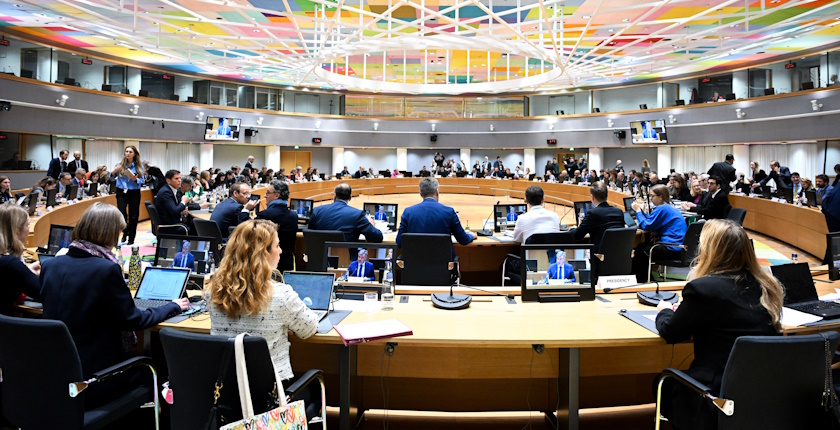
The Council of the European Union upheld the proposed 90% emissions cut target for 2040 ahead of the United Nations Climate Change Conference COP30 in Brazil, but with substantial workaround possibilities. In addition, the environment ministers failed to define the 2035 ambition, leaving the desired reduction in the amount of released greenhouse gases in a range of 66.25% to 72.5%.

Faced with declining competitiveness due to high energy prices and its strict climate and environmental standards, the EU is loosening its decarbonization goal. Following a marathon session in Brussels, the so-called Environment Council kept the desired greenhouse gas emissions reduction by 2040 at 90%, against the 1990 level, to take it to the COP30 event in Belém, Brazil. However, the competent ministers making up the body allowed several important flexibilities to avoid a last-minute stalemate.

Namely, the Council of the EU approved an updated nationally determined contribution (NDC) of the 27-member bloc and individual states to submit it at the Conference of the Parties of the UN Framework Convention on Climate Change (UNFCCC). Political leaders are gathering tomorrow, while COP30 formally lasts from November 10 to 21.

Following the 2020 NDC and its 2023 update, the new one covers the period up to 2035.

Outsourcing climate improvements instead of domestic decarbonization

On the path to eliminating net emissions by 2050, the EU is sticking with its nominal 2040 goal. On the other hand, in the latest version, the environment ministers allow “an adequate contribution of high-quality international credits in a manner that is both ambitious and cost-efficient.”

In particular, five percentage points of the 90% can be met via emission cuts promised outside the EU, and governments would be allowed to outsource a further five points, Greenpeace warned. It means they would buy carbon credits abroad as offsets.

EU is counting on purchases of other countries’ carbon credits for offsets

“The European Scientific Advisory Board on Climate Change [ESABCC] had called for emissions cuts of 90%-95% by 2040, and had stressed that this target must be for domestic reductions to climate pollution, not cuts outsourced to other countries. Environment ministers also agreed that the European Commission should reopen and water down the climate target in the case of high energy prices, a perceived negative economic impact or in light of technological advances. To reach a deal with reluctant countries, ministers also agreed to delay the start of the EU’s carbon market for pollution from cars and heating systems, extend pollution permits for heavy industry and exempt some ‘low-carbon’ fuels under the internal combustion engine phaseout,” the organization added.

The carbon market in question is the planned Emissions Trading System 2 (EU ETS 2). The Environment Council proposed to delay its establishment by a year, until 2028, and work on measures for a smooth launch.

“According to the ESABCC, only 16% of offsets have delivered genuine emissions reductions. But if they were high-quality offsets, they would be costly, and relying on them would divert investment from transforming the EU’s own industries, economy, and workers,” World Wide Fund For Nature (WWF) pointed out.

Indicative range for 2035 goal entirely below required efforts

The protracted discussions between the EU’s national governments also delayed the announcement of the EU’s indicative climate target for 2035, under the Paris Agreement. It is supposed to be submitted at the UN Climate Change Conference COP30.

“Ministers failed to agree a firm 2035 target, instead keeping a previously agreed range of 66.25% to 72.5% emission cuts, even the upper end of which is inconsistent with a credible pathway to the proposed 90% cut for five years later, undermining the EU’s position as a climate leader at COP30,” Greenpeace stressed.

Climate-competitiveness-independence tradeoff

The European Parliament’s Committee on Environment, Public Health and Food Safety (ENVI) is expected to discuss the matter soon. After a plenary vote, the institution would negotiate with the Council of the EU and European Commission.

“We need climate, competitiveness and independence. All three are crucial and going forward we need to ensure that one doesn’t come at the expense of the other. This morning, the environment and climate ministers of all member states reached a pragmatic, ambitious deal which ensures that,” said European Commissioner for Climate, Net-Zero and Clean Growth Wopke Hoekstra.
by in News

Greenpeace maps Croatia’s path to 100% renewable power by 2030

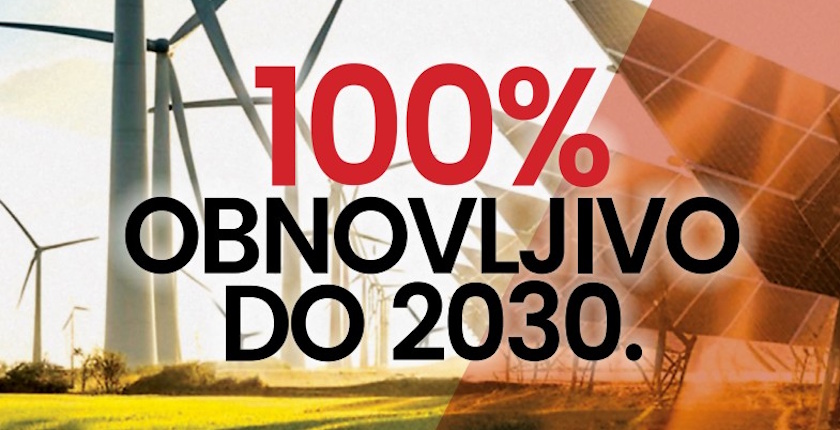
Croatia can fully transition to using only renewable electricity by 2030, according to Greenpeace. The organization presented its study: 100% Renewable by 2030 – A Plan for the Green Transition of Croatian Power Sector in the country’s capital Zagreb. Political will is the precondition for materializing the goal, it said.

The study was conducted by an expert team led by Professor Goran Krajačić from the Faculty of Mechanical Engineering and Naval Architecture in Zagreb. Of note, at the end of 2023, the share of electricity produced from renewables in total power consumption in the country exceeded 55%.

Greenpeace Croatia said the climate crisis, fueled by the fossil fuel industry, affects the entire world, including Europe and Croatia. The results are lost human lives and increasing material damage caused by extreme weather conditions, the organization noted.

Its ambitious goal for Croatia, to source all electricity from renewables by 2030, is based on a shift to solar and wind energy, as well as investments in the transmission network. The study puts the necessary solar power capacity at 5 GW, compared to 4.2 GW from wind.

In just five years, Greece, installed 7 GW of solar capacity, and Hungary added 5.5 GW

Greenpeace cites examples from the region. Croatia has five years until 2030, and the same period was enough for Greece to install 7 GW of solar capacity, while Hungary added 5.5 GW. Croatia has only recently reached 1 GW from photovoltaic system, despite ranking among the top countries in Europe in terms of solar potential, Greenpeace said.

According to Professor Goran Krajačić, the results of the study indicate that a firm political decision is needed to achieve 100% renewable electricity consumption in Croatia.

Andrić: A strong shift toward renewable energy is a strategic move for energy security, reduced dependence on fossil fuels, and economic opportunities

“Such a decision should include clear signals toward improving the power system, building and strengthening the grid and ensuring energy storage. Renewables also promote the democratization of society by involving citizens in energy communities to produce, store, and share energy,” Krajačić said.

Petra Andrić, program lead at Greenpeace in Croatia, stressed that a strong shift toward renewable energy as an ecologically sound decision. But it is also a strategic move for strengthening energy security, reducing dependence on fossil fuels, and creating economic opportunities, she added.

Calculation: large investments but even greater savings


Power generation mix

The authors estimate the costs of building facilities and underwater cables and strengthening cross-border grid capacities at EUR 12.2 billion by 2030. If it were financed through commercial loans at a 5% interest rate with a 25-year repayment period, the annual payment would be EUR 864 million, according to the calculation.

The repayment would be financed from savings and additional revenues, the study revealed.

Savings from allowances for CO2 emissions from electricity production, using 2023 as a reference year with a CO2 price of EUR 83 per ton, would amount to EUR 198 million by 2030.

The presentation of the study also featured a panel discussion

Fuel cost savings for electricity production were estimated at EUR 231.2 million in 2030, and profits from net exported electricity would bring in EUR 360 million.

The savings and profits would cover the annual repayments of loans needed to build the facilities, making them financially viable under commercial terms, the study claimed.

The event also hosted a panel discussion featuring Professor Krajačić, member of the Croatian Parliament Dušica Radojčić, Mario Stipetić (Ministry of Environmental Protection and Green Transition), Davor Škrlec (Faculty of Electrical Engineering and Computing – FER), Melani Furlan (Green Energy Cooperative – ZEZ), and Nina Domazet (Croatian Chamber of Commerce – HGK). It was moderated by Robert Pašičko from the United Nations Development Programme (UNDP).

by in News

Croatia among EU’s top three emitters of methane from oil, gas industry

Croatia is one of the three European Union member countries with the highest methane emissions from the oil and natural gas industry, according to research by Greenpeace Croatia and the Clean Air Task Force (CATF). Greenpeace Croatia noted that methane has 84 times greater global warming potential than carbon dioxide on a 20-year timescale.

Methane emissions from oil and gas infrastructure in Croatia have been comprehensively analyzed for the first time, according to Greenpeace Croatia.

“Methane hunter” Théophile Humann-Guilleminot from the international climate organization Clean Air Task Force (CATF) has examined more than 500 locations all around the world. He also recently visited 27 locations in Croatia, measuring methane emissions at all but one of them.

Greenpeace stressed it is an astonishing 96% of the investigated sites and the highest score by CATF in any EU member state.

Emissions were documented in detail by CATF at each site

The two organizations have visited several locations in Croatia with facilities for the production, transportation, and storage of oil and gas. The infrastructure is owned or operated by INA, Plinacro, and Okoli Underground Storage.

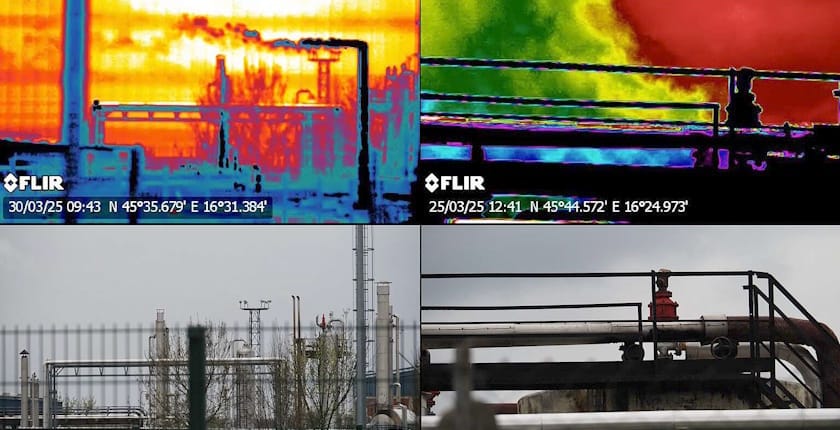
At 26 locations, methane emissions were documented in the form of gas release, venting, and flaring, which could also harm human health, Greenpeace underlined.

CATF carefully documented emissions at each location using infrared (IR) videos and IR and digital photos. The collected evidence is part of the group’s Cut Methane campaign in Europe and the world.

Humann-Guilleminot: Companies are releasing methane and accelerating climate change, all in pursuit of short-term profits

Théophile Humann-Guilleminot said the research strongly confirmed what scientists have been warning about for years – methane is leaking or being released along the entire oil and gas supply chain.

From the vast gas fields of Texas to Plinacro’s pipelines, companies are releasing methane and accelerating climate change, all in pursuit of short-term profits, he added. In his words, out of all the countries he visited, Croatia ranks amongst the worst three in terms of results.

“The scenes of methane gushing from open, rusted reservoirs in the Ivanić-Grad area, as well as leaks from wells at the Okoli location, are extremely worrying. During the energy crisis, this level of waste demonstrates a clear disregard for the climate and Croatian citizens,” Humann-Guilleminot stated.

Andrić: Greenpeace calls on the government to take seriously the implementation of new regulations on methane

Petra Andrić from Greenpeace Croatia pointed out the researchers could have assumed that methane emissions would be registered in some locations, but that they couldn’t have predicted such shocking results.

“Greenpeace is calling on the Government of the Republic of Croatia to take seriously the implementation of the new regulations on methane. In the long term, it is even more important to phase out fossil gas by 2035 and ban new gas and other fossil projects. The solutions are energy efficiency and renewable energy sources, in which Croatia has enormous potential, especially solar and wind,” she stressed.

Eszter Mátyás from Greenpeace Central and Eastern Europe said the new regulations would be much stricter for the operators in the fossil fuel industry. Therefore they will have to regularly carry out measurements and submit reports to regulatory bodies to prevent the release of methane from their infrastructure, she added.