by in News

Serbia needs EUR 27 billion to reach decarbonization goals

Serbia faces a substantial financial and structural challenge in its transition toward a low-carbon energy system. According to recent statements from senior management at the state-owned utility EPS, the country will need approximately EUR 27 billion in investment to meet its decarbonization objectives by 2050.

This estimate underscores both the scale of transformation required and the limits of the current energy model, which remains heavily reliant on fossil fuels—particularly coal—while moving toward alignment with European climate and energy policies.

Financing the Transition: Beyond Public Balance Sheets

A central conclusion emerging from the discussion is that Serbia’s decarbonization pathway cannot be financed through internal resources alone. EPS leadership emphasized that achieving a sustainable transition will require a diversified financing structure involving the state, international financial institutions, commercial banks, and capital markets.

In practical terms, this reflects a broader shift in energy policy: decarbonization is no longer only a technical or environmental issue, but fundamentally a question of financial architecture. Access to long-term, low-cost capital—combined with appropriate risk-sharing mechanisms—will be critical to mobilizing the required investment scale.

To that end, EPS is preparing to enter both domestic and international capital markets. A key milestone in this process is the expected acquisition of a credit rating, which would enable the company to issue green bonds and attract institutional investors.
Such instruments are increasingly central to energy transition financing across Europe, particularly in markets where public funding capacity is constrained.

Structural Transformation of the Power Sector

Beyond financing, the transition implies a deep restructuring of Serbia’s generation portfolio. The gradual decommissioning of aging thermal power plants is seen as inevitable, reflecting both environmental requirements and declining economic viability.

At the same time, the development of renewable energy capacity—primarily wind and solar—is expected to accelerate. EPS has indicated a willingness to engage more actively with private investors through joint ventures, power purchase agreements (PPAs), and even the acquisition of completed or late-stage renewable projects.

This signals a notable evolution in the role of the state utility, from a traditional vertically integrated operator toward a more market-oriented and partnership-driven entity.

Importantly, Serbia’s existing asset base—particularly land holdings and grid infrastructure—provides a strategic advantage for scaling renewable deployment. Leveraging these assets efficiently could reduce project development timelines and costs, improving overall investment attractiveness.

Market Integration and Investor Engagement

The transition strategy also highlights the need for stronger integration with private capital and market mechanisms. EPS leadership explicitly stressed the importance of becoming more agile and active in the market, including building relationships with investors and adapting to competitive dynamics.

This reflects a broader regional trend in the Western Balkans, where historically state-dominated energy sectors are gradually opening to private participation. However, this transition requires not only regulatory reform but also improvements in corporate governance, transparency, and financial performance.

Recent financial results from EPS indicate positive momentum, with a significant increase in annual profit, which could strengthen its credibility with investors and lenders.
Nevertheless, maintaining financial discipline while undertaking large-scale capital expenditure will remain a key challenge.

Strategic Implications: A Transition at Scale and Speed

From a policy perspective, the EUR 27 billion investment requirement highlights the magnitude of Serbia’s decarbonization challenge. The country’s energy system is still largely carbon-intensive, with fossil fuels accounting for a dominant share of electricity generation, making the transition both urgent and complex.

Decarbonization will therefore require a coordinated approach that integrates infrastructure investment, market reform, and financial innovation. It will also need to address social and economic implications, particularly in regions dependent on coal production and thermal generation.

Crucially, the success of this transition will depend on Serbia’s ability to align its energy policy framework with EU standards, improve investment conditions, and mobilize both domestic and international capital at scale.

Conclusion

Serbia’s pathway to decarbonization is now clearly defined in terms of scale, direction, and urgency. The estimated EUR 27 billion investment requirement is not merely a financial figure it represents a comprehensive transformation of the country’s energy system.

The coming years will be decisive. Progress will depend on the effectiveness of financing strategies, the pace of structural reform, and the ability of key institutions such as EPS to evolve into modern, market-oriented energy players. Without these elements, the transition risks delays; with them, Serbia has the potential to position itself as a credible participant in Europe’s low-carbon energy future.
by in News

Slovenia sells Europe’s first sustainability bond, worth EUR 1 billion

Slovenia accessed the international markets with its inaugural sustainability-linked bond, oversubscribed by more than 6.5 times. The interest payable can grow or drop by 50 basis points depending on the country’s progress in cutting greenhouse gas emissions. It is the first-ever sustainability-linked bond issue from a European sovereign, the Ministry of Finance pointed out.

Bankers and fund managers flocked around the first sustainability-linked bond that Slovenia offered in the market. Demand reached over 6.5 times more than the EUR 1 billion available, with a 10-year maturity. It is also the first-ever sustainability-linked bond issue from a European sovereign, the Ministry of Finance pointed out.

The country’s Sustainability Bond Framework is also in line with the Green Bond Principles of the International Capital Market Association – ICMA, and it takes into account the Green Bond Standard of the European Union. The proceeds from sustainability bonds are for financing or refinancing eligible green or social projects.

If Slovenia doesn’t achieve a 35% cut in total greenhouse gas emissions by 2030, relative to the 2005 baseline, the interest payable on the note will increase by 50 basis points, commencing nine years after the settlement date. If the emissions cuts surpass 45%, the rate will go 50 points lower, the documentation shows.

High demand resulted in a drop in the price spread from 70 to 61 basis points above the benchmark

The initial price guidance was at 70 basis points above the mid-interest rate swap as benchmark. Strong demand, including EUR 435 million in joint lead managers (JLM) interest, slashed the spread to 61 points. The note has a 3.125% fixed-rate coupon, reoffer yield of 3.155% and reoffer price of 99.746%, the ministry revealed.

As for the geographical distribution of the buyers, 23% are in the United Kingdom or Ireland, 20% is in the region comprising Belgium, Netherlands and Luxembourg, and 15% are from Germany, Austria or Switzerland. Next is Southern Europe, with 12%, followed by Slovenia’s 11%, a 9% Nordics share and 5% for France.

Asset managers amounted to 54% of the total sum. Central banks and other official institutions, at 18%, were just barely ahead of other banks (17%). Insurance and pension funds purchased 5% and hedge funds now hold 4% of the issue.

by in News

Electrica sells green bonds for EUR 500 million amid record demand

Electricity supplier and distributor Electrica listed its first green bonds on the Luxembourg Stock Exchange. It was the largest issuance of its kind among Romanian companies, excluding financials.

Electrica, in which the Romanian Government controls a stake of just under 50%, issued green bonds worth up to EUR 500 million. It is using the proceeds to finance and refinance its projects, mainly for green energy production and energy storage.

The senior unsecured green bonds, maturing in five years, are now listed on the Luxembourg Stock Exchange. Admission to trading on the Bucharest Stock Exchange is estimated to take place at the beginning of August, Electrica said.

The company’s core activities are electricity distribution and supply and energy services, but it is expanding into renewables and battery storage.

Pricing reaches 2.3 percentage points above benchmark rate

Credit appraisal agency Fitch has assigned the 4.375% senior unsecured green notes a BBB- rating. It is the lowest investment grade. The projects will have a limited connection to Electrica’s 100%-owned distribution and supply subsidiaries Distribuție Energie Electrică Romania (DEER) and Electrica Furnizare, the note adds.

Electrica targets 1 GW of installed renewable energy capacity by 2030 alongside the deployment of 900 MWh of energy storage

The company’s inaugural debt securities were priced at a yield of 4.566%, according to a regulatory filing. It was 2.3 percentage points above the benchmark mid-interest rate swap. The demand from investors at the final price exceeded the supply by more than 11.5 times, marking a record oversubscription in bond issuances of Romanian companies, Electrica pointed out.

Moreover, it was the largest green bond issuance in Romania excluding financial institutions. Electrica targets 1 GW of installed capacity by 2030 alongside the deployment of 900 MWh of energy storage.

Electrica grows market capitalization by one fifth this year

Banca Comercială Română (member of Erste Group), BNP Paribas, Citi, ING, J.P. Morgan and Raiffeisen Bank International were the joint global coordinators and joint bookrunners in the transaction, while BT Capital Partners, IMI-Intesa Sanpaolo, Société Générale and UniCredit were joint bookrunners.

Electrica has EUR 1.06 billion in market capitalization. Its shares surged 21.1% since the end of last year.

by in News

Bulgaria aims to make Europe’s biggest energy community

The Ministry of Energy, Electricity System Operator (ESO) and the Bulgarian Development Bank (BDB) are launching a solar power program for municipalities, schools, kindergartens, hospitals and small businesses. There are no upfront costs and the installations become the beneficiary’s ownership within eight years.

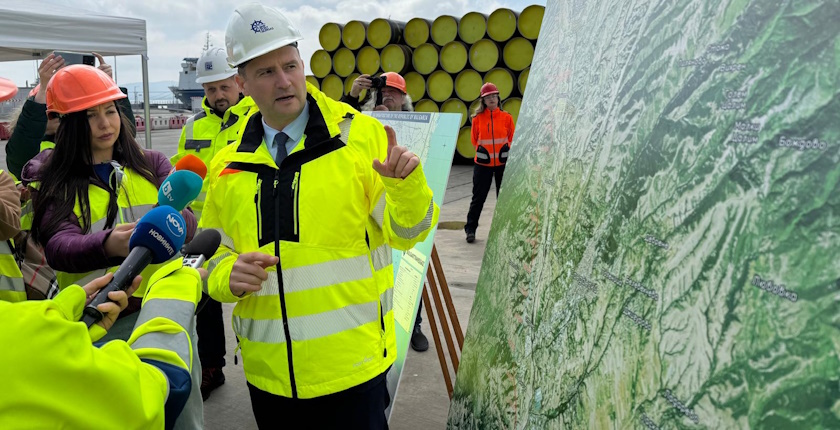
Minister Zhecho Stankov said the goal is to create the largest energy community in Europe and hinted that the government would finance the scheme with a green bond. He also declared the start of the regional Vertical Gas Corridor project in Bulgaria as the first pipes were delivered.

Every school and hospital in Bulgaria can become an electricity producer, Minister of Energy Zhecho Stankov stressed as he presented a financial support mechanism designed with the ambition to create the largest energy community in Europe. The model will benefit both the public sector and private business, he pointed out in the port city of Burgas at a ceremony marking the arrival of the first 4,000 pipes for the Bulgarian sections of the regional Vertical Gas Corridor.

The joint initiative with the country’s power transmission system operator ESO and the Bulgarian Development Bank is for the installation of solar panels with no upfront costs. Beneficiaries – municipalities, schools, kindergartens, hospitals and small businesses – would pay through energy savings and become owners in six to eight years, Stankov claimed.

Bulgaria mulls issuing green bond to finance sustainable energy

The minister also said the project could lead to the government’s first green bond to finance clean and locally produced energy available to a wide range of consumers.

For example, Burgas Municipality can equip all schools, hospitals, kindergartens and other facilities with photovoltaic panels without spending a penny from the local budget, Stankov explained.

Government to invest EUR 57 million in Vertical Gas Corridor

The Vertical Gas Corridor is envisaged to connect Greece, Bulgaria, Romania, Moldova and Ukraine. They plan to transport the fuel from liquefied natural gas (LNG) terminals Alexandroupolis and Revithoussa in Greece, and from the Caspian region, via the Southern Gas Corridor.

The government is fully funding the first stage of the project on Bulgarian territory, with EUR 57 million. The pipes for the pipelines came from India.

Stankov: Bulgaria will never again be left without natural gas

“Bulgaria will never again be left without natural gas,” said Minister Stankov. The capacity of the line between Kulata, on the border with Greece, and Kresna will be increased to 3.6 billion cubic meters per year from 2.3 billion, he added. The distance is 48.5 kilometers.

The most difficult part is between Mikrevo and Ribnik, where three kilometers will be built by horizontal drilling, the minister revealed. He explained there would be no aboveground work, so that nature and infrastructure wouldn’t be affected.

Another section, 80 kilometers, is from Rupcha to Vetrino. The purpose of the investment is to double the maximum annual flow toward Romania to 10 billion cubic meters, Stankov stressed. The last one, Tarnik-Piperovo, is 51 kilometers long.

The compressors on the corridor are reversible, allowing gas supply in both directions, the minister noted.