by in News

Israel, Greece, Cyprus reaffirm commitment to joint energy projects

Amid chronic delays in the projects for offshore gas and the Great Sea Interconnector and Turkey’s warnings, the leaders of Israel, Greece and Cyprus said after a trilateral summit that they would safeguard their sea lanes and critical infrastructure against emerging threats.

Prime Minister of Israel Benjamin Netanyahu, Prime Minister of Greece Kyriakos Mitsotakis and President of Cyprus Nikos Christodoulides agreed to reinforce trilateral cooperation on security, defense and military matters. In a declaration from their summit in Jerusalem, they reaffirmed the importance of the dialogue in a 3+1 format with the United States.

The joint statement came amid chronic delays in the projects for offshore gas and the Great Sea Interconnector. The latter, an undersea electricity link, is planned to run from the island of Crete in Greece to Cyprus and, from there, to Israel.

Turkey has been openly opposing such projects and even sending its navy to disturb research and exploration. Countering the Great Sea Interconnector, the government in Ankara is apparently planning to establish a power link with the northern Cypriot Turkish-dominated entity.

Netanyahu, Mitsotakis and Christodoulides particularly emphasized the importance of the Great Sea Interconnector project

“Today’s trilateral summit reaffirms our unwavering commitment to strengthen our cooperation, enhancing the security and resilience of our nations for generations to come… We reaffirm our determination to advance joint energy projects, including natural gas development, electricity interconnectors, and renewable energy initiatives, as a solid foundation for cooperation in the region, based on international law, including the law of the sea and the respect of all states to exercise their rights in their respective EEZ / continental shelf,” the document reads.

EEZ is exclusive economic zone, a maritime area in which a country claims exclusive rights. Netanyahu, Mitsotakis and Christodoulides particularly emphasized the importance of the Great Sea Interconnector project.

“We underscore the importance of maritime security and pledge to deepen collaboration in safeguarding sea lanes and critical infrastructure against emerging threats,” they said. The three leaders added they would collaborate regional interconnectivity projects within the so-called India – Middle East – Europe Economic Corridor (IMEC).
by in News

New Cypriot Minister of Energy, Commerce and Industry Michael Damianos takes office

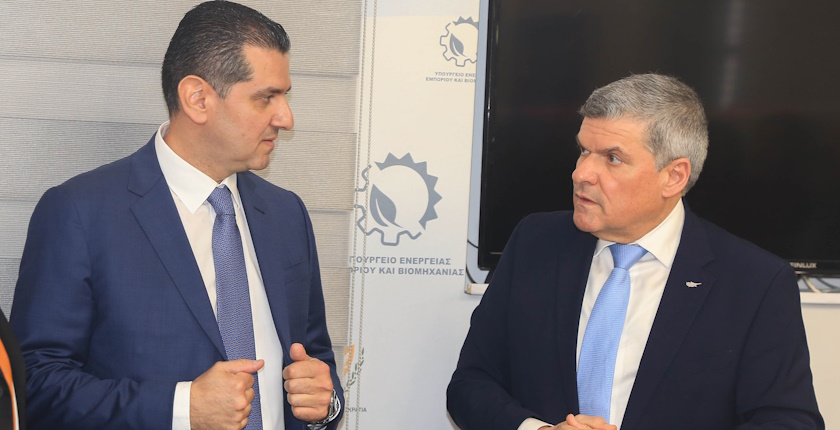
A careful and organized course is required to achieve the energy transition in Cyprus, support the industry and strengthen the economy, ensuring sustainable solutions for the country’s energy future, new Minister of Energy, Commerce and Industry Michael Damianos said. He took over from his predecessor George Papanastasiou.

Five ministers were replaced in a cabinet reshuffle under President of Cyprus Nikos Christodoulides. Among them, the now former Minister of Health Michael Damianos took helm of the Minister of Energy, Commerce and Industry from George Papanastasiou.

Cyprus is assuming the presidency of the Council of the European Union on January 1 for six months. It means Damianos will chair the meetings of ministers responsible for the sectors in his portfolio, like the so-called Energy Council.

“We will work with innovation, excellence and sustainability in mind, to ensure that Cyprus continues to move in a direction that will serve the common good and future generations,” the new minister said at the handover ceremony.

Realistic, measurable goals for tangible results for all citizens

A careful and organized course is required to achieve the energy transition in Cyprus, support the industry and strengthen the economy, ensuring sustainable solutions for the country’s energy future, according to Damianos. He highlighted the importance of setting “realistic and measurable goals” to bring tangible results for all citizens.

Papanastasiou’s departure could be a signal from Nicosia about the fate of the Greece-Cyprus-Israel subsea power link

Some media is speculating that the switch is a signal from Cyprus about the embattled Great Sea Interconnector, a proposed underwater cable that would link Greece, via Crete, with Cyprus and Israel. Papanastasiou was apparently one of the few ardent supporters of the project in the country’s government.

The investment remains stuck over expenses and threats from Turkey.

University of Cambridge alum

Damianos studied law at the University of Southampton, from where he graduated with honours and received the best academic performance award. He earned a master of laws degree at the University of Cambridge, specializing in international law. The minister has received the best academic performance award from the Fitzwilliam College of the University of Cambridge.

The minister holds the professional title of a solicitor, granted by the Supreme Court of England and Wales. Damianos worked at the international law firms Simmons and Simmons and Hogan Lovells in London, specializing in corporate, commercial and energy matters.

In 2010 in Cyprus, he founded a law firm that bears his name. Damianos served as a municipal councillor in Strovolos Municipality from 2011 to 2016. Since 2018, he has been the vice president of the Democratic Party (DIKO).

Damianos became the minister of health in January 2024.

by in News

Uncertain future of Greece-Cyprus Great Sea Interconnector project

Greece and Cyprus find themselves at odds when it comes to Great Sea Interconnector (GSI), their big project for a subsea electricity cable. A new investigation by the European Public Prosecutor’s Office (EPPO) further complicates things.

Great Sea Interconnector is an envisaged 1,208-kilometer power line that would connect Crete, Cyprus and Israel. Planned for 1,000 MW in capacity and doubled later, the link would provide energy security and lower energy costs for Cypriot consumers, who currently pay the highest wholesale prices in Europe. Cyprus has also been plagued by very high curtailments and rolling blackouts, meaning that a solution is needed urgently.

The EUR 1.9 billion project benefits from a EUR 657 million funding from the Connecting Europe Facility (CEF), for the Greece-Cyprus section. It is also included in the Projects of Common Interest (PCI) list.

Currently, GSI is at the stage of bathymetric surveys in the offshore region between Greece and Cyprus. Italian ships were hired, but they were stopped last year by Turkish naval forces near the island of Kasos, east of Crete. This year, the Greek government appeared ready to reinitiate the surveys, this time with military escort, but in recent days, the government in Nicosia raised new concerns.

Cyprus raises cost issues

Statements by the two governments revealed diverging views about GSI. Cyprus has raised the issue of economic viability, with Minister of Finance Makis Keravnos maintaining a hard line and saying that it is not evident whether the interconnection would benefit his country.

“No one knows how much it will cost consumers and when the project will be completed,” said Keravnos.

Greece responded by reminding the decision makers in Nicosia that an agreement was signed last year, specifying that Cyprus needs to pay EUR 25 million annually to the project promoter, the Greek Independent Power Transmission Operator (IPTO or ADMIE). The first payment is expected this year, if the project is to continue.

IPTO has said that without the remaining decrees from Cyprus Energy Regulatory Authority (CERA or RAEK), it would stop paying Nexans, the French company in charge of building the cable. At that point, the interconnector project freezes.

Essentially, Greece wants Cyprus to pay before it moves ahead with new surveys around Kasos, which could trigger a military showdown with Turkey. On the other hand, the government in Nicosia wants Greece to complete the surveys before providing the money, thus removing any geopolitical risk.

Mitsotakis: Cyprus must show it wants the project

“Cyprus is the primary beneficiary of this project, therefore it must show its commitment,” said Greek Prime Minister Kyriakos Mitsotakis.

Things have been further complicated by EPPO’s new investigation. According to leaks in the Cypriot press, the administration in Brussels is looking into potential mismanagement when EuroAsia Interconnector was the project promoter, before IPTO took over.

Geopolitics at the epicenter

However, the elephant in the room is the geopolitical issue. Greece and Cyprus have delimited their exclusive economic zones (EEZs) in the waters between them, in line with international law. However, they haven’t signed a bilateral demarcation agreement.

Turkey, on the other hand, laid a claim over the marine region. It is one of the few countries that have not signed the United Nations Convention on the Law of the Sea (UNCLOS). In 2022 it signed an EEZ agreement with Libya to solidify its claims, which Greece, Cyprus and the European Union have called illegal.

by in News

Second HVDC link from mainland Greece to Crete coming online

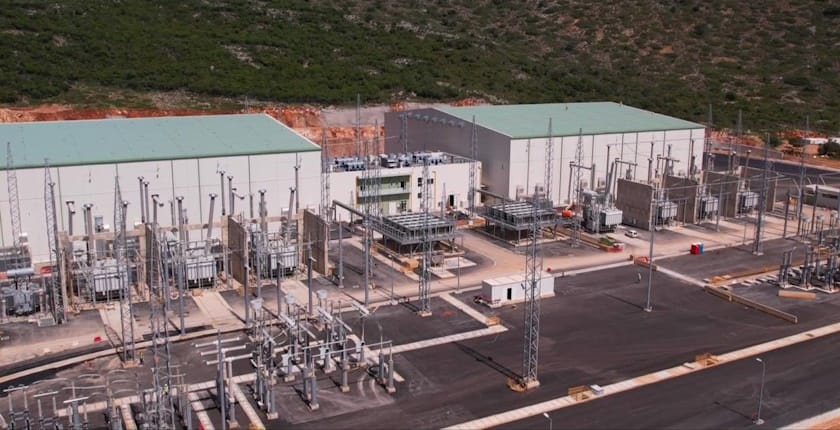
Greece’s Independent Power Transmission Operator (IPTO) is completing the last elements of the Ariadne Interconnection project, one of the deepest subsea links in the world. The company plans to switch on the double high-voltage direct current (HVDC) cable between Attica and Crete by the end of the month. In addition, IPTO and its Italian counterpart Terna are developing a project for a second interconnector between them.

Final tests and equipment checks are being completed at the Damasta Converter Station in Heraklion ahead of the start of the trial operation of the Crete-Attica electricity link. The management of IPTO, also known by its Greek acronym Admie, and the HDVC Ariadne Interconnection project firm inspected the site.

The transmission system operator said it plans to energize it this week by injecting reactive power into the electricity system in the country’s biggest island.

The transmission of active power from Attica to Crete is set to begin in late May, the update adds. Ariadne consists of two 500 kV cables of  500 MW each. One end is in Pachi in the city of Megara, between Athens and Corinth, and the other one in Korakia in Crete. The submarine and underground cables were tested earlier.

Line on mainland is under trial electrification

At the same time, on the Attica side, a trial electrification of a 400 kV cable system is taking place between the Koumoundouros Converter Station and the adjacent Extra High Voltage Center. Ariadne Interconnection is the largest and most complex electricity transmission project in Greece so far, IPTO underscored.

Furthermore, a 150 kV transmission line between Chania and Damasta recently received the decision on the approval of environmental conditions (AEPO), the company added. It is considered necessary for an optimal combined use of Crete’s two interconnections with the mainland, the announcement reads. The first one, from Peloponnese, was established in 2021.

Ariadne, worth more than EUR 1.1 billion, is one of the three deepest interconnections in the world. The HVDC line’s capacity matches the interconnector to Sardinia, the strongest power link so far with an island.

The project is co-financed through the National Strategic Reference Framework (NSRF 2014-2020 and NSRF 2021-2027), via the European Union, with up to EUR 535.5 million. The idea for the endeavor dates back to the 1990s.

The contractors are Nexans and Prysmian. Each was responsible for one of the two cables while the latter also laid two submarine telecommunication lines.

Erdoğan again taunts Great Sea Interconnector by promising alternative cable

Ariadne is part of a proposed corridor with the Great Sea Interconnector project, formerly EuroAsia Interconnector, envisaged going to Cyprus and Israel. The Crete-Cyprus investment has been suffering heavy delays amid financing issues, ownership disputes and Turkey’s threats.

In early May, President Recep Tayyip Erdoğan visited the Cypriot Turkish breakaway republic, recognized only by Turkey, and promised an interconnection with his country. He compared it to an existing water pipeline.

“Did we bring water from under the sea to Northern Cyprus from Turkey? Now we are in the second stage. God willing, we will bring electricity and with that we will cover the needs of Northern Cyprus in water and electricity,” Erdoğan stated.

Notably, IPTO denied yesterday a press report that it is considering the possibility, together with Nexans, the contractor, to alter the route and connect Crete with the Dodecanese Islands instead of with Cyprus. The archipelago includes Rhodes, Astypalaia (Astypalea), Kos and Tilos.

EBRD is providing a grant for the first studies for an interconnection between Greece and Egypt

In other news, the European Bank for Reconstruction and Development (EBRD) and Elica Interconnector, a member of the Copelouzos Group, signed a grant agreement for the first studies for the planned Egypt-Greece (GREGY) electricity interconnection.

IPTO and its Italian counterpart Terna signed today a memorandum of understanding to install a second undersea HDVC power line. The GR.ITA 2 project is for a double cable, two times 500 MW, scheduled for completion in 2031. The two sides earmarked a total of EUR 1.9 billion.

The existing 500 MW interconnector, in operation since 2002, is temporarily down due to a malfunction.

by in News

Turkey pushing against rivals for transmission of green electricity to EU

Turkey’s agreement with Azerbaijan, Georgia and Bulgaria on the transmission of renewable electricity could set back the project for an interconnector under the Black Sea between Georgia and Romania. In addition, President Recep Tayyip Erdoğan’s government fiercely opposes the Great Sea Interconnector project, part of the proposed Greece-Cyprus-Israel submarine link. Turkey is also pushing against rival hydrocarbon projects around Cyprus.

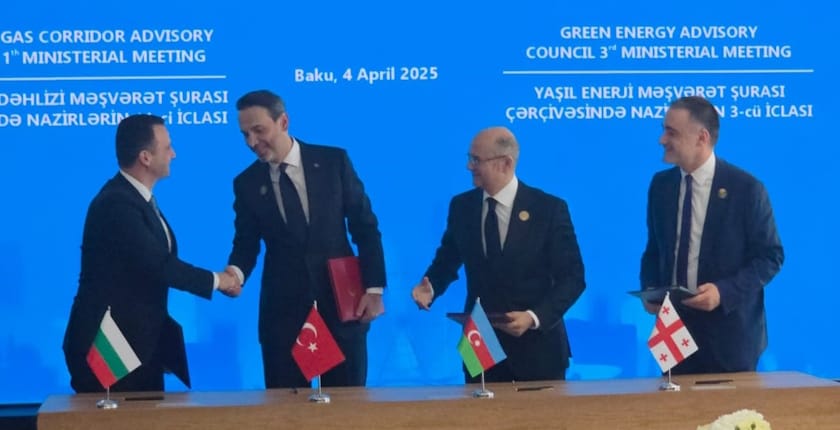
On the margins of the Southern Gas Corridor (SGC) annual meeting, a regional green energy project has come to the fore. Ministers of energy of Turkey, Bulgaria, Georgia and Azerbaijan, the host country, signed a memorandum of understanding on green electricity transmission and trade. The initiative envisages the establishment of a green energy corridor toward Europe.

The proposal for a power interconnections upgrade is an apparent competitor against a project by Romania, Georgia, Azerbaijan and Hungary. They plan to lay a high-voltage direct current (HVDC) cable under the Black Sea. Bulgaria does have a seat at the table, but even after several meetings it still hasn’t become a partner in the GECO submarine link project. The alternative onshore line through Turkey would give it a central role.

Bulgaria, which has been waiting to become a partner in the Black Sea submarine interconnection project, would get a central role in an onshore power transmission corridor that would go through Turkey

President Recep Tayyip Erdoğan’s government is determined to establish the key transmission and production hub for electricity and fossil fuels for the European Union. The new memorandum is another indicator, together with Turkey’s fierce opposition to the Great Sea Interconnector project, which is part of a proposed Greece-Cyprus-Israel submarine power link, and to hydrocarbon drilling around Cyprus.

Turkey also benefits from the TurkStream pipeline, which carries gas from Russia. It was built instead of the abandoned South Stream project, which was supposed to directly connect Russia and Bulgaria.

Studies to be commissioned by June

Turkish Minister of Energy and Natural Resources Alparslan Bayraktar said electricity from Azerbaijan and the region would reach his country via Georgia as well as Azerbaijan’s exclave of Nakhchivan. It means a line would go through Armenia.

The four energy ministers said a working group would complete the technical details and commission feasibility studies already by June.

Azerbaijani President Ilham Aliyev said his country would add 6.5 GW of renewable energy capacity by 2030, compared to the current 8 GW, from all sources. One of the biggest private investors is Abu Dhabi Future Energy Co. (Masdar).

TANAP’s capacity to be doubled

Turkey is diversifying its energy supply, Bayraktar noted. “Our natural gas imports from Turkmenistan, which started on March 1, are an important step towards the goal of securing our own supply while also carrying Central Asian energy to European markets,” he stated.

The minister highlighted the goal to increase the capacity of the Trans Anatolian Natural Gas Pipeline (TANAP), part of the Southern Gas Corridor, to 31 billion cubic meters per year from 16 billion.

Tensions rising as seabed survey for Great Sea Interconnector to resume

The NG Worker vessel is returning to carry out seabed surveys east of Greece’s Kasos-Karpathos island area, Energypress reported. The activity, part of the Great Sea Interconnector, was interrupted again in February after a Turkish corvette approached the ships NG Worker and Ievoli Relume.

After research was completed in the territorial waters of Greece and Cyprus, the last section is in international waters. Türkiye Gazetesi learned from security sources that Turkey wouldn’t allow “such a fait accompli.” The unnamed sources said the seabed survey is a breach of international law.

The power link project has also faced delays due to disputes around financing and it still risks losing a massive EU funding package. Turkey is promoting the idea of a cable connecting Cyprus to its own electricity transmission network instead.

by in News

Cypriot minister not optimistic about cable project with Greece amid Turkish intimidation

Cypriot Minister of Finance Makis Keravnos said the Great Sea Interconnector (GSI) project still faces very serious political obstacles. He highlighted the pressure from Turkey, alongside the financing disputes with Greece regarding the EU-backed bilateral investment to lay an undersea electricity cable that would connect the two countries.

Following a second incident this month when Turkish navy intimidated ships researching the seabed, Minister of Finance of Cyprus Makis Keravnos expressed doubt in the feasibility of the Great Sea Interconnector (GSI). It is a project to connect his country’s electricity system with Greece’s through Crete, by laying a cable under the sea.

“I can’t say I’m optimistic, especially when there are still very serious political obstacles, namely those posed by Turkey,” the official said, as quoted by domestic media. Namely, Turkish corvette TCG Bartın has approached Ievoli Relume and NG Worker, Italian vessels conducting research for the interconnection, in international waters just north of Crete.

GSI investment concerns now have to be addressed

Nevertheless, a recent due diligence study by a hired foreign consultancy showed the draft bilateral deal heavily favors Greece’s Independent Power Transmission Operator (IPTO or, in Greek, Admie). The authors warned of an “unnecessary additional layer of risks for any equity investors in GSI.”

Keravnos said the document confirms his concerns and that they must be discussed. While the two sides are working to overcome their financing dispute, the project is suffering delays, increasing the risk of cancellation.

Keravnos said in October that the total cost could well surpass EUR 2 billion. The Crete-Cyprus part is substantially leaning on funding from the European Union. The idea was to later extend the interconnector to Israel.

Turkey has been obstructing both GSI surveys and hydrocarbon exploration around Cyprus. There were several incidents involving gunboats.

Cyprus craves interconnections, flexibility sollutions

Meanwhile, Cyprus is struggling to maintain the stability of its isolated electricity system. Oil-fired power plants are increasingly working near their upper limits in peak hours. Conversely, storage capacities, flexibility systems and digital controls are needed for mitigating the pressure on the grid at times of weather-induced jumps in the production of wind and solar power, but also sharp drops.

It is the only noninterconnected country in the European Union. Moreover, Cyprus has no access to natural gas yet.

GSI was formerly known as EuroAsia Interconnector.