by in News

Renewable Gas Injections in the EU Rise to 4.3 bcm Over Two Gas Years, ENTSOG Reports

Renewable gas injections into natural gas grids across the European Union have climbed steadily over the past two gas years, reaching 4.3 billion cubic meters (bcm), according to the latest assessment by European Network of Transmission System Operators for Gas (ENTSOG).

The report, covering the period from October 1, 2023, to September 30, 2025, examines annual renewable gas injections into transmission and distribution networks. It encompasses both biomethane and renewable hydrogen.

Steady Growth in Renewable Gas Volumes

According to ENTSOG, renewable gas injections rose from 38.1 TWh to 43.2 TWh over the two most recent gas years—equivalent to approximately 4.3 bcm—representing an annual increase of 12%.

This marks ENTSOG’s second dedicated report on renewable gas injections into European gas networks. The first assessment was included in its 2024 Annual Report, published in April 2025, and covered data for the 2023–2024 gas year.

The latest growth was primarily driven by the commissioning of new biomethane plants and existing facilities reaching their nominal production capacity.

Renewable hydrogen injections remained limited. Germany was the only member state reporting hydrogen injection into its gas system, with volumes declining from 3 GWh to 1 GWh during the reporting period.

It should be noted that the report does not account for biomethane flows occurring outside transmission system operator (TSO) and distribution system operator (DSO) grids.

Biomethane Growth Without Major Infrastructure Investments

Piotr Kuś, ENTSOG’s General Director, emphasized that renewable and low-carbon gases can be readily integrated into existing natural gas infrastructure, supporting the transport of sustainable and secure energy molecules.

He stressed that gas TSOs will continue to provide the necessary infrastructure to facilitate the energy transition.

“In particular, biomethane market growth can be facilitated without the need for significant infrastructure investments. This growth is essential if we are serious about meeting the EU’s REPowerEU target of 35 bcm biomethane by 2030,” Kuś said, referring to the European Union’s REPowerEU objectives.

Five Countries Dominate Renewable Gas Injections

The distribution of biomethane injections varies significantly among EU member states. Five countries—France, Germany, Denmark, Italy, and Netherlands—accounted for 94% of total renewable gas injections, the report reveals.

Several member states reported no injections, in some cases due to on-site consumption of renewable gases that eliminates the need for grid injection.

Among the five leading countries, all recorded significant increases in biomethane injections into TSO and DSO grids during the last gas year.

France posted a 2 TWh rise in injections, reaching 13 TWh—approximately 1.3 bcm—by the end of the reporting period. The increase was attributed to the continued rollout of new injection points and the gradual ramp-up of production sites to full operational capacity, a process that often takes time following initial commissioning, according to the Report on Annual Renewable Gas Injections into Gas Networks.

by in News

Enercon inks first delivery of its 7 MW wind turbines to Turkey

Enercon received the first order from Turkey for its latest, 7 MW wind turbines, from Reges Elektrik.

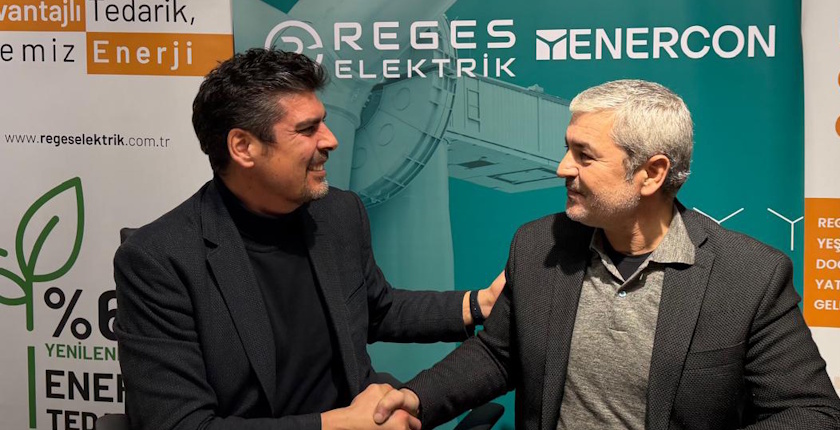
The agreement with Reges Elektrik is for the first deployment of Enercon’s 7 MW onshore turbine in Turkey, according to the German wind turbine producer. At the same time, it is the Turkish company’s first wind energy investment.

Enercon and Reges Elektrik have launched a strategic partnership by signing a turbine supply agreement for the Demirli wind farm to be constructed in Kırşehir.

Under the deal, Enercon will supply ten of its new E‑175 EP5 E2 wind turbines, totaling 70 MW of installed capacity.

The new top model is among the highest yielding onshore wind turbines in Europe

It is the first collaboration between the two companies. The agreement was signed at Reges Elektrik’s headquarters in Istanbul.

According to Enercon, featuring a large rotor diameter of 175 meters, advanced engineering solutions, and high energy yield, the E‑175 EP5 E2 stands as its most powerful and efficient onshore turbine to date.

turkey enercon reges elektrik contract Arif Günyar Mustafa Ünal
Arif Günyar and Mustafa Ünal (photo: Enercon)

It is among the highest-yielding onshore wind turbines in Europe, the German company claimed.

Ünal: The agreement represents a significant milestone for Reges Elektrik as it makes its first investment in wind energy

Arif Günyar, Enercon Regional Head for Central Asia, the Middle East and Africa (CAMEA), thanked Reges Elektrik for its trust in his company’s technology.

“We look forward to strengthening our cooperation through future projects,” he added.

According to Mustafa Ünal, Chairman of the Board of Reges Elektrik, the agreement represents a significant milestone for his firm as it makes its first investment in wind energy.

“Partnering with Enercon and deploying the E-175 EP5 E2 turbines aligns perfectly with our long-term vision to expand our renewable energy portfolio with high-efficiency, future-proof technologies,” he stressed.

Of note, Enercon has installed wind turbines with a total capacity of 60 GW in more than 50 countries around the world.

by in News

Sunotec advances Germany’s largest EEG hybrid power plant

Sofia-based solar and battery developer Sunotec announced a key milestone in the construction of the Hybrid Power Plant Zerbst. The company claims it is set to become Germany’s largest solar-battery hybrid power plant under the Renewable Energy Sources Act (EEG).

Located on a 41-hectare former gravel pit, the site combines 73,000 solar modules with a capacity of 46.4 MWp and a 57 MWh battery energy storage system (BESS).

The facility is designed and built to operate as a fully co-located hybrid asset, providing grid-supportive, dispatchable renewable power, Sunotec explained.

The project is being developed by Statkraft

The project is being developed by Statkraft. The Hybrid Power Plant Zerbst will deliver 50,000 MWh of renewable electricity per year. It is sufficient for 14,000 households.

This is the company’s first hybrid power plant in Germany and a proof of concept for its fully integrated, beyond-EPC delivery model, according to Sunotec.

The model is different from a traditional EPC contract. Sunotec implemented the core phases of the Zerbst hybrid power plant internally, including engineering, geotechnical assessments, and environmental planning.

Following completion, Sunotec will continue to manage the operations and maintenance of the PV plant.

​Atanasov-Lankes: we demonstrate the strength of Sunotec’s integrated model

This integrated approach reduces interfaces, eliminates fragmentation, and guarantees high-quality delivery, the company said.

“With the Hybrid Power Plant Zerbst, we demonstrate the strength of Sunotec’s integrated model and our ability to deliver complex systems at scale,” Zharin Atanasov-Lankes, Managing Director of Sunotec Germany, stressed.

He underscored that the project reflects the engineering depth and execution capability of the firm’s teams.

Over the last six months, Sunotec has made major steps in developing its operations in Europe.

In November 2025 the company signed an agreement with oil and gas major Shell on the development of battery energy storage systems in Central Eastern Europe. In July it has agreed with China-based Sungrow to install 2.4 GWh of BESSs.

by in News

Sunotec advances Germany’s largest EEG hybrid power plant

Sofia-based solar and battery developer Sunotec announced a key milestone in the construction of the Hybrid Power Plant Zerbst. The company claims it is set to become Germany’s largest solar-battery hybrid power plant under the Renewable Energy Sources Act (EEG).

Located on a 41-hectare former gravel pit, the site combines 73,000 solar modules with a capacity of 46.4 MWp and a 57 MWh battery energy storage system (BESS).

The facility is designed and built to operate as a fully co-located hybrid asset, providing grid-supportive, dispatchable renewable power, Sunotec explained.

The project is being developed by Statkraft

The project is being developed by Statkraft. The Hybrid Power Plant Zerbst will deliver 50,000 MWh of renewable electricity per year. It is sufficient for 14,000 households.

This is the company’s first hybrid power plant in Germany and a proof of concept for its fully integrated, beyond-EPC delivery model, according to Sunotec.

The model is different from a traditional EPC contract. Sunotec implemented the core phases of the Zerbst hybrid power plant internally, including engineering, geotechnical assessments, and environmental planning.

Following completion, Sunotec will continue to manage the operations and maintenance of the PV plant.

​Atanasov-Lankes: we demonstrate the strength of Sunotec’s integrated model

This integrated approach reduces interfaces, eliminates fragmentation, and guarantees high-quality delivery, the company said.

“With the Hybrid Power Plant Zerbst, we demonstrate the strength of Sunotec’s integrated model and our ability to deliver complex systems at scale,” Zharin Atanasov-Lankes, Managing Director of Sunotec Germany, stressed.

He underscored that the project reflects the engineering depth and execution capability of the firm’s teams.

Over the last six months, Sunotec has made major steps in developing its operations in Europe.

In November 2025 the company signed an agreement with oil and gas major Shell on the development of battery energy storage systems in Central Eastern Europe. In July it has agreed with China-based Sungrow to install 2.4 GWh of BESSs.

by in News

EU4CAET project pre-selects 43 ideas for first renewable energy communities in BiH

A total of 43 project ideas from 28 local authorities for establishing the first renewable energy communities in Bosnia and Herzegovina have been pre-selected to receive assistance under the EU for Collective Action for Energy Transition project.

The EU for Collective Action for Energy Transition (EU4CAET) project is jointly financed by the European Union and the German Federal Ministry for Economic Cooperation and Development (BMZ). Under the slogan ‘Together for Energy Transition,’ the EUR 3 million project is implemented by GIZ.

The initiative aims to empower local municipalities, citizens, and private actors to develop sustainable energy solutions that create jobs, improve energy efficiency, and advance climate goals, according to the EU Delegation to Bosnia and Herzegovina.

A total of 51 municipalities submitted 89 project ideas

In the project’s development phase, 51 municipalities submitted a total of 89 project ideas, such as solar power plants, heat pumps, biomass heating systems, public lighting upgrades, and electric vehicle charging stations.

The proposed projects also included kindergartens, youth centers, sports halls, theaters, health centers, and other public facilities. Following the evaluation, 28 local self-governments submitted their first concept notes, and 43 ideas were pre-selected.

“The final selection, based on detailed concept notes, is currently ongoing. The number of final projects will depend on the quality of submitted concepts and available funding under EU4CAET,” the Communication Office of the Delegation of the EU to BiH & EU Special Representative in BiH told Balkan Green Energy News.

The evaluation will begin in January 2026

The deadline for the pre-selected local authorities to submit their detailed concept notes was December 20. The evaluation of the submitted concepts will begin in January 2026.

Selected local authorities will be invited to present and discuss their ideas in more detail, according to the Communication Office.

The strongest concepts will receive assistance for capacity development, business planning, feasibility studies, and the preparation of technical design documentation.

The 28 municipalities pre-selected for further evaluation are as follows: Bijeljina, Bileća, Centar Sarajevo, Doboj, Donji Vakuf, Drvar, Goražde, Ilijaš, Kakanj, Kalesija, Laktaši, Maglaj, Milići, Modriča, Mostar, Novi Grad, Novi Travnik, Novo Sarajevo, Šamac, Sokolac, Srebrenica, Teslić, Travnik, Višegrad, Vogošća, Zenica, Živinice, and Zvornik.

BiH does not yet have renewable energy communities, but one of its two entities – the Republic of Srpska – managed to adopt the necessary regulations for their establishment in May this year, becoming the first in the region to do so.

Hahr: The grant call is planned for February 2026 and 2027

Mareike Hahr, Head of EU4CAET, said the project is now focused on tailored technical assistance to further refine the ideas and prepare high-quality applications for the grant call, planned for February 2026 and 2027.

“What has been particularly encouraging is the remarkable level of interest and readiness shown by local communities from both entities to ‘enter new terrain’—to propose their own project concepts, explore innovative solutions, and actively shape their energy future,” she explained.

by in News

EU4CAET project pre-selects 43 ideas for first renewable energy communities in BiH

A total of 43 project ideas from 28 local authorities for establishing the first renewable energy communities in Bosnia and Herzegovina have been pre-selected to receive assistance under the EU for Collective Action for Energy Transition project.

The EU for Collective Action for Energy Transition (EU4CAET) project is jointly financed by the European Union and the German Federal Ministry for Economic Cooperation and Development (BMZ). Under the slogan ‘Together for Energy Transition,’ the EUR 3 million project is implemented by GIZ.

The initiative aims to empower local municipalities, citizens, and private actors to develop sustainable energy solutions that create jobs, improve energy efficiency, and advance climate goals, according to the EU Delegation to Bosnia and Herzegovina.

A total of 51 municipalities submitted 89 project ideas

In the project’s development phase, 51 municipalities submitted a total of 89 project ideas, such as solar power plants, heat pumps, biomass heating systems, public lighting upgrades, and electric vehicle charging stations.

The proposed projects also included kindergartens, youth centers, sports halls, theaters, health centers, and other public facilities. Following the evaluation, 28 local self-governments submitted their first concept notes, and 43 ideas were pre-selected.

“The final selection, based on detailed concept notes, is currently ongoing. The number of final projects will depend on the quality of submitted concepts and available funding under EU4CAET,” the Communication Office of the Delegation of the EU to BiH & EU Special Representative in BiH told Balkan Green Energy News.

The evaluation will begin in January 2026

The deadline for the pre-selected local authorities to submit their detailed concept notes was December 20. The evaluation of the submitted concepts will begin in January 2026.

Selected local authorities will be invited to present and discuss their ideas in more detail, according to the Communication Office.

The strongest concepts will receive assistance for capacity development, business planning, feasibility studies, and the preparation of technical design documentation.

The 28 municipalities pre-selected for further evaluation are as follows: Bijeljina, Bileća, Centar Sarajevo, Doboj, Donji Vakuf, Drvar, Goražde, Ilijaš, Kakanj, Kalesija, Laktaši, Maglaj, Milići, Modriča, Mostar, Novi Grad, Novi Travnik, Novo Sarajevo, Šamac, Sokolac, Srebrenica, Teslić, Travnik, Višegrad, Vogošća, Zenica, Živinice, and Zvornik.

BiH does not yet have renewable energy communities, but one of its two entities – the Republic of Srpska – managed to adopt the necessary regulations for their establishment in May this year, becoming the first in the region to do so.

Hahr: The grant call is planned for February 2026 and 2027

Mareike Hahr, Head of EU4CAET, said the project is now focused on tailored technical assistance to further refine the ideas and prepare high-quality applications for the grant call, planned for February 2026 and 2027.

“What has been particularly encouraging is the remarkable level of interest and readiness shown by local communities from both entities to ‘enter new terrain’—to propose their own project concepts, explore innovative solutions, and actively shape their energy future,” she explained.