by in News

BiH’s electricity imports double to record EUR 321.6 million in 2025

Electricity imports into Bosnia and Herzegovina in 2025 reached a record BAM 629 million (EUR 321.6 million), twice as much as the previous year. The surge was due to production halts caused by coal shortages, power plant maintenance, and changes in electricity prices. On the other hand, exports were significantly higher than in 2024, but still well below the record levels seen in previous years.

The exact value of electricity imports into BiH in 2025 was BAM 628,956,500, compared with BAM 312,612,000 in 2024, Capital reported, citing data from the Indirect Taxation Authority of BiH.

The largest share of imported electricity in 2025 came from Croatia (BAM 267 million) and Slovenia (BAM 108 million), followed by Albania (BAM 89 million) and Serbia (BAM 86.7 million). 

The largest share of imported electricity in 2025 came from Croatia

In previous years, electricity imports fluctuated but remained significantly lower than in 2025, amounting to BAM 215.9 million in 2023, BAM 393.5 million in 2022, BAM 218.8 million in 2021, and just BAM 96.3 million in 2020.

In May and June 2025, two thermal power plants, which together produce 65% of electricity in the Republic of Srpska, one of the two political entities of BiH, were offline simultaneously for about 10 days during maintenance. Due to the overlapping overhauls of the two facilities, Ugljevik and Gacko, state-owned power utility Elektroprivreda Republike Srpske (ERS) was forced to import large quantities of electricity, Capital noted.

The planned annual overhaul at Ugljevik was carried out from April 21 to June 5, lasting 45 days, while the major, five-year overhaul at Gacko took 70 days, from May 24 to August 2.

Both entities of Bosnia and Herzegovina are struggling with coal shortages

In addition, Ugljevik halted production several times last year due to a lack of coal.

Coal shortages, coupled with outdated thermal power plants, are also a problem in the other BiH entity, the Federation of BiH, where electricity production has decreased by almost a quarter over the past four years, Capital recalled.

Electricity exports also rose, but 2022 and 2023 remain record years

When it comes to exports, Bosnia and Herzegovina sold electricity worth BAM 868.8 million in 2025, compared with BAM 669.8 million the previous year.

In 2022 and 2023, the country posted record electricity exports, over BAM 1 billion each. In 2022, the value of exports was 1.056 billion, and the following year, BAM 1.075 billion.
by in News

Margün Energy takes over licenses for potential 505 MW in geothermal power plants

Turkish contractor and solar power plant operator Margün Energy, which is expanding to geothermal energy including lithium extraction, acquired nine geothermal licenses that enable access to a potential power production capacity of 505 MW. It counts on USD 405 million per year from electricity sales alone.

Margün Energy, listed at the Istanbul Stock Exchange since 2021, said it would establish a subsidiary called Margün Jeotermal. It would be responsible for nine geothermal licenses in the provinces of Denizli, in southwestern Turkey, and Manisa, in the west.

The company said it is targeting 3.86 TWh in annual electricity output upon completing the investments. In a regulatory filing, Margün Energy revealed that it conducted the transaction through its fully-owned subsidiary Bosphorus Yenilenebilir Enerji, which would own 77.5% of the new business.

Having a potential new power production capacity of 505 MW overall, the company counts on USD 405 million in sales. It translates to an annual earnings before interest, tax, depreciation and amortization of USD 324 million, it added.ž

Turkey is the fourth in the world in geothermal power capacity.

The company mostly operates solar power plants and works as a contractor for engineering, procurement and construction (EPC) and operations and maintenance.

Notably, it owns the largest stake in Enda Energy Holding. The affiliate operates four hydropower plants, five wind power plants, one geothermal power plant and three solar power plants of 200 MW altogether.

Margün Energy intends to search for lithium in geothermal waters in Seferihisar in western Turkey, where it took over a 12 MW geothermal power plant earlier this year. It also launched a project to add a photovoltaic unit of 5.4 MW to the existing facility and create a hybrid power plant.

Turkey is the fourth in the world in geothermal power capacity.

by in News

RES Croatia to Brussels: Renewables have no future in Croatia

RES Croatia, together with SolarPower Europe and WindEurope, has sent a letter to the European Commission to raise concerns about the crisis in Croatia’s renewable energy sector.

The three associations emphasized that for several years, 60 projects for investments in solar, wind, geothermal, and batteries have been blocked, and that if nothing is done, many of them would soon be abandoned.

Without urgent deblocking of renewable energy projects, Croatia will lose investments, increase fossil fuel imports, which already exceed 25%, and miss the European Union’s and national target of at least 42.5% of energy consumption coming from renewables by 2030, according to Renewable Energy Sources of Croatia (RES Croatia), SolarPower Europe and WindEurope.

The national organization warned that the government is gradually phasing out subsidies for electricity prices for citizens and entrepreneurs. At the same time, the development of renewable energy sources as the only sustainable solution for lower bills and lowering imports is at a complete standstill, it added.

Projects with a total capacity of 3.5 GW and investments of EUR 3 billion are blocked

Croatia is currently subject to infringement proceedings due to delays in implementing the European Union’s RED II and RED III directive. They aren’t just a piece of paper, but a mechanism to ensure energy security and independence, which is of strategic interest for Croatia and its citizens, RES Croatia underscored.

The organizations are urging the European Commission to use its tools to demand from the government to determine the grid connection fee, but at EUR 0 per kWh, open up the balancing market for renewable energy producers, and integrate battery energy storage systems (BESS) and electrification into national planning.

Currently, 60 projects for solar power plants, wind farms, geothermal power plants, and batteries with a total capacity of 3.5 GW and investments of EUR 3 billion are blocked, according to the letter, accompanied by an annex.

The domestic industry is unable to sign long-term PPAs

For these projects, the state has already charged EUR 25 million through energy approvals— the first in a series of documents that requires payment to the state, which, due to the blockage, are beginning to expire at the end of this year.

Organizations stressed that these projects are permanently losing the paid money, while local communities are losing significant revenues that would have been allocated to them from the implementation of renewable energy projects.

They also drew attention to the domestic industry’s inability to sign long-term power purchase agreements (PPAs) with renewable energy producers, securing more favorable market conditions and thereby increasing its competitiveness in European and global markets.

Of note, the European Commission advised Croatia in June to speed up the installation of renewable energy capacities.

If nothing is done, projects of as much as 2.5 GW overall will be abandoned as early as next week

The associations pointed out that the development of new projects larger than 10 MW has stalled since 2022 because the Croatian Energy Regulatory Agency (HERA) has not set a transmission network connection fee for renewable power plants.

Instead, they added, Croatia’s transmission system operator (TSO) HOPS is trying to shift the costs of network modernization – planned over ten years ago and not related to new projects – to new renewable energy projects.

The minister of economy said in March that the upcoming connection fee would be EUR 0 per kW

It is increasing the project cost by 30% to 40%, making them unprofitable, RES Croatia said.

Such a model for financing the network is not from European practice, because 80% of member states rely on EU funds and their national budgets, rather than on producers.

They also recalled that the minister of economy announced in March that a connection fee would be set at EUR 0 per kW and that developers would be offered flexible contracts to encourage investment in battery storage. But that promise has not yet been fulfilled.

The three organizations warn that if nothing is done, projects of up to 2.5 GW altogether would be abandoned as early as next week after HOPS’s decision,. It means companies would withdraw from the Croatian market and lose millions in investments that would have permanently lowered energy prices in the country, RES Croatia claimed.

The balancing market is not functional

An additional problem is the non-functional balancing market, according to the letter.

HEP Proizvodnja, a subsidiary of state-owned utility Hrvatska Elektroprivreda (HEP), is the dominant provider of balancing services, and often the only one. HOPS is legally obliged to ensure market-based procurement of these services, yet it is itself a wholly owned subsidiary of HEP.

It creates an obvious conflict of interest and undermines market competition, the signatories underlined.

“Despite the demonstrated technical ability of solar and wind power plants to provide balancing services, HOPS doesn’t allow these plants to participate in balancing markets. As a result, HOPS frequently activates extremely expensive balancing resources, often at maximum regulated prices even during hours of high renewable generation and positive market prices,” the letter reads.

Croatia has no serious electrification plan

The organizations pointed out that such pricing constitutes a clear violation of the EU principle that balancing services must reflect only the actual costs incurred by the TSO.

They also stressed that Croatia lacks a concrete electrification plan. In 2022, renewable energy accounted for only 2.4% of final energy consumption in transport, with electricity from renewables contributing just 0.2%.

The target for renewable electricity in transport by 2030 is only 5.8%, reflecting limited ambition compared to the EU ambitions, according to the letter.

Electrification of railways could significantly reduce emissions and accelerate the transition, however, it remains an untapped potential, the signatories organizations noted.

by in News

Turkey launches solar, wind power auctions with November deadlines

The Ministry of Energy and Natural Resources of Turkey issued a public call for solar and wind power auctions for 2 GW in total. It will receive the applications on November 4 and November 18, respectively. One competitive bidding process is for a floating solar power project of 35 MW.

Following the successful auctions for renewable energy projects that were completed early this year, Turkey kicked off another round. It is also for 2 GW of overall connection capacity, in light of the country’s ambition to grow its combined solar and wind power capacity to 120 GW by 2035. The two technologies reached 37.1 GW together a month ago, out of 120.2 GW in total.

Auctions are held under the Renewable Energy Zones (REZ) state support mechanism. The scheme is better known by its Turkish acronym YEKA.

Ten solar power areas in eight provinces

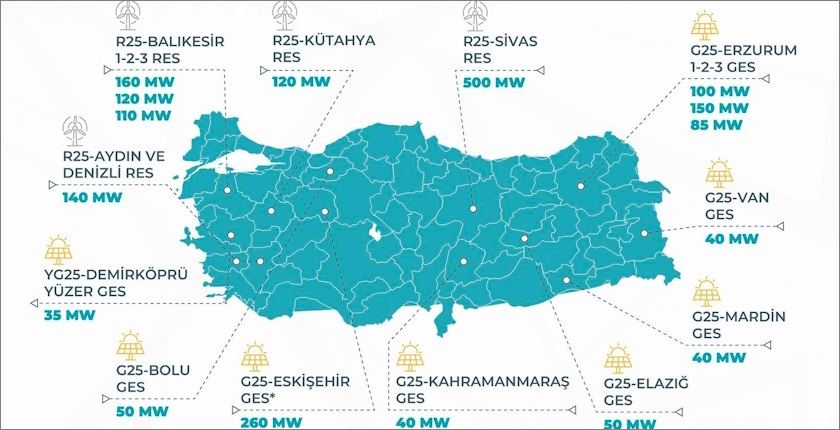
The upcoming solar energy auctions, REZ SPP 2025 (YEKA GES 2025), are for 850 MW altogether. There are ten areas in eight provinces designated for bidding: Kahramanmaraş, Mardin and Van, with 40 MW each, Bolu and Elazığ (50 MW each), Erzurum 1-3 (100 MW, 150 MW and 85 MW), Eskişehir (260 MW) and Demirköprü in Manisa province, with 35 MW.

The upcoming solar power auctions will include Turkey’s first bidding for a floating photovoltaic plant

Notably, the last one is for a planned floating solar power plant on the reservoir of the Demirköprü hydropower plant. The facility on the Gediz river, east of Izmir, is owned by state-owned Electricity Generation Corp. (EÜAŞ). Turkey now hosts only two small floating photovoltaic units, and the auction will be the first of its kind.

Applications will be received on November 4, the ministry said and added it would subsequently publish a schedule for bidding.

Wind power capacity quota is 1.15 GW

Participants can apply on November 18 for the wind energy round of auctions, REZ WPP 2025 (YEKA RES 2025). It is for an overall 1.15 GW in six areas.

Investors will compete for 500 MW in Sivas province, a 140 MW project in Aydın and Denizli, 120 MW in Kütahya and three areas in Balıkesir – 160 MW, 120 MW and 110 MW.

Winners to submit guarantees of EUR 75,000 per MW for PV projects, EUR 100,000 per MW for wind

Potential bidders will pay a fee of EUR 1,550 for each auction they apply for. They must submit letters of guarantee lasting one year and worth EUR 15,000 per MW for photovoltaics and EUR 20,000 per MW for wind power. Winners will submit 10-year guarantees before signing their contracts: EUR 75,000 per MW and EUR 100,000 per MW, respectively.

The ceiling or starting price is EUR 55 per MWh and the floor prices are EUR 32.5 per MWh for solar power and EUR 35 per MWh for wind. If bids hit the floor, another auction will be held between the competitors, like in the previous round. It is for a so-called contribution share that they are ready to pay. The minimum is EUR 10,000 per MW of planned capacity and the highest bid wins.

Successful participants can sell electricity on the free market for five years in the case of solar power plants, while the period lasts six years for wind. After that, both categories enter a 20-year scheme with a guaranteed price.

Turkey tops 120 GW in total electricity capacity

At the end of July, electricity capacity in Turkey totaled 120.2 GW, the ministry revealed. Hydropower accounted for 26.9% or 32.3 GW, compared to 23.4 GW in photovoltaics (19.5%) and 13.7 GW of wind power, translating to 11.4%.

The share of biofuel and waste was 1.9%, with 2.34 GW, and geothermal power plants had 1.73 GW altogether, which is 1.4%. Gas power plants in Turkey had 24.7 GW in combined capacity (20.6%). The remainder is coal: 21.9 GW or 18.3%.

by in News

ENNA measures even higher temperatures at its Zagocha geothermal well

ENNA Geo completed additional production testing of the well at the site of the planned geothermal power plant GTE Zagocha in northeastern Croatia. It found even higher temperatures at the reservoir than before. In addition, drilling of the exploratory well Babina Greda GT-1 for another geothermal power plant began this week.

ENNA Geo, a member of the ENNA Group, said the additional production testing in Čađavica near Slatina was successful. It is the well for its planned 20 MW geothermal power plant GTE Zagocha. Furthermore, so-called rigless testing at the site, in northeastern Croatia, was carried out earlier this month on the well called Podravska Slatina GT-6beta (PSGT-6beta), said GTE Zagocha’s Project Manager Boris Vidoš.

The primary objective was to collect water samples from the geothermal reservoir at a depth of 4,582 metres and to measure additional production parameters essential for the development of the power plant project.

“Two downhole samples of geothermal water were collected under dynamic conditions, along with several surface samples of water and gas, which have been sent for detailed analysis to several internationally recognised geothermal laboratories (New Zealand, France, Turkey and Croatia). We are particularly pleased that the geothermal reservoir itself, only a few months after completion of the well, is showing higher measured temperature values both at reservoir level (well bottom) and at the surface,” he asserted.

Slatina 2 field’s significant potential confirmed

A maximum temperature of 211 degrees Celsius was recorded at the bottom of the PSGT-6beta well, versus 180 degrees at the surface, Vidoš said.

He explained that all downhole and surface flow measurements, geochemical analyses of water, and gas analyses would provide a broader picture of the geothermal potential of the Slatina 2 field, enabling the ENNA Geo team to begin concrete discussions with suppliers of the process equipment for the geothermal power plant.

The drilling of the well was completed in March, followed by initial production testing, which confirmed the significant geothermal potential of the Slatina 2 field. The additional rigless testing – planned petroleum engineering operations – was successfully carried out, Vidoš added.

Waiting for market premium tender for almost two years

Croatia has considerable geothermal potential, but currently not a single operational geothermal power plant. Namely, the Velika 1 facility in Ciglena near Bjelovar has been long offline due to an ownership dispute.

GTE Zagocha is the most advanced geothermal power plant project in Croatia to date. It depends on the launch of a public tender for the allocation of a market premium.

ENNA Group noted that Germany subsidizes geothermal power plants over a 20-year period with a guaranteed price of EUR 252 per MWh, and that Italy offers a guaranteed price of EUR 200 per MWh over 25 years.

The Zagocha project has been prepared for a public call since November 2023, but the Croatian Energy Market Operator (HROTE) has not issued a public call for three years, the company said in its update.

Drilling starts at Babina Greda 2 field for 15 MW geothermal power plant

ENNA Geo, through the project company Geo Power Babina Greda, is also developing a geothermal power plant project in Babina Greda in Croatia’s northeast, planning 15 MW. On the geothermal exploration field Babina Greda 2, drilling of the exploratory well Babina Greda GT-1 (BaGGT-1) began this week.

The plan is to drill the deep geothermal well Babina Greda 1 and conduct production testing over the next 110 days. Additionally, the company revealed it expects surface flow of 110 liters per second of geothermal water of 170 degrees Celsius.

ENNA Solar agreed in April to take over an 87.5 MW ready-to-build photovoltaic project in Romania from Austria-based Kraftfeld Energy.

by in News

Turkish renewables firm to drill for geothermal lithium

Margün Energy intends to search for lithium in geothermal waters in Seferihisar in western Turkey, where it took over a 12 MW geothermal power plant. It also launched a project to add a photovoltaic unit of 5.4 MW to the existing facility and create a hybrid power plant.

Turkey, the fourth in the world in geothermal power capacity, also has significant potential for lithium extraction. The production of the mineral used in batteries can increase the cost-effectiveness of geothermal energy projects. Margün Energy, listed at the Istanbul Stock Exchange since 2021, said it would conduct exploration works on 3,125 hectares in Izmir province.

The company recently bought a geothermal power plant in the area for USD 16 million from RSC Elektrik. The 12 MW facility is in Kavakdere in Seferihisar district. Margün Energy denied speculation that it would mine lithium.

If it finds a valuable amount of the mineral in geothermal water, it will build an extraction plant, according to the update. Margün Energy issued the statement after local residents expressed concern over potential environmental damage from lithium mining.

“We have not obtained any mining permits. Furthermore, Margün Energy is not a mining company… Mining lithium, which is used in battery production, and extracting lithium from geothermal fluid by separating it are very different things,” the announcement reads.

Margün Energy to look for precious metals as well

The company said it would continue its investments in geothermal energy such as electricity production and greenhouse farming, arguing it would create jobs for locals. It suggested it could extract carbon dioxide for commercial use as well.

Margün Energy added it would explore the presence of precious metals in geothermal fluids.

Planned PV unit to generate 10 GWh per year

In addition, it submitted a proposal to the country’s Energy Market Regulatory Authority (EMRA or EPDK) for the installation of a photovoltaic unit with 5.4 MW in peak capacity. It would be added to the existing facility, creating a hybrid power plant. The solar power system would generate 10 GWh per year and increase revenue by USD 1.05 million, the company estimated.

The PV plant would lift Margün Energy’s total capacity to 135.4 MW. The company mostly operates solar power plants and works as a contractor for engineering, procurement and construction (EPC) and operations and maintenance.

Notably, it owns the largest stake in Enda Energy Holding. The affiliate operates four hydropower plants, five wind power plants, one geothermal power plant and three solar power plants of 200 MW altogether.

Margün Energy rallied 109% since the beginning of the year.

by in News

IRENA: 91% of new renewables units are more cost-effective than fossil fuel alternatives

The fossil fuel age is crumbling, according to UN Secretary-General António Guterres. Renewables maintained their cost leadership in global power markets, the International Renewable Energy Agency said in an annual report. In 2024, onshore wind farms were the cheapest of all versus the lowest-cost fossil fuel alternatives, by 53% on average, while photovoltaic systems were 41% cheaper.

Onshore wind power was also the cheapest in levelized cost of electricity (LCOE) terms, followed by solar power. At the same time, 91% of newly commissioned utility-scale capacity was delivering power at a cost lower than for the cheapest electricity from new fossil fuel–fired units.

The Renewable Power Generation Costs in 2024 report confirmed the price advantage of renewables over fossil fuels, with cost declines driven by technological innovation, competitive supply chains and economies of scale, the International Renewable Energy Agency said. IRENA expects cost reductions to continue, but highlighted the short-term challenges.

Geopolitical shifts including trade tariffs, raw material bottlenecks, and evolving manufacturing dynamics, particularly in China, could temporarily raise costs.

Asia, Africa and South America, with stronger learning rates and high renewable potential, could see pronounced cost declines.

Higher costs are likely to persist in Europe and North America, driven by structural challenges such as permitting delays, limited grid capacity, and higher balance-of-system expenses, according to the update. In contrast, regions like Asia, Africa and South America, with stronger learning rates and high renewable potential, could see pronounced cost declines.

The organization pointed to the need for stable and predictable revenue frameworks to lower investment risk and attract capital.

“Clean energy is smart economics – and the world is following the money,” United Nations Secretary-General António Guterres stressed. In his view, the fossil fuel age is crumbling.

Capital costs inflating LCOE in developing countries

Mitigating financing risk is central to scaling renewables in both mature and emerging markets. Instruments such as power purchase agreements (PPAs) play a pivotal role in accessing affordable finance, while inconsistent policy environments and opaque procurement processes undermine investor confidence, IRENA added.

In many developing countries of the Global South, high capital costs, influenced by macroeconomic conditions and perceived investment risks, significantly inflate the levelized cost of electricity (LCOE) of renewables.

Onshore wind power production cheapest by far of all kinds of electricity

In 2024, onshore wind farms were the cheapest of all versus the lowest-cost fossil fuel alternatives, by 53% on average, while photovoltaic facilities were 41% cheaper. Of note, the cost of battery energy storage systems (BESS) declined by 93% from 2010 to 2024, to USD 192 per kWh.

Onshore wind remained the most affordable source of new renewable electricity, with a global weighted average LCOE at USD 0.034 per kWh (USD 34 per MWh), followed by new solar, at USD 0.043 per kWh, and new hydropower plants, USD 0.057 per kWh.

Again per the levelized cost of electricity, 91% of newly commissioned utility-scale renewables capacity was delivering power at a lower cost than the most affordable new fossil fuel–based units.

That said, LCOE increased slightly for solar power, by 0.6%. Onshore wind power was 3% more expensive than in 2023, compared to 4% for offshore wind and 13% for the bioenergy segment. Meanwhile, costs declined for concentrated solar power (CSP), by 46%, followed by electricity from geothermal units, 16%, and hydropower, which slipped 2%.

Solar and wind energy prices have begun to stabilize, which is a natural sign of market maturity, the authors underscored.

Photo: Renewable energy LCOE 2010-2024, in United States dollars per kilowatt-hour (IRENA)

Clear path to affordable, secure, sustainable energy

The addition of 582 GW of renewables capacity in 2024 led to significant cost savings, avoiding fossil fuel use valued at about USD 57 billion, new data shows. Looking at all renewables in operation, the avoided fossil fuel costs in 2024 reached up to USD 467 billion, IRENA’s Director-General Francesco La Camera stated.

New renewable power outcompetes fossil fuels on cost, offering a clear path to affordable, secure and sustainable energy, he pointed out.

by in News

Croatia confirms major geothermal resource for district heating

The Croatian Hydrocarbon Agency’s exploratory activities at a preliminary exploration site in Velika Gorica have confirmed significant geothermal potential. The output from this single geothermal well could meet nearly 60% of the thermal energy needs of the city’s district heating system, the agency said.

The recorded reservoir temperature exceeds 100 degrees Celsius, and the well’s capacity meets the projected targets in full, the agency stated. The exploratory activities in Velika Gorica are part of a wider project to develop geothermal potential for district heating in Croatia, covering six cities.

To fully realize the geothermal system’s potential for district heating in Velika Gorica, a second well is planned. This would create a so-called production-injection pair, allowing for the continuous and safe use of this natural resource, the agency said.

A second well is planned in Velika Gorica to fully utilize the geothermal potential

In addition to its application in district heating, the geothermal potential in the Velika Gorica area also holds promise for agricultural production, it added.

“This is one of the first concrete steps in the use of geothermal energy for heating in continental Croatia. The project is financed through the National Recovery and Resilience Plan (NRRP), and the works were carried out by CROSCO, a member of the INA Group,” the agency said.

The project to explore the geothermal potential in six cities – Vinkovci, Vukovar, Osijek, Sisak, Zaprešić, and Velika Gorica – was launched earlier this year, with a total budget of EUR 50 million. The agency plans to complete the project and determine the geothermal energy potential for all six cities by June next year.

by in News

Turkey aims to become major lithium producer with its geothermal wells

Turkey is using only 10% of its geothermal potential, according to Chairman of the Geothermal Power Plant Investors Association (JESDER) Ufuk Şentürk. He said existing wells alone could open the way for the country to become one of the world’s major producers of lithium.

Studies are underway to determine the accessibility of valuable minerals in Turkey’s geothermal waters. There are already some one thousand wells with 100,000 tons of water coming out every hour, Chairman of JESDER Ufuk Şentürk told Anadolu Agency Energy Terminal. He pointed to the potential for the extraction of lithium, cesium, selenium and silicon.

Turkey is utilizing only 10% of its geothermal potential, Şentürk stressed. An inventory is under development of wells that were drilled to find oil and left unused, he added. The temperatures are as high as 150 degrees Celsius and the said resources can provide heat for 5,000 hectares of greenhouses, the organization’s chief said.

Researchers have found a lithium source in Turkey of 20 parts per million in geothermal water

The İzmir Institute of Technology (İYTE) and Afyon Kocatepe University have been conducting studies for two years, within the Turkish-German Energy Partnership, on obtaining minerals, Şentürk noted. He said there are 100 parts per million of lithium in one geothermal source in Germany, while 20 parts per million were found in Turkey.

Investment costs are much lower without exploratory drilling, if lithium is extracted from geothermal water already coming to the surface. The head of JESDER, Geothermal Power Plant Investors Association, estimated that Turkey could produce 35,000 tons per year and said global production came in at 36,000 tons last year.

“Even if we obtain 10%, we will still be one of the countries with the largest lithium resources in the world,” he stated.

Volumes of lithium extracted from geothermal waters are still symbolic

As Şentürk didn’t elaborate, it remains unclear if he compared the country’s potential to the output from so-called direct lithium extraction (DLE) or perhaps evaporation from brine pumped from underground. They make up one tenth and one quarter, respectively, of the 240,000 tons of lithium produced last year in the world. The rest is mined.

A different benchmark, the lithium carbonate equivalent or LCE, is almost five times larger. Additionally, about 5% of lithium ion batteries are recycled. The volumes of lithium extracted from geothermal waters are still symbolic.

Investors are betting on the combination with geothermal energy, to make lithium production cost effective, as it is found in very small quantities in underground water. Direct extraction of the alkali metal from water has an immeasurably lower environmental impact than mining.

Existing geothermal power plants can provide heat to 4,000 hectares of greenhouses

Şentürk pointed out that Turkey hosts 65 geothermal power plants of 1.74 GW overall. They generated 11.2 TWh in 2024 of the total 350 TWh.

Geothermal energy currently heats 7,000 hectares of greenhouses in Turkey and 160,000 homes, Şentürk said. The Ministry of Agriculture and Forestry is providing incentives for greenhouse zones of 2,800 hectares in total. But existing geothermal power plants alone could, with such support, provide for 3,500 to 4,000 hectares of greenhouses, the association’s chief estimated.

On a global scale, Turkey trails only the United States, Indonesia and the Philippines in geothermal power. Nevertheless, after several years of rapid growth, it only added 120 MW in capacity since 2020.

A recent study, conducted within the project called Li+Fluids, showed geothermal waters in north Germany and its Thuringia state contain between 0.39 and 26.5 million tons of lithium. The country’s demand for 2030 is projected at 0.17 million tons.

by in News

Turkey discovers its hottest geothermal well to date

Turkey’s Sanko Holding has discovered the country’s hottest geothermal well with access to a geothermal source, with temperatures reaching 308 degrees Celsius, according to an announcement from JESDER, the Turkish association of geothermal power plant developers.

“After a difficult and determined search, we learned with great pride that the hottest geothermal production well […] in Turkey, which reached 308°C, has been successfully discovered,” reads a Facebook post by JESDER.

Describing the discovery as a landmark achievement highlighting a strategic position of geothermal energy among renewable energy sources, the association congratulated everyone involved on what it called a giant step for Turkey’s energy future.

The well is a giant step for Turkey’s energy future

A geothermal resource reaching 341 degrees Celsius, at a depth of 3,845 meters, had previously been discovered in Turkey, but it never reached the production stage, according to media reports. Geothermal resources are considered suitable for investment if their temperatures range between 140 and 370 degrees, the Yeni Akit news website writes.

The temperatures in geothermal sources that can generate electricity vary between 103 and 295 degrees. The ones below are usually utilized for thermal spa tourism or heating, the Turkish media outlet added.

Turkey ranks fourth in the world in geothermal power capacity

Turkey’s geothermal power capacity is equivalent to that of the European Union and Iceland combined, making it fourth in the world in the field. It reached 1.73 GW in 2024, or about 1.5% of its overall power capacity, Deputy Minister of Energy and Natural Resources Abdullah Tancan revealed.

According to JESDER, geothermal power plants accounted for 3.2% of electricity output in Turkey last year, providing 11.2 TWh out of a total of 350 TWh.