by in News

North Macedonia, Kazancı sign memorandum on gas power plants

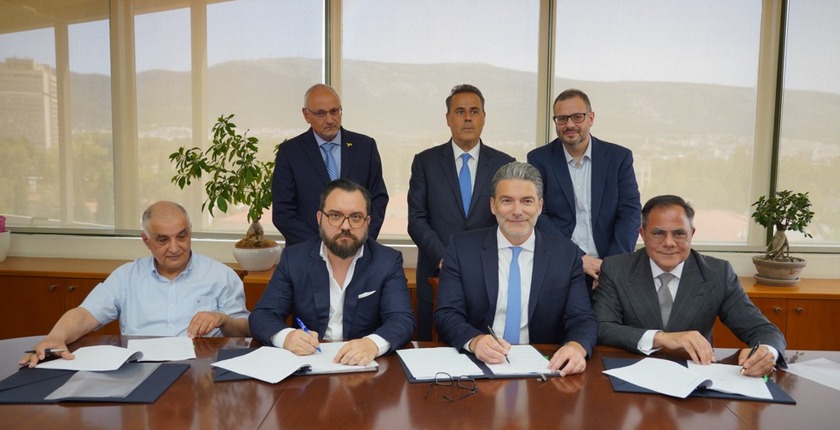
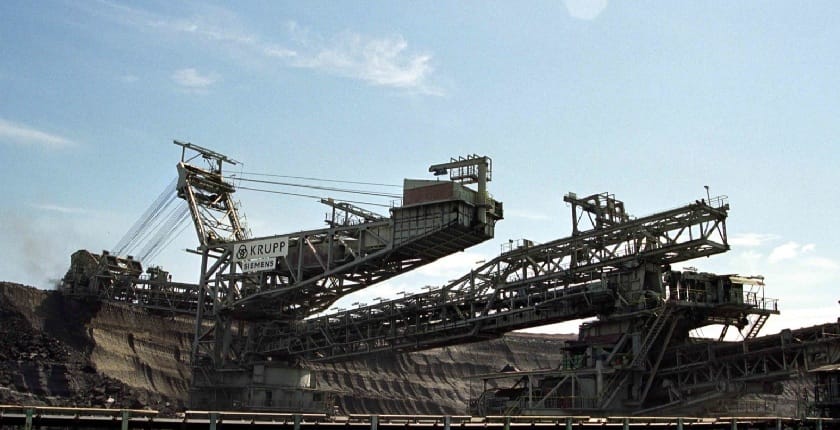
The Government of North Macedonia and Kazancı Holding have signed a memorandum of understanding that paves the way for a EUR 1 billion investment in the country’s energy sector.

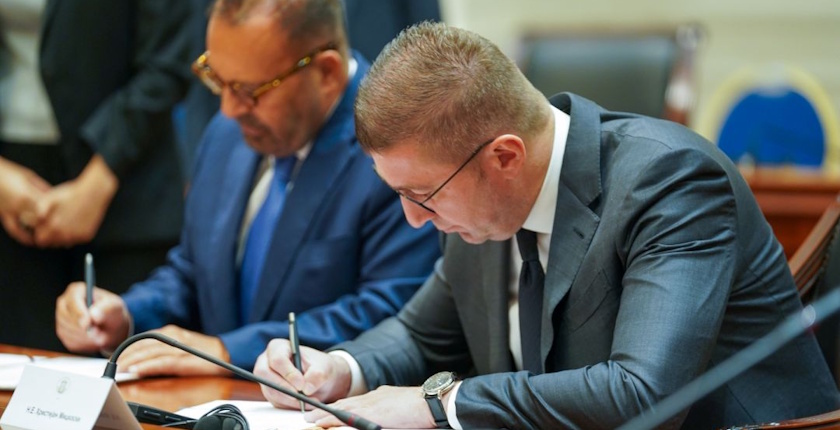
The memorandum of understanding was signed by Prime Minister Hristijan Mickoski and Cemil Kazancı, President of the Board of Directors of Kazancı Holding.

In February, Mickoski announced that the company would invest EUR 1 billion in gas power plants, gas and heat distribution grids.

Now he stressed that the memorandum demonstrates the country’s determination and plan to secure its energy sovereignty and protect its economic interests.

Mickoski: We are reducing import dependence and the impact of external price and political risks

According to the government, the document creates the conditions for a project with a long-term impact on the country’s energy sector.

It consists of three segments: development of new power production facilities, construction of natural gas and heat distribution grids, and implementation of measures to increase gas supply security, Mickoski explained.

Photo: Government of North Macedonia

In his view, a domestic energy source and a stable energy distribution system represent security, predictability, and control over one of the country’s most vital systems.

By developing domestic production facilities, North Macedonia is reducing its reliance on imports and minimizing exposure to external price and political shocks, the prime minister added.

Kazancı: The project is already prepared

Cemil Kazancı recalled that discussions about the investment began a long time ago. The project, in his words, is already prepared. Now research will be conducted, after which the implementation of the EUR 1 billion endeavor will start, he claimed.

It will be a strategic center in the Balkans, according to Kazancı. He expressed confidence that the project would be implemented shortly.

The government has not disclosed details of the memorandum with the company, which operates in the energy sector through its Aksa brand.

Earlier, Prime Minister Mickoski said the two sides were considering cogeneration facilities of 500 MW in combined capacity. They would produce 4.1 TWh of electricity and 720 GWh of heat per year.

The construction of a distribution grid for gas and heat would enable gas and heat to be distributed to as many citizens as possible.
by in News

Gas power plant Brestanica in Slovenia adds photovoltaic unit

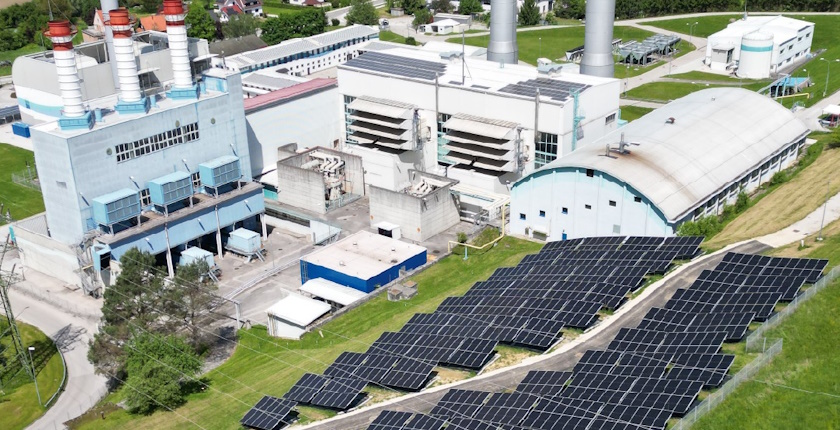
A ground-mounted solar power plant of 466 kW started generating electricity on a regular basis at Slovenian state-owned gas power plant Termoelektrarna Brestanica (TEB).

GEN-I’s subsidiary GEN-I Sonce installed a photovoltaic system, as the contractor, at the gas power plant run by fellow GEN Group member Termoelektrarna Brestanica (TEB). The 466 kW ground-mounted solar power plant entered regular operation, Naš stik reported.

The new facility in Brestanica in the municipality of Krško near Slovenia’s border with Croatia consists of 810 modules. The project was backed by the government’s renewable energy grant program. It covered 20% of the cost, which amounted to just under EUR 600,000.

MFE TEB4, the new unit, entered test operation in February. It is the fourth PV system at the Brestanica gas power plant. Two are on roofs and one is a solar canopy on the parking lot. Commissioned in 2009 and 2010, they have 170 kW in combined peak capacity.

The estimated annual production of the fourth solar power system can meet the electricity needs of more than one hundred Slovenian households.

Almost a third of the project budget was invested in the installation of a transformer. It enables more renewable electricity capacity to be connected to the grid around TEB, the article reveals.

GEN Group’s state-owned parent company GEN energija operates the Krško nuclear power plant, also known by the acronym NEK and, in Slovenian, JEK.

by in News

BEF 2025: Technologies for energy transition are here, getting cheaper every day

Technologies for the energy transition already exist, and their use is increasing thanks to falling costs. Investors and bankers claim they are ready to invest and that money isn’t an issue. The missing part are upgraded transmission grids, along with policies and regulations to integrate everything into a suitable environment, according to investors and lenders gathered at Belgrade Energy Forum 2025.

The third Belgrade Energy Forum, BEF 2025, welcomed four hundred participants from more than 30 countries from the region, Europe, and beyond. The two-day conference was organized by Balkan Green Energy News.

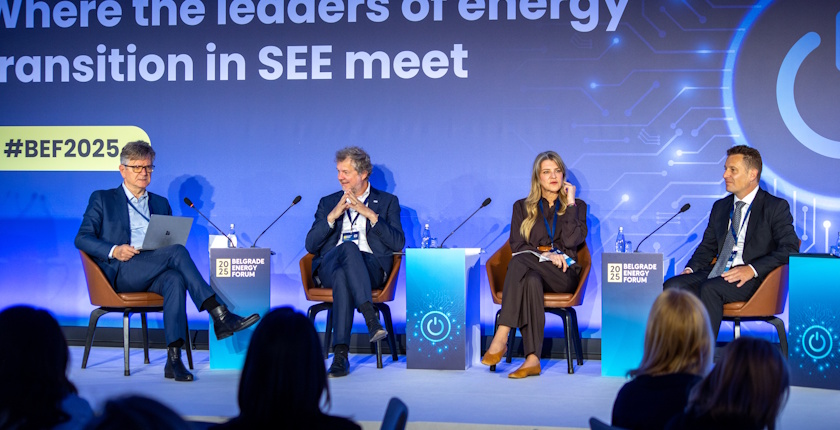
Participants in the panel Energy revolution underway – uniting efforts to deliver green, intelligent, and sustainable energy solutions were Maja Turković, Senior Vice President of CWP Europe, Aleš Prešern, Vice President and Head of Southeast Europe of Siemens Energy, and Christian Beynio, Head of Advisory of Kommunalkredit Austria AG.

According to panel moderator Mirza Kušljugić, a member of the Board of the Regional Center for Sustainable Energy Transition (RESET) from Bosnia and Herzegovina, the energy transition is actually a revolution, given the technological changes.

“The region is still burdened by tradition. We know the transition is inevitable, but we aren’t fully aware that it will be disruptive,” Kušljugić stated.

Technology is here, and so is financing

Mirza Kušljugić, Aleš Prešern and Maja Turković (photo: Balkan Green Energy News)

Maja Turković, Senior Vice President of CWP Europe, stressed that technology, currently undergoing a revolution, is the best card the world has in the transition. She even suggested that financing isn’t a problem and that there are more financial resources available than projects qualified to receive funding.

However, she is surprised by the rapid growth in solar power installations. Turković argued that market-based projects cannot achieve double-digit internal rates of return on equity. Part of the explanation may lie in the fact that panel prices have dropped by 60% over two years.

Battery prices have also fallen. The largest drop was last year, 40%, with a further 5% decline this year alone, according to Turković. Prices have slipped below EUR 100,000 per MWh.

Turković: Regarding CAPEX and technology, we’re ready

The latest trend is the integration of batteries with solar power plants. While transmission system operators in the region still don’t allow it, in some countries a grid connection approved for solar can also be used for batteries. “Regarding CAPEX and technology, we’re ready,” Turković underlined.

Aleš Prešern, Vice President and Head of Southeast Europe in Siemens Energy, is particularly impressed with the speed of change.

“We who are working in the energy sector are used to very slow changes. Energy was a conservative industry. In 2004, 1 GW of solar was built, but now data shows that it is how much is installed in one day. Batteries cost EUR 1 million per MWh not that long ago, and now they are ten times cheaper,” he noted.

Prešern: Transmission networks are the bottleneck of the transition

They are indeed dramatic changes, for which the existing power system wasn’t prepared. It is clear why Siemens Energy, as a technology company, considers transmission networks to be the bottleneck in the transition, Prešern said.

To illustrate the slowness of grid investments, he pointed to Austria, as one of the examples, where it took 10 years to build one important segment of the 400 kV network.

Both Turković and Prešern agree that nowadays the keyword is flexibility.

Maja Turković and Christian Beynio (photo: Balkan Green Energy News)

She explained there are operating battery management systems at low voltage levels that incorporate artificial intelligence and use market signals for activation when prices are low.

Prešern added that the required stability through balancing could be provided by gas power plants. Siemens Energy has never seen such high demand for gas turbines like today, he asserted.

Beynio: Don’t forget the non-banking institutions when looking in new financing

“If you ask about availability of financing, yes, it’s there,” Christian Beynio, Head of Advisory at Kommunalkredit Austria AG, confirmed. In his view, prices or, rather, the drop in prices of equipment, is the biggest innovation. Earlier, he said, it was a completely different game, heavily subsidized, while nowadays no subsidies are required per se.

The trend that Kommunalkredit Austria AG identified is the pooling of smaller assets, and a shift from financing projects toward financing developers and companies as corporates. It is yet to come to the region, he added.

Investment in grids, in his words, has to be initiated by the government. They have two solutions – go to the sovereign debt market or engage private investors. “Don’t forget the non-banking institutions when looking for new financing. This is a trend across Europe, and it will be relevant for the Balkans,” Beynio advised.

Battery projects won’t go so smoothly

Aleš Prešern (photo: Balkan Green Energy News)

Maja Turković expressed the belief that installing batteries won’t go as smoothly as solar. The main reason is the difficulty of securing a stable cash flow for batteries, unlike for production facilities. Cash flow enables financing, so batteries will likely need to be financed with internal funds, she underlined.

Turković noted that batteries are best monetized by providing system services and arbitrage, but pointed out they can also participate in capacity mechanisms, a scheme that could involve power purchase agreements (PPAs).

She said the development of the regulatory framework should be faster, to facilitate investments in batteries. Investors are ready to commit their funds to battery installation, and everyone in the market agrees that batteries are essential, Turković stressed.

Prešern: People and not technology are a guarantee that networks will exist and function properly

Amid the widespread discussions about technology and regulations, Aleš Prešern highlighted another issue. Energy, in his opinion, has always been an exciting sector, but the message hasn’t been getting through to young people in recent years. It was the case not only in the region but also in Europe, and beyond, leading to a shortage of skilled personnel.

However, he expressed the belief that things are changing and enthusiasm is returning. Prešern even suggested it could be a major advantage for the region, well known for its high-quality engineers.

Siemens Energy strives to employ as many good engineers as possible because, ultimately, people and not technology are a guarantee that networks will exist and function properly, he stressed.

The solution is also in using new technologies to better utilize existing grids

Christian Beynio (photo: Balkan Green Energy News)

The combination of rapid changes in the energy sector and slow investments in the grids threatens to put the transition to a standstill.

Better utilization of existing infrastructure could be the solution. Siemens Energy fits well there, as several years ago it established a division called Digital Grid. According to Prešern, the idea was to be quicker in data utilization, something that other sectors like automotive have long advanced, while energy has lagged.

The company recently acquired a Slovenian-Austrian firm that produces sensors installed directly on power lines, a technology called dynamic line rating. The devices provide real-time data about the conditions in power lines, potentially enabling their use beyond original design limits.

“With this technology, we believe we can increase the capacity of existing networks by an average of 30%,” Prešern revealed.

New technologies have changed bankers’ jobs as well

New technologies have changed bankers’ jobs as well, Christian Beynio admitted. He recalled that it was easy to finance wind farms in Serbia because they had feed-in tariffs from the government. The only risk element was the wind blowing or not blowing, Beynio said.

Nowadays there are merchant power producers that combine their facilities with batteries and use algorithms in electricity trading, he added. It means bankers need to sit with market consultants to identify all outcomes, he stressed.

“You won’t find singular cash flow streams. It’s going to be multi-dimensional and people simply need to adjust. It’s going to be more short term also on the lending side. It’s rather going to be corporate lending to people and companies who know what they are doing and can credibly demonstrate that with a track record. That is the digitalization impact we see”, Beynio said.

Maja Turković (photo: Balkan Green Energy News)
by in News

Greece’s DEPA joins forces with Clavenia to build 792 MW gas power plant

A Greek-Israeli consortium has signed an agreement to build a 792 MW gas power plant in Larissa, Greece, in an investment valued at EUR 600 million. The facility will use an advanced combined cycle gas turbine (CCGT) technology, enabling a net thermal efficiency of 62.6%.

The proposed gas power plant is expected to be the most efficient CCGT facility in the country. It will utilize Mitsubishi Heavy Industries’ advanced technology, specifically M 701JAC, according to a statement by Greek state-controlled gas supplier and trader DEPA Commercial, one of the partners in the consortium.

The Larissa plant is expected to be the most efficient CCGT facility in Greece

The project is led by Clavenia, registered in Cyprus but with Israeli ownership. It has a 38.5% stake. The other three stakeholders are based in Greece – DEPA Commercial, with 35%, energy investment fund EUSIF Larissa, with 16.5%, and local retail electricity supplier Volton, with 10%.

A final investment decision is expected by the end of 2025, and construction would begin in early 2026. All required permits have already been secured. DEPA revealed it would be responsible for the commercial supply of natural gas for the operation of the plant.

The project could be expanded to include a data center, energy storage, and hydrogen

Clavenia plans to expand the project by developing a broader energy hub in the region, including battery storage facilities, a data center, and potentially hydrogen production and carbon capture technologies, according to Energypress.

Nissan Caspi, managing partner at Clavenia, described the Larissa project as the first phase of a broader plan, incorporating innovative Israeli technologies, such as hydrogen storage, green methanol production, and lithium ion batteries.

DEPA is already building a CCGT plant in Greece of 840 MW

DEPA, in partnership with state-controlled Public Power Corp. (PPC), is building an 840 MW gas power plant in Greece using CCGT technology. It is also involved in a project for a gas-fired power plant in Albania, together with Greece-based GEK Terna and Albanian firm Gener 2.

The company owns 20% of the Alexandroupolis LNG Terminal and 25% of ICGB, which operates the Interconnector Greece-Bulgaria (IGB) gas pipeline.

by in News

Hungary’s MVM inks deal with Çalık Holding, Ansaldo Energia for combined cycle gas turbine power plant

Hungarian power utility MVM signed an agreement with a consortium of Turkey-based conglomerate Çalık Holding and Italian company Ansaldo Energia, which are tasked with building a 1,000 MW combined cycle gas turbine power plant at the Tiszaújváros site in northeast Hungary.

It is the second time this year that MVM contracted the construction of gas-fueled and hydrogen-ready facilities at sites of former power plants running on fossil fuels. Two months ago, the company signed a deal with domestic firms Status KPRIA and West Hungária Bau, and Egypt-based Elsewedy Electric for a 650 MW power combined cycle gas turbine (CCGT) at the Mátra Power Plant.

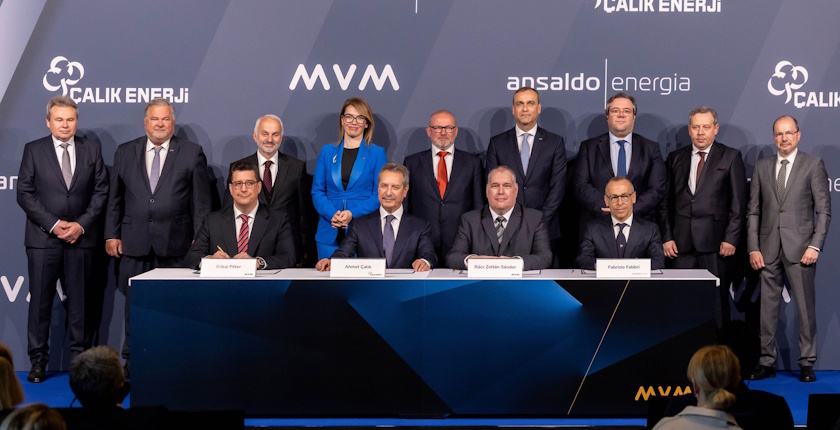
Now the contract for the development of a modern CCGT power plant was signed by MVM Tisza Power Plant Ltd. of the MVM Group, Çalık Holding, the consortium lead, and Ansaldo Energia.

The agreement marks the beginning of turnkey execution planning, procurement, and construction of what is expected to be Hungary’s most efficient large-scale power plant, the companies said.

Lantos: No new baseload power plant has been built in Hungary in more than 15 years.

The power plant is expected to supply an average of 7,500 GWh of electricity annually. It will also be prepared to use hydrogen.

The two-member consortium was awarded the construction and long-term maintenance of the gas turbines at the public procurement tender.

After the signing, Hungarian Minister of Energy Csaba Lantos lauded the deal as historic, noting that no new baseload power plant has been built in Hungary in more than 15 years.

“The new facility will play an important role in balancing renewable electricity production, thereby supporting the successful energy transition,” he added.

Mátrai: A modern, flexible generation capacity

Károly Mátrai, MVM Group CEO, said a modern, flexible generation capacity would replace the previously decommissioned traditional power plant. Of note, it was a gas power plant.

The facility to be built at the Tiszaújváros site will leverage existing electricity grid connections, a cooling water system, and access to natural gas at a nearby point, Mátrai underscored.

According to Fabrizio Fabbri, Ansaldo Energia CEO, the MVM Tisza power plant will be the country’s most efficient, ready to meet Hungary’s growth and increasing energy needs. He said his company would bring its most advanced gas turbine technology, suitable for hydrogen use.

Ahmet Çalik, President of Calik Enerji Swiss, said the company is honored to contribute to Hungary’s energy supply and enhance its energy security.

by in News

Project for first gas power plant in Albania enters next stage

In partnership with domestic company Gener 2, Greece-based GEK Terna and DEPA Commercial are preparing to build the first gas power plant in Albania. The current phase involves seeking financing. Separately, Azerbaijan’s SOCAR is expected to start installing the first gas distribution network in Albania, in the city of Korça.

Albania is almost 100% dependent on hydropower plants in domestic electricity production. Efforts are underway to diversify the mix with solar and wind energy and introduce storage capacities. Actually, not a single wind turbine has been built yet, but there is another opportunity for strengthening the energy supply: with gas from the Trans Adriatic Pipeline – TAP. Greek conglomerate GEK Terna and state-owned gas supplier, importer and trader DEPA Commercial intend to build the first gas power plant in Albania, with a local partner.

Late last year, the Council of Ministers, the country’s government, approved the project and determined a three-year deadline for completion. The site for the gas plant is in the municipality of Roskovec in Fier in western Albania. Notably, the county attracts most solar power projects in the country.

Gas facility in western Albania reportedly to have 147 MW in capacity

In the current project development phase, Fier Thermoelectric, the joint venture, is seeking financing, Insider.gr reported. The facility is envisaged to have 147 MW in capacity, according to the article. The government’s decision was for 170 MW.

DEPA Commercial, also known as DEPA Emporias (in Greek), DEPA Commerce and DEPA Trading, entered the project in 2023. It took over a 35% stake from GEK Terna and signed a seven-year gas supply contract for the proposed facility.

They have equal ownership, while Albanian company Gener 2 holds the remaining 30%. It is active in construction, infrastructure, civil works, energy, real estate development, telecommunications and retail in Albania and the broader region.

Both GEK Terna and Gener 2 have solar power projects in Albania as well

Gener 2 has submitted a 50 MW solar power project to the government a year ago. The location is in Bistrica in Finiq municipality, Vlora district.

The government’s approval is not for a concession, but the operator is obligated to either deliver 2% of electricity it produces, as royalty – royal right, or give an equivalent sum for the state budget. The permit is for 49 years since the entry of the decision into force. The firm also needs to sell a share of output to the public power supplier, in accordance with the country’s law.

A group of residents of surrounding villages has repeatedly protested against the investment, arguing that they weren’t consulted. The locals even filed a criminal complaint against Roskovec Mayor Majlinda Bufi.

They claim that the gas facility would pollute the area and jeopardize public health while exporting 90% of the produced electricity.

GEK Terna to benefit from synergies with its gas power plants in Greece

GEK Terna has three gas-fired power plants in Greece. The group’s other energy investment in Albania, through its subsidiary Heron, isn’t without controversy either.

The project is for a 93 MW photovoltaic plant in Libohova, near the Greek border, in Gjirokastër county. Project firm Faethon won approval from the Council of Ministers in Tirana in early 2024. It would be valid for up to 49 years.

GEK Terna’s solar power plant project in Gjirokastër was disrupted last year over fake documentation

Local press wrote last summer that some land documentation for the 122-hectare area was forged, prompting a raid and arrests in the cadastral office in Gjirokastër. The operator of the Libohova plant is obligated to deliver 2% of its electricity for free, too.

First gas distribution network in Albania about to be built in Korça

Albania aims to become a net electricity exporter before the end of the decade. There is also a project for a liquefied natural gas (LNG) terminal in the port city of Vlora, where a gas-fired power plant is planned to be built.

A long-awaited project called Nur, for the gasification of Korça, was presented last week. It would be the first city in Albania with gas.

The final investment decision is expected this year. State Oil Company of Azerbaijan (SOCAR) would be tasked with implementation, with financing from its government. The estimated cost is EUR 21 million. The idea is to then expand the local gas distribution network to nearby Pogradec and Erseka.

Fier and Elbasan are next on the schedule. Azerbaijan and its company are also interested in the project for the LNG terminal in Vlora and to connect the facility with TAP.

by in News

Aurora forecasts Western Balkans power capacity growth of 20 GW by 2040

The Western Balkans could see a 20 GW increase in installed capacity by 2040, with nearly 65% coming from renewables, Aurora Energy Research found. Short-term volatility and increased costs of commodities are expected to keep electricity prices near or over EUR 100 per MWh until 2030.

Aurora Energy Research issued its first forecast for the Western Balkans, eyeing investor movement. The firm expanded its market forecasting services, now offering full granularity modeling for Albania, Kosovo*, North Macedonia, Montenegro and Bosnia and Herzegovina, available in its Western Balkans Power and Renewables Market Forecast.

The announcement follows the conclusion of a multiclient study comprising three workshops, the results of which reveal increased investor interest in the region.

Photovoltaics have the fastest growth rate and biggest capacity in the forecast

The combined installed capacity in the Western Balkans excluding Serbia is expected to grow by 20 GW by 2040 and by as much as 35 GW by 2060 from the current levels, leading to tens of billions in investments, Aurora said. Renewables account for the lion’s share with nearly 65% while battery energy storage systems (BESS), interconnectors and hydrogen-fired combined-cycle gas turbines (CCGT) make up the remaining capacity additions.

Solar power shows the fastest rate of growth and absolute capacity value, according to the global power market analytics provider.

Electricity market prices returning below EUR 100 per MWh only after 2030

Looking into wholesale prices, the analysis expects the Western Balkans to follow similar trends as other SEE markets but with regional nuances, based on the local energy system evolution. Short-term volatility and increased commodities are foreseen to keep prices near or over the EUR 100 per MWh mark until 2030 while long-term baseload prices under Aurora’s central scenario are expected at between EUR 70 per MWh and EUR 80 per MWh, driven by high commodity prices, while an increasing renewables’ penetration acts in the opposite direction.

Early movers have an advantage as cannibalization looms

Renewable energy assets capture prices will benefit from lower cannibalization levels in the early years compared to other SEE countries, as there is less capacity in the system, giving early movers an advantage, the analysis reads. Over time, the momentum for storage seen in SEE likely spreads to the Western Balkans.

Coal phaseout seen by 2045

The speed of decarbonization in the region largely depends on the implementation of the European Union’s Carbon Border Adjustment Mechanism (CBAM) or alignment with the EU Emissions Trading System (EU ETS). The shift away from lignite could take time, Aurora’s experts say, with a full exit expected by 2045, but its share in the power system is expected to decrease significantly in the next decade due to pressure from CBAM and carbon taxes.

“The Western Balkans are Europe’s most rapidly changing power markets. Ageing thermal fleets, liberalisation of markets, policy support schemes, and strong fundamental economics are poised to bring the Western Balkans at the forefront of developers’ agendas,” said Panos Kefalas, Research Lead at Aurora Energy Research.

The Western Balkans Power and Renewables Market Forecast provides in-depth insights, detailed market analysis, and data-driven projections for investors, developers, and stakeholders.

Established in 2013, Aurora Energy Research provides power market forecasting and analytics for investment and financing decisions. Headquartered in Oxford, it operates out of 16 offices worldwide covering Europe, North and South America, Asia, and Australia. The firm’s services include market outlook for energy industry participants, advisory support, and software solutions.

* This designation is without prejudice to positions onstatus and is in line with UNSCR 1244/99 and the ICJ Opinion on the Kosovo declaration of independence.
by in News

PPC plans EUR 5.8 billion makeover of Western Macedonia coal region, including data centers

Public Power Corp. (PPC) presented a EUR 5.8 billion investment plan for the coal region of Western Macedonia in northern Greece. It held the ceremony in the retired Kardia 2 lignite-fired power plant.

According to PPC’s chairman and CEO George Stassis, the endeavor consists of the decommissioning of old assets and the rollout of new energy technologies.

Stassis: Western Macedonia can reinvent itself

PPC, or DEI in Greek, said it would return to the government 8,000 hectares of coal land that it no longer needs, after completely restoring it. All equipment, such as 400 kilometers of lignite conveyor belts, cooling towers and excavators, are planned to be recycled up to 95%.

According to the decarbonization timeframe, Ptolemaida 5 will be the last coal plant in the country, continuing to operate until the end of 2026. It is set to be converted to a gas power plant with a capacity of 350 MW. PPC is also open to upgrading it to 500 MW or even 1 GW.

New photovoltaics, storage underway

“Western Macedonia can reinvent itself using new technology,” said the CEO.

The group aims to install a total of 2.1 GW in photovoltaics across the region. A 550 MW solar power plant in the former lignite mine of Ptolemaida is almost complete. It will be the biggest in the Balkans. Separately, a group of clusters of 940 MW is under construction within the Meton joint venture with German RWE.

Energy storage is another major segment in PPC’s investment plan. Within the next three years, it aims to funnel EUR 940 million for a total capacity of 860 MW. It includes two pumped storage hydropower projects. The one in Kardia is for 320 MW and an eight-hour storage duration, and the other in the South Lignite Field – 240 MW and a 12-hour duration. The projects are worth EUR 430 million and EUR 310 million, respectively.

Equally important, battery storage units of 300 MW altogether would be installed in Amyndaio, Akrini, Meliti and Kardia in the country’s main coal region. The other one is Megalopolis in the Peloponnese.

PPC plans a 50 MW hydrogen production facility together with Motor Oil, as Hellenic Hydrogen, and a cogeneration plant to cover district heating needs from the end of 2026.

Large 300 MW data center

Last but not least, the Greek group aims to create a 300 MW data center, as part of an investment of EUR 2.3 billion. A subsidiary in fiber optic cables would upgrade the telecommunication links with Thessaloniki and Igoumenitsa to improve data flow in Greece and abroad.

If conditions are favorable, PPC would further upgrade the data center to 1 GW, increasing its investment by EUR 5.4 billion.

Greek Prime Minister Kyriakos Mitsotakis said at the event that existing infrastructure in Western Macedonia is a great advantage.

  • 1
  • 2