by in News

Europe’s largest floating solar power plant begins operation

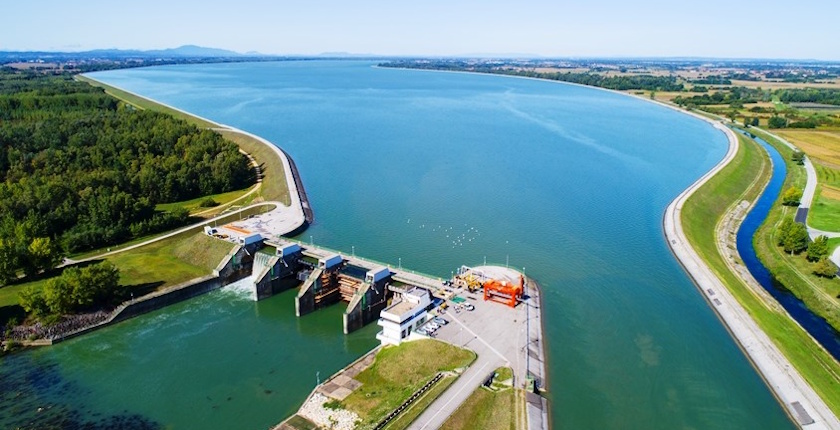
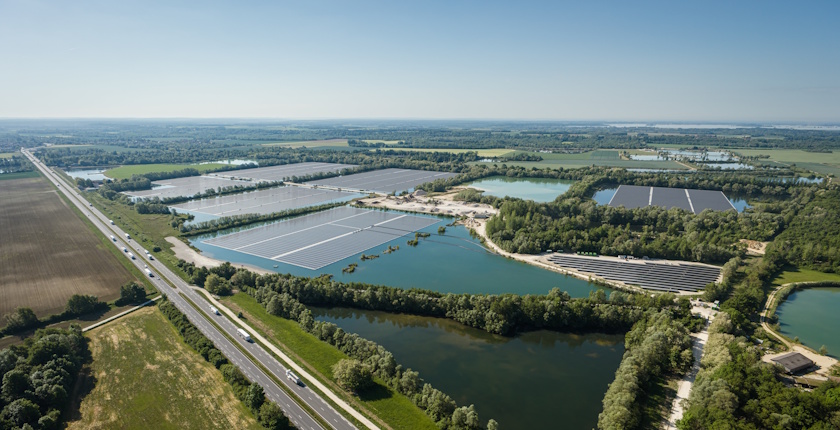
The largest floating solar power plant in Europe, named Les Ilots Blandin, has officially begun operation in France. With a total capacity of 74.3 MW, the facility is located in the Haute-Marne department, on the site of former gravel pits, and is expected to generate enough electricity to supply 37,000 people annually.

In the Haute-Marne department, the largest floating solar plant in Europe was launched by Q Energy and Velto Renewables. Located near the commune of Perthes, the facility features 135,000 solar panels installed on floating platforms.

It sits on basins formed by flooded former gravel pits, closed in 2020 and owned by local company Etablissements Blandin. The newly inaugurated floating solar power plant was named Les Ilots Blandin, which translates as Blandin’s islets.

The solar panels cover 45.5 hectares

The total area spans 127 hectares, and the solar panels cover 45.5 hectares, project manager at French floating solar developer Ciel et Terre, Vincent Pinchou, told pv magazine France. The company was responsible for supplying and installing the floating structures, modules, and inverters.

The power plant has a total peak capacity of 74.3 MW, with 72.3 MW installed on floating platforms and 2 MW on land. The ground-mounted section was strategically integrated to optimize both energy production and the site’s economic performance. The installation consists of six separate platforms, each ranging in capacity from 8 MW to 17 MW.

According to the developers, the plant will generate enough renewable electricity to supply 37,000 people and prevent 18,000 tons of CO₂ emissions per year.

Floating solar plants are more expensive to build and maintain than ground-mounted ones

In northern regions of France, there is significant potential for the development of floating solar technology. However, Corentin Sivy, Development Director of Q Energy, emphasized that one of the main challenges remains economic. Floating solar plants are more expensive to build and maintain than ground-mounted ones. Moreover, France’s Commission de Régulation de l’Énergie (CRE) does not hold separate tenders for floating projects; they must compete directly with ground-based systems.

The project’s financing was secured in September 2024, with more than EUR 50 million provided by Crédit Agricole Transitions & Energies and Bpifrance. In early 2025, Spanish renewable energy company Velto Renewables acquired a 50% stake in the project.

“Velto is accelerating its development in France with a clear objective: to establish a long-term presence in France for several decades. We are here to stay. Our mission is to develop, operate, and support projects over the long term, in harmony with local specificities; this is one of the reasons we are proud of our partnership with Q Energy in France,” CEO of Velto Renewables Lucas de Haro said at the inauguration.
by in News

Hidroelectrica to begin construction of its pilot floating photovoltaic plant

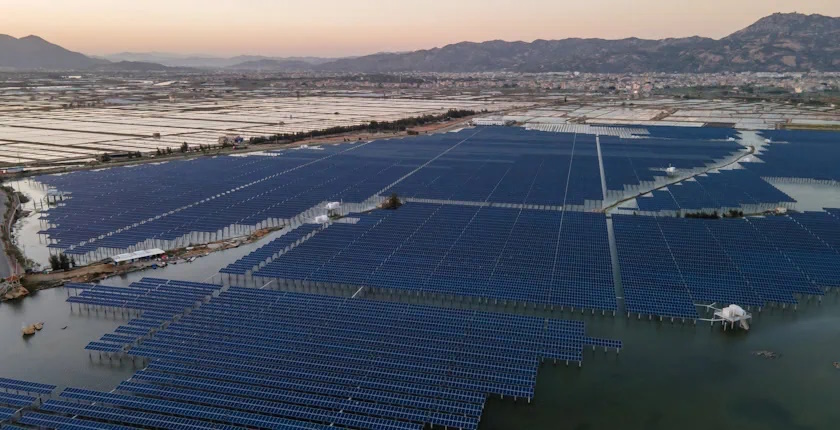
Romanian state-owned hydropower plant operator Hidroelectrica picked the contractor for a 10 MW floating solar power plant, its first, on the reservoir of the Ipotești hydroelectric plant.

Hidroelectrica awarded the contract for the construction of the Proiect Pilot Nufărul floating photovoltaic system.

The pilot project could open the way for the installation of a group of such facilities, also on the Olt river and in a joint venture with Abu Dhabi Future Energy Co. (Masdar).

Pilot floating plant is part of wider push for synergy of photovoltaic technology with hydropower

Notably, Hidroelectrica picked the contractor last month for setting up solar panels on the roofs of its 20 hydroelectric plants. They are on the middle and downstream parts of the Olt river as well.

The site for the 10 MW pilot project is the reservoir of the 57 MW Ipotești hydropower plant. Hidroelectrica conducted the procurement through a tender, which it valued at EUR 9.3 million excluding value-added tax. The utility awarded the deal to Waldevar Energy, which won with a bid of EUR 7.7 million excluding VAT.

The firm’s subcontractors are Marine Research, S.C. DHI-SW Project, and Makor Energy Solutions.

Project implementation is limited to 14 months, of which the works would last ten months.

Hidroelectrica to learn from new investment to replicate it

The floating power plant will consist of bifacial photovoltaic panels of 620 W, inverters of 100 kW, energy optimizers and four transformer stations, the documentation reveals. Annual output is estimated at 13.4 GWh. The floaters would be made of high-density polyethylene (HDPE).

The facility would be connected to the grid via the Ipotești hydropower plant.

Hidroelectrica pointed out that it aims to diversify the production portfolio and capitalize on synergy between solar and hydropower. The state-owned hydropower operator intends to obtain know-how from the construction and exploitation of the pilot system and replicate the concept elsewhere.

The turnkey contract includes design, purchases, assembly, installation, testing and commissioning.

Hidroelectrica operates 188 plants with a capacity of 6.4 GW overall. It has one wind farm, Crucea Nord, of 108 MW.

by in News

Hidroelectrica picks contractor for PV systems on 20 hydropower plants

Romanian state-owned hydropower plant operator Hidroelectrica signed a deal with Servelect and subcontractor Electroplus, which need to install solar panels on the roofs of 20 hydroelectric plants. They are on the middle and downstream parts of the Olt river.

Combining hydropower with photovoltaics including floating solar power plants is becoming popular. The two sources are compatible, especially if there is a dam, as it can save water in reservoirs. The grid infrastructure for PV panels is already there and there are usually no land ownership issues. Hidroelectrica, which mostly operates hydropower plants, is about to solarize its existing facilities.

The Romanian state-owned company pursuing diversification signed an agreement with Servelect and its subcontractor Electroplus. There were four bids in the tender.

First solar power project for Hidroelectrica

Solar power systems will be on the roofs of 20 hydropower units on the middle and downstream sections of the Olt river. Hidroelectrica, listed at the Bucharest Stock Exchange since 2023, turnkey deal, said it aims to optimize production costs. However, it didn’t reveal whether it would operate the colocated assets jointly, as hybrid power plants.

Hidroelectrica is the largest electricity producer in the country, but it will be its first solar power units. The deal, for an overall 2.96 MW, is worth EUR 1.77 million excluding value-added tax. The deadline is 24 months, of which four months for the design.

Servelect, Electroplus responsible for all phases from procurement to commissioning

The utility also tasked the two firms, based in Cluj-Napoca, with manufacturing and procurement, transportation, testing and commissioning. The PV systems would consist of 620 W panels and 100 kW inverters. Hidroelectrica estimated the combined annual output at 3.71 GWh.

The company operates 188 hydropower plants, 6.4 GW overall, and the Crucea Nord wind park of 108 MW. Earlier, Hidroelectrica and Masdar were considering a pilot project, under an upcoming joint venture, for floating solar power plants on seven reservoirs, also on the Olt.

Servelect is active in engineering and energy services. It was founded in 2005. Electroplus, which handles electrical installations, operates since 2001.

by in News

Croatia’s HEP to install first floating PV plant on reservoir of HPP Dubrava

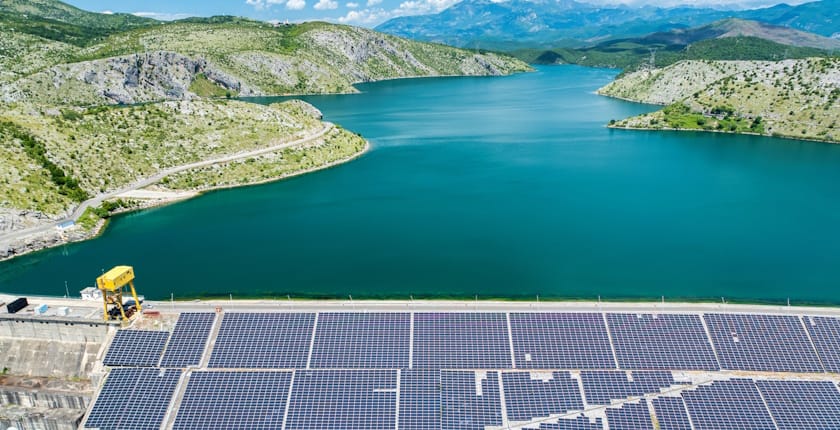
Hrvatska Elektroprivreda is preparing to build its first floating solar power plant, with a capacity of 12 MW. It will be installed on the reservoir of its Dubrava hydropower plant.

State-owned company Hrvatska Elektroprivreda (HEP) has already installed one photovoltaic facility near HPP Dubrava, but it was ground-mounted. The Donja Dubrava PV plant has a capacity of 9.9 MW.

Combining hydro with solar into hybrid power plants is an increasingly popular solution for power companies. HEP is already building a hybrid energy park, the first in the country. It is located near the town of Benkovac.

The floating photovoltaic plant would have a barrier against waves and waste

Back in 2023, the company presented plans to build a floating PV plant as part of HPP Dubrava, on the Drava river. It has a capacity of 79.78 MW, while the average production, which started in 1989, is 350 GWh.

It is located near the town of Prelog, in northern Croatia.

HPP Dubrava is the last on in a cascade three multi-purpose HPPs on the Drava river. In addition to producing electricity, they contribute to water supply, flood and soil erosion protection, irrigation and drainage, and host roads. Now they are set to add solar panels.

HEP has submitted an application to the Ministry of Environmental Protection and Green Transition for the evaluation of the need for an environmental impact assessment (EIA) for its floating solar project.

The facility will be attached to the lake bottom with 62 anchors

It would be installed on a floating platform consisting of a prefab structure, buoys filled with expanding polystyrene foam, and an anchoring structure, the request reads.

The power plant would also have a barrier against waves and floating waste. The floating platform and the barrier are planned to be attached by steel ropes to the bottom of the lake at 62 spots.

The project comprises 19,812 solar panels with a capacity of 615 W, spanning 8.9 hectares. More details on the project can be found in an environmental protection report issued in October 2024 and updated in March by the Hrvoje Požar Energy Institute.

by in News

Turkey’s renewables failing to cover power demand growth despite solar boom

Turkey switched in 2024 from a net electricity importer to net exporter, but renewables are still not growing fast enough to meet rising domestic power demand – one of the highest in the world, Ember found. The country has become Europe’s biggest coal power producer and there are plans for more such capacity.

Wind and solar generated 18% of electricity last year or 62 TWh, according to data from Ember’s Türkiye Electricity Review 2025. Together they were higher than domestic coal again, at 47 TWh, after surpassing it for the first time in 2023. But imports account for 61% of coal power production in the country.

Solar power growth spiked 39% in Turkey or by 7.3 TWh and the capacity reached 19.8 GW by the end of 2024. It compares to the global rise of 29% in output.

Photovoltaics had a 7.5% share, after 5.7% one year earlier. The wind power item advanced by only 0.1 percentage point, to 10.7%.

Government’s ambitions for renewables would result in 49% combined solar, wind power share in production

At 5.5%, Turkey had one of the highest increases in power demand last year in the world, mostly because of record meteorological heat pushing up cooling needs. The amount was 18 TWh and the total reached 342 TWh.

The rise in domestic electricity generation totaled 23 TWh and Turkey achieved a switch from a net power importer to net exporter. Nevertheless, wind and solar are still not growing fast enough to meet rising demand, translating to costly imported fossil fuel power generation, the report points out. The situation is similar on a worldwide scale.

The 7.3 TWh increase in solar accounted for 32% of the jump in electricity generation, compared to 40.2% on a global scale. The ambitious renewables targets for 2035 would result in a share of fossil fuels of 20%, and wind and solar at 49% in combination.

“Although demand growth has slowed in recent years, it is still outpacing the rate of new wind and solar additions. Demand increased by 42 TWh in the last five years, compared to 31 TWh of additional wind and solar. The rest of demand is met by imported coal and gas,” said Ufuk Alparslan, the report’s author and the energy think tank’s regional lead for Turkey and the Caucasus.

‍Romania beats Turkey in solar power production share

In the group of 20 countries with the highest electricity demand in Europe, Turkey surpassed Switzerland in solar electricity generation in 2024. On the other hand, it fell one position behind Romania, which is ranked 12th, as it doubled its solar power share to 7.8% in 2024.

The first in the list is Hungary, with 24.9%, followed by Greece (21.5%) and Spain (21.2%).

Adding solar to hydroelectric plants with dams mitigates drought impact

From 2020, solar power plants can be installed as an auxiliary source in power plants in Turkey, which creates hybrid power plants. Making more use of solar and wind power plants, which have a complementary generation profile to hydroelectricity, will play a key role in ensuring Türkiye’s energy security, the report reads.

Terrestrial and floating solar power plants as secondary sources to existing hydroelectric power plants reduce the risk of a shortfall from hydro in dry years, it added.

Although the amount of incoming water in 2024 was very close to the previous two years, hydroelectric power generation with dams increased by 29%. Total hydropower generation was 75 TWh or 17% more than in 2023 and it was the third-highest result so far.

Turkey is largest coal power producer in Europe

Despite a jump in electricity generation from coal by 3.4% to 122 TWh, its share in electricity mix declined from 36.9% to 35.6%. With coal-fired power generation continuing to decline across Europe, Turkey overtook Germany to become number one. Meanwhile, gas power fell by 4%. It brought the share of fossil fuels in production to 55% — the lowest level since 1993.

There are no coal-fired power plants under construction, but several projects remain. There is a plan to expand the largest facility in the fleet, Afşin Elbistan A (1.36 GW), by two units of an overall 688 MW.

Germany’s coal power output fell 17% to 104 TWh while in Poland, the third in the list, it declined 8% to 91 TWh. As for the share in domestic electricity production, Poland is first, with 53.6%, followed by Czechia (36.5%), Turkey (35.6%), Germany (21.8%), Bulgaria (21.6%), Romania (13%) and Greece, with just 5.7% last year.

As for the Western Balkans, Kosovo* is ranked the highest in the world, now at 92%. Serbia and Bosnia and Herzegovina are fifth and sixth, respectively, both at 63% on a rounded basis.

* This designation is without prejudice to positions onstatus and is in line with UNSCR 1244/99 and the ICJ Opinion on the Kosovo declaration of independence.
by in News

Montenegro labels 15 energy projects as infrastructure priorities

The most valuable priority infrastructure projects in the energy sector of Montenegro are the Komarnica and Kruševo hydropower plants, the Trans-Balkan Electricity Corridor and the Ionian-Adriatic pipeline.

The Government of Montenegro has adopted a list of priority infrastructure projects for the energy sector to fulfill the final criteria of chapter 21 – Trans-European Network, of the country’s negotiations on the accession to the European Union.

The list consists of 15 projects with a total estimated value of around EUR 1.38 billion, according to the announcement.

The EU will use list to consider financial support from the Western Balkans Investment Framework

The list was updated in line with the Western Balkans Investment Framework (WBIF) methodology. In line with priorities defined at the state level, the list is for the European Commission to select projects for financial support from the scheme.

WBIF is the main mechanism for the EU’s financial support in the region in the period from 2024 to 2027, the government noted.

The following projects are on the list:

  • HPP Komarnica – EUR 315 million
  • Ionian-Adriatic Pipeline for natural gas (IAP) – EUR 210 million
  • interconnection Italy – Montenegro – Serbia – Bosnia and Herzegovina (Trans-Balkan Electricity Corridor) – EUR 163 million
  • HPP Kruševo – EUR 160 million
  • energy efficiency in public and residential buildings – EUR 104 million
  • improving the quality of power supply in tourist regions – EUR 78 million
  • creation of conditions for the integration of renewables and the construction of a new power interconnection – EUR 73.6 million
  • solar power project Solari 10,000+ – EUR 66 million
  • Slano floating solar power plant – EUR 60 million
  • Krupac photovoltaic plant – EUR 40 million
  • smart grid and smart metering system for electricity distribution system operator CEDIS – EUR 35 million
  • A8 unit at HPP Perućica – EUR 24 million
  • smart grid program of electricity transmission system operator CGES – EUR 21 million
  • decarbonization – EUR 21 million
  • reconstruction of oil storage tanks – EUR 10 million.

Montenegro also has a list of priority infrastructure projects, including energy. It was introduced in 2018 and updated in the meantime.

Compared to the list from 2021, the Gvozd wind farm and the ecological reconstruction of the Pljevlja thermal power plant were erased, while the following projects were added: HPP Kruševo, Krupac solar power plant, decarbonization and the reconstruction of oil storage tanks.

  • 1
  • 2