by in News

World’s first floating solar power plant with vertical panels comes online

A floating solar power plant with vertically installed panels was commissioned in Germany. Sinn Power, the company that deployed the technology, claims it is the world’s first utility-scale facility of its kind.

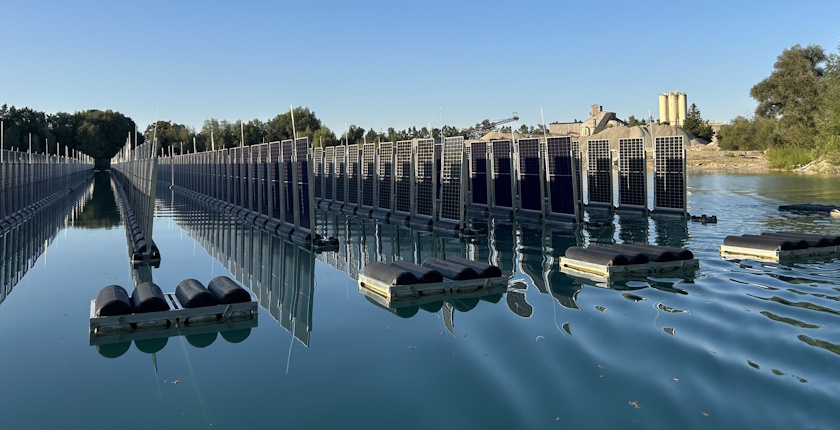
The floating solar power plant featuring vertically mounted panels is situated on artificial lake Jais, created by gravel extraction, in the Starnberg district of Bavaria in southern Germany. With a peak capacity of 1.87 MW, the plant is expected to generate around 2 GWh of electricity annually.

The technology, called SKipp by Sinn Power, is designed for artificial water bodies deeper than 1.6 meters, such as quarry lakes and gravel pits. Floating solar installations on artificial water surfaces are particularly valuable because they provide additional opportunities for solar energy generation without occupying land.

On Jais, arrays of vertical east-west oriented solar panels are separated by at least four meters. The company claims it ensures stable electricity generation throughout the day and increases output during morning and evening hours when conventional solar systems produce less energy.

Each SKipp-Float segment requires only a narrow submerged base, serving as the stabilizing part of the structure. At up to 1.6 meters below the water surface, it ensures a minimal spatial footprint, according to the company’s engineers. The substructure secures the modules and allows controlled movement under wind loads and fluctuating water levels.

Additionally, the plant is connected to the grid via a floating cable and a shore-based feed-in point, enabling smooth energy transfer without disrupting the lake’s ecosystem.

The installation of the floating solar plant has a positive impact on the lake’s ecosystem

The SKipp-Float system was commissioned on August 21 and officially inaugurated last week. Among the speakers at the ceremony was Bavarian Minister-President Markus Söder, who emphasized that the project demonstrates what an innovative energy transition looks like.

“The huge floating solar power plant on the lake generates electricity following the sun’s position. This is an example of Sinn Power’s engineering expertise, perfectly suited to Bavaria – a land of engineers and start-ups, as well as a leader in renewable energy,” said the regional leader, noting that Bavaria contributes 25% to Germany’s overall expansion of new capacity.

During the initial phase of operation, the company managing the gravel pit, Kies- und Quetschwerk Jais, reduced its grid electricity consumption by around 60%, with savings expected to reach up to 70% once production stabilizes, Sinn Power added.

The company said its floating PV plant occupies only 4.65% of the lake’s surface, well below the 15% maximum allowed under the German Federal Water Resources Act. An expansion of 1.7 MW of installed capacity is planned, keeping total lake coverage below 10%.

The company emphasized that the solar power plant has shown no negative ecological impact. On the contrary, the structure itself improves oxygen exchange and allows sunlight to reach deeper water layers, with reports indicating that water quality has improved since commissioning. New waterfowl nests have been observed on the floating sections, while schools of fish gather around the submerged stabilizing part of the platform.

Sinn Power plans to extend its vertical floating solar concept to open sea applications, further advancing renewable energy production at sea.
by in News

Montenegro building two solar plants at hydropower dams

Montenegro’s state power utility, Elektroprivreda Crne Gore (EPCG), is installing a 2.5 MW solar plant at the Slano hydropower dam near Nikšić, while a photovoltaic plant is also being installed at the Vrtac dam. The project marks yet another step towards increasing the share of renewable sources and strengthening Montenegro’s energy independence, said EPCG-Solar gradnja, a subsidiary of EPCG.

The project is implemented by EPCG-Solar gradnja, which specializes in the procurement, design, installation, and maintenance of photovoltaic systems. Both dams belong to hydropower plant Perućica.

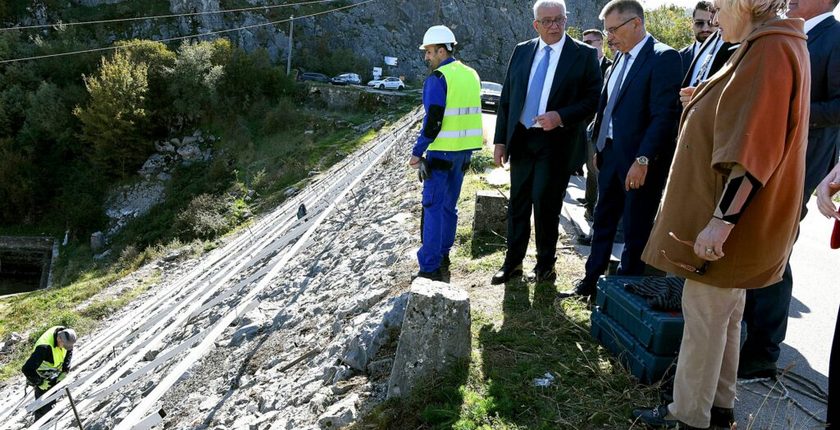
The works at the Slano dam are challenging, as the solar panels are being installed on very steep terrain, according to Marina Jočić, president of the board of EPCG-Solar gradnja. She was speaking during a tour of the site with EPCG management, Speaker of the Parliament of Montenegro Andrija Mandić, and Mayor of Nikšić Marko Kovačević.

The total planned capacity of the Slano and Vrtac solar plants is 3.7 MW

According to earlier announcements, the total installed capacity of the Slano and Vrtac solar power plants will be 3.7 MW. Works on the Vrtac power plant are in the final phase, said Miro Vračar, head of production at EPCG.

EPCG also plans to build the country’s first floating solar power plant at the Slano reservoir. Late last year, the investment valued at EUR 60 million was listed as one of 15 priority infrastructure projects in Montenegro’s energy sector.

EPCG also plans a floating solar plant at the Slano reservoir

Solar power plants on dams are also being built in other countries in the region. In Slovenia, one such facility was put into operation in June, installed on the reservoir wall of the Avče pumped storage hydropower plant.

When it comes to floating solar, North Macedonia plans to integrate such facilities into the national irrigation network.

by in News

Croatia’s HEP to install first floating PV plant on reservoir of HPP Dubrava

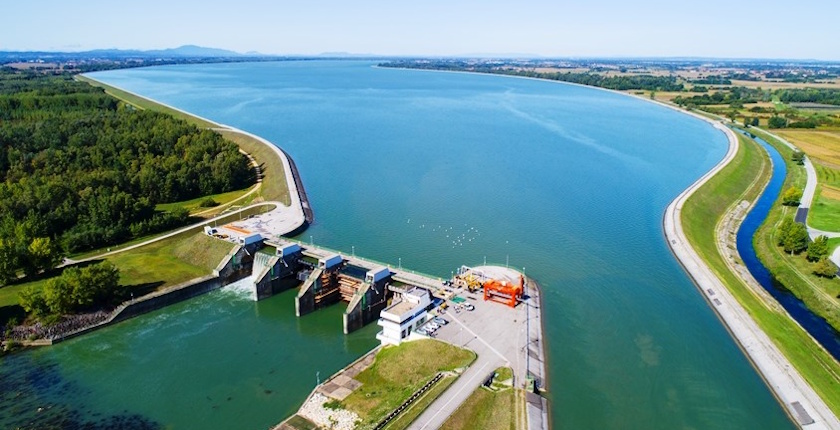
Hrvatska Elektroprivreda is preparing to build its first floating solar power plant, with a capacity of 12 MW. It will be installed on the reservoir of its Dubrava hydropower plant.

State-owned company Hrvatska Elektroprivreda (HEP) has already installed one photovoltaic facility near HPP Dubrava, but it was ground-mounted. The Donja Dubrava PV plant has a capacity of 9.9 MW.

Combining hydro with solar into hybrid power plants is an increasingly popular solution for power companies. HEP is already building a hybrid energy park, the first in the country. It is located near the town of Benkovac.

The floating photovoltaic plant would have a barrier against waves and waste

Back in 2023, the company presented plans to build a floating PV plant as part of HPP Dubrava, on the Drava river. It has a capacity of 79.78 MW, while the average production, which started in 1989, is 350 GWh.

It is located near the town of Prelog, in northern Croatia.

HPP Dubrava is the last on in a cascade three multi-purpose HPPs on the Drava river. In addition to producing electricity, they contribute to water supply, flood and soil erosion protection, irrigation and drainage, and host roads. Now they are set to add solar panels.

HEP has submitted an application to the Ministry of Environmental Protection and Green Transition for the evaluation of the need for an environmental impact assessment (EIA) for its floating solar project.

The facility will be attached to the lake bottom with 62 anchors

It would be installed on a floating platform consisting of a prefab structure, buoys filled with expanding polystyrene foam, and an anchoring structure, the request reads.

The power plant would also have a barrier against waves and floating waste. The floating platform and the barrier are planned to be attached by steel ropes to the bottom of the lake at 62 spots.

The project comprises 19,812 solar panels with a capacity of 615 W, spanning 8.9 hectares. More details on the project can be found in an environmental protection report issued in October 2024 and updated in March by the Hrvoje Požar Energy Institute.