by in News

Albania’s Solar Gold Rush: Who Profits, Who Pays?

As Albania races to become a net exporter of electricity, dozens of vast solar parks have sprouted almost overnight on fertile farmland and pastures, igniting fierce resistance from local communities. In Fier’s village of Boçovë, a normally quiet farming district near the Seman delta, families woke one day to find heavy machinery digging up fields they had tended for generations. “It turned out a photovoltaic park was being built here, and our lands aren’t ours anymore,” complained Nikoll Ndoi, a local schoolteacher. Ndoi and his neighbours say they gained these plots in the early 1990s under Albania’s land-reform law (Law 7501), but were never issued legal titles and now discover the state has quietly expropriated them for solar panels. More than a dozen families in Boçovë are locked in a fight to reclaim their soil from a new small company, “Brevi Construction”, where it is mentioned in the media that it is affiliated with the family of Pëllumb Salillari. Such clashes are multiplying nationwide as the government greenlights hundreds of megawatts of solar capacity, prompting farmers and herders to denounce an “energy revolution” that is trampling their rights and livelihoods.

Residents of the Levan Administrative Unit protested again in the village of Boçova, after work began on their agricultural lands to install photovoltaic panels by the company "Brevi Construction", with administrator Afërdita Salillari.

Residents of the Levan Administrative Unit protested again in the village of Boçova, after work began on their agricultural lands to install photovoltaic panels by the company “Brevi Construction”, with administrator Afërdita Salillari.

The Albanian government, led by Prime Minister Edi Rama, has made a dramatic pivot from its traditional hydropower surplus to a sun‑driven future. Since 2018, the Council of Ministers approved dozens of solar park projects and the energy regulator (ERE) licensed over 70 private solar companies. The planned PVs are a total of nearly 1,000 MW, about 30% of Albania’s installed capacity and none of it is guaranteed for local use. Instead, most is slated for export to Italy and beyond. Ex-director of Energy Policies at Ministry of Infrastructure and Energy  Gjergj Simaku warns this is a “paradox”: Albania could end up exporting clean power while continuing to import fossil‑fuel electricity during winter. Simaku notes that 1 GW projects have no obligation to sell domestically, leaving local grids and consumers sidelined. Notably, Simaku does not address his own role during his long tenure at the Ministry of Infrastructure and Energy, where he was directly involved in shaping and implementing national energy policies. The governance gaps and regulatory weaknesses he now criticizes were also evident during the wave of small hydropower plant licensing over the past decade—a period marked by widespread concessions, limited oversight, and significant social and environmental consequences for local communities. The current tensions surrounding large-scale solar development bear striking similarities to that earlier expansion, raising questions about institutional continuity and accountability in Albania’s energy policymaking.

Municipal Public Assets Leased by Purpose of Use 2015 – 2024 (in hectares)

This policy u‑turn was codified in 2023 when the government amended the renewables law to allow solar farms on any land even vital grazing areas not just barren terrain. Green activists point out that at least half of Albania’s solar license rush is on former public pastures and forests. A recent survey by the All Green Center found many lease auctions were rushed, with no real competition or community input. “Support for green energy must not come at the expense of natural capital,” says environmentalist Ola Mitre. Birding expert Taulant Bino adds that multiple solar projects have been approved piecemeal, ignoring their cumulative impact on biodiversity. In fertile districts like Fier, dozens of solar parks now ring protected river deltas and migratory corridors. Normally one of Europe’s greenest electricity producers (90% hydro), Albania’s renewable expansion is outpacing environmental safeguards.

Locals report no meaningful consultations. In Boçovë, villagers say a developer quietly re‑zoned their family farms (marked on cadastral maps as “arable” or “forest”) into “unused state land” just as construction began. When the community complained to the Cadastre and Agriculture Ministry, nothing was fixed. In Darzezë (nearby Boçovë), elders who believed promised benefits (new roads, lighting) are now “disappointed,” saying “nothing was done, and they even took our water”. The local mayor’s office in Fier readily absolved itself of responsibility: “These projects aren’t licensed by local government,” Fier’s municipal response notes, adding only that it receives property taxes and nothing else. In effect, powerless villagers have found themselves squeezed: the state offers no legal recourse when it simply rents out “public” pastures to private developers.

A protest by residents of the village of Imshte in the Bubullimë unit in Lushnje.

Across the southwest, similar scenes played out. Last month in Imshtë (Lushnjë), about 70 farmers blocked the road to their police station, demanding authorities halt a planned solar park on 100 hectares they have grazed and farmed for 30 years. They accuse a local businessman, Elton Çekrezi, of quietly buying up the plot once officially designated as non‑transferable state land and forming a shell company SunXpower to install PV panels. MP Erion Braçe, who supports the Imshtë community, blasted the episode on social media as a “robbery of public land” by a clandestine “new agha,” warning that his supporters had been threatened during clashes with men bearing weapons. (Çekrezi’s family insists the land was legally bought at auction from former private owners, and they hold cadaster documents dating back to 1945 and 1998.) In Levan (Fier), villagers of Boçovë protested similarly when the company Bervi Construction began clearing fields they had cultivated for “almost 30 years”. Fourteen families, granted plots under the 1990s land law, but their claims were ignored, and now official records abruptly list the land under Brevi’s name. Farmers like Sandër Mujo have even petitioned prosecutors and the anti‑corruption SPAK agency, warning they will resort to self-vendication if the state does not intervene.

In August 2025, around 40 sheep farmers in Çërravë (Pogradec) held a rally after the local council moved to lease their one communal pasture (35.5 ha) to a solar investor. They decried the measure as a “direct violation of our livelihood” and threatened escalating protests if it proceeded. Independent councillor Arbër Male warned that the vote was a foregone conclusion with the beneficiary company “pre‑selected” by insiders. Such frustrations highlight a growing fear: that the clean‑energy drive is being hijacked by politically connected interests at the expense of ordinary Albanians.

A protest in the village of Çërrava, in the municipality of Pogradec

Critics say the evidence of cronyism is hard to dismiss. The Boçovë solar park was nominally awarded to “Albania Solar Power” (a tiny firm with €100,000 capital) owned by businessman Engjëll Agalliu yet locals see it as Pëllumb Salillari’s project in disguise. Likewise, in Imshtë a construction firm once run by Salillari is tied to Çekrezi’s land deal. Journalist investigations have exposed how clusters of permits went to companies tied to a few elite families, often without competitive bidding. (For example, four solar firms controlled by Armand Lilo’s relatives won megawatt‑scale licenses after a brief ministerial review.) The torrent of approvals has largely skipped formal auctions: as energy expert Simaku notes, “auctions have been forgotten; now licenses are given only on the free market, sold to us as if for domestic use but it’s not true”. NGOs also complain that municipalities have merely rubber‑stamped solar leases, lacking clear strategic planning on where solar parks are appropriate. All Green Center warns that so far, zero hectares of new PV forest have a strategic environmental assessment or master plan to guide them.

A protest in the village of Çërrava, in the municipality of Pogradec

Defenders of the solar boom argue Albania urgently needs a new generation after recent blackouts. The government’s National Energy Plan targets 54.4% renewables by 2030, so big solar projects are deemed necessary for “energy sovereignty”. Prime Minister Rama’s infrastructure ministry underscores that thousands of hectares of mostly unproductive land are available for lease; the projects will create green jobs and revenues. Indeed, Albania’s solar push aligns with EU climate goals and avoids new dams (and displacements) for hydropower. Statisticians note that in the past 10 years Albanian municipalities have leased about 6,350 hectares of public land for all purposes, with over a third (2,325 ha) of that just in 2024 mostly for solar parks. In total some 3,750 ha of state land are now contracted for renewable energy projects. Energy Minister Belinda Balluku, who is under investigation by SPAK, insists each plant needed both a Council of Ministers decision and technical approvals and that “everything is lawful, with environmental studies in place,” though she has not publicly addressed the growing protests.

Photovoltaic power plant in Kolonjë, residents in protest

Nevertheless, the ethical question remains stark. Who really benefits from this boom? Many locals answer: not them. Herders point out that solar panels are theoretically compatible with grazing (the technology allows it), yet companies invariably fence off and occupy the land outright. In Kolonjë, villagers say the developer (Turkish firm Fortis Energy & Construction) even redrew cadastral boundaries to claim around 400 hectares of steep pasture and riverbed (“zall”) that herders need for winter grazing. “If they put up panels, our village will have to leave,” one farmer warned, noting the man behind the project quietly acquired neighbouring plots over decades. Such tensions raise hard choices about property rights and the state’s role in declaring some lands sacrosanct for community use or not.

Protest against PV installation by local communities

Protest against PV installation by local communities

For now, many communities are calling for moratoria. Simaku and other analysts urge a strategic pause: map out priority corridors for solar (avoiding protected zones), require genuine public auctions and participatory planning, and bind new plants to domestic needs. Environmentalists warn that Albania’s decades‑old tradition of hydropower should not be cynically traded for a different form of energy dependence. “We risk exporting renewable energy and importing coal,” Simaku says. If that happens, the country may have allowed a green transition to line the pockets of the connected few rather than serve its people’s interests.

In the heated debate over Albania’s clean‑energy path, one thing is clear: expansion of renewables cannot be at the unchecked expense of farming communities. Without transparent governance and respect for local livelihoods, each new solar panel risks deepening rural distrust. Some farmers now speak of taking their case all the way to the European courts. Whether Albania’s solar revolution will shine on as a model of sustainability or become a catalyst for social unrest may hinge on whose voices are heeded in the fields, the villagers who till the earth, or the energy “czars” behind the grid.

by in News

Bankers Petroleum in Albania: Production Halt, Tax Dispute, and Rising Labour Anger Converge

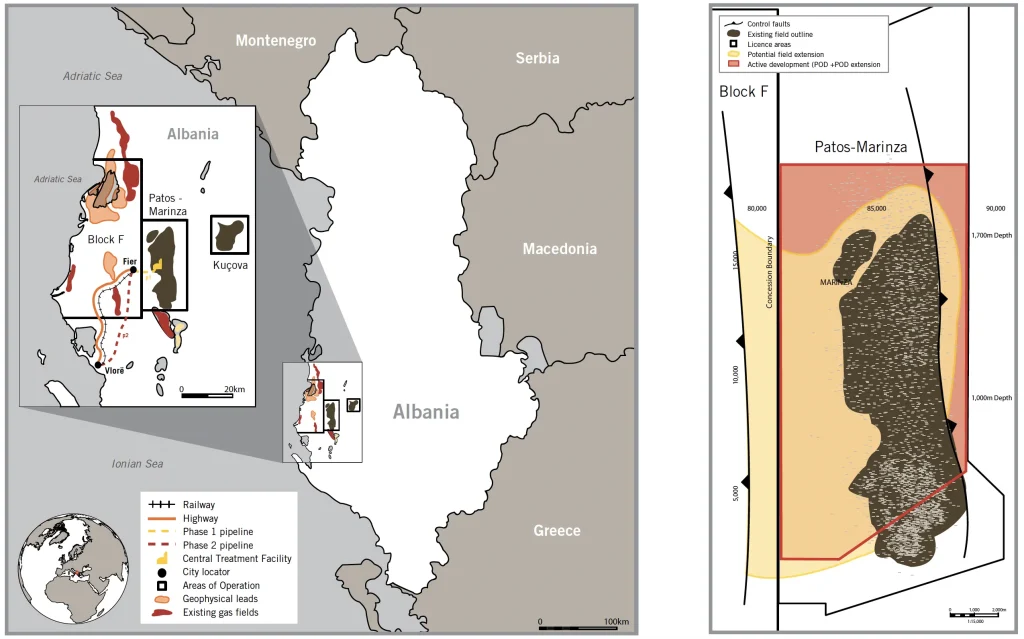
Bankers Petroleum Albania—operator of the Patos-Marinzë oilfield—has been hit by a fast-moving convergence of crises that now threatens both output and stability in one of Albania’s most strategic industrial zones. Within the space of roughly 24 hours, the company’s production activity was effectively frozen by customs authorities, while workers and subcontractors intensified protests over pay and working conditions, raising fears of a wider operational breakdown and renewed political escalation.

Customs blockade stops extraction at Patos-Marinzë

The most immediate shock came from the General Directorate of Customs, which—according to multiple Albanian media reports citing the company—ordered the blocking of Bankers Petroleum’s production and financial activity at the Patos-Marinzë extraction facilities. The stated trigger is an excise-tax dispute tied to the “diluent” used in heavy-oil production: customs authorities argue the company has not paid excise obligations for this input.

Bankers Petroleum

Bankers Petroleum’s response frames the action as arbitrary and procedurally unlawful, arguing that the diluent should not be subject to excise because it is not consumed in Albania and is used as a technical input in extracting and transporting crude that is exported. The company also points to a long-running legal conflict over this same issue, describing it as a matter still in court rather than one that should be enforced via an immediate operational shutdown.

Report TV links the current enforcement move to a much larger historical penalty: a fine totaling €120 million, reportedly assessed in 2019 after a customs investigation concluded Bankers had avoided at least €30 million in excise obligations related to diluent, with a further €90 million calculated as a penalty.

A technical shutdown with high-stakes consequences

Beyond the legal argument, Bankers and sector officials warn the stoppage is not a simple “pause.” Heavy crude at Patos-Marinzë requires continuous handling; once cooling begins, viscosity rises sharply and oil can solidify inside pipelines and storage infrastructure. In the company’s account—also quoted by Gazeta Shqip—Albania’s National Agency of Natural Resources (AKBN) has warned that extraction must run continuously (24/7) to avoid the crude becoming unusable in pipelines and tanks, and that storage constraints can force a full field shutdown with wider safety and environmental risks.

This is a critical point because it redefines the customs decision from a financial enforcement measure into an operational hazard: if the field is shut in abruptly, restarting can be technically difficult, expensive, and in some wells impossible—an argument Bankers uses to portray the blockade as disproportionately damaging to the Albanian state as resource owner, not only to the operator.

Labour unrest: “unpaid November” and a protest that is no longer isolated

While the customs dispute escalated at the institutional level, the social front has also heated up. The protest on 16 December 2025 did not appear in a vacuum. Earlier reporting through 2025 describes repeated mobilisations—demands for wage increases, implementation of collective agreements, improved working conditions, and recognition of oil-worker status. In October, workers were also reported to have entered a hunger strike, urging the state to mediate more actively. Bankers, for its part, previously acknowledged industrial action and union pressure but insisted production had continued normally during the strike period and pointed to planned increases in allowances while rejecting further wage hikes due to “financial pressures,” including oil-price weakness and exchange-rate effects.  The risk is that each pressure point amplifies the other: when workers fear wages are at risk, a state-ordered shutdown looks like confirmation; when the state sees instability, enforcement can harden.

A broader legal cloud hangs over the operator

Layered onto the operational and labour crisis is an expanding legal narrative around Bankers Petroleum’s finances.

Albania’s Prosecutor’s Office in Fier described an investigation alleging Bankers Petroleum Albania Ltd engaged in fraudulent schemes related to VAT, concealment of income, money laundering, and other offenses, with precautionary measures taken against multiple individuals and others declared wanted. The same source release claims the company reported losses consistently from 2004 through 2024, despite large volumes of exports and domestic sales, and alleges damages to the state budget linked particularly to fraudulent VAT claims.

This backdrop matters because it shapes how every new development is interpreted. For critics, the customs blockade and wage protests reinforce a narrative of a politically protected operator now facing overdue accountability. For the company, aggressive enforcement is portrayed as premature, legally questionable, and capable of destroying assets that ultimately belong to the Albanian public.

What is happening now—and what happens next

As of 16 December 2025, the situation around Bankers Petroleum can be summarised as a three-front confrontation:

  1. Institutional enforcement: Customs has moved to block operations over a contested excise obligation tied to diluent, with references in reporting to a much larger unresolved fine dating back to 2019.

  2. Operational risk: AKBN warnings cited in media coverage underline that halting heavy-oil production can cause technical damage and safety risks if the system is not managed carefully.

  3. Workforce instability: Protests and claims of unpaid wages—especially among subcontractors—indicate growing social stress at the field level, with political actors amplifying the message and demanding state intervention.

The immediate next steps are likely to unfold across institutions rather than at the wellhead: pressure on the Ministry of Finance to intervene, continued court and prosecutorial actions, and negotiations (formal or informal) over how the field can be kept safe and technically stable while legal disputes continue. The deeper question—still unresolved—is whether Albania’s largest onshore oil operation can sustain output and social peace while sitting at the intersection of labour conflict, tax enforcement, and criminal investigation.

If the blockade persists, the costs will not be measured only in barrels lost, but also in jobs, contractor liquidity, community safety, and the credibility of the state’s ability to regulate strategically vital assets without triggering destabilising shocks.


Bankers Petroleum Albania — operatori i fushës naftëmbajtëse Patos-Marinzë — është goditur nga një përqendrim krizash me zhvillim të shpejtë, që tashmë kërcënon si prodhimin ashtu edhe stabilitetin në një nga zonat industriale më strategjike të Shqipërisë. Brenda rreth 24 orëve, aktiviteti prodhues i kompanisë u ngrirë praktikisht nga autoritetet doganore, ndërsa punëtorët dhe nënkontraktorët intensifikuan protestat për pagat dhe kushtet e punës, duke rritur frikën për një prishje më të gjerë të operacioneve dhe një përshkallëzim të ri politik.

Bllokada doganore ndal nxjerrjen në Patos-Marinzë

Goditja më e menjëhershme erdhi nga Drejtoria e Përgjithshme e Doganave, e cila — sipas disa raportimeve të mediave shqiptare që citojnë kompaninë — urdhëroi bllokimin e aktivitetit prodhues dhe financiar të Bankers Petroleum në impiantet e nxjerrjes në Patos-Marinzë. Shkaku i deklaruar lidhet me një mosmarrëveshje për akcizën, që ka të bëjë me “diluentin” e përdorur në prodhimin e naftës së rëndë: autoritetet doganore argumentojnë se kompania nuk ka paguar detyrimet e akcizës për këtë input.

Reagimi i Bankers Petroleum e paraqet veprimin si arbitrar dhe procedurialisht të paligjshëm, duke argumentuar se diluenti nuk duhet t’i nënshtrohet akcizës, sepse nuk konsumohet në Shqipëri dhe përdoret si input teknik në nxjerrjen dhe transportin e naftës së papërpunuar që eksportohet. Kompania thekson gjithashtu se ekziston një konflikt ligjor i kahershëm për të njëjtën çështje, duke e përshkruar si një materie ende në gjykatë dhe jo diçka që duhet zbatuar përmes një mbylljeje të menjëhershme të operacioneve.

Report TV e lidh këtë lëvizje aktuale të zbatimit me një penalitet historik shumë më të madh: një gjobë totale prej 120 milionë eurosh, e cila thuhet se është vendosur në vitin 2019, pasi një hetim doganor konkludoi se Bankers kishte shmangur të paktën 30 milionë euro detyrime akcize që lidhen me diluentin, ndërsa 90 milionë euro të tjera u llogaritën si penalitet.

Një ndalim teknik me pasoja të mëdha

Përtej argumentit ligjor, Bankers dhe zyrtarë të sektorit paralajmërojnë se ndalimi nuk është një “pauzë” e thjeshtë. Nafta e rëndë në Patos-Marinzë kërkon trajtim të vazhdueshëm; sapo fillon ftohja, viskoziteti rritet ndjeshëm dhe nafta mund të ngurtësohet brenda tubacioneve dhe infrastrukturës së depozitimit. Sipas përshkrimit të kompanisë — i cituar edhe nga Gazeta Shqip — Agjencia Kombëtare e Burimeve Natyrore (AKBN) ka paralajmëruar se nxjerrja duhet të funksionojë pandërprerë (24/7) për të shmangur bërjen të papërdorshme të naftës në tubacione dhe depozita, si dhe se kufizimet e magazinimit mund të detyrojnë mbyllje të plotë të fushës, me rreziqe më të gjera për sigurinë dhe mjedisin.

Ky është një element kritik, sepse e riformulon vendimin e doganave nga një masë zbatimi financiar në një rrezik operacional: nëse fusha mbyllet papritur, rifillimi mund të jetë teknikisht i vështirë, i kushtueshëm dhe në disa puse i pamundur — një argument që Bankers e përdor për ta paraqitur bllokadën si proporcionalisht dëmtuese edhe për shtetin shqiptar si pronar i burimit, jo vetëm për operatorin.

Pakënaqësia e punës: “nëntor i papaguar” dhe një protestë që s’është më e izoluar

Ndërsa mosmarrëveshja me doganat u përshkallëzua në nivel institucional, edhe fronti social është tensionuar. Protesta e 16 dhjetorit 2025 nuk u shfaq në boshllëk. Raportime më të hershme gjatë vitit 2025 përshkruajnë mobilizime të përsëritura — kërkesa për rritje pagash, zbatim të marrëveshjeve kolektive, përmirësim të kushteve të punës dhe njohje të statusit të punëtorit të naftës. Në tetor, punëtorët raportohet se hynë edhe në grevë urie, duke i kërkuar shtetit të ndërmjetësonte më aktivisht. Bankers, nga ana e vet, më parë e pranoi ekzistencën e veprimeve industriale dhe presionin sindikal, por këmbënguli se prodhimi kishte vijuar normalisht gjatë periudhës së grevave dhe përmendi rritje të planifikuara të dietave/kompensimeve, ndërsa hodhi poshtë rritje të mëtejshme pagash për shkak të “presioneve financiare”, përfshirë dobësinë e çmimeve të naftës dhe efektet e kursit të këmbimit. Rreziku është që secili presion ta amplifikojë tjetrin: kur punëtorët druhen se pagat janë në rrezik, një mbyllje e urdhëruar nga shteti shihet si konfirmim; kur shteti sheh paqëndrueshmëri, zbatimi i masave mund të ashpërsohet.

Një re më e gjerë ligjore mbi operatorin

Mbi krizën operative dhe të punës shtresohet edhe një narrativë ligjore në zgjerim rreth financave të Bankers Petroleum.

Prokuroria e Fierit përshkroi një hetim që pretendon se Bankers Petroleum Albania Ltd është për leaving në skema mashtruese të lidhura me TVSH-në, fshehje të të ardhurave, pastrim parash dhe vepra të tjera penale, me masa sigurie ndaj disa personave dhe të tjerë të shpallur në kërkim. E njëjta deklaratë pretendon se kompania ka raportuar humbje në mënyrë të vazhdueshme nga 2004 deri në 2024, pavarësisht volumeve të mëdha të eksportit dhe shitjeve brenda vendit, dhe ngre pretendime për dëme në buxhetin e shtetit, veçanërisht të lidhura me kërkesa të rreme për rimbursim/kompensim të TVSH-së.

Ky sfond ka rëndësi, sepse formëson mënyrën se si interpretohet çdo zhvillim i ri. Për kritikët, bllokada doganore dhe protestat për paga forcojnë një narrativë se një operator i mbrojtur politikisht po përballet më në fund me llogaridhënie të vonuar. Për kompaninë, zbatimi agresiv paraqitet si i parakohshëm, i diskutueshëm ligjërisht dhe i aftë të shkatërrojë asete që në fund i përkasin publikut shqiptar.

Çfarë po ndodh tani — dhe çfarë mund të ndodhë më pas

Që nga 16 dhjetori 2025, situata rreth Bankers Petroleum mund të përmblidhet si një përballje në tre fronte:

  • Zbatim institucional: Doganat kanë lëvizur për të bllokuar operacionet mbi një detyrim të kontestuar akcize të lidhur me diluentin, me referenca në raportime për një gjobë shumë më të madhe të pazgjidhur që daton nga viti 2019.

  • Rrezik operacional: Paralajmërimet e AKBN-së të cituara në mbulim mediatik nënvizojnë se ndërprerja e prodhimit të naftës së rëndë mund të shkaktojë dëme teknike dhe rreziqe sigurie nëse sistemi nuk menaxhohet me kujdes.

  • Paqëndrueshmëri e fuqisë punëtore: Protestat dhe pretendimet për paga të papaguara — veçanërisht nga nënkontraktorët — tregojnë rritje të stresit social në nivel fushe, me aktorë politikë që e amplifikojnë mesazhin dhe kërkojnë ndërhyrje të shtetit.

Hapat e menjëhershëm ka gjasa të zhvillohen më shumë nëpër institucione sesa te pusi: presion mbi Ministrinë e Financave për të ndërhyrë, vijim i proceseve gjyqësore dhe veprimeve prokuroriale, si dhe negociata (formale ose joformale) për mënyrën se si fusha mund të mbahet e sigurt dhe teknikisht e qëndrueshme ndërsa mosmarrëveshjet ligjore vazhdojnë. Pyetja më e thellë — ende e pazgjidhur — është nëse operacioni më i madh tokësor i naftës në Shqipëri mund të ruajë prodhimin dhe paqen sociale, teksa gjendet në kryqëzimin e konfliktit të punës, zbatimit tatimor dhe hetimit penal.

Nëse bllokada vazhdon, kostot nuk do të maten vetëm me fuçi të humbura, por edhe me vende pune, likuiditet të kontraktorëve, siguri komunitare dhe me besueshmërinë e aftësisë së shtetit për të rregulluar asete strategjikisht jetike pa shkaktuar tronditje destabilizuese.

by in News

Fier and Lushnja, the main destination for photovoltaic parks in Albania

The Ministry of Infrastructure and Energy in Albania has announced on Monday that it has received 10 new expressions of interest for the construction of photovoltaic parks in the country.

The requirements of various companies for the construction of these plants have been numerous throughout the summer after the approval of tariffs that the government will apply. The price of 100 euros per MWh for the purchase of electricity and various support schemes has caused many to run after the renewable resources.

Although so far, all requests have come for solar photovoltaic plants and none for the Wind Farm plants.

Fier and Lushnja areas have also received the most numerous applications, 5 only in the latest announcement, but added dozens of other requests since August. Along with the high level of solar irradiance supply throughout the year, and good flat terrain is a factor that has caused Myzeqeja Region to emerge in the demands of private investors.

In the Darëzezë area in Fier region, company SOLAR RENEWABLE ENERGY seeks to utilize 3.6 hectares of land to install a 2MW plant. The value of the investment amounts to 1.7 million euros.

Even in Seman Fier region, the company “3AD Energy” wants to use 2.34 hectares to set up a 1.75 MW photovoltaic park. The investment here amounts to 2.3 million euros.

In Lushnja region, “Plug” area, a temporary joint venture of three companies seeks to invest 3.9 million euros. This joint venture has asked the MEI to use a 10-hectare surface to install a 5MW power plant.

Again in Lushnja region, the temporary association of companies “FAVINA 1” SH.A. and “ARTYKA 2” SH.PK, has expressed the interest to build a 2MW photovoltaic park. The investment in the region thus adds an additional value of 2 million euros.

The company “Favina” wants to invest 2 million euros in Fier, to set up an 8 hectare plant of 2 MW.

Again  the company “Favina 1” wants to repeat the same investment in the Korca region. In Korça, a similar investment is required by the companies “HIDROCENTRALI QARR & KALTANJ”, as well as “REJ” sh.a.

In Pilur of Himara region, the company “Max Energy” wants to utilize 3 hectares of land to install a 2 MW photovoltaic park. This investment will reach the value of about 1.92 million euros.

In Durres, Solar – Expert Society wants to utilize 2.5 acres of land to set up a 1.98 MW plant with an investment value of 2.7 million euros.

The Solarium Society wants to build a 1.99 MW photovoltaic park in Vora near Tirana, utilizing 2.53 hectares of land. Here, too, the investment amounts to 2.7 million euros.

The total investment for this block of interest expressions published by the Ministry reaches 23.2 million euros and will increase the country’s power capacity by 22.7 MWh.