by in News

Bislimoski urges ESM to pivot toward market procurement of electricity

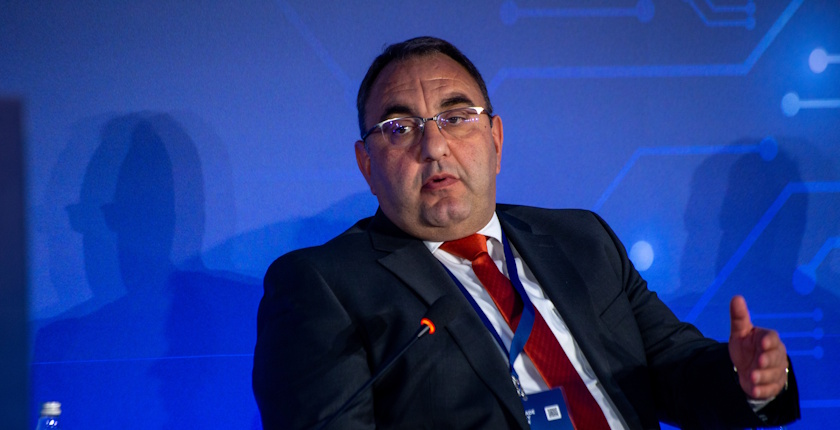
State-owned power utility Elektrani na Severna Makedonija should make the most of the opportunities when prices on the power market are lower than its production costs, according to Marko Bislimoski, President of the Energy, Water Services and Municipal Waste Management Services Regulatory Commission of the Republic of North Macedonia (ERC or RKE).

​Marko Bislimoski doesn’t see the future of Elektrani na Severna Makedonija (ESM) only in production. He expressed the belief it should also be much more active in the wholesale and retail markets.

The mindset that ESM should only produce power should be abandoned, in his view.

In times when the price of electricity in the domestic and regional market is lower than its production price, it is much more logical for the company to buy it on the market, Bislimoski underlined.

This is going to reduce costs, he added.

ESM should purchase electricity when prices are lower than its costs as well as when the level is below the one at which it sells the energy to universal supplier EVN Home, Bislimoski pointed out. The firm is responsible for all households, among other categories.

North Macedonia’s solar power capacity has reached 1,200 MW

He recalled that solar power plants with a total capacity of 1,200 MW are installed in the country.

Their owners sell electricity on the market to other suppliers and traders, who then resell it to consumers.

If ESM offers them a fair price, it would have a stable and predictable cost structure in terms of purchasing and producing electricity, Bislimoski pointed out.

He noted that ESM imports coal and mixes it with domestic coal, which has caused an increase in its power production costs. In Bislimoski’s view the company can offer a fair price over a longer period, five to 10 years.

Solar power would save water in hydropower plant reservoirs and coal for thermal power plants

It would enable, especially in the summer and spring months, the purchase of electricity from domestic photovoltaic plants at a price that should be lower than EUR 65 per MWh, avoiding losses, according to Bislimoski.

Of note, the company has offered to supply electricity to EVN Home at a rate of EUR 65 per MWh for 2026.

Purchasing electricity from photovoltaic plants would allow saving water in hydropower plant reservoirs, and only one unit in the REK Bitola coal power would be required to work during some daily hours, Bislimoski concluded.
by in News

Third Regional Power Sector Exchange in Ohrid: Power grids at core of energy transition

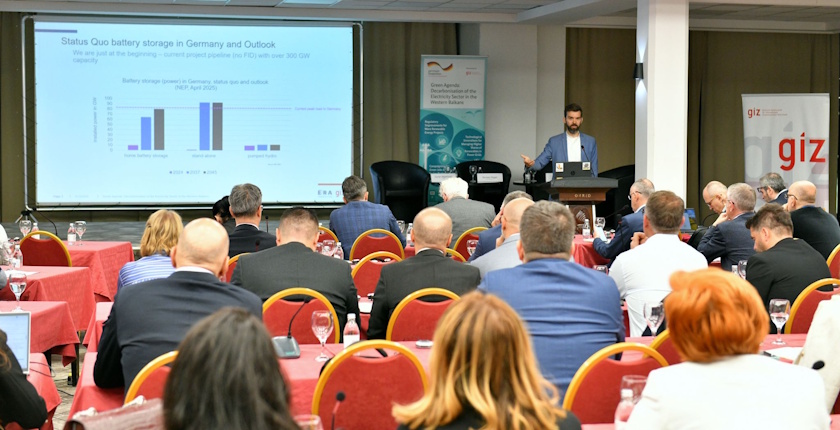
The third Regional Power Sector Exchange of the Western Balkans in Ohrid in North Macedonia gathered over 80 energy professionals from the region to discuss the future of electricity decarbonization and the urgent need to modernize power infrastructure.

Organised under the framework of the Regional Climate Partnership between Germany and the Western Balkans, the conference brought together representatives of transmission and distribution system operators, energy regulators, and energy ministries to accelerate coordinated action toward a greener, more resilient power system.

“No grids, no glory. This slogan captures the challenge in front of us. Without investment in power grids, adaptable regulation, and skilled professionals, the renewable energy transition cannot succeed,” Project Manager at GIZ Nicolas Heger said in his welcoming remarks.

Oberhuber: The Western Balkans have the potential to become a major exporter of clean electricity

Opening addresses were delivered by David Oberhuber, GIZ Country Director in North Macedonia, Anca-Iulia Cimpeanu, European Commission (DG ENER), and Davor Bajs, Energy Community Secretariat.

In his keynote speech, Oberhuber stressed the region’s strategic importance in the Regional Climate Partnership.

The Western Balkans has the potential to become a major exporter of clean electricity to Western Europe and a hub for investment and innovation in renewable energy, he said.

North Macedonia is advancing its energy transition by expanding renewables – solar power capacity reached 506 MW in 2023 – and reducing coal dependency, although thermal power plants still accounted for 47.3% of total electricity production in early 2024.

In 2023, renewables made up 33.15% of electricity generation, with households, transport, and industry as the top energy consumers.

To accelerate the shift, tailored support projects were launched. The Energy, Water Services and Municipal Waste Management Services Regulatory Commission is tackling the surge in renewables applications. Distribution system operator (DSO) EVN is focusing on smart grids and energy quality, and transmission system operator (TSO) MEPSO is exploring options to reduce balancing costs through regional market mechanisms.

Six tailored support projects presented

The event included three sessions on tailored support projects.

Professor Nermin Suljanović presented the project Concept on Data Exchange Between System Operators in Bosnia and Herzegovina.

The data platform enables automatic data exchange among all actors in the electricity market in Bosnia and Herzegovina, ensuring data interoperability and harmonized communication interfaces, according to Suljanović.

He also outlined the project Technical Specification and Requirements for Integration of Renewables into DSO Telecommunication Network.

E-mobility is not only related to energy but also to transportation, telecommunication, data security

A project titled Procedure for Handling RES Connection Requests to the Grid – Queue Management was presented by expert Miltos Aslanoglou, and the Roadmap for Creating a Legal and Regulatory Framework for EV Charging by expert Dejan Stojadinović.

“EU legislation on this matter is a good base for the Western Balkan countries to prepare relevant legal and regulatory frameworks. E-mobility is not only related to energy but also to transportation, telecommunication, data security, and other issues,” Stojadinović said.

Goran Majstrović, Deputy Director and Head of the Energy Transmission and Distribution Department at Energy Institute Hrvoje Požar (EIHP), gave an insight into the project Feasibility Analysis and Funding Assessment for using Dynamic Line Rating (DLR) on the Kosovo* Transmission Grid.

Simplification of Procedures for Prosumer Connection to the Distribution Network in the Federation of BiH was the name of the project introduced by expert Goran Dobrić.

The need for regionally integrated networks has never been greater

Blackouts in both Southern and Southeastern Europe have highlighted vulnerabilities in grid infrastructure amidst growing shares of renewable energy. The need for modern, flexible, and regionally integrated networks has never been greater.

The event was part of a wider regional project implemented by GIZ on behalf of the German government, supporting the integration of renewables and enhancing energy security across the WB6.

In just two years, the project has supported over 30 institutions, trained more than 135 energy professionals, and facilitated the development of the Action Plan for Power Grids in the Western Balkans, in cooperation with the Energy Community Secretariat.

Network redesigns are lagging behind renewables by seven to ten years

Goran Majstrović from Energy Institute Hrvoje Požar presented the Action Plan for Power Grids in the Western Balkans.

“The path to integration of renewables is not just replacing power plants but redesigning the entire system to accommodate them. Network redesigns are lagging behind renewables by seven to ten years,” he asserted.

In the plan, the required grid investments by 2030 in the six countries of the Western Balkans (WB6) are estimated at EUR 10 billion to EUR 14 billion. Investments in primary equipment are seen at EUR 6 billion to EUR 8 billion. As for secondary equipment (digitalization), the forecasted tally is EUR 4 billion to EUR 6 billion.

Phase 2 of the project Green Agenda: Decarbonisation of the Electricity Sector in the Western Balkans is scheduled for completion in 2028. The Regional Power Sector Exchange will remain a key platform for cooperation, helping ensure the energy transition in the region is just and inclusive.

* This designation is without prejudice to positions onstatus and is in line with UNSCR 1244/99 and the ICJ Opinion on the Kosovo declaration of independence.