by in News

Bulgaria to add batteries of up to 10,000 MWh in capacity within months – ESO

Bulgaria’s Electricity System Operator has received applications for the connection of batteries with 12 GW in total capability, according to the transmission system operator’s Executive Director Angelin Tsachev.

Bulgaria currently has 500 MW in battery energy storage systems (BESS), with a capacity of 1,300 MWh. The facilities are in private ownership.

Angelin Tsachev told Bulgarian National Radio that the Electricity System Operator (ESO) received applications for about 12,000 MW, with a capacity of 35,000 MWh.

The TSO’s technical council has considered each grid connection request. The operator issued its opinions on the possibilities for enabling network access to the batteries when the conditions are met, Tsachev pointed out.

BESS can now cover about 1.5% of the country’s daily consumption

BESS can now cover about 1.5% of the country’s daily consumption, he revealed. However, in the coming months, batteries with a combined capacity of 7,000 MWh to 10,000 MWh are expected to be installed, the official added. They would be a serious factor, Tsachev stressed.

No state-owned or private conventional power plants are currently equipped with energy storage systems, he asserted.

After the balancing methodology was changed, commercial developers of projects for intermittent power plants became more disciplined, and now there are no concerns about the balancing of the system, Tsachev said. Electricity exports in the first seven months of this year were higher than in the same period of 2024. Net exports reached almost 230,000 MWh, Tsachev noted.

Good investment opportunity

According to an earlier analysis by Rystad Energy, the best potential profits in battery storage in Europe in 2013 were in Greece and Bulgaria. The country’s city of Lovech, northeast of Sofia, hosts the strongest BESS in the Balkans.

The Ministry of Energy of Bulgaria is reportedly working on a public call for EUR 120 million in state aid for investments in battery energy storage systems of 1.5 GWh overall. In April, it granted EUR 587 million to 82 battery storage projects.

The pace of large photovoltaic projects in Bulgaria indicates that total capacity can reach 6 GW by the middle of next year.

However, the Association for Production, Storage and Trading of Electricity (APSTE) warned that the government’s disproportionately high fees for solar panels and energy storage batteries are preventing the possibility of having permanently low electricity prices in Bulgaria.

by in News

Romanian bourse BRM joins power auctions within European Single Intraday Coupling

The Romanian Commodities Exchange – Bursa Română de Mărfuri (BRM), the country’s second nominated electricity market operator (NEMO), has joined intraday auctions (IDAs) under the European Single Intraday Coupling (SIDC) framework. With this move, BRM becomes part of the operational IDA system, launched across Europe in June 2024, according to a press release from European power exchange EPEX Spot.

Other partners involved in the Regional Integration Project (RIP) are the Hungarian Power Exchange (HUPX), the Independent Bulgarian Energy Exchange (IBEX), the Romanian Electricity and Gas Market Operator (OPCOM), Bulgaria’s Electricity System Operator (ESO), Hungary’s Independent Transmission Operator Company (MAVIR), and Romanian transmission system operator Transelectrica, said EPEX Spot.

BRM’s integration marks the second wave of the European IDA rollout, which began on June 13, 2024, when NEMOs and transmission system operators (TSOs) introduced the pricing of intraday cross-zonal capacity through three pan-European auctions, it added.

It is another key milestone in enhancing Europe’s single power market

By integrating BRM, the SIDC framework has reached another important milestone, increasing the efficiency of the single European electricity market, EPEX Spot said. The market has become more liquid and increasingly competitive, in line with its core objectives of ensuring efficient, fair, and non-discriminatory functioning.

Future waves of the IDA rollout will expand its geographic scope

The European power exchange added that future waves of the IDA rollout would continue to expand its geographic coverage and product scope, further enhancing the EU’s internal electricity market.

The SIDC is a market mechanism within the intraday timeframe based on continuous trading and complemented by three intraday auctions, or IDAs. It enables market participants to trade electricity continuously across Europe on the day it is needed. Additionally, IDAs enable pricing cross-border capacity within the intraday timeframe, according to the press release.

by in News

Solar power exceeds Bulgaria’s entire electricity demand for first time

For the first time, photovoltaic production alone surpassed power consumption in Bulgaria – for two hours. Interestingly, even more electricity was exported at the same time.

On Friday, June 20, the active photovoltaic capacity in Bulgaria between 10:00 and 11:00 before noon was 2,935 MW, and in the following hour it grew to 3,230 MW, state news agency BTA reported. According to data from the Electricity System Operator (ESO) and the European Network of Transmission System Operators for Electricity (ENTSO-E), it exceeded the country’s entire consumption for the first time ever, by 17 MW and 313 MW, respectively.

Even more electricity was exported at the same time, as total domestic production amounted to 6,567 MW and 6,736 MW.

Of note, not all solar power went to Bulgarian consumers, given that some traders and customers have long-term contracts with other suppliers, like the National Electricity Co. (NEK) and nuclear power plant Kozloduy, the article adds.

“This is a significant event and a great success for Bulgaria and the Bulgarian energy sector. Positioning us this way – as a leading country in the production of photovoltaic energy – not only supports the implementation and fulfillment of the commitments that Bulgaria has made for decarbonization, but it also has a positive effect on the country’s investment climate. Thanks to the solar energy that we transform into electricity, we are modernizing the entire Bulgarian energy sector,” Chairwoman of the Bulgarian Photovoltaic Association Meglena Rusenova commented.

Photovoltaics are perhaps the fastest-growing private investment sector in Bulgaria, she said.

Photovoltaics are biggest factor lowering prices at the electricity exchange

Over the past two years, over EUR 2 billion have been invested in electricity production, according to Rusenova. On top of that there are capital investments in energy storage and infrastructure, she pointed out.

Solar energy contributes to reducing prices for end users, and in practice, photovoltaics are the most significant factor for lower prices on the Independent Bulgarian Energy Exchange (IBEX), Rusenova underscored.

According to ESO, a total of 3.5 GW of photovoltaic capacity has been connected in the last three years, bringing the total to 4.7 GW.

by in News

Low consumption causes grid failure, power outage in North Macedonia

A grid failure caused a brief power outage in North Macedonia in the early hours on Sunday, May 18. Disruptions at the affected 400/110 kV transformer stations were triggered by high voltage levels in the grid, caused by low consumption, typical for nighttime hours and weekends at this time of year, according to a statement by the country’s transmission system operator, MEPSO.

MEPSO said its teams restored normal electricity supply in about an hour and were working to fully normalize the stability of the power system.

According to the update, grid instability caused by low consumption at nighttime and on weekends is a problem shared by almost all transmission system operators in the region and around Europe.

Bulgaria’s energy minister: Bulgaria played the crucial role in stabilizing North Macedonia’s grid

At the same time, Bulgarian Minister of Energy Zhecho Stankov said that a grid failure had affected several countries in Southeast Europe, though not Bulgaria. He added that his country’s balancing facilities were crucial in stabilizing North Macedonia’s grid, restoring supply, and preventing the crisis from spreading further. In Bulgaria, the Electricity System Operator (ESO) is responsible for the transmission network.

He claimed Serbia and Croatia have also experienced problems due to a lack of balancing facilities. “The colleagues from Serbia also had certain difficulties in the morning hours, and we managed to balance them out,” Stankov stated.

EMS has denied that any disruptions or outages occurred in Serbia

However, Serbia’s transmission system operator Elektromreža Srbije (EMS) told Balkan Green Energy news that the country’s grid did not experience any disruptions or outages and that there was no need for assistance from Bulgaria. EMS said it would not specifically comment on the Bulgarian minister’s statement because it was unclear what it was referring to.

In its reply to Balkan Green Energy News, EMS underscores that there were no consequences for the transmission system of the Republic of Serbia, explaining that EMS, at the request of MEPSO, to facilitate the repairs in North Macedonia, temporarily shut down the 400 kV transmission line between the Vranje 4 transformer station and the North Macedonian border.

Renewables had no share in the problem, according to Stankov

Stankov also stressed that solar power plants did not play a role in the crisis, unlike in Portugal and Spain in late April. The grid failure occurred in the early morning hours and amid low renewable energy generation, he said, adding that “renewable energy had no share in the problem.”

Bulgaria plans to build three new pumped storage hydropower plants

Bulgaria’s system remained stable thanks to its generating and balancing capacities, in Stankov’s view. He told the press that the country possesses 90% of all the reactive energy compensation capabilities in Southeast Europe.

Bulgaria is working with the European Investment Bank (EIB) to build at least three pumped storage hydropower plants in the Rhodope region, aimed at further enhancing regional grid resilience, Stankov pointed out. The minister vowed to keep the country’s grid on standby to support other regional networks in need of stabilization.

Stankov revealed that one such project is being developed for the Vacha dam. The other two pumped storage hydropower plants are planned to be built on the Dospat and Batak dams.

by in News

Greece’s IPTO connects to balancing energy platform PICASSO

The Independent Power Transmission Operator of Greece announced that it connected to PICASSO. It is the second transmission system operator or TSO in Southeastern Europe that joined the European platform, so now it can exchange balancing energy with its counterpart in Bulgaria. In addition, IPTO (or Admie, in Greek) has proposed the introduction of negative prices in the domestic balancing market.

The Platform for the International Coordination of Automated Frequency Restoration and Stable System Operation (PICASSO) optimizes balancing energy between control blocks in the Continental Europe synchronous area. Bulgaria’s Electricity System Operator (ESO) joined last month, but it was isolated as it didn’t share electrical borders with any other operational member. Neighboring Greece’s transmission system operator IPTO (or, in Greek, Admie), has just connected to the platform, so the two countries can now exchange balancing energy.

Denmark, Germany, Belgium, the Netherlands, Czech Republic, Slovakia, Austria and Italy are a geographically separate group within PICASSO. Lithuania’s Litgrid joined earlier this month.

Key step for common European energy market

By becoming the 14th operational member, IPTO made a key step in the process of formation of a resilient and efficient common European energy market, the statement adds. The PICASSO methodology and algorithm are intended primarily for the cross-border provision of secondary reserve so that the electricity grid’s operating frequency remains stable.

There are 29 TSOs from the European Network of Transmission System Operators for Electricity – ENTSO-E in the project. Additionally, North Macedonia’s MEPSO, which has electrical borders with both Bulgaria and Greece, is an observer in PICASSO. The platform doesn’t include the rest of the Western Balkans.

With the latest achievement, IPTO and ESO can jointly benefit from the automatic frequency restoration reserve (aFRR). Romania has been delaying its connection to PICASSO.

The platform collects and rates all available offers for balancing energy from aFRR according to their prices, placing them into a common merit order list – CMOL.

PICASSO helping reduce number of balancing price spike events

The new method for calculating cross-border marginal prices on PICASSO has greatly improved performance as the number of instances of electricity balancing price spikes dropped, according to European Union Agency for the Cooperation of Energy Regulators (ACER). Integrating balancing markets across borders lowers costs and improves efficiency by allowing TSOs to activate cheaper balancing energy bids, the body explained.

In other relevant news, IPTO has proposed the introduction of negative prices in the balancing market in Greece of EUR 50 per MWh at most for one year, Energypress reported. The change would enter into force on allocation day April 10, ahead of Easter, a critical moment for grid stability.

The TSO said the limit should be boosted to EUR 15,000 per MWh after joining PICASSO.

by in News

Bulgaria aims to make Europe’s biggest energy community

The Ministry of Energy, Electricity System Operator (ESO) and the Bulgarian Development Bank (BDB) are launching a solar power program for municipalities, schools, kindergartens, hospitals and small businesses. There are no upfront costs and the installations become the beneficiary’s ownership within eight years.

Minister Zhecho Stankov said the goal is to create the largest energy community in Europe and hinted that the government would finance the scheme with a green bond. He also declared the start of the regional Vertical Gas Corridor project in Bulgaria as the first pipes were delivered.

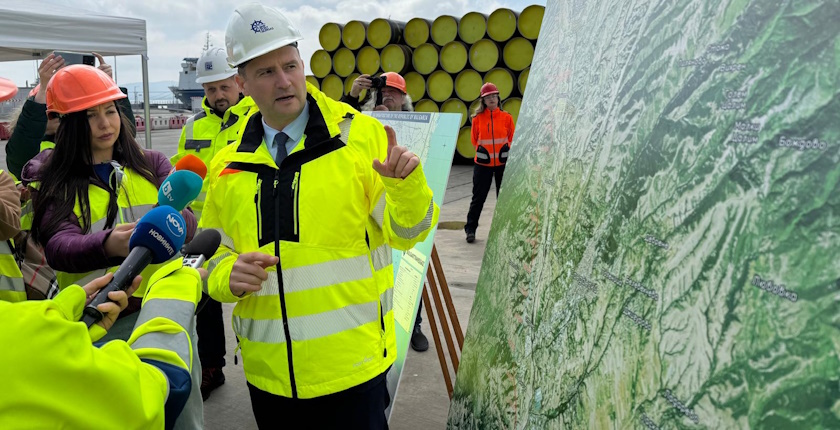
Every school and hospital in Bulgaria can become an electricity producer, Minister of Energy Zhecho Stankov stressed as he presented a financial support mechanism designed with the ambition to create the largest energy community in Europe. The model will benefit both the public sector and private business, he pointed out in the port city of Burgas at a ceremony marking the arrival of the first 4,000 pipes for the Bulgarian sections of the regional Vertical Gas Corridor.

The joint initiative with the country’s power transmission system operator ESO and the Bulgarian Development Bank is for the installation of solar panels with no upfront costs. Beneficiaries – municipalities, schools, kindergartens, hospitals and small businesses – would pay through energy savings and become owners in six to eight years, Stankov claimed.

Bulgaria mulls issuing green bond to finance sustainable energy

The minister also said the project could lead to the government’s first green bond to finance clean and locally produced energy available to a wide range of consumers.

For example, Burgas Municipality can equip all schools, hospitals, kindergartens and other facilities with photovoltaic panels without spending a penny from the local budget, Stankov explained.

Government to invest EUR 57 million in Vertical Gas Corridor

The Vertical Gas Corridor is envisaged to connect Greece, Bulgaria, Romania, Moldova and Ukraine. They plan to transport the fuel from liquefied natural gas (LNG) terminals Alexandroupolis and Revithoussa in Greece, and from the Caspian region, via the Southern Gas Corridor.

The government is fully funding the first stage of the project on Bulgarian territory, with EUR 57 million. The pipes for the pipelines came from India.

Stankov: Bulgaria will never again be left without natural gas

“Bulgaria will never again be left without natural gas,” said Minister Stankov. The capacity of the line between Kulata, on the border with Greece, and Kresna will be increased to 3.6 billion cubic meters per year from 2.3 billion, he added. The distance is 48.5 kilometers.

The most difficult part is between Mikrevo and Ribnik, where three kilometers will be built by horizontal drilling, the minister revealed. He explained there would be no aboveground work, so that nature and infrastructure wouldn’t be affected.

Another section, 80 kilometers, is from Rupcha to Vetrino. The purpose of the investment is to double the maximum annual flow toward Romania to 10 billion cubic meters, Stankov stressed. The last one, Tarnik-Piperovo, is 51 kilometers long.

The compressors on the corridor are reversible, allowing gas supply in both directions, the minister noted.