by in News

Kosovo* becomes full member of Association of Issuing Bodies

Kosovo* joined the Association of Issuing Bodies (AIB) as a full member at the last meeting of the organization’s general assembly. However, the Western Balkans and other Energy Community contracting parties require full alignment with the European Union’s regulations to enable cross-border trading in renewable electricity.

The Energy Regulatory Office (ERO or ZRrE) of Kosovo* said its request to become a full member of the Association of Issuing Bodies (AIB) has been approved. It is now part of the European platform for guarantees of origin, the update reads.

It increases the transparency and credibility of renewable energy certification, enabling more efficient cross-border trade and paving the way for new investments in the renewable energy sector, ERO pointed out. The membership also confirms Kosovo’s* commitment to the energy transition path and harmonization with the European Union’s acquis communautaire, according to the announcement.

ERO added that AIB approved the application at the latest meeting of its general assembly, in Lisbon, Portugal. By joining the organization, Kosovo* has adopted its European Energy Certificate System (EECS), ensuring that guarantees of origin issued in Kosovo* are recognized throughout Europe, the regulatory body stressed.

LuxDev assisted ERO in AIB bid

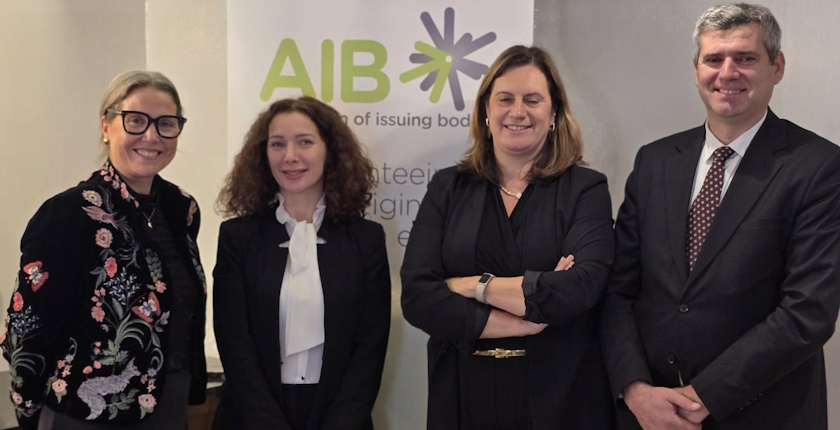
Chair of ERO’s Board Ymer Fejzullahu and Lindita Daija from LuxDev Kosovo, a branch of the Luxembourg Development Cooperation Agency, attended the event. The membership strengthens institutional capacities, increases transparency in renewable energy certification and positions Kosovo* as a reliable partner in the European energy market, Fejzullahu asserted. LuxDev supported the initiative.

In other news from Southeastern Europe, the National Energy Regulatory Authority (ANRE) of Romania obtained the status of an observer in AIB, both in the electricity and gas schemes. Albania and Bulgaria became members and applied to join the electricity scheme group last year, after which North Macedonia became an observer in the electricity segment.

Mutual recognition of GOs with EU possible in 2026

One guarantee of origin or GO certifies that 1 MWh was generated from renewable sources. Nearly all issuing bodies in the Western Balkans have established national electronic registries for issuing GOs.

However, cross-border trade in renewable energy will be enabled only when they become fully aligned with EU legislation and requirements.

Energy Community Secretariat Director Artur Lorkowski recently said in an interview with Balkan Green Energy News that he hoped for a decision on mutual recognition of GOs next year.
* This designation is without prejudice to positions onstatus and is in line with UNSCR 1244/99 and the ICJ Opinion on the Kosovo declaration of independence.
by in News

Kosovo* power distributor KEDS cuts off businesses without supplier after market liberalization

Kosovo’s distribution system operator, KEDS, has disconnected around 90% of electricity meters belonging to businesses that have not signed an agreement with a licensed supplier following the power market liberalization. KEDS, owned by Turkish companies Çalik Holding and Limak, claims the law prohibits it from keeping any consumers on the grid who do not have a licensed supplier, while the Kosovo Chamber of Commerce says it will press ahead with a legal battle.

KEDS’ spokesperson, Lulzim Krasniqi, stated that as of August 16, around 90% of some 1,400 designated business electricity meters had been disconnected from the grid, while the remaining companies would be cut off in the coming days unless they reached an agreement with a supplier, the media in Kosovo* reported.

KEDS has disconnected over 1,400 electric meters at firms without a licensed supplier

The move comes after the appeals chamber of the Commercial Court ruled against postponing electricity market liberalization for businesses with more than 50 employees and an annual turnover exceeding EUR 10 million. Previously, the Commercial Court had granted a request by some companies to delay their obligation to purchase electricity on the free market, a decision that was interpreted as overturning the entire market liberalization process.

The decision to liberalize the electricity market in Kosovo*, which stripped large companies of the right to regulated prices, officially took effect on June 1.

The Kosovo Chamber of Commerce (KCC or OEK), which opposes the adopted liberalization model, claims the entire process is riddled with legal and procedural irregularities and urges the Government of Kosovo* and the Energy Regulatory Office (ERO) to immediately suspend its implementation and launch a transparent review. The chamber also stated that, if necessary, it would take the case to the Supreme Court and the Constitutional Court.

The Kosovo Chamber of Commerce has warned of severe economic consequences

The KCC warns that the model chosen by the ERO will have severe consequences for the economy, including a significant increase in the price of electricity and other products, a potential loss of 22,000 jobs, a decline in domestic production and increased imports, as well as the closure of a large number of businesses.

The chamber had earlier demanded that businesses be allowed a fair transitional period in the electricity market liberalization process.

* This designation is without prejudice to positions onstatus and is in line with UNSCR 1244/99 and the ICJ Opinion on the Kosovo declaration of independence.
by in News

Court ruling brings risk of reversal of power market liberalization in Kosovo*

The Commercial Court in Kosovo* supported the claims filed by one company in a complaint, suspending its obligation to purchase electricity in the free market. The ruling follows protests against the controversial liberalization of the power market for larger firms, which came into force on June 1.

Two old coal-fired power plants in Kosovo* account for 92% of domestic production, which is the highest level in the world. Outages often prompt expensive emergency imports of electricity. Just last week, all operational coal units malfunctioned, while one in Kosovo B has been under reconstruction since last month.

Nevertheless, the authorities pushed through a controversial liberalization of the market for companies with more than 50 employees or an annual turnover of more than EUR 10 million. The measure, which came into force on June 1, led to two large protests. Almost 1,300 firms must purchase electricity in the free market.

However, the Commercial Court in Kosovo* suspended the obligation for REKS in a recent first-degree ruling. The company filed a complaint after it wasn’t allowed to use universal supply. It argued that it faced irreversible financial damage.

KEK signs few commercial power purchase contracts

The designated supplier of last resort is government-controlled Kosovo Energy Corp. (KEK). It is the operator of the Kosovo A and Kosovo B coal plants. Corporate consumers can opt for contracts of up to six months with the supplier of last resort.

KEK said a week ago that 360 such deals have been signed and that another 540 were coming. It only had 16 commercial contracts until that point.

Kosovo Chamber of Commerce claims KESCO is favored in liberalization

In the interpretation of the Kosovo Chamber of Commerce (KCC or OEK), the new court ruling means the entire power market liberalization needs to be suspended.

Conversely, the Energy Regulatory Office (ERO) said that last week the Basic Court of Prishtina rejected the motion that the chamber filed challenging the regulator’s public notice on the matter, which it issued in March.

KCC suggested that KESCO was favored in the switch, citing the lack of offers to consumers from other power suppliers. Dozens of other companies have also filed complaints, it added. The chamber called for a fair and feasible transitional phase and the creation of a clear plan that would ensure the stability for businesses and citizens.

Also of note, the Commercial Court said REKS’s gross income last year amounted to just EUR 6.5 million.

In other news, the opposition Democratic Party of Kosovo (PDK) said it would challenge ERO’s decision at the Basic Court because of the potential increase in electricity prices due to the liberalization.

* This designation is without prejudice to positions onstatus and is in line with UNSCR 1244/99 and the ICJ Opinion on the Kosovo declaration of independence.
by in News

Kosovo’s electricity market liberalization sparks protest by businesses

Kosovo’s decision to liberalize its electricity market threatens to spark a new crisis, as business consumers face significantly higher prices compared to the current, regulated rates. As a warning, disgruntled business owners plan to block the main roads leading into the capital, Prishtina, for two hours on Thursday, May 29.

Starting on June 1, businesses with an annual turnover of over EUR 10 million will be required to buy electricity on the open market, losing the right to regulated prices. Kosovo’s electricity market is the only one in the region that has not yet been opened to competition, and the decision to do so has been postponed several times since 2017.

The Kosovo Chamber of Commerce (KCC) said last week that out of 19 power companies licensed to supply electricity, only KESCO had made an offer to customers, at a price many times higher than the current rate, according to Kosovapress.

AmCham: Businesses are facing electricity price hikes of over 200%

The American Chamber of Commerce in Kosovo* has also expressed its deep concern regarding the significant risks that the liberalization, in its current form, poses to economic activity, employment, and long-term competitiveness of Kosovo*. It warned that businesses are exposed to electricity price increases of over 200%

The protest planned for tomorrow follows a series of meetings and numerous attempts to delay the latest decision on market liberalization. The KCC has said the business community wants the government to enable a fair and manageable transition phase, warning the protests will continue until the demands are met.

Businesses want a transition phase to enable a fair integration into the free market

The transition phase would allow for the gradual preparation of businesses for a sustainable and fair integration into the free energy market, the KCC said in a press release.

“If institutions do not reflect and do not take concrete steps to address the demands of businesses, the protests will continue until they are met,” it added.

The KCC also claims that the Energy Regulatory Office’s (ERO) decision to liberalize the market was made without proper analysis or consultation with stakeholders. It also said it would launch a “legal battle” to challenge the decision.

* This designation is without prejudice to positions onstatus and is in line with UNSCR 1244/99 and the ICJ Opinion on the Kosovo declaration of independence.