by in News

Engie Romania to double its renewables capacity with 253.1 MW wind farm project

Engie Romania, a subsidiary of French energy giant Engie, has bought a 253.1 MW wind farm project in Ialomiţa County. The wind farm, currently under construction, will double the company’s renewable energy portfolio in Romania to over 500 MW.

The Ialomiţa Nord wind farm project was acquired from the Romanian subsidiary of Portugal-based Greenvolt, owned by US investment fund KKR. The value of the transaction was not disclosed. According to earlier reports, the project is valued at EUR 400 million.

With 42 turbines, Ialomiţa Nord will be among the largest wind farms in Romania. It is expected to become fully operational in 2027, local media reported, and sell electricity through a 15-year contract for difference (CfD).

The project will benefit from a 15-year contract for difference

Engie Romania currently owns and operates a total of 248 MW of renewable energy facilities – three wind farms, with a total capacity of 178 MW, and six solar power plants, totaling 70 MW. Ialomiţa Nord will increase its total renewables generation capacity in the country to 501.1 MW.

“With this acquisition, Engie continues to make significant progress in achieving its development plans in Romania, doubling its installed capacity for renewable energy production and consolidating its position in a market with remarkable potential,” said Cristian Buzan, Executive Vice President of Engie Romania.

The company has also secured CfDs for two other projects – one wind farm and one solar park – with a combined capacity of 224 MW. Earlier this year, it completed the acquisition of a 54 MW wind power project. The site is in Mereni in central Romania.

Engie plans to boost its renewables production and energy storage capacity in Romania to 1 GW

Engie’s objective is to increase its renewable energy production and storage capacity in Romania to 1 GW by 2030. The company supplies natural gas and electricity to over 2.3 million customers in Romania.
by in News

Romania preparing to include biomethane in gas grid

Romania has drafted a directive that would regulate the production, transportation and distribution of biomethane and its inclusion into the gas network. The change is aimed at limiting the increase in the prices of gas for household heating, expected from the upcoming introduction of the ETS 2 carbon allowance scheme in the European Union. Delaying the shift would also affect the costs of industrial production and for other non-household consumers of gas.

Biomethane produced from sustainable sources is carbon neutral under the EU Emissions Trading System (EU ETS), making it appropriate for buildings and transportation, the Romanian Ministry of Energy said in a new draft emergency ordinance. With the executive order, it intends to pave the way for utilizing the renewable fuel in the natural gas network, Profit.ro reported.

The document is set to amend several acts and regulate the production, transportation and distribution of biomethane. It would counter, to an extent, the increase in gas prices for households, which is expected from the expansion of the EU’s carbon pricing scheme to buildings and transportation, the ministry explained. Namely, ETS 2 is scheduled to be introduced in 2027.

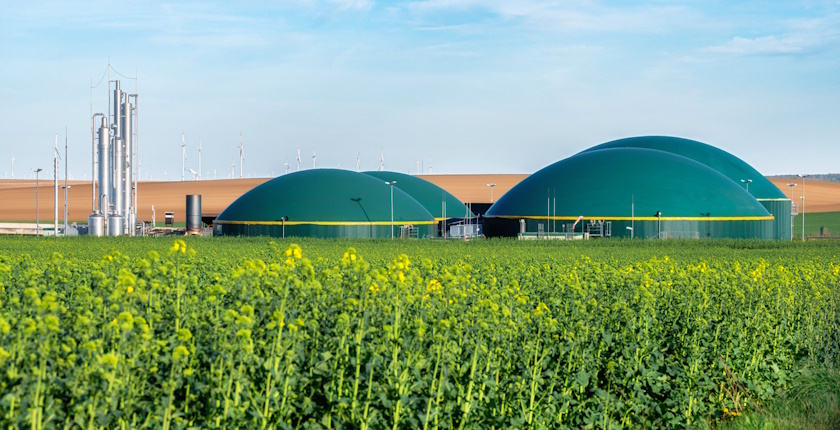
Biomethane is usually obtained by processing biogas to get methane of the same purity as in fossil gas

Any delay in allowing biomethane in the existing grid draws a risk of increasing the costs of natural gas consumption, both for non-household and household customers, the accompanying note reads.

Biomethane is usually obtained by processing biogas to get methane of the same purity as in fossil gas. The gaseous biofuel can also be produced from clean hydrogen and carbon dioxide. The EU allows incentives for biomethane facilities. Some countries in Southeastern Europe, like Greece, are developing the legal framework for embracing the technology within their energy transition.

Share in gas network planned to reach 10% by 2050

Romania is planning a 5% share of biomethane in its natural gas network in 2030 and to double it by mid-century. The sectors of waste management and agriculture can produce an estimated 501,000 tons of oil equivalent in 2050.

The EU is imposing strict requirements on the removal of biodegradable organic matter from wastewater and the reduction of food waste, the ministry noted. Together with agricultural and organic municipal waste, they are the main raw materials for the production of biogas.

According to the proposal, publicly announced business plans can secure a share of renewable gases in the grid up to 1.5%. However, without an urgent legislative intervention, the investments can’t materialize, the Ministry of Energy warned. The draft directive would update the definitions of guarantees of origin, biogas, biomethane, natural gas, renewable gases and biomethane producers.

BSOG Energy, Engie Romania at forefront of upcoming biomethane investment wave

As for other developments in the segment, BSOG Energy (BSOGE), a subsidiary of Black Sea Oil and Gas, recently hired industrial services provider Bilfinger for a biomethane facility in Alba county in Transylvania.

Earlier, BSOGE said it would invest EUR 30 million in the construction of a biomethane plant. It has signed deals with milk producer DN Agrar Group for up to 15 MW in capacity, with the possibility of exceeding 20 MW in later stages.

In April, the firm partnered with Unigrains Trading in a project for a biomethane and organic fertilizer facility. They estimated the investment at EUR 65 million, for 57 MW of biomethane capacity and over 250,000 tons of organic fertilizers per year. Parent company BSOG is controlled by controlled by investment firm Carlyle.

Engie Romania launched plans a year ago with Heineken to build a biodigester for brewery waste

Last November, French-owned Engie Romania obtained the first license in the country for biogas and biomethane supply. Earlier it established a partnership with Heineken for decarbonization projects in three breweries in Romania, including heat pumps and one biodigestion system.

The firm is the largest supplier and distributor of natural gas in the country, as well as an electricity producer and supplier.

by in News

Battery storage investors in Romania rapidly expanding project pipeline

In an accelerating investment wave, companies in Romania are combining BESS with solar power, hydropower and wind power, or building standalone energy storage facilities. The group includes R.Power, Hidroelectrica, Engie and more big names.

Recent updates about investments in battery energy storage systems (BESS) in Romania indicate the technology is becoming another pillar of the country’s energy transition alongside wind power. For several years now, photovoltaics, and prosumers in particular – including municipal authorities, have dominated the scene. Geothermal energy is another emerging segment.

The government has provided incentives both for households and utility-scale battery storage. Companies are combining batteries with solar and wind power as well as hydropower capacity.

Investing in BESS colocated with renewable electricity plants or as standalone facilities in Southeastern Europe enables income from high spreads between wholesale power prices in daily trading. It is especially significant given the increase in the occurrence of zero and negative prices.

Notably, neighboring Bulgaria has earmarked massive funds for support to BESS investments while also focusing on pumped storage hydropower projects. Greece also held several rounds of auctions for battery storage.

R.Power to start building 127 MW standalone battery

R.Power is investing in BESS in Romania, which is one of its strategic markets, together with Poland, where it is headquartered, and Italy, Germany, Spain and Portugal. Battery storage makes up 17.5 GW or more than half of its total development pipeline in Europe.

The company said it would hybridize its existing and future PV assets and scale the integrated capacity to several gigawatts in the coming years. It has over 1.2 GW of projects for standalone BESS in Romania. “And that’s just the beginning,” R.Power said.

It obtained EUR 15 million in funding for a future 127 MW facility. It is about to start building the BESS in Scornicești in Olt county, west of Bucharest. R.Power is planning to complete it in a year. The battery energy storage system would have a duration of two hours, translating to 254 MWh in capacity. The project received funding from the National Recovery and Resilience Plan (NRRP or, in Romanian, PNRR).

Still, in the company’s view, further legislative changes are needed to fully harness the potential of the technology.

Hidroelectrica to add large battery to Iron Gate 2 hydroelectric plant

State-owned Hidroelectrica, the largest electricity producer in Romania, wants to install a battery storage system at Iron Gate 2 (Porțile de Fier 2) on the Danube. Located on the border with Serbia, it is the second-largest hydroelectric plant in the country, at 252 MW in nominal capacity. The complex, which the two countries share, is known as Đerdap in Serbian.

The BESS would have 64 MW in nominal power and a four-hour duration (256 MWh), Profit.ro reported. Hidroelectrica plans to use it for providing balancing services to the national electricity system (SEN) and adjust the time intervals of its hydropower production.

The contract for the installation of the facility is estimated at EUR 61.2 million plus value-added tax, according to the article. It would be integrated with the hydroelectric plant. The company is receiving bids from potential contractors by August 28.

French Engie has BESS projects for its existing PV plant, wind park

France-based Engie’s subsidiary in Romania intends to install a BESS at its newest solar power plant, of 37.2 MW in peak capacity, in Ariceștii Rahtivani. It commissioned the PV facility in June. The location is north of Bucharest, in Prahova county.

The battery energy storage system project is for 20 MW in operating power and 80 MWh. It would consist of 16 containers, 192 inverters and four transformer units.

The wind park in Băleni will reportedly add a small BESS facility

Engie Romania is working on another investment, through its Alizeu Eolian project firm. It plans to add batteries to a 50 MW wind park in Băleni, Galați county, which was built in 2013.

The company obtained the building permit last year. It also got clearance two months ago for connecting the BESS with a 110/20 kV transformer station via an underground line. Economica.net learned that the battery storage facility would have 5 MW and a two-hour duration, costing the firm EUR 2 million.

Engie’s project was included in the reserve list last September after a public call for support to battery storage. The Ministry of Energy selected 13 applications for grants from NRRP. Another 25 passed, but remained below the line.

Government bolstering battery investments with grants

The state aid scheme was worth EUR 103.5 million, of which EUR 79.6 million came from the European Union’s Recovery and Resilience Facility (RRF).

Among the beneficiaries are Electrica, in which the government holds just under 50%. Renovatio Trading. OMV Petrom, Public Power Corp. (PPC) and Verbund have projects on the B list.

For its 65 MWh project in Toplița in Harghita county, in eastern Transylvania, Renovatio Trading is buying the equipment from Trina Storage. The firm is part of Trina Solar.

Visual Fan is winning major contracts for the procurement and installation of batteries

Allview Energy, part of Romanian company Visual Fan, is handling the alternating current (AC) side in Renovatio Trading’s investment.

In addition, Visual Fan became the contractor for a BESS within Eurowind Energy’s Teiuș solar park.

The Danish developer intends to deploy a 117 MWh energy storage unit with lithium-iron-phosphate (LFP) batteries, within a year. It valued the project at over EUR 16.6 million. The companies said they would carry out the works in partnership with TQM Services and Voltlink. The investment includes the battery management system and liquid cooling.

In June, the ministry approved a EUR 3.4 million grant from the EU’s Modernisation Fund to Termoficare Oradea. It has a project for a 10 MW solar park with a 15 MWh storage unit, worth EUR 18.6 million altogether.

Austria’s Verbund conducting EUR 22.7 million project

Verbund has almost all the permits for a BESS project at its 226 MW wind farm in Casimcea in Tulcea county. The company headquartered in Austria said it has secured financing as well and that it is already contracting the equipment.

The wind farm was commissioned in 2012. The energy storage segment would have up to 50 MW and up to 100 MWh. It would be located at the Alpha Wind Nord section of the existing facility, of 81 MW.

Still, the basic variant’s size will be 48.3 MW, with 76 MWh in capacity, according to Profit.ro. There would be 34 containers at the site selected for the BESS.

The majority government-controlled utility values the investment at EUR 22.7 million, of which more than EUR 10.7 million is for the storage facility itself. The location spans five hectares.

After coming up short in the public call, Verbund submitted the project for a grant from the Modernisation Fund.

In mid-May, Romania hosted 240.7 MW of battery capability and a total capacity of 404.9 MWh.

by in News

Romania completes second round of renewable energy auctions – third of wind quota unallocated

Companies that participated in the second round of auctions in Romania for contracts for difference (CfDs) for wind and solar power projects received the ranking list. The target quota for photovoltaics was slightly surpassed, with 1.49 GW approved. Conversely, only 1.26 GW was allocated in the wind project segment, against the available 2 GW. Average winning prices were EUR 40.35 per MWh and EUR 73.89 per MWh, respectively.

Winners include Rezolv Energy’s Dama Solar, which at 1.04 GW in total would currently be by far the largest PV system in Europe, excluding Turkey.

Romania’s Ministry of Energy and transmission system operator Transelectrica have conducted the country’s second wind and solar power auctions for government support in the form of CfDs. They imply fixed prices for beneficiaries for 15 years. If the producer sells its electricity in the market at a higher price, the government receives the difference. It works the other way around as well. The average winning price for wind power was EUR 73.89 per MWh, compared to EUR 40.35 per MWh for photovoltaics.

There was 2 GW available for wind power projects, but the authorities selected only 1.26 GW, within 23 qualified projects. It means their bids were lower than the ceiling of EUR 80 per MWh. Romanian media learned most of the details, while the official report is yet to be issued.

Rezolv, OX2, OMV Petrom, among winners in wind power segment

In the wind power auction, the participants secured less than two thirds of the quota. There are 23 projects of 21 companies on the list, with 1.26 GW accepted overall of the available 2 GW.

Midmar Callatis passed with the lowest bid, EUR 65.17 per MWh, for the Dunărea East project in Constanța county. The entity, controlled by Rezolv Energy, is eligible for a CfD for 211.2 MW. It is the largest proposed capacity that participated in the auction. The Dunărea East and West project is for 600 MW altogether.

The firm signed the grid connection contract last year. It expects to complete the wind park in 2030, to meet the deadline, like almost all other auction winners in both segments.

OX2 has split its project and won three contracts

The second winner by size is the Cerchezu wind power project. The owner, OX2, has split it into chunks, so 128 MW, 25.6 MW and 25.6 MW earned entry into the market incentives scheme. The special purpose vehicle (SPV), called South Wind, has bid EUR 69.87 per MWh, EUR 74.5 per MWh and EUR 76.5 per MWh, respectively, for a combined capacity of 179.2 MW.

Coming in third in terms of selected capacity, with 111.6 MW, is the future Poiana wind power project. The developer is Green Labs, which operates under Electrocentrale Borzești, part of the Renovatio group, under OMV Petrom.

Through its project firm CEF Pelicanu, Renovatio also won a CfD for 103.7 MW for its Alexandru Odobescu project. It bid EUR 76.9 per MWh.

Winning prices in second wind power auction higher amid demand drop

Ecoener Carpatica’s Miroslovești project in Iași county can sign a contract for 54.4 MW, at a price of EUR 68.75 per MWh. The Urleasca project passed with EUR 71.93 per MWh for 31 MW.

Eurowind Energy’s Cheap Energy Company was successful with a bid of EUR 78.5 per MWh for the Pecineaga Northeast (Nord Est or NordEst) endeavor. It applied for 48 MW.

Engie Romania passed with its Falcon wind power project

Falcon Wind of Engie Romania secured a CfD for 52.4 MW with a price of EUR 72.7 per MWh. It was the first under the line in the first round, with a bid that was EUR 5 higher. The location is in Mereni in Constanța county.

The accepted prices in the wind power auction are between EUR 65.17 per MWh and EUR 79.5 per MWh, compared to a range of EUR 54.59 per MWh to EUR 77.33 per MWh in the first round.

Accepted bids for solar power projects significantly lower than in first round

Conversely, solar power prices were much lower than last time. They landed at EUR 35.77 per MWh to EUR 45.2 per MWh, against a range of EUR 45.05 per MWh to EUR 54.19 per MWh in December. This time, the ceiling was EUR 73 per MWh. The commission accepted 26 bids of 1.49 GW in total, extending the quota by 16 MW.

The largest capacity, 520 MW, was awarded to special purpose vehicle West Power Investments for its Dama Solar project. It is for 1.04 GW in total peak capacity, which would make it the biggest solar power plant in Europe excluding Turkey. Rezolv Energy developed the project, together with Monsson. It won the incentives through two equal lots, with bids of EUR 42.2 per MWh each, on a rounded basis.

Enery Element gets almost 460 MW for its two PV projects

Other companies also partitioned their projects for the auction. Enery Element won 11 out of the 26 contracts, for its proposed Baboia PV plant, also called Ogrezeni. The bids were between EUR 35.77 per MWh and EUR 42 per MWh.

In the previous round, it failed to make the quota with EUR 56.82 per MWh. The combined capacity is 350.1 MW. According to Economica.net, the developer may have opted for splitting the PV plant to avoid surpassing the 50-hectare threshold per lot. The Ogrezeni project in Giurgiu county is for more than 500 MW overall, the media outlet noted.

The company also succeeded with four lots of its Dumbrava 2 project. Enery Element’s subsidiary Siret Solar Plant has bid EUR 38.76 per MWh to EUR 38.79 per MWh. The combined capacity is 108.6 MW.

Engie Romania is now eligible for a CfD for 170 MW in peak capacity, for its proposed Cornățelu photovoltaic facility. Its bid was the highest on the list, EUR 45.2 per MWh. The site is in Dâmbovița county

Of note, the government has so far signed contracts with 21 firms that won in the first solar and wind power auctions.

by in News

Foreign renewable energy investors remain committed to Romania as large plants coming online

Renewable energy companies from abroad aren’t intimidated by negative power prices in Romania, especially with the battery storage segment accelerating. Energy giants EDP Renewables and Engie have new solar power plants, and more renewable energy facilities are coming online, while the government is disbursing European grants.

The renewable energy market in Greece is consolidating and a number of foreign investors are leaving, but some other countries in the region that Balkan Green Energy News tracks remain attractive, especially Romania and Turkey. Big names from abroad keep coming, and the established ones are commissioning facilities and committing to more projects.

Like elsewhere in Europe and beyond, the increasing occurrence of low, zero and negative power prices are impacting the sentiment in Romania. But funding from the European Union, the government’s administrative support, renewable energy auctions and bets on battery storage seemingly outweigh the current risks.

EDPR’s new photovoltaic park Albina will generate 67 GWh per year

EDP Renewables (EDPR), subsidiary of Portuguese energy giant EDP, recently inaugurated its Albina photovoltaic plant. Located in western Romania, just outside of the city of Timisoara, the renewable energy unit came online late last year.

Albina has 60 MW in peak capacity and a 48.8 MW grid connection. The company expects it to generate 67 GWh per year. EDP said that with the new plant it reinforces its commitment to Romania. It operates wind and solar power plants in the country of over 570 MW in combined capacity.

Engie praises renewable energy potential in Romania

Engie Romania commissioned the sixth photovoltaic park in its portfolio. It is located in the commune of Ariceștii Rahtivani in Prahova county. Together with the new facility, of 37.2 MW in peak capacity, French Engie’s branch in Romania now has 248 MW in renewable energy in operation.

The site covers ​​57 hectares. Estimated annual output is 57 GWh. The firm owns three wind farms of 178 MW in total while its six PV systems have 70.3 MW in overall peak capacity. Last year it built one of the first hybrid power plants in the country.

Engie Romania said the new plant strengthened its position and praised the country’s “significant potential” in the renewable energy segment. The firm targets 1 GW in the country by 2030. It also distributes natural gas and supplies both gas and electricity, and offers energy services.

Rezolv building one of largest wind power plants in Europe

The Vifor wind farm in Buzău county, northeast of Bucharest, is almost half done. Rezolv Energy plans to finish it in 2027. The first phase is for 192 MW, with a planned expansion to a colossal 461 MW.

The company purchased Vestas turbines for the wind park, which is set to become the largest in Europe and the second-largest in Romania. The developer won a fixed electricity price for 15 years in the form of a contract for difference at the country’s renewable energy auction. The wind power plant will also benefit from a power purchase agreement (PPA).

Wind farm of 99.2 MW Galaţi in to launch operations next year

OX2 is building the Green Breeze wind farm, delivering the project as a turnkey construction project for the investor, Nala Renewables. The project involves 16 Vestas V162-6.2 MW turbines, or 99.2 MW altogether. Annual production at the future wind power plant in Galaţi in the eastern part of the country is 312 GWh, according to the estimate.

The facility is on schedule for the start of operations in the first half of next year. Together with Green Breeze, OX2 is working on 620 MW in five wind power projects. The Swedish company has said it intends to grow and diversify in the country.

Enery from Austria lining up renewable electricity plants in Romania

Romania-based Enevo announced that it started building a solar park of 54.2 MW in peak capacity for Enery Development.

Also in Dâmbovița county, Enery Element, the joint venture of the Austrian company with Element Power Group, has a project for a battery-backed PV park.

Total investment is some EUR 27.5 million, of which EUR 2.4 million is from the EU’s Modernisation Fund. The solar power component is 74 MW and the battery energy storage system (BESS) would provide 10.2 MWh in capacity. The location, formally run by project firm Gura Solar Plant, is in the Gura Ocniței commune.

Ecoener, headquartered in Spain, is developing an agrivoltaic project of 11 MW

A Spanish group with an annual turnover of almost EUR 100 million wants to build the first agrisolar park in Iași county, in the commune of Țibănești. Solar panels of 11 MW in total peak capacity would be placed 1.5 meters above ground. The investor, Ecoener, established a Romanian subsidiary for the endeavor: Ecoener Țibănești.

Greece’s PPC turning its wind, PV facilities into hybrid power plants with battery storage

Greek state-controlled Public Power Corp. (PPC) is developing a BESS investment through its firm Sun Challenge, which operates the Lumina solar power project in Călugăreni, Giurgiu county. The PV facility of 63 MW in peak capacity has been online for two years now. Lumina is PPC Renewables’ largest solar power unit in Romania.

It is one in a string of the Greek company’s energy storage projects. PPC plans BESS at its wind farms Topolog (27 MWh), Corugea (80 MWh) and Sălbatica (60 MWh) in Tulcea county. It slated another 120 MWh in total storage capacity at wind power plants Nicolae Bălcescu and Târgușor in Constanța county.

PPC operates wind, photovoltaic and hydropower capacity in Romania of 1.3 GW overall

The Fântânele-Cogealac-Gradina wind farm, which PPC took over from Macquarie Asset Management, already includes a BESS facility. The 600 MW facility is the largest in Romania of its kind.

In Prahova, PPC Renewables Romania plans a 10 MWh storage system at the Berceni 1 photovoltaic park, with an installed capacity of 9.8 MW. Another storage system, of 8 MWh, would be integrated with the Colibași photovoltaic park (7 MW) in Giurgiu county.

PPC operates wind, photovoltaic and hydropower capacity in Romania of 1.3 GW overall.

Turkey-based YEO Technologies, Danish company Eurowind Energy and Solarpro, a contractor from neighboring Bulgaria, all have new investment updates, too.

by in News

Engie Romania takes over 54 MW wind power project

Engie Romania has completed the acquisition of a 54 MW wind power project located in Mereni in central Romania.

Engie Romania said the Mereni wind project is located in Constanța county, an area with high wind potential, recognized for its superior yields in green energy production.

The project represents a strategic step in expanding the company’s renewable energy portfolio and supports its goal of reaching an installed capacity of 1 GW by 2030, according to Engie Romania, a subsidiary of the French energy giant Engie.

The project was acquired in a “ready-to-build” stage, with all necessary building permits in place to begin construction. Installation is scheduled to begin later this year, with commissioning scheduled for 2027, according to a press release.

The Mereni wind farm will deliver 180 GWh of renewable energy annually

With an estimated annual production of 180 GWh, the Mereni wind farm will deliver renewable energy equivalent to the annual consumption of approximately 90,000 households. Engie estimates that this amount of electricity can support the operation of about 20 medium-sized data centers with 1 MW of continuous power each.

Cristian Buzan, Deputy General Manager of Engie Romania, underlined that this acquisition reflects the company’s constant commitment to actively contributing to the energy transition by developing a diversified portfolio of renewable projects.

Engie Romania currently operates an installed capacity of 211 MW from renewable sources

“We continue our evolution with concrete steps, supported by the ambition to be a trusted partner for our customers, offering sustainable and competitive solutions, adapted to their long-term needs,” Buzan noted.

Engie Romania currently operates an installed capacity of 211 MW from renewable sources. The portfolio comprises three wind farms with a combined capacity of 178 MW and five photovoltaic plants totaling 33 MW. These assets are located in different regions of the country.

The company’s latest projects are its first 57 MW hybrid power plant and the acquisition of an operational 80 MW wind farm.

Its next move is to put into operation a 37.2 MWp solar power plant in Ariceștii Rahtivani, Prahova County.