by in News

Renalfa Advances Oslomej Solar Project with 50 MW Battery Storage Installation

Austria-based developer and independent power producer Renalfa IPP has commenced the installation of a battery energy storage system (BESS) at its solar power plant in Oslomej, North Macedonia. The system will have an operating power of 50 MW and a storage capacity of 200 MWh, marking a significant step in enhancing grid flexibility and renewable integration.

The co-located BESS is being deployed alongside the 65.8 MW Oslomej solar power plant, which is situated on the site of a former coal mine. The project reflects ongoing efforts to repurpose legacy fossil fuel infrastructure into clean energy assets. The solar facility was developed through a public-private partnership with state-owned utility Elektrani na Severna Makedonija (ESM).

Financing for the solar plant was provided by the Green for Growth Fund, which has also committed €24 million to support the deployment of the battery storage system. The combined investment forms part of a broader initiative to transition North Macedonia’s coal-based energy complex toward sustainable generation.

In 2025, Renalfa secured a €315 million loan facility from a consortium led by the European Bank for Reconstruction and Development. The financing underpins the company’s €1.2 billion regional investment program, which targets the development of approximately 1.6 GW of renewable generation capacity and 3.3 GWh of co-located battery storage across Bulgaria, Hungary, Romania, and North Macedonia.

These assets are expected to produce around 2.3 TWh of green electricity annually—sufficient to meet the energy needs of approximately 920,000 households—while supporting grid stability through integrated storage solutions.

Beyond North Macedonia, Renalfa is also advancing a major hybrid renewable project in Hungary. The company is developing a 450 MW solar power plant in Szihalom, complemented by a BESS with an operating power of 250 MW and a capacity of 1 GWh. The battery system is being supplied by HiTHIUM.

According to Renalfa, the Szihalom project represents the largest hybrid renewable energy development undertaken in Hungary to date and ranks among the most significant such projects in Europe.

by in News

Early-Stage Progress and Challenges Mark Energy Community’s Priority Infrastructure Projects

Most projects included in the first list of Projects of Energy Community Interest (PECI) remain at an early stage of development, with several challenges likely to affect their implementation timelines, according to an assessment by the Energy Community Regulatory Board.

The Evaluation Report on PECI projects provides a comprehensive overview of progress on initiatives selected in the 2024 PECI list. It covers six priority investments—five in electricity transmission and one in energy storage—identified as critical for strengthening cross-border interconnections, enhancing security of supply, and enabling greater integration of renewable energy across the Energy Community.

The projects under review include:

  • Completion of the 400 kV Albanian internal transmission ring;
  • Capacity expansion of the existing 220 kV interconnection between Bosnia and Herzegovina and Montenegro (Trebinje–Perućica overhead line);
  • The Trans-Balkan Corridor, specifically the 400 kV double overhead line linking Bajina Bašta in Serbia with Višegrad in Bosnia and Herzegovina and Pljevlja in Montenegro (with the latter two sections included in the PECI list);
  • Reconfiguration of Albania’s 400 kV grid alongside a new Albania–Kosovo* interconnection;
  • The 330 kV overhead line between Balti in Moldova and Dnestrovsk HPP-2 in Ukraine;
  • The 225 MW DTEK energy storage project.

To date, only the Bosnia and Herzegovina–Montenegro interconnection has secured direct financing, provided by the European Bank for Reconstruction and Development. Meanwhile, two projects—the Albanian internal ring and the Albania–Kosovo* interconnection—received financial backing in 2025 from the European Commission through the Western Balkans Investment Framework, as highlighted by the Energy Community Secretariat.

The report finds that most projects are still in conceptual, feasibility, or planning phases, with expected implementation timelines extending from 2028 to 2032. Throughout 2025, efforts have largely focused on feasibility assessments, preparatory activities, financing structures, and regulatory alignment, rather than physical construction.

Importantly, the evaluation notes that no systemic delays have been identified when measured against the expected level of project maturity following their designation in the 2024 PECI list.

However, the report underscores several structural challenges that could affect delivery in later stages. These include complex permitting and administrative procedures—particularly for cross-border infrastructure—ongoing financing constraints and rising investment costs, as well as external risks such as geopolitical and security factors, especially in relation to Ukraine.

The assessment emphasizes that early identification and mitigation of such risks will be essential to ensure a smooth transition from planning to construction in the coming years.

The ECRB also stresses the importance of continued regulatory oversight and proactive engagement by national regulatory authorities to maintain project momentum and ensure efficient implementation.

Looking ahead, the Energy Community Secretariat launched a public consultation in March on eight candidate projects for the next PECI list. The updated selection, aligned with the TEN-E Regulation framework, is expected to be adopted in December 2027, following an opinion from the ECRB anticipated by the end of August 2026.

by in News

Albania’s 2026 Electricity Law: Powering a Competitive, Secure, and Green Energy Future

The new draft Law on the Electricity Sector (2026) aims to overhaul Albania’s power framework for a competitive, secure and green market. Its stated objectives include guaranteeing secure and sustainable supply, deepening market liberalisation and consumer choice, and supporting climate goals. Government spokespeople emphasize moving “away from a centralized model” toward “a more open, more competitive, more flexible” market aligned with EU norms. Similarly, the Energy Community stresses that Albania must shore up security of supply (through EU-aligned risk-preparedness planning) and fully integrate its electricity market regionally. As one official put it, Albania needs to “shore up security of supply through EU-aligned risk-preparedness plans and achieve full market coupling with the EU”. In line with climate targets (Albania’s 2050 neutrality goal), the law also promotes renewables, efficiency and low-carbon flexibility. For example, a separate 2023 Renewables Law explicitly targets increased renewable use, reduced greenhouse gas emissions and sustainable rural energy access. The 2026 electricity law complements this by facilitating renewables integration (e.g. grid access, storage) while also formalizing consumer-friendly concepts like smart meters and dynamic pricing for a low-carbon economy.

Institutional Framework and the Regulator

A key element is the Energy Regulatory Authority (ERE). Under the draft law, ERE remains the independent regulator for electricity (and gas) with strengthened powers. Official briefings note that the new law “expands and makes more important” ERE’s role, explicitly giving it major competencies “for developing market rules, monitoring their operation and ensuring competition”. In practice, ERE already issues tariffs, licenses, and technical codes; the law likely reaffirms its authority over grid tariffs, network access and licensing. EU rules (Electricity Directive 2019/944 Art.59) require national regulators to be fully independent and impartial, and the Energy Community has advised Albania to “strengthen the independence and capacities of all authorities” including ERE. The draft law reportedly aligns with this: it clearly vests regulatory tasks in ERE, separating them from political control. Nonetheless, implementation depends on ERE’s capacity to handle new duties (e.g. oversight of cross-border markets) and to enforce the complex EU-aligned regime. The law will also designate the energy ministry as the risk-preparedness authority (see below), but ERE is expected to coordinate in emergencies and in implementing EU network codes.

Market Design and Competition

The new law fundamentally repackages the market model. Under the current 2015 law, Albania began liberalising in 2021–2025, opening the market by threshold and establishing the ALPEX exchange. Today, large consumers can choose suppliers, and ALPEX operates a day-ahead and intraday auction. The draft law continues this trend: it formally mandates third-party access to networks and the full operation of wholesale markets (day-ahead, intraday, balancing, and even derivatives trading) to ensure transparent price formation. In April 2023 Albania launched its day-ahead market, which in January 2024 was successfully coupled with Kosovo’s market – the first electricity market coupling in the Energy Community. Regional intraday auctions (so-called CRIDAs) between Albania and Kosovo followed in late 2024. The new law codifies these developments and sets the stage for eventual coupling with EU markets, subject to completing EU-market rules. Indeed, Energy Community analysts note that full alignment with EU rules (the Electricity Integration Package) through this law is essential for Albania to join the EU’s single day-ahead and intraday coupling.

At the same time, the law removes many legacy distortions. The current public service obligations (PSOs) – such as requiring the state generator KESH to supply the universal service provider (FSHU) at a government-set price – will be phased out or restructured. Ministry statements emphasize moving away from a model where “state actors had the largest decision-making” and towards one where competition is the basis of the market. In practice, this means eliminating price-setting interventions: for example, Albania’s wholesale market until now has been burdened by non-market contracts for network losses and for supplying captive consumers, which “does not meet the requirements” of EU market rules. The new law should require all grid services (transmission and distribution losses) to be procured on organized markets under competitive principles. It also formally establishes the market operator (ALPEX) as a Nominated Electricity Market Operator (NEMO) under EU law and extends ALPEX’s remit to ancillary markets. Unbundling is enforced: Albania’s transmission operator (OST) is already ownership-unbundled and ENTSO-E member, and distribution (OSSH) is a separate DSO. Clear rules on independent operation of networks and transparent tariff-setting are included to meet EU requirements.

Renewable Energy Integration and Low-Carbon Transition

Although Albania’s generation is dominated by hydropower, renewable integration is a priority. The new law addresses intermittency and grid flexibility: it introduces concepts like energy storage, active prosumers, aggregation and energy communities. For instance, it explicitly provides a legal basis for energy storage systems (to smooth renewable output) and for “active customers” who both consume and generate power. These mirror EU Directive 2019/944 provisions (articles on prosumers, dynamic tariffs and communities) that Albania has not yet fully transposed. The law also encourages technologies such as smart meters and even electric vehicle charging (“electromobility”) as flexibility tools. A separate Law 24/2023 already incentivises renewable deployment (through auctions, PPAs and CfDs) with the goal of reducing fossil imports and emissions. The electricity law complements this by guaranteeing renewables’ grid access and balancing: for example, under the renewables law temporarily-stored solar power is treated as delivered for subsidy purposes, a useful flexibility clause. In short, the legal framework is shifting to support a low-carbon mix: renewables get priority access to networks, and the market must accommodate their variability via storage and demand-side response. Energy efficiency is implicitly supported through demand participation measures, though detailed efficiency obligations remain part of separate legislation.

Security of Supply and Reliability

Ensuring continuous supply is a core aim. The law reportedly designates the infrastructure minister as the authority for risk preparedness and obliges that ministry to adopt a national risk-preparedness plan. This reflects EU Regulation 2019/941 (on gas supply risks), which Albania had missed implementing by its 2023 deadline. The draft law includes initial steps toward compliance: it provides for a risk plan and emergency protocols. In practice, this means formalising procedures for crisis response, including strategic reserves and demand curtailment rules. The law likely retains provisions for last-resort supply and universal service to protect consumers in shortages: under the current system, for example, the state generator KESH sells power to the universal supplier FSHU and to cover network losses. These contracts (often via contract-for-difference at regulated prices) are to be reformed.

Cross-border integration also enhances security. By coupling with neighbours, Albania gains access to wider regional capacity during droughts. Energy Community officials emphasize that full market coupling with Kosovo and eventually the EU “creates larger, more resilient markets” protecting against shocks. Albania’s new law strengthens this by setting clear rules for allocating cross-border capacity and operating bidding zones. Additional stress on reliability is addressed through mandated reserve capacities and balancing mechanisms: the law provides for the TSO to procure reserves and conduct redispatch if needed.

Nonetheless, challenges remain. Albania’s heavy reliance on hydropower (with seasonal rainfall variability) requires backup sources or storage. The law does not itself build new plants, so its impact on resource adequacy depends on fostering investment. Moreover, while emergency oil-stock regulations remain outdated (outside electricity law’s scope), the focus here is on electricity reserves. Overall, the draft law marks progress toward EU-style security measures, but full implementation will require secondary rules and investments in new capacity (or demand response) to ensure true reliability.

Consumer Rights and Protection

The draft law places consumers at the centre of the market. It acknowledges that consumers can also be producers, and it explicitly incorporates EU ideas of active customers, dynamic pricing contracts and citizen energy communities. In practice, Albania has already liberalized retail supply for most customers: all households and businesses above low-voltage can choose supplier. The state supply company FSHU (formerly OSHEE retail) continues as the universal service provider for small (0.4 kV) customers, and has been designated the supplier of last resort for larger low-voltage customers. Under the new law, these protections persist but in more defined forms. For vulnerable groups, the framework is improving: Albania now defines “energy-poor” and “vulnerable” households, bans disconnection for them, and offers subsidies (for heating and electricity) to the poorest. The law is expected to enshrine such protections, in line with EU norms (Directive 2019/944 requires special safeguards for vulnerable consumers).

However, some consumer-rights provisions must still be fleshed out. The Energy Community notes that novel rights – such as aggregation services, transparent billing, and consumer-driven demand response – have not yet been fully enacted. Similarly, current pricing interventions (like keeping FSHU rates regulated) “do not comply with” EU criteria, implying the law will need transitional rules to liberalize prices over time. To ensure transparency, the law should mandate clear billing, easy switching procedures and robust complaint mechanisms (all EU requirements). In sum, the draft law advances consumer empowerment (even heralding a “democratization” of the sector through communities and active customers), but its effectiveness will hinge on accompanying regulations detailing consumer rights, metering standards, and social safeguards as per EU directives.

Harmonization with EU Energy Acquis

A principal motive is alignment with the EU’s Clean Energy Package. The draft law explicitly aims to fulfill Albania’s energy chapter (15) accession commitments. It transposes key elements of the Electricity Directive and Regulation (2019/944 and 2019/943) – together known as the Electricity Integration Package – which govern market design, unbundling, and cross-border trade. For example, secondary legislation under these acts is already underway: in 2025 ERE approved a capacity allocation regulation (adopting CACM Regulation 2015/1222) to manage congestion. The law also enshrines EU-style unbundling (Albania’s OST was certified under ownership unbundling in 2017) and prepares for implementing remaining EU network codes (intra-day auctions 2017/1719 and balancing code 2017/2195 are in process).

Multiple EU directives come into play. Besides the electricity-specific rules, the law must be consistent with the Renewable Energy Directive (now RED II, 2018/2001, as partially reflected in Law 24/2023) and the Energy Efficiency Directive (2018/2002). It must meet EU requirements on state aid neutrality and competition as well. The Energy Community’s recent report underscores that Albania “should complete transposition of the EIP and… strengthen the independence and capacities of all authorities”. In sum, the 2026 law appears designed to maximize convergence: officials claim it will “ensure a high degree of alignment” with EU law. Yet gaps remain (EU country reports note missing adoption of e.g. Regulation 2019/941 on security of supply). The new law closes many gaps, but full compliance will require follow-up secondary legislation (grid codes, consumer rules, capacity markets) to operationalize EU norms.

Implementation Challenges and Outlook

Achieving the law’s vision will be challenging. Legacy market distortions must be unraveled carefully: KESH’s dominance and the public-service contracts for losses and captive load are deeply entrenched, and removing them could face resistance or temporary supply risks. The Energy Community warned that Albania’s PSOs, originally “temporary measures” during crises, still “threaten to impede efficient competition”. Regulatory capacity is another concern: the new regime is complex, and ERE and the ministry must issue numerous secondary rules (e.g. network codes, imbalance settlement procedures, risk plans) quickly. Reports note that even now, some network code implementations (like 15-minute settlement) have been postponed by ERE.

Integration efforts require investment. Building transmission links (to Greece, Macedonia, Italy) and reinforcing grids for bidirectional flow will determine how well cross-border trade can alleviate domestic shortages. Financing remains an issue: regulators and government must coordinate to fund smart metering and storage projects (as envisaged in the law). Socially, the phase-out of price controls must be balanced with protection for the poor; gaps between this law and existing subsidy programs could cause confusion if not harmonized. Finally, political commitment will be tested: the law’s success depends on steady implementation amid changing governments.

In summary, the draft law sets a forward-looking framework: it promises a liberalized, EU-harmonized market with empowered consumers and high renewable integration. If fully enacted and backed by robust secondary measures, it should significantly advance Albania’s goals of a competitive, secure and sustainable electricity sector. However, the road from law to reality involves filling regulatory gaps and overcoming institutional inertia; without that follow-through, key objectives (market liquidity, EU coupling, consumer protections) may fall short. Overall, the 2026 Electricity Law represents a critical step toward a modern Albanian power market – one that, if implemented effectively, aligns closely with best practices in the EU

by in News

PPC and Metlen Forge 1.5 GW Regional Battery Storage Alliance

In a major move to solidify their dominance in the Southeast European energy transition, Greece-based PPC Group and Metlen Energy and Metals (formerly Mytilineos) have entered into a strategic joint venture. The agreement aims to develop, construct, and operate a massive portfolio of Battery Energy Storage Systems (BESS) totaling 1.5 GW in power capacity and 3 GWh in energy storage across Romania, Bulgaria, and Italy.

Fast-Tracking Storage Infrastructure

The partnership is designed for rapid deployment, with both companies targeting the completion of 1 GW of capacity within just 12 months. This aggressive timeline underscores the urgency of integrating flexible assets into regional grids to manage the influx of intermittent renewables.

The technical specifications of the portfolio focus on high-efficiency, utility-scale technology:

  • Total Capacity: 1.5 GW / 3 GWh (representing two-hour duration systems).

  • Technology: Liquid-cooled Lithium-Iron-Phosphate (LFP) batteries.

  • Asset Management: The venture will be equally owned (50/50), leveraging PPC’s regional market presence and Metlen’s specialized EPC (Engineering, Procurement, and Construction) expertise.

Synergy Beyond Solar

This deal follows a landmark 2024 agreement between the two entities, which saw them collaborate on a 2 GW solar pipeline across Italy, Romania, Bulgaria, and Croatia. While that previous arrangement focused on an “at-completion” acquisition model by PPC, this new BESS venture creates a deeper operational partnership.

The storage facilities are intended to perform two critical functions:

  1. Renewable Support: Balancing the output of adjacent photovoltaic and wind farms.

  2. Grid Stability: Providing essential ancillary services to national electricity systems to prevent frequency fluctuations.

Strategic Implications for Southeast Europe

For the government-controlled PPC Group, this alliance secures a significant portion of its three-year energy storage targets. For Metlen, the deal represents a pivotal milestone in its broader European strategy, positioning the firm as a leading player in the continent’s storage infrastructure sector.

“This agreement creates value for both parties and further expands our group’s already significant presence in Southeast Europe,” noted Konstantinos Mavros, PPC Group’s Deputy CEO for Renewables.

As the Balkan and Mediterranean markets continue to decarbonize, the rapid commissioning of these 3 GWh of storage capacity is expected to be a cornerstone for regional energy security and market liquidity.

by in News

KESH partners with France’s EDF and AFD to develop Albania’s Energy Storage Roadmap

Tirana — In a decisive move toward modernizing its national grid, the Albanian state-owned power utility, KESH (Albanian Electric Power Corp), has finalized a strategic partnership with Électricité de France (EDF) and the French Development Agency (AFD). The collaboration focuses on the development of a comprehensive energy storage strategy, underpinned by a €400,000 grant earmarked by the AFD.

This initiative arrives at a critical juncture for Albania. While the country boasts a near-total reliance on renewable hydropower for domestic production, its lack of grid-scale energy storage remains a significant structural vulnerability. As the global energy transition demands higher flexibility, the partnership aims to bridge the gap between Albania’s current hydro-centric model and a diversified, resilient future.

Engineering Flexibility: The Scope of the Partnership

The primary objective of the agreement is to identify and evaluate the most effective storage technologies suited for Albania’s existing infrastructure. The resulting study will serve as a technical blueprint for the nation’s Energy Storage Strategy, focusing on several key pillars:

  • Renewable Integration: Facilitating the entry of solar and wind energy into a grid historically dominated by water power.

  • System Modernization: Increasing the security of supply and enhancing operational flexibility.

  • Climate Resilience: Improving the long-term sustainability and management of Albania’s vital water resources and assets.

The technical expertise for this transition will be provided by the French state-owned giant EDF, a global leader in low-carbon energy, while the AFD continues to expand its financial and developmental footprint across the Western Balkans.

High-Level Diplomatic Support

The signing ceremony was attended by Nicolas Forissier, the French Minister Delegate for Foreign Trade and Economic Attractiveness. Minister Forissier emphasized that this agreement underscores Albania’s status as a priority partner for France, reflecting Paris’s commitment to supporting the country’s integration into the European Union through the mobilization of technical and financial instruments.

Under the leadership of Viola Haxhiademi, who assumed the role of CEO in late December, KESH is positioning itself to manage significant future capacities. Currently, planned projects—including KESH’s pumped storage capacity in the Drin (Drim) cascade and Statkraft’s Moglica project—represent a potential 1.6 GW of storage capacity.

A Continuing Collaboration

This latest deal builds upon an existing relationship between KESH and the AFD. Last year, the two entities signed an agreement focused on the advanced management of the Drin River cascade, the backbone of Albania’s energy sector. By adding a formal storage strategy to this framework, Albania is taking a sophisticated step toward aligning its energy sector with EU standards and the exigencies of the green transition.

by in News

DAPEEP Study Signals Strong Revenue Prospects for Greece’s First Standalone Battery Projects

Standalone battery projects in Greece poised for strong revenues, says Operator of Renewable Energy Sources & Guarantees of Origin (DAPEEP), Greece, battery storage, DAPEEP, energy storage, balancing market, wholesale market, grid services, auctions, investors, 700 MW, 4.7 GW

Greece’s first standalone battery storage installations are projected to generate substantial revenues when they enter commercial operation, according to a new study by DAPEEP.

The study modelled several scenarios; its principal case assumes revenues 75% above the baseline. Under that scenario, two-hour systems running for the full year of 2026 could earn about EUR 157,057 per MW annually. Four-hour systems are estimated to yield EUR 100,885 per MW per year, although those units are expected to commence operations in the second half of 2026.

Although the projected figures assume continuous operation through 2026, the report notes they are theoretical: the earliest standalone batteries are expected to reach commercial operation from late spring. A number of installations have already been built and are awaiting final regulatory clearance. Investors have expressed frustration at delays, warning that prolonged idle time can degrade battery performance and reduce capacity.

The initial tranche from the country’s three auctions will deliver roughly 700 MW by late in the first half of 2026, DAPEEP says, followed in subsequent years by an additional 4.7 GW of unsubsidised capacity.

DAPEEP highlights a dual revenue model for standalone storage. Operating income will be derived partly from the wholesale electricity market and partly from the balancing market. The difference between minimum and maximum hourly prices in the wholesale market is identified as the principal profit driver, while balancing services provide a complementary revenue stream and system-stabilising value.

In the early phase, day-ahead and intraday trading are expected to account for roughly 65% of revenues; that share is forecast to decline to about 40% later in the year as market dynamics evolve. DAPEEP anticipates that wholesale revenues will be resilient to the initial influx of projects, but cautions that the balancing market will be more sensitive to the additional standalone storage capacity.

The study’s findings underline the commercial potential of battery storage in Greece while also highlighting operational and market-integration challenges that policymakers, regulators and investors will need to resolve to realise that potential.

by in News

MEMO Analysis Links Solar Output to Lower Day-Ahead Power Prices in North Macedonia

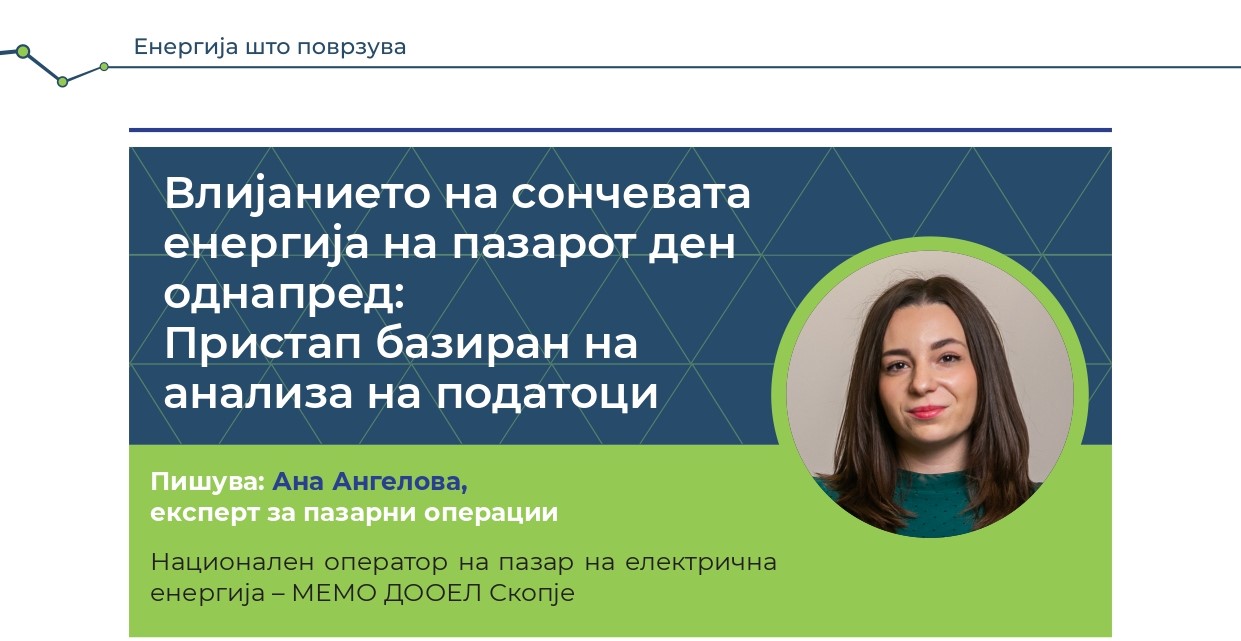
Electricity generation from solar power plants tends to push prices down on the power exchange, while reduced solar output is associated with price increases, according to an analysis by Ana Angelova, a market operations specialist at the National Electricity Market Operator (MEMO).

The analysis aimed to identify seasonal trends and highlight the relationship between photovoltaic (PV) generation, electricity consumption, traded volumes, and day-ahead prices on the North Macedonian power exchange. MEMO noted that the day-ahead market operates in an isolated mode.

Angelova used official power exchange data for 2024, focusing on hours when PV plant efficiency exceeded 30%.

Consumption remains broadly stable across the year

The findings point to a clear seasonal pattern. Electricity consumption stays relatively steady throughout the year, with only minor declines during spring and summer. PV generation, however, shows a pronounced seasonal swing—peaking in summer and reaching its lowest levels in winter.

Angelova also stressed that higher PV output coincides with increased traded volumes on the day-ahead market.

Prices bottom out in April, rise toward winter

According to the analysis, day-ahead prices are lowest in April, a period linked to milder weather, lower demand, and stronger solar production. From summer onward—and particularly during winter—prices trend higher, peaking in November.

The November price peak aligns with a combination of weak PV generation and higher consumption.

“Increased electricity generation from photovoltaic plants is associated with lower prices, while low generation leads to higher market prices, emphasizing the impact of renewable energy availability on price formation. The trend indicates that energy policies should focus on addressing weaknesses during the winter period and harnessing the potential of solar energy in summer,” Angelova wrote.

Proposed measures to strengthen renewables integration

north macedonia solar analysis memo power exchange ana angelova

Photo: MEMO

Angelova outlined several options to improve the integration of renewables—especially solar—into the power system. The proposed mechanisms include:

  • Flexible market mechanisms: introduction of a 15-minute trading interval, creation of an intraday market, dynamic tariffs, and guarantees of origin.

  • Energy storage technologies: battery energy storage systems (BESS) and pumped-storage hydropower plants.

  • Alignment with the European energy framework: adoption of ENTSO-E grid codes, coupling with the single European electricity market, deployment of smart meters, and use of financial instruments such as contracts for difference (CfD) and power purchase agreements (PPA).

by in News

Romania Nears 3.35 GW in capacity prosumers as residential solar catches up with business installations

Romania had nearly 290,000 prosumers by the end of November, with a combined installed capacity of 3.35 GW, according to the national energy regulator. While prosumer projects have been the main driver of the country’s solar expansion for years, utility-scale developments moved to the forefront in 2025. At the same time, the prosumer segment is showing a notable shift: residential capacity has effectively converged with installations owned by legal entities, including small companies and institutions.

In its latest update, the Romanian Energy Regulatory Authority (ANRE) reported 287,985 prosumers at the end of November, together accounting for 3.35 GW of electricity production capacity. That represents a sharp year-on-year increase of 47.8% in the number of prosumers and 43.4% in installed capacity. The comparison with previous years highlights the scale of the boom: Romania counted just 303 prosumers at the end of 2019, and the country crossed the 3 GW prosumer threshold in August last year.

Households nearly match legal entities in installed capacity

ANRE’s data also point to a narrowing gap between households and non-household prosumers. The number of residential prosumers reached 257,748, compared with 30,237 legal entities. Installed capacity was almost evenly split between the two categories: households held 1.67 GW, while legal entities accounted for 1.68 GW.

Energy storage deployment also continued to accelerate. ANRE said 58,012 prosumers had integrated batteries alongside their rooftop solar systems. Households represented 55,962 of those installations, meaning more than one in five residential prosumers had storage.

Industry estimate: solar capacity exceeded 7 GW in 2025

Separately, the Romanian Photovoltaic Industry Association (RPIA) estimated that Romania’s total installed solar capacity surpassed 7 GW in 2025. The association assessed net additions at 2.2 GW over the year, up from 1.7 GW in the preceding 12-month period.

RPIA attributed the strongest momentum to utility-scale projects, estimating they contributed 1.2 GW of new capacity—almost double the level recorded in 2024—largely supported by renewable energy auctions conducted under contracts for difference (CfDs). Prosumers added an estimated 1 GW. RPIA further said residential systems reached 1.8 GW by the end of last year, broadly in line with commercial and industrial (C&I) installations.

Looking ahead, RPIA projects new solar capacity in 2026 at 2.5 GW. If delivered, that pace would bring Romania to its 10 GW target for 2030 well ahead of schedule.

In wider regional developments, Turkey is preparing to allocate 3.5 GW of capacity for self-consumption in 2026. Energy and Natural Resources Minister Alparslan Bayraktar said recently that priority would be given to local authorities, public institutions, and strategic, export-oriented sectors.

by in News

Saudi Arabia to build 2 GW of solar power in Turkey within 5 GW deal

After extended negotiations, Saudi Arabia has signed an agreement enabling its companies to develop solar power plants totaling 2 GW across two provinces in Turkey. The move forms part of a broader bilateral framework covering 5 GW of photovoltaic and wind capacity.

Turkey’s Minister of Energy and Natural Resources, Alparslan Bayraktar, and Saudi Arabia’s Minister of Energy, Abdulaziz bin Salman Al Saud, signed an intergovernmental agreement focused on renewable electricity generation. Bayraktar said the objective is to deliver a combined 5 GW of solar and wind power plants in Turkey with Saudi Arabian companies.

In the first phase, two 1 GW solar projects are planned: one in Taşeli in Karaman province and another in Sivas province, Bayraktar said.

Bilateral agreements positioned as a new model for large-scale projects

Bayraktar noted that tenders under Turkey’s state-backed Renewable Energy Zones mechanism (REZ/YEKA) are continuing, alongside investments in self-consumption power plants and energy storage projects. He described intergovernmental and bilateral agreements as a new model for delivering large-scale electricity generation projects, adding that such structures can secure electricity at significantly lower prices over long periods. He made the remarks in Riyadh, where the negotiations were concluded.

Bayraktar reiterated Turkey’s target to triple its combined wind and solar PV capacity to 120 GW by 2035.

He also said the investments—described as a major example of foreign direct investment in Turkey’s energy sector—would be financed externally, with loans expected from international financial institutions.

25-year offtake terms and pricing

Bayraktar stated that electricity from the Karaman solar plant would be purchased for 25 years at 1.995 euro cents per kilowatt-hour (EUR 19.95 per MWh), while power from the Sivas project would be priced at 2.3415 euro cents per kilowatt-hour. He said both levels are the lowest among Turkey’s renewable electricity plants.

He added that the projects are expected to support Turkey’s electrical equipment and services sectors through a 50% locality rate. Bayraktar estimated the first two solar power plants will require around USD 2 billion in investment and will cover the electricity needs of 2.1 million households.

According to Bayraktar, foundations are scheduled to be laid in 2027, with overall completion targeted across 2028 and 2029.

Bayraktar previously said Turkey had been in talks with Saudi partly state-owned utility ACWA.

Turkey had 25.1 GW of solar capacity and 14.8 GW of wind capacity at the end of last year, within a total installed power capacity of 122.5 GW. Bayraktar also said last week that 3.5 GW of self-consumption capacity would be allocated this year, prioritising local authorities, public institutions, and strategic and export-oriented sectors.

by in News

GEN-I to optimize operation of R.Power’s battery system in Romania

GEN-I and R.Power have signed a long-term optimisation agreement for the Scornicesti battery energy storage system (BESS), one of Romania’s largest utility-scale storage projects currently under development. The project is planned with an installed capacity of 127 MW and an energy storage capacity of 254 MWh.

Under the deal, GEN-I will serve as the exclusive commercial optimiser and trading partner for the Scornicesti BESS, covering the period from the start of commercial operations through to the fifth anniversary of full revenue activation. GEN-I will oversee the asset’s commercial optimisation across wholesale electricity markets and ancillary service mechanisms, including market optimisation, revenue management and real-time dispatching, supported by 24/7 algorithmic trading operations.

Igor Koprivnikar, Ph.D., MBA, Member of the Management Board of GEN-I, and
Rafał Hajduk, Chief Commercial Officer at R.Power.

The partnership is structured around a long-term revenue-sharing model, aligning the interests of R.Power as the asset owner and GEN-I as the optimisation partner. Alongside performance-based revenue sharing, GEN-I will also provide a minimum revenue guarantee, intended to deliver more predictable cash flows for the project while supporting the long-term market value of the battery asset.

“This agreement represents another important step in the expansion of GEN-I’s battery storage optimisation portfolio in Central and South-Eastern Europe,” said Igor Koprivnikar, Ph.D., MBA, a member of GEN-I’s Management Board. He added that Romania is undergoing a power-market transformation, with growing renewable capacity and an increasing role for flexibility and storage solutions in maintaining system balance. According to Koprivnikar, GEN-I aims to translate market complexity into value for asset owners by combining regional market knowledge, real-time trading capabilities and long-term optimisation expertise.

The Scornicesti project is co-owned by R.Power and its joint venture partner Eiffel Investment Group, following Eiffel’s acquisition of a 49.9% equity stake in October 2025. The optimisation agreement marks a key milestone in establishing the project’s long-term commercial strategy ahead of market entry.

GEN-I said the agreement strengthens its position as an independent optimiser for utility-scale battery energy storage systems in Central and South-Eastern Europe. The company added that by supporting efficient market participation, system services provision and dynamic revenue optimisation, it helps investors and developers unlock the value of flexibility assets while contributing to power system stability and the integration of renewable energy.

About GEN-I

Founded in 2004, GEN-I is an energy market participant active across 27 markets in Europe. The company was recognised as Best Energy and Power Dealer in Europe in the Energy Risk Commodity Rankings 2025. GEN-I operates in wholesale energy trading and provides services linked to the green transition, including renewable portfolio management, ancillary services and battery energy storage optimisation. It said its optimisation models, 24/7 trading operations and integrated risk and operational processes support its goal of becoming a leading asset optimiser in Central and South-Eastern Europe.

About R.Power

R.Power is an independent power producer active in renewable energy across multiple European markets, with operations spanning origination and development through to commercialisation and long-term operation. Founded in 2010 and headquartered in Warsaw, the company has 1.4 GW of projects operational or under construction. Its growth strategy includes a pipeline of grid-secured battery energy storage projects, both standalone and hybrid with solar PV. R.Power said it has more than 10 GW of grid-secured, utility-scale BESS, hybrid and renewable generation projects across markets including Poland, Romania, Germany, Italy, Portugal and Spain.

R.Power’s long-term equity investment partners include the European Bank for Reconstruction and Development and the Three Seas Initiative Investment Fund (3SIIF), advised by Amber Infrastructure, while its debt finance partners have included BNP Paribas and ING.