by in News

Solar power has become dispatchable anytime at low cost

Turning cheap daytime solar electricity into a dispatchable profile results in a total electricity cost of USD 76/MWh, according to the latest analysis by Ember.

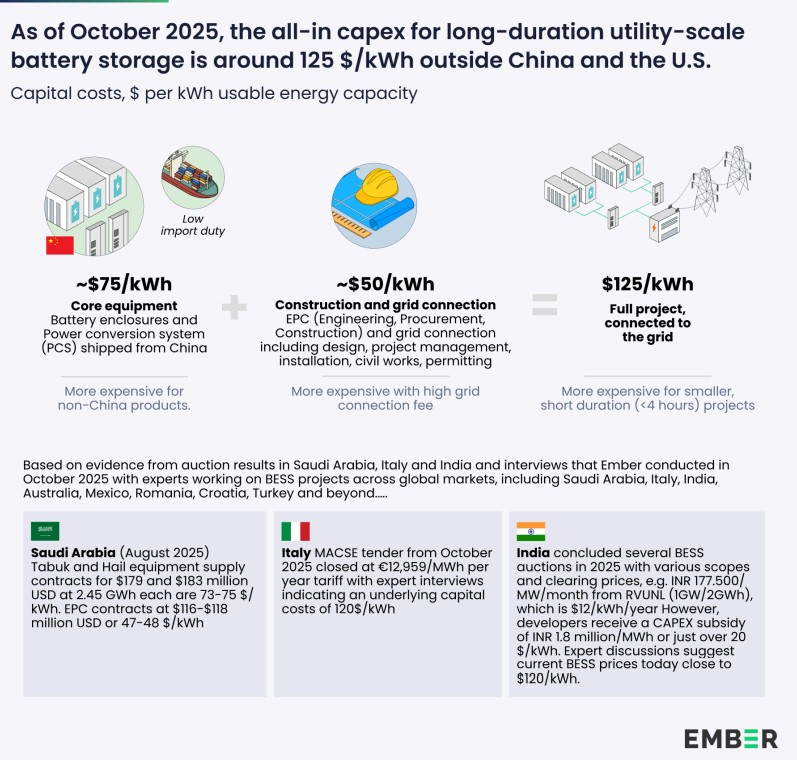
Ember’s assessment of storage costs is based on recent auctions in Italy, Saudi Arabia and India and on expert interviews.

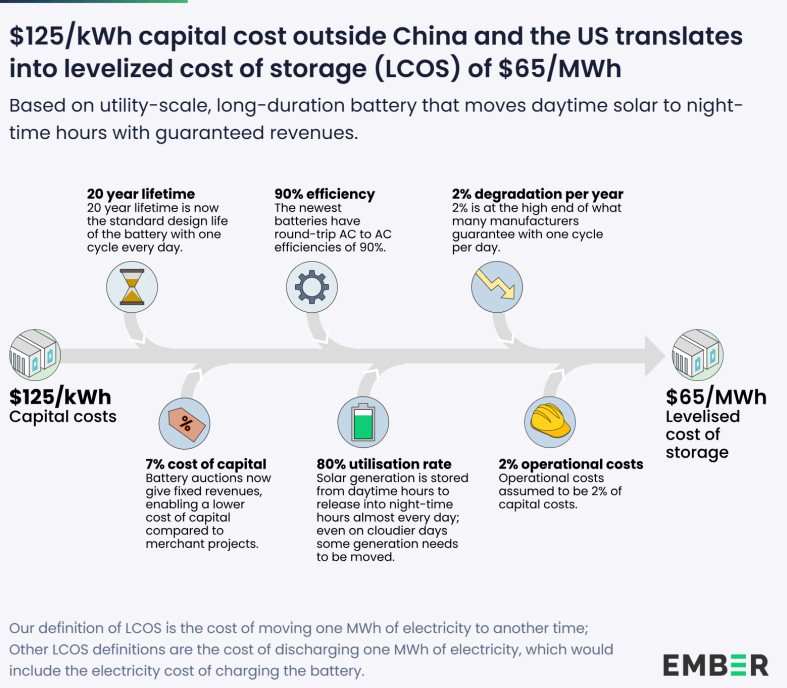
Across global markets outside China and the United States, the total capex to build a long-duration (four hours or more) utility-scale battery energy storage system (BESS) project is around USD 125/kWh, the study reads.

The price combines USD 75/kWh for the core equipment shipped from China and USD 50/kWh to install and connect the battery.
world ember bess energy storage cost capex

The authors of the analysis calculated a levelized cost of storage (LCOS) to be USD 65/MWh.

The metric reflects the cost of shifting one megawatt-hour to another time, such as moving daytime solar to nighttime. It doesn’t include the cost of electricity to charge the battery.

This low LCOS is not only the result of cheaper batteries, given that longer lifetimes, higher efficiencies and lower financing costs thanks to clearer revenue models like auctions have all helped to push the indicator down sharply, according to the analysis.

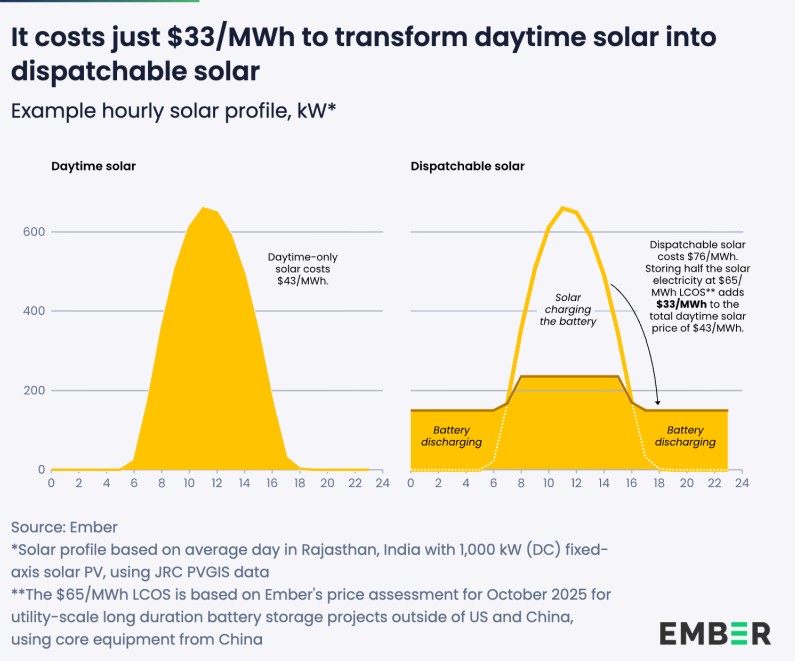
With the cost of storing electricity at USD 65/MWh, storing 50% of a day’s solar generation for consumption in nighttime hours adds USD 33/MWh to the total cost of solar. The authors used IRENA’s global average price of solar in 2024 of USD 43/MWh.

Delivering constant power every hour of the year requires solar overbuild and more battery storage

Turning this cheap daytime electricity into a dispatchable profile that is closer to an actual demand profile, would therefore result in a total electricity cost of USD 76/MWh, the analysis reads.

The authors stressed that this isn’t the same as baseload solar. Delivering constant power every hour of the year, including cloudy weeks and seasonal lows, requires solar overbuild and more battery storage, they added.

However, shifting half of daytime solar is a major step that aligns solar generation more closely with a typical demand profile, meaning solar can meet a much larger share of the evening and nighttime demand, the authors explained.
world ember bess energy storage cost lcos

Kostantsa Rangelova, ‍Global Electricity Analyst at Ember, pointed out that after a 40% fall in 2024 in battery equipment costs, another major drop is clearly on track in 2025.

“The economics for batteries are unrecognizable, and the industry is only just getting to grips with this new paradigm. Solar is no longer just cheap daytime electricity, solar is now anytime dispatchable electricity. This is a game-changer for countries with fast-growing demand and strong solar resources,” she is convinced.

Cheap batteries will enable solar to meet the majority of global energy growth
world ember bess energy storage cost lcos dispatchable solar

The analysis cited a projection from the IEA’s latest World Energy Outlook that in the next decade, 80% of global energy demand growth would come from regions with high-quality solar irradiation.

For these countries, combining solar with storage is now the most affordable path to meet soaring demand, improve energy security and reduce dependence on fossil fuel imports, according to the analysis.

It is an opportunity to develop clean industries

Dispatchable solar with a price of USD 76/MWh is cheaper and quicker than building a new gas power plant, especially if the country relies on more expensive LNG imports, they stressed.

The authors also pointed out that the installation of BESS could help the development of clean industries.

Even when core BESS equipment is imported, roughly 40% of total project value (about USD 50/kWh out of USD 125/kWh) remains local through engineering, civil works, grid connection and other EPC activities, the analysis reads.
by in News

Record solar panel imports in Africa: a lifeline for a continent where 600 million people lack electricity

Half of Africa’s population still lacks access to electricity, but a record surge in solar panel imports could signal a turning point. A report by the Ember research center shows a 60% increase in solar panel imports from China to Africa. Although it is too early to make forecasts, the report suggests that the solar boom could positively impact the power systems of many African countries.

As many as 570 million people in Africa still lack reliable access to electricity, which is almost half of the continent’s population. According to data from the Energy Progress Report, in 2022, 685 million people worldwide did not have access to electricity, meaning that Africa accounts for 80% of the global population without access.

While North African nations and countries like Ghana, Gabon, and South Africa have made progress, major challenges remain in Central Africa and the Sahel region (Burkina Faso, Mali, Niger, Cameroon, Guinea, Gambia, Senegal, Nigeria, Chad, and Mauritania), where entire communities remain off the grid.

Solar energy could be an opportunity for Africa to skip the phase of relying on fossil fuels and make a significant step toward an energy transition. It is still too early to say if this process is already underway, but the latest report by Ember shows that solar power is gaining serious momentum.

The total imported capacity reached 15,032 MW

According to their analysis, from June 2024 to June 2025, solar panel imports from China to Africa increased by 60%. The total imported capacity during these 12 months amounted to 15,032 MW. Ember used Chinese customs data in the report because China is the world’s largest producer and exporter of solar panels, accounting for around 80% of the global output in 2024.

The last significant increase in solar imports was recorded in 2023, when South Africa experienced a solar boom due to its energy crisis. However, new data shows that interest in solar energy is spreading to other countries as well. Solar panel imports outside South Africa nearly tripled in the last two years, rising from 3,734 MW to 11,248 MW.

The report shows that a record solar panel import was set in as many as 20 African countries, while 25 countries imported at least 100 MW of solar capacity from June 2024 to June 2025.

Increasing solar panel imports could reduce fuel imports

Ember’s analysis suggests that solar could significantly contribute to electricity production in many African countries. If Sierra Leone installed all the panels imported in the last 12 months, it could produce the equivalent of 61% of its total electricity output from 2023. Similar results are seen in Chad — 49%.

In five countries, newly imported solar panels could contribute more than 10% of total electricity production from 2023: Liberia (25%), Somalia (15%), Eritrea (15%), Togo (11%), and Benin (10%). Overall, 16 countries have the potential to increase electricity production by at least 5%, according to the report.

In addition, solar panel imports can significantly reduce fossil fuel imports, especially diesel, on which many African countries still rely. According to 2022 research by Wood Mackenzie, 17 African countries had more diesel generator capacity than grid-connected power plants.

In some countries, such as Nigeria, if diesel imports for electricity production were stopped, savings could cover the cost of solar panels in approximately six months or even less.

Although solar expansion in Africa is accelerating, experts emphasize that the process is still in its early stages and that more data and research are needed to fully understand its potential.

by in News

Global solar installations soar 64% in the first half of 2025

The world’s total capacity of solar power plants has increased by 380 MW in the first half of 2025. It is a 64% increase compared to the same period last year, according to Ember.

In the first six months of 2024 the world added 232 GW. It took until September that year for new solar capacity to surpass 350 GW – a result for the entire 2023. This year the milestone of 350 GW was reached in June, according to the energy think tank Ember.

The total global cumulative installed capacity reached 2.2 TW by the end of 2024.

The rapid expansion of solar capacity in recent years has made it the fastest growing source of new electricity generation. In 2024, global solar output rose by 28% (+469 TWh) compared to 2023, more than any other source, Ember noted.

China continues to lead the world in solar growth. Global Energy Monitor said in July that three quarters of global solar, wind capacity under construction is in China.

From January until the end of June, the country’s photovoltaic installations were more than 100% higher year-over-year.”

China accounted for 67% of the global new installations – up from 54% in the first half of 2024, according to the think tank.

The result was partly driven by the developers’ intention to finish projects before new rules on wind and solar compensation came into effect in June this year.

This situation could lead to lower installation in the rest of the year, however Ember stressed new clean power procurement requirements for industry and higher full-year deployment expectations from China’s solar PV association (CPIA) as evidence that a new record volume of solar power plants would be recorded in 2025.

India follows China

All other countries together installed an estimated 124 GW in the first half of 2025 – 15% higher than the first half of 2024.

India won second place with 24 GW, a 49% increase over the already strong 16 GW added in deployment in H1-2024. The United States ranked third with 21 GW, up 4% year-on-year, despite recent moves by the US government to restrict clean power deployment.

The remaining countries added 65 GW in H1-2025, 22% more than in H1-2024. Ember pointed out data for Africa in which imports from China rose 60% in the last 12 months. But, the effects on the ground are still not unknown.

2025 is on track to become another historic year for solar power

Solar became the EU’s largest source of electricity for the first time in June 2025. However, the EU is set to install less new solar capacity in 2025 than it did last year – the first annual drop in a decade.

Ember estimated that 2025 is on track to become another historic year for solar power.

“These latest numbers on solar deployment in 2025 defy gravity, with annual solar installations continuing their sharp rise. In a world of volatile energy markets, solar offers domestically produced power that can be rolled out at record speed to meet growing demand, independent of global fossil fuel supply chains,” Senior Energy Analyst of Ember Nicolas Fulghum noted.

by in News

World far off track from tripling renewables by 2030

Two years after a pledge at COP28 to triple global renewables capacity to 11 TW by 2030, a new analysis by Ember shows the world is only on track to double it, to 7.4 TW. The report finds that national targets have increased globally by just 2% since 2023 and that only 22 countries have updated their goals since COP28, mostly in the European Union.

Bruce Douglas, CEO of the Global Renewables Alliance (GRA), said it is “crazy to see how far off track” the world is from tripling renewables. In a LinkedIn post, he warned that despite renewable energy breaking records every year and the energy transition being inevitable, countries are not moving fast enough.

Douglas: Despite renewable energy breaking records, countries are not moving fast enough

The International Energy Agency (IEA) and the International Renewable Energy Agency (IRENA) have both confirmed that doubling energy efficiency and tripling renewables capacity is the fastest and cheapest way to decarbonize and deliver energy security in this decade, he wrote.

The new data, according to him, should be used to double global efforts, hold governments to account for what they signed up to, and encourage all stakeholders to seize this once-in-a-generation opportunity. Ember’s report states that increases in national commitments, followed by swift implementation, can help bring the global tripling goal within reach.

Ember: Increased targets and swift implementation can help triple renewables

According to Ember, among the top 20 electricity producers globally, national ambition remains largely unchanged.

The United States does not have a national target for renewable energy by 2030 and is not expected to set it in the near future. India’s target of 500 GW remains unchanged, while Russia does not have a 2030 target and is not expected to publish one.

China is currently finalizing its 15th five-year energy plan, which is expected to include a renewable energy target by 2030, according to Ember.

Its analysis comes at a time when countries are preparing for COP30 in Brazil in November.

by in News

Solar beats nuclear in June, becoming EU’s biggest electricity source for first time

Solar became the EU’s largest source of electricity for the first time in June 2025. National records for both photovoltaics and wind rolled in in May and June, pushing coal to an all-time low.

Solar was the largest source of electricity in the European Union for the first time last month, with multiple countries producing record amounts of solar power, Ember found. Wind power achieved the highest ever generation for the months of May and June, the think tank said.

Solar power generated 22.1% of EU electricity (45.4 TWh) in June, more than any other power source. It was a year-over-year increase of 22%. In second place was nuclear, with 21.8% (44.7 TWh), followed by wind, with 15.8% (32.4 TWh).

The big opportunity now comes from adding battery storage and flexibility to extend the use of renewable power into mornings and evenings, where fossil fuels still set high power prices, according to Ember’s Senior Energy analyst Chris Rosslowe.

At least thirteen EU countries set monthly solar records

At least thirteen countries recorded their highest-ever month of solar generation, amid an ongoing surge in photovoltaic installations. Among them were Bulgaria, Croatia, Greece, Slovenia and Romania, all the EU countries in the region that Balkan Green Energy News is focused on except Cyprus, for which there was no data for June.

Wind power reached an all-time high shares of 16.6% (33.7 TWh) and 15.8% (32.4 TWh) in May and June, respectively

Strong photovoltaic output helped the power system to handle higher levels of demand resulting from heatwaves that gripped the continent towards the end of the month, according to the report.

Wind farms generated 16.6% (33.7 TWh) and 15.8% (32.4 TWh) of EU electricity in May and June, respectively. It was an all-time high for both months. Notably, at the start of the year, wind conditions were relatively poor. They improved, and they were the main driver, though capacity has been continuously growing over the past year. Several large offshore wind farms were commissioned.

Coal falls to record low

As a result of high renewables generation in June, coal had the lowest-ever share of EU electricity. Total fossil generation was also low, but it grew in the entire first half of the year on an annual basis.

Coal generated just 6.1% (12.6 TWh) of EU electricity in June, down from the 8.8% registered in the same month of last year.

The two countries that account for the vast majority of EU coal power (79% in June) both saw record lows in June. Namely, Germany generated just 12.4% (4.8 TWh) of its power from coal, and Poland 42.9% (5.1 TWh). Four other countries recorded their lowest-ever month of coal generation in June: Czechia (17.9%), Bulgaria (16.7%), Denmark (3.3%) and Spain (0.6%), which is approaching its coal phaseout.

Fossil fuels generated 23.6% (48.5 TWh) of EU electricity in June, just above the record low of 22.9% in May 2024. Nevertheless, fossil generation in the first half of 2025 was 13% higher (by 45.7 TWh) than in the first half of 2024, mainly due to a jump in gas generation by 19% or 35.5 TWh. Lower hydropower (due to drought) and wind generation than last year, and increasing demand marked the period.

Electricity demand continued on an upward trajectory. In the first half of 2025, the EU consumed 1.31 PWh of electricity or 2.2% more than in the same period of last year.

by in News

Serbia’s power demand soars 20%

Electricity consumption in Serbia has increased by 15% to 20% over the past three weeks compared to the same period last year, according to Dragan Rakić, the head dispatcher of Serbia’s transmission system operator Elektromreža Srbije.

The main reason for the rise in electricity consumption is the increased use of air conditioning units due to the heat wave, which began as early as mid-June this summer.

Dragan Rakić, the head dispatcher of TSO Elektromreža Srbije (EMS), told public broadcaster RTS that the system remains stable despite high temperatures and the reduction of electricity production in hydropower plants.

The record high for summer electricity consumption was set on July 17 last year

Daily consumption in recent days has been 92 GWh to 95 GWh, with the peak of 98.5 GWh reached on June 26. Rakić recalled that the all-time summer consumption record was 105.8 GWh on July 17 last year.

The highest consumption occurs in major cities such as Belgrade, Novi Sad, and Niš. Air conditioners are on even at night, both at home and at work, he added.

Rakić stressed that the electricity supply situation is stable, although hydrological conditions are negatively affecting electricity production in hydropower plants, and partially coal-fired power plants, which require water for cooling.

He added that much of Europe was affected by the dry spell.

EMS is also prepared for extreme weather events

Meanwhile, European think tank Ember noted that record solar power production, backed by energy storage capacity, helped maintain the stability of the electricity system in Europe during the latest heatwave.

Temperatures across Europe jumped to more than 40 degrees Celsius, triggering an increase in electricity demand as the use of air conditioners soared. Daily electricity demand on July 1 was up to 6% higher in Germany, 9% in France, and 14% in Spain than on June 24.

Rakić claimed EMS is ready for extreme weather conditions as well as other emergencies. The company has emergency power line towers and crews on standby when a red weather alert is issued, he explained.

by in News

Heatwave strains European grid, brings profit to energy storage operators

Record solar power production, backed by yet insufficient energy storage capacity, helped maintain the stability of the electricity system in Europe during the latest heatwave, Ember said. Many nuclear and other thermal power plants reduced their activity as river water temperature wasn’t low enough for efficient cooling. Intraday price spreads at European power exchanges landed a windfall for owners of battery energy storage systems and pumped storage hydropower plants.

The heatwave since late June has caused stress for European power systems, driving electricity demand and doubling daily power prices. Yet grids remained stable, fueled by record volumes of solar, think tank Ember pointed out in a report.

Outside temperatures jumped to more than 40 degrees Celsius, triggering an increase in electricity demand as the use of air conditioners soared. Outages in nuclear and thermal power plants exacerbated the challenges.

Daily electricity demand on July 1 was by up to 6% higher in Germany, 9% in France and 14% in Spain than on June 24. As for peak demand, it jumped by 12% in France, 15% in Spain, and 5% in Germany and Poland.

A bigger electricity price spread within one day means higher income for operators of battery energy storage systems

The average daily price surged 15% in Spain, 106% in Poland, 108% in France and 175% in Germany.

“Despite the huge pressure, European grids passed the stress test, and solar electricity played a major role in keeping them running. The surplus of solar energy during the day helped prevent blackouts. However, the use of energy storage is still insufficient, leading to reduced energy supply after sunset. This translated into a sharp increase in electricity prices,” said Ember’s Europe Programme Director Paweł Czyżak.

Record EU solar generation helps keep power supply stable

June saw the highest solar generation on record in the European Union – 45 TWh, which kept the grid well-supplied during daytime hours. The result was 22% up from one year before.

“Heatwaves will not go away – they will only get more severe in the future. Solutions that can help mitigate their impacts, such as battery storage, interconnection, demand flexibility and dynamic tariffs, should become a key part of grid planning and power market design,” Czyżak added. The biggest opportunity is to store solar electricity, to help power air conditioning well into the evening, he stressed.

Outages limited but still posing concern

The overheating of cables is the likely cause of power outages in Italy on July 1. With rising air and water temperatures, the cooling of thermal power plants becomes more challenging as well. It led to forced reductions in electricity generation from nuclear power plants in France and Switzerland.

The French nuclear fleet has been impacted the most, with all but one of the 18 facilities experiencing some type of capacity reduction. According to the update, up to 15% of the capacity may have been impacted.

A blackout of several hours struck large parts of the Czech Republic including Prague on July 4. However, the authorities only blamed it on a transmission cable in the country’s northwest falling, and the resulting domino effect. Notably, the air temperature was much lower than in previous days.

Sun brings power alongside heat

In the peak days of the heatwave in Germany, solar delivered 50 GW and even more, generating 33% to 39% of Germany’s electricity. The country hosts 14 GW of battery energy storage systems (BESS) and 10 GW of pumped storage, which partly bridged the gap between the peaks of production and consumption.

The rallies in electricity prices in the evenings are getting passed on to consumers, so using air conditioners gets more expensive upon sunset. It is a business case for clean flexibility solutions. Due to a high supply of solar electricity during the day, and a cooling-related demand peak in the late afternoon hours, the daily electricity price spreads skyrocketed.

The spread in Poland in the day-ahead segment almost reached EUR 500 per MWh on July 1. Namely, the daily low was EUR 21.04 per MWh below zero, and the peak amounted to EUR 471 per MWh. In Germany, the benchmark went from EUR 0.16 per MWh in negative territory to EUR 404.91 per MWh.

Storage assets charge at low prices and discharge during peak time, reducing the need for costly imported fossil fuels in the evening, and supporting the balancing of the grid, the analysts underscored.

Interconnection played a role as well. The heatwave peaked in different countries on different days, so interconnectors moved electricity to where it was needed most, dissipating the price peaks in the process.

by in News

Turkey’s renewables failing to cover power demand growth despite solar boom

Turkey switched in 2024 from a net electricity importer to net exporter, but renewables are still not growing fast enough to meet rising domestic power demand – one of the highest in the world, Ember found. The country has become Europe’s biggest coal power producer and there are plans for more such capacity.

Wind and solar generated 18% of electricity last year or 62 TWh, according to data from Ember’s Türkiye Electricity Review 2025. Together they were higher than domestic coal again, at 47 TWh, after surpassing it for the first time in 2023. But imports account for 61% of coal power production in the country.

Solar power growth spiked 39% in Turkey or by 7.3 TWh and the capacity reached 19.8 GW by the end of 2024. It compares to the global rise of 29% in output.

Photovoltaics had a 7.5% share, after 5.7% one year earlier. The wind power item advanced by only 0.1 percentage point, to 10.7%.

Government’s ambitions for renewables would result in 49% combined solar, wind power share in production

At 5.5%, Turkey had one of the highest increases in power demand last year in the world, mostly because of record meteorological heat pushing up cooling needs. The amount was 18 TWh and the total reached 342 TWh.

The rise in domestic electricity generation totaled 23 TWh and Turkey achieved a switch from a net power importer to net exporter. Nevertheless, wind and solar are still not growing fast enough to meet rising demand, translating to costly imported fossil fuel power generation, the report points out. The situation is similar on a worldwide scale.

The 7.3 TWh increase in solar accounted for 32% of the jump in electricity generation, compared to 40.2% on a global scale. The ambitious renewables targets for 2035 would result in a share of fossil fuels of 20%, and wind and solar at 49% in combination.

“Although demand growth has slowed in recent years, it is still outpacing the rate of new wind and solar additions. Demand increased by 42 TWh in the last five years, compared to 31 TWh of additional wind and solar. The rest of demand is met by imported coal and gas,” said Ufuk Alparslan, the report’s author and the energy think tank’s regional lead for Turkey and the Caucasus.

‍Romania beats Turkey in solar power production share

In the group of 20 countries with the highest electricity demand in Europe, Turkey surpassed Switzerland in solar electricity generation in 2024. On the other hand, it fell one position behind Romania, which is ranked 12th, as it doubled its solar power share to 7.8% in 2024.

The first in the list is Hungary, with 24.9%, followed by Greece (21.5%) and Spain (21.2%).

Adding solar to hydroelectric plants with dams mitigates drought impact

From 2020, solar power plants can be installed as an auxiliary source in power plants in Turkey, which creates hybrid power plants. Making more use of solar and wind power plants, which have a complementary generation profile to hydroelectricity, will play a key role in ensuring Türkiye’s energy security, the report reads.

Terrestrial and floating solar power plants as secondary sources to existing hydroelectric power plants reduce the risk of a shortfall from hydro in dry years, it added.

Although the amount of incoming water in 2024 was very close to the previous two years, hydroelectric power generation with dams increased by 29%. Total hydropower generation was 75 TWh or 17% more than in 2023 and it was the third-highest result so far.

Turkey is largest coal power producer in Europe

Despite a jump in electricity generation from coal by 3.4% to 122 TWh, its share in electricity mix declined from 36.9% to 35.6%. With coal-fired power generation continuing to decline across Europe, Turkey overtook Germany to become number one. Meanwhile, gas power fell by 4%. It brought the share of fossil fuels in production to 55% — the lowest level since 1993.

There are no coal-fired power plants under construction, but several projects remain. There is a plan to expand the largest facility in the fleet, Afşin Elbistan A (1.36 GW), by two units of an overall 688 MW.

Germany’s coal power output fell 17% to 104 TWh while in Poland, the third in the list, it declined 8% to 91 TWh. As for the share in domestic electricity production, Poland is first, with 53.6%, followed by Czechia (36.5%), Turkey (35.6%), Germany (21.8%), Bulgaria (21.6%), Romania (13%) and Greece, with just 5.7% last year.

As for the Western Balkans, Kosovo* is ranked the highest in the world, now at 92%. Serbia and Bosnia and Herzegovina are fifth and sixth, respectively, both at 63% on a rounded basis.

* This designation is without prejudice to positions onstatus and is in line with UNSCR 1244/99 and the ICJ Opinion on the Kosovo declaration of independence.
by in News

Ember: Warming’s 2024 share of global power demand rise was covered with fossil fuels

According to Ember’s new figures, renewable energy sources met almost three quarters of last year’s increase in the world’s electricity demand. Together with nuclear energy, they would have covered almost the entire jump if it wasn’t for the share attributed to the annual increase in temperatures. Looking at it the other way around, the need for additional cooling accounted for the overwhelming part of the rise in fossil fuel use, and at the same time the resulting additional emissions contributed to the acceleration of global warming.

The share of low-carbon sources rose to a historic 40.9% of global output in 2024. Photovoltaics made up 55.2% of renewable electricity production growth. Hungary, Greece and Bulgaria are among the world’s strongest solar power producers while Turkey has one of the highest power demand growth rates.

Taken together, wind and solar power, hydroelectric plants, other renewables and nuclear energy amounted to 40.9% of global electricity generation in 2024. One year earlier, the level was 39.4%. Last year’s share was the highest since the 1940s, when the global electricity system was fifty times smaller, Ember said in its Global Electricity Review 2025. 

At the time, there was only hydropower and some biomass on the list. Solar power has been the main factor of change over the past several years, and so has China.

Global electricity demand jumped 4% last year or 1.17 PWh, amplified by heatwaves, and reached an all-time high of 30.9 PWh. Periods of higher temperatures in another hottest year ever drove up demand for cooling. The relative increase in 2023 was 2.6%.

Hydropower remained the largest source of low-carbon electricity (14.3%), followed by nuclear (9%). Wind (8.1%) and photovoltaics (6.9%)  are rapidly gaining ground and together they overtook hydro in 2024, while nuclear’s share reached a 45-year low.

Renewables meet 73.2% of growth in world power demand

Renewable power sources accounted for 858 TWh of added output. The previous record of 577 TWh was set two years earlier, as hydropower dropped in 2023, also mostly because of heat.

EVs, heat pumps, data centers and other new drivers of power demand more than doubled their share in annual growth in five years

Renewables met 73.2% of growth in demand and nuclear energy covered 5.9%. Together, they nearly accounted for all growth except the temperature effects, and the rest was from fossil fuels.

Interestingly, looking at it the other way around, the need for additional cooling accounted for the overwhelming part of the rise in fossil fuel use. Of course, the resulting additional emissions contributed to the acceleration of global warming.

Fossil fuel use would have remained almost unchanged if temperatures didn’t grow, the think tank claims. Global power sector emissions rose by 1.6% to a new all-time high of 14.6 billion tonnes of CO2.

But at least the demand for cooling during the day mostly runs in parallel to solar power production. Moreover, the pace of energy storage capacity increase still isn’t keeping up with the growing need to balance photovoltaics and wind power, as they depend on the weather.

However, the update focuses only on one indicator, within the annual growth in power demand. The system is much more complex and fossil fuels weren’t only and directly used for cooling. There is also the matter of distribution across segments from the entire output.

New drivers of demand such as electric vehicles, heat pumps and data centers contributed roughly the same to annual demand growth as the temperature effect, but more than twice as much as they did five years before.

China nearing one third of global electricity demand

China’s electricity demand surged 6.6% or by 623 TWh, which accounted for more than half of the global rise. Its 10.07 PWh in total was 32.6% of the overall figure. Five years before the country was at 28%. Renewables and nuclear energy covered 81% of its demand increase.

China’s per capita electricity use overtook France’s for the first time last year

The United States is number two overall, with 4.4 PWh in 2024 or 14.3% of the global level. China’s per capita electricity use overtook France’s for the first time, and was five times that of India’s.

Turkey’s growth rate, 5.6%, was among the highest on the planet. In absolute terms, demand jumped 18 TWh.

Photovoltaics beat coal power in 2024 in EU

Solar power production spiked by a stunning 29%, which was a six-year high, or by 474 TWh. Photovoltaics were the largest segment of new electricity for the third year in a row and grew the fastest for the 20th straight year. Total output reached 2.13 PWh.

Global solar power capacity reached 1 TW in 2022 after decades of growth, but it surpassed 2 TW only two years later. China amounted to 53% of the increase in PV generation in 2024.

Solar power topped coal power output in the European Union for the first time. As for the share of domestic production, Hungary tops the global list, with 25%. Chile is second at 22%, and Greece is third and best, with 22%, among the countries that Balkan Green Energy News mainly tracks.

Bulgaria is also in the main chart, coming in ninth on a global scale, with 14.4%.

As for solar power production per capita, Australia leads by far with 1.87 MWh, followed by the United Arab Emirates (1.29 MWh) and Greece, also at 1.29 MWh on a rounded basis. Hungary is seventh in the category, at 971 kWh per person.

In the rest of Southeastern Europe, Turkey sticks out as tenth on the planet in hydropower output, at 75 TWh. Albania has the fourth-highest share of domestic production, 97%.

Notably, Kosovo* tops the list of coal’s share in electricity production, with 92%. Bosnia and Herzegovina and Serbia still seem pretty much stuck with the technology. They are fifth and sixth, respectively, both at 63% on a rounded basis.

* This designation is without prejudice to positions onstatus and is in line with UNSCR 1244/99 and the ICJ Opinion on the Kosovo declaration of independence.