by in News

European electricity industry issues Paris Pledge on pumped storage hydropower

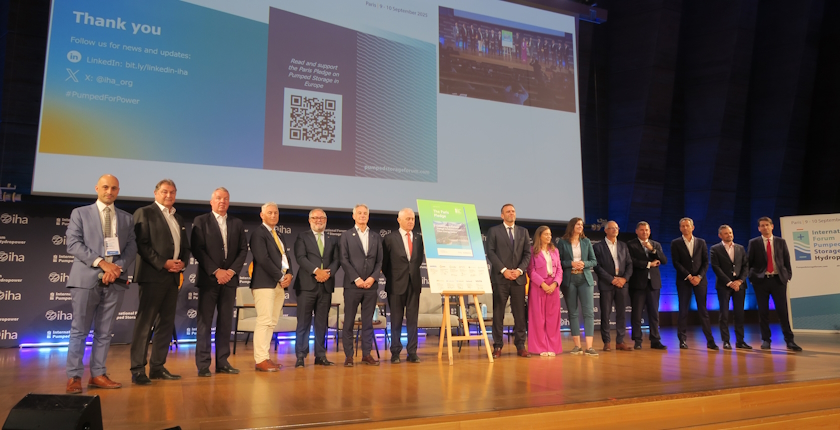
The International Hydropower Association (IHA) and Eurelectric launched the Paris Pledge. It is a collective call to action, aimed at unlocking the potential of pumped storage hydropower in Europe. The signatories urge the European Union and national governments to create the right conditions for long-duration storage to meet clean energy goals.

Over 50 utilities, hydropower suppliers and energy-focused associations have signed the Paris Pledge. The document’s alternative headline is Committing to Pumped Storage to Secure Europe’s Clean Energy Future.

The International Hydropower Association (IHA) and Eurelectric – Union of the Electricity Industry launched the initiative. They warned that Europe faces an urgent and growing need for long-duration electricity storage to secure a reliable, affordable and sustainable energy future.

Amid the transition to a renewables-dominated power system, the ability to store and dispatch electricity over long periods will be critical to balance variable generation from wind and solar, ensure grid stability and resilience, and reduce reliance on imported fossil fuels, the authors stressed. They called pumped storage hydropower or PSH the most important, scalable and cost-effective long-duration electricity storage solution available today. It still provides over 90% of the world’s long-duration electricity storage capacity.

PSH is currently the most important, scalable and cost-effective long-duration electricity storage solution, the industry pointed out

By 2050, around 86% of production capacity in Europe will come from variable sources, according to the material accompanying the Paris Pledge. Encouragingly, 78 pumped storage hydropower projects are under development, for 35 GW overall. The EU accounts for over 32 GW, and the rest is in Switzerland, Norway and Turkey.

The combined pipeline would provide storage capacity in excess of 700 GWh, equivalent to more than 10 hours of consumption of Italy and Spain taken together. There is 3.9 GW in the ready-to-build phase, and 2.8 GW is under construction. Of note, an earlier report showed 52.9 GW of PSH was under development.

The existing capacity amounts to 48 GW, compared to 190 GW globally. In the EU, pumped storage hydropower systems can store 1.2 TWh overall.

Photo: Types of pumped storage (IHA, Eurelectric)

Paris Pledge calls for separate legislation for long-duration energy storage

Among other proposals, the signatories are asking the EU for a dedicated initiative to boost the rollout of electricity storage. They suggested legislation to be separate for long duration, short duration and other solutions.

The Paris Pledge calls on member states to remunerate the provision of system services and security of supply for all time frames. They should eliminate double grid fees on electricity storage technologies and accelerate permitting for PSH, the document reads.

With strong political commitment, Europe can double its pumped storage hydropower capacity in the next 25 years, according to the Paris Pledge. In-person signatories represent EDP, EDF, Iberdrola, Andritz, Enel, Statkraft, Voith, Hydrogrid, Verbund, Landsvirkjun and GE Vernova.

Pumped storage hydropower’s contribution during Iberian Peninsula blackout

During the power blackout in Spain and Portugal on April 28, pumped storage played a pivotal role in balancing and supporting the recovery of the system. In Spain, PSH generated 11 GWh of electricity in the first 12 hours, instead of the planned 12 GWh recharge. Similarly, in Portugal, hydropower and pumped storage covered 80% of the demand in the first ten hours.

Such facilities also made a major contribution to restoring the electricity grid in the entire peninsula, thanks to their so-called black start capability. It allows the power plant to be restarted without relying on external power sources and to reenergise the power system.

“Very few technologies can provide this function. As a result, within a few minutes, the first pumped storage plants were ready for synchronization and awaiting dispatch instruction” from transmission system operators, notes the report published with the Paris Pledge.
by in News

EDP Renewables sells wind farms in Greece to Enel-Macquarie joint venture

Principia agreed to acquire all four EDPR’s wind power plants in Greece. The joint venture of Enel and Macquarie Asset Management’s funds is nearing 800 MW in renewable energy and battery storage capacity in the country.

Principia, owned equally by Italy-based Enel and funds managed by Macquarie Asset Management, headquartered in Australia, is strengthening its presence in Greece with a purchase of four wind farms. EDP Renewables is selling the facilities to the firm after reportedly deciding to exit the country.

The joint venture, which expects to close the transaction later this year, revealed that the estimated enterprise value exceeds EUR 200 million. The measure can include debt and some other items. The takeover is adding 149.6 MW to its operational capacity, which would reach 727 MW, from 70 power plants. Wind power accounts for 517.8 MW.

With the purchase, Principia will operate a total of 517.8 MW in wind power capacity.

“The acquisition of this portfolio strategically strengthens Principia’s presence in the Greek renewable energy market, in a constantly evolving environment, and reaffirms a role of leadership in the country’s energy transition. With this investment, we further reinforce our position in the Greek clean energy market and take another step toward delivering on our ambitious plan for growth, diversification, and reliable clean energy generation across Greece,” Principia’s Chief Executive Officer Aristotelis Chantavas said.

All four wind farms operate within CfD scheme

All four wind farms are operating under 20-year contracts for difference (CfDs). Livadi (45 MW) and Erimia (35 MW) are in Malesina, Phthiotis. Wind power plants Xironomi (36 MW) and Chalcodonio (33.6 MW) were commissioned this year. They are located in Boeotia, Central Greece, and Magnesia, Thessaly, respectively.

Newmoney learned, without revealing its source, that Terna Energy, ENI Plenitude, HELLENiQ Energy and some investment funds also participated in the process, interested in the portfolio. The acquisition will lift Principia by one notch to become third among the largest wind farm operators in the country, the article adds.

Principia aims to complete construction of 49 MW battery system by year-end

Principia has another 230 MW under construction or in the ready-to-build stage, and 5.6 GW more in various stages of development.

It is building a battery energy storage system (BESS) of 49 MW in Polygyros, in the Halkidiki peninsula. It won government support at Greece’s second energy storage auction.

The Paleolivada facility is due to come online before the end of the year. Construction began in March. It will have 98 MWh in guaranteed capacity, versus 127 MWh installed.

The firm has a mature project for a hybrid power plant of 111 MW and 70 MW of solar power capacity. The site is in Atherinolakos, in Sitia in the south of Crete.

Principia inaugurated a photovoltaic cluster of 95 MW in May. The Perasma facility, near the villages of Mavrodendri and Sidera, is set to generate 126.8 MW per year. It comprises seven units and 170,000 bifacial panels.

Macquarie Asset Management agreed to buy 50% of Enel Green Power Hellas in 2023.

Of note, EDP Renewables (EDPR) is headquartered in Spain, but traded on the Euronext Lisbon stock exchange. It is a subsidiary of EDP.

by in News

Foreign renewable energy investors remain committed to Romania as large plants coming online

Renewable energy companies from abroad aren’t intimidated by negative power prices in Romania, especially with the battery storage segment accelerating. Energy giants EDP Renewables and Engie have new solar power plants, and more renewable energy facilities are coming online, while the government is disbursing European grants.

The renewable energy market in Greece is consolidating and a number of foreign investors are leaving, but some other countries in the region that Balkan Green Energy News tracks remain attractive, especially Romania and Turkey. Big names from abroad keep coming, and the established ones are commissioning facilities and committing to more projects.

Like elsewhere in Europe and beyond, the increasing occurrence of low, zero and negative power prices are impacting the sentiment in Romania. But funding from the European Union, the government’s administrative support, renewable energy auctions and bets on battery storage seemingly outweigh the current risks.

EDPR’s new photovoltaic park Albina will generate 67 GWh per year

EDP Renewables (EDPR), subsidiary of Portuguese energy giant EDP, recently inaugurated its Albina photovoltaic plant. Located in western Romania, just outside of the city of Timisoara, the renewable energy unit came online late last year.

Albina has 60 MW in peak capacity and a 48.8 MW grid connection. The company expects it to generate 67 GWh per year. EDP said that with the new plant it reinforces its commitment to Romania. It operates wind and solar power plants in the country of over 570 MW in combined capacity.

Engie praises renewable energy potential in Romania

Engie Romania commissioned the sixth photovoltaic park in its portfolio. It is located in the commune of Ariceștii Rahtivani in Prahova county. Together with the new facility, of 37.2 MW in peak capacity, French Engie’s branch in Romania now has 248 MW in renewable energy in operation.

The site covers ​​57 hectares. Estimated annual output is 57 GWh. The firm owns three wind farms of 178 MW in total while its six PV systems have 70.3 MW in overall peak capacity. Last year it built one of the first hybrid power plants in the country.

Engie Romania said the new plant strengthened its position and praised the country’s “significant potential” in the renewable energy segment. The firm targets 1 GW in the country by 2030. It also distributes natural gas and supplies both gas and electricity, and offers energy services.

Rezolv building one of largest wind power plants in Europe

The Vifor wind farm in Buzău county, northeast of Bucharest, is almost half done. Rezolv Energy plans to finish it in 2027. The first phase is for 192 MW, with a planned expansion to a colossal 461 MW.

The company purchased Vestas turbines for the wind park, which is set to become the largest in Europe and the second-largest in Romania. The developer won a fixed electricity price for 15 years in the form of a contract for difference at the country’s renewable energy auction. The wind power plant will also benefit from a power purchase agreement (PPA).

Wind farm of 99.2 MW Galaţi in to launch operations next year

OX2 is building the Green Breeze wind farm, delivering the project as a turnkey construction project for the investor, Nala Renewables. The project involves 16 Vestas V162-6.2 MW turbines, or 99.2 MW altogether. Annual production at the future wind power plant in Galaţi in the eastern part of the country is 312 GWh, according to the estimate.

The facility is on schedule for the start of operations in the first half of next year. Together with Green Breeze, OX2 is working on 620 MW in five wind power projects. The Swedish company has said it intends to grow and diversify in the country.

Enery from Austria lining up renewable electricity plants in Romania

Romania-based Enevo announced that it started building a solar park of 54.2 MW in peak capacity for Enery Development.

Also in Dâmbovița county, Enery Element, the joint venture of the Austrian company with Element Power Group, has a project for a battery-backed PV park.

Total investment is some EUR 27.5 million, of which EUR 2.4 million is from the EU’s Modernisation Fund. The solar power component is 74 MW and the battery energy storage system (BESS) would provide 10.2 MWh in capacity. The location, formally run by project firm Gura Solar Plant, is in the Gura Ocniței commune.

Ecoener, headquartered in Spain, is developing an agrivoltaic project of 11 MW

A Spanish group with an annual turnover of almost EUR 100 million wants to build the first agrisolar park in Iași county, in the commune of Țibănești. Solar panels of 11 MW in total peak capacity would be placed 1.5 meters above ground. The investor, Ecoener, established a Romanian subsidiary for the endeavor: Ecoener Țibănești.

Greece’s PPC turning its wind, PV facilities into hybrid power plants with battery storage

Greek state-controlled Public Power Corp. (PPC) is developing a BESS investment through its firm Sun Challenge, which operates the Lumina solar power project in Călugăreni, Giurgiu county. The PV facility of 63 MW in peak capacity has been online for two years now. Lumina is PPC Renewables’ largest solar power unit in Romania.

It is one in a string of the Greek company’s energy storage projects. PPC plans BESS at its wind farms Topolog (27 MWh), Corugea (80 MWh) and Sălbatica (60 MWh) in Tulcea county. It slated another 120 MWh in total storage capacity at wind power plants Nicolae Bălcescu and Târgușor in Constanța county.

PPC operates wind, photovoltaic and hydropower capacity in Romania of 1.3 GW overall

The Fântânele-Cogealac-Gradina wind farm, which PPC took over from Macquarie Asset Management, already includes a BESS facility. The 600 MW facility is the largest in Romania of its kind.

In Prahova, PPC Renewables Romania plans a 10 MWh storage system at the Berceni 1 photovoltaic park, with an installed capacity of 9.8 MW. Another storage system, of 8 MWh, would be integrated with the Colibași photovoltaic park (7 MW) in Giurgiu county.

PPC operates wind, photovoltaic and hydropower capacity in Romania of 1.3 GW overall.

Turkey-based YEO Technologies, Danish company Eurowind Energy and Solarpro, a contractor from neighboring Bulgaria, all have new investment updates, too.

by in News

EDPR reportedly exiting Greece as all power plants, projects are on sale

EDP Renewables (EDPR) is about to divest of all its assets in Greece and leave next year, according to the domestic media. Market-oriented green electricity producers in the country are at a disadvantage, due to low and negative prices and curtailments, against companies involved in retail supply and with long-term power purchase agreements (PPAs) and feed-in tariff support.

Green energy giant EDP Renewables (EDP Renováveis) is expecting official bids for its four wind parks northwest of Athens, while also looking to sell all its other assets to MORE, the renewables subsidiary of oil refiner Motor Oil Hellas, according to news reports. The latter portfolio is said to include their joint venture.

EDPR, part of Portugal-based EDP Group, is apparently planning to exit the country next year, as early as the summer, and is already cutting jobs. The company entered Greece in 2018.

The wind parks, reportedly pursued by four domestic companies, are Livadi (45 MW) and Erimia (35 MW) in Malesina, Phthiotis, both commissioned last year, and new facilities Xironomi (36 MW)  and Chalcodonio (33.6 MW). They are located in Boeotia, Central Greece, and Magnesia, Thessaly, respectively.

Of note, EDP Renewables is headquartered in Spain, but traded on the Euronext Lisbon stock exchange.

Project portfolio includes major wind power clusters in Evia

The Greek press learned that MORE is likely to buy out EDPR’s 51% share in their projects for two wind farm clusters in Evia (Euboea), of 150 MW and 214 MW. Other assets that the oil refiner would pursue include another cluster under development for sites in the same island, of 156 MW, an operating 22 MW photovoltaic park in the Peloponnese and two wind farms under construction in Boeotia (also Beotia and Viotia).

In addition, the company has a pipeline of less mature projects for photovoltaics, standalone battery energy storage systems (BESS), hybrid power plants and wind power. They could all fit into one large package for sale.

EDPR is also exiting Hungary, Belgium, the Netherlands, Colombia, Brazil and a group of Asian countries.

Vertical integration or bust

Analysts have pointed out that the Greek market is no longer attractive to companies in the sector that are not vertically integrated. Namely, renewable energy producers oriented toward the market are exposed to curtailments and low, zero and negative power prices at electricity exchanges.

The ones also active in the supply and retail market have an advantage, as do the operators of power plants that receive subsidies like feed-in tariffs or have long-term PPAs.

The share of curtailed electricity in Greece is set to be more than doubled this year

Since the beginning of the year, over 860 GWh has been curtailed, Euro2day wrote. It is already more than all last year, when the share of lost electricity was 4%

But some companies seem dedicated to the Greek market.

France-based Valorem recently completed a wind park of 27 MW in Vlasti in the municipality of Eordaia. It is located in the Kozani regional unit in the region of Western Macedonia in northern Greece. The facility consists of six turbines, with an estimated annual output of 68 GWh overall.

Also in Kozani, Principia inaugurated a photovoltaic cluster of 95 MW. The firm is a joint venture between Enel and funds managed by Macquarie Asset Management. The Perasma facility, near the villages of Mavrodendri and Sidera, is set to generate 126.8 MW per year. It comprises seven solar power plants.

by in News

EDP Renewables inaugurates two wind power plants in Greece

EDP Renewables declared its two new wind farms in Central Greece and Thessaly open, adding almost 70 MW to the transmission grid. The country expanded its wind power capacity by only 125 MW last year.

EDP and its subsidiary EDP Renewables held an inauguration ceremony for two wind parks in Greece. It secured government support for both in 2019 at renewable energy auctions, through 20-year contracts for difference (CfD). At the time, the Portugal-based utility expected to begin commercial operations in 2022.

The two facilities have almost 70 MW in combined capacity connected to the transmission grid. The expected annual output is 143 GWh. It is equivalent to the electricity needs of more than 37,000 Greek households. EDP Renewables estimated carbon dioxide emissions savings to be over 102,000 tons per year.

Greece increased its wind power capacity by only 125 MW last year.

EDP Renewables relies on 20-year CfDs in its wind power investments in Greece

The event was held at the Xironomi site in Boeotia (also Beotia and Viotia) in the region of Central Greece. The wind farm has a capacity of 36 MW and the CfD is for 33 MW.

The other facility is Chalcodonio. It is located in the Magnesia regional unit in Thessaly. The 33.6 MW wind farm project has won a 30 MW contract for difference.

“Greece is emerging as a regional leader in renewable energy, as its abundant wind and solar resources offer enormous potential. The country’s commitment to reduce carbon emissions by 55% by 2030, in line with EU targets, makes it an attractive market for clean energy investments,” said Country Manager of EDP Renewables Dionysios Andronas.

Company has four facilities online

The company has 150 MW online in Greece in four wind parks, positioning it among the top 10 operators in the segment, according to the announcement.

Last year EDP Renewables commissioned its Erimia wind power plant of 35 MW and an estimated annual production of 71 GWh. It entered the Greek market in 2018 with two 20-year CfDs.

The company later reached an agreement with infrastructure group Ellaktor for the joint development of onshore wind projects.

EDP plans 3 GW of renewable energy capacity per year, focusing on wind and solar power as well as energy storage. In its business plan for the period 2023-2026, the company earmarked EUR 12 billion for investments on a global scale.