by in News

Serbia deciding whether to nationalize Gazprom-owned oil company NIS

As the United States, which imposed sanctions on Serbian oil company NIS, rejected a proposition for a change in management, difficult decisions are ahead, according to Minister of Mining and Energy Dubravka Đedović Handanović. The government in Belgrade is holding an emergency meeting tomorrow, she added and pointed out that it needs to decide whether to nationalize the business. NIS runs the country’s only refinery.

US sanctions against Serbian oil refiner and fuel distributor NIS – Naftna industrija Srbije came into force on October 9, after they were postponed several times for nine months overall. Its majority owner is Russian state-controlled Gazprom, through two subsidiaries.

The Government of Serbia didn’t succeed in securing any kind of deal that could enable a smooth transition. The company owns the only refinery in the country and the biggest chain of service stations.

Minister of Mining and Energy Dubravka Đedović Handanović said the US rejected NIS’s proposal of a contract for a change in management. “The difficult message for us is that we didn’t even get one day for Naftna industrija Srbije to continue working. Citizens, you understand that it is impossible to change ownership in seven or eight days,” she stressed, apparently referring to how long the refinery’s dwindling oil reserves would last.

There was speculation earlier that Hungary-based MOL could assume control, given that the country, Serbia’s northern neighbor, managed to obtain a one-year exemption from the US for Russian oil and gas.

US demands Russia’s complete exit from NIS

The US administration wants a complete exit of Russian ownership from NIS, according to Đedović Handanović. “There can be no hiding of any Russian associate, Gazprom or the Russian government behind that,” she added.

There is only approval for talks about a change in ownership and it expires on February 13, the minister explained.

“I believe that there are difficult decisions ahead of us. Namely, whether to conduct a takeover of the company, after which the damages would be determined and compensated. I know that President Vučić is against nationalization, as are many of us in the Government of Serbia and beyond and we repeated that several times,” Đedović Handanović stated.

Đedović Handanović: We hope that our Russian friends will understand the gravity of the situation

An emergency cabinet session is scheduled for tomorrow at 11 am local time, she announced and revealed that President Aleksandar Vučić would attend it.

“What I can tell you is that we won’t let our country come into jeopardy and that some of the most difficult decisions in our history are ahead of us in the following days. We hope that our Russian friends will understand the gravity of the situation and that they will help us overcome it. Because without any fault of our own, we have found ourselves in a dire situation. A political war is at hand, a geopolitical war is at hand, and we, as a small country, need to pay a high price. A small country that only wanted to be fair and just to everyone. Both to all our partners and all our friends,” Đedović Handanović underscored.

Oil crisis could turn to gas crisis

To make matters worse, Serbia is dependent on Russian gas, which comes via the Balkan Stream pipeline, an extension of TurkStream. The main question is whether the Kremlin would slash or even end the supply in case NIS is nationalized. Serbia is buying gas under short-term arrangements since May.

Furthermore, Lukoil, which operates a gas station network in the country, is also under US sanctions.

by in News

Vučić: Serbia ready to offer premium to buy oil company NIS from Russia

Potential European and Asian investors will speak about a takeover with Russian owners of Serbian oil refiner and service station chain operator NIS, President of Serbia Aleksandar Vučić said. If the talks fail, Serbia “should offer a better price… whatever it costs” to avoid “nationalization, confiscation and property usurpation,” he stressed, but also warned that “the refinery must work and the oil industry must work.”

Minister of Mining and Energy Dubravka Đedović Handanović said she doesn’t see a way to overcome the blow from US sanctions against NIS and added that she is prepared to resign.

The Government of Serbia held an emergency meeting as the sanctions that the United States imposed on NIS, the owner of the country’s sole oil refinery and the largest service station chain, are threatening to cripple the economy. Since October 9, the company has been unable to draw oil through the Croatian Jadranski naftovod (JANAF) pipeline.

Gazprom is the majority owner of NIS, also known as Naftna industrija Srbije – oil industry of Serbia. Gazprom Neft, which is the one actually under direct US sanctions, has 44.5%, while Intelligence, the Russian state-controlled gas giant’s other subsidiary, holds an 11.3% stake. Serbia owns 29.9%.

A decision must be made within seven days, according to President of Serbia Aleksandar Vučić, who attended the cabinet session. He revealed that potential European and Asian partners are about to speak with the Russian side about a takeover.

If a deal doesn’t come through, Serbia “should offer a better price,” even if it would need to pay for it on its own, he underscored and pointed out that the authorities have been planning a “special operation” for financing. “If we don’t have another solution, whatever it costs, as high as it costs, we will find the money,” the president claimed. He went on to say Serbia is ready to “overpay” to take the company back.

Reserves won’t matter as soon as the first delays become evident

Vučić told relevant ministers to obtain additional quantities of diesel, for EUR 40 million, gasoline, for EUR 60 million and fuel oil, in the meantime.

“I want to avoid nationalization, confiscation and property usurpation at any cost,” like what “the Bulgarians and the Romanians did,” the president asserted. Nevertheless, he warned, “the refinery must work and the oil industry must work.”

Fuel reserves are “full to the brink” and the country won’t feel any consequences for more than thirty days from now, in the president’s view, who urged against panic.

Vučić: Without any fault of our own, we were crushed like grass in a collision of elephants

“However, these reserves won’t save us the very second when they see that we have a delay for five trucks, when people don’t get bread in the morning in two bakeries. The destruction or closure of the refinery, the lack of fuel, pushes us to a total disaster,” Vučić stated.

The army will cede diesel to the healthcare sector if necessary, he added.

The situation with the US has nothing to do with Serbia, Vučić said. “It has to do with their relations with the Russians and geopolitics. Without any fault of our own, we were crushed like grass in a collision of elephants,” in the words of the head of state.

Vučić also highlighted the fact that Serbian financial institutions are at risk because of the government’s “relations with the Russians.” He said he asked US officials to allow seven to eight more days and that they accepted, though unofficially.

No choice but to act now, ministers warn

There is “no more time,” according to Minister of Mining and Energy Dubravka Đedović Handanović. Serbia must take necessary measures, she warned.

“Leading the energy sector in a situation where the oil industry is sanctioned is almost impossible. I am ready even to submit my resignation, because I don’t see a way to overcome this situation. Because, simply, there is no life for us without the refinery in Pančevo. It is vital for our citizens, for our companies, for our healthcare, for our police, for our schools, for our kindergartens. Because without fuel, simply, maybe even bakeries can’t get bread every day. Just to be aware of the complexity of the situation we are in. We waited for a long time. We were very patient. We were very loyal. We spoke multiple times with our Russian partners,” she stated.

Serbia has no choice but to act, said First Deputy Prime Minister and Minister of Finance Siniša Mali.

“This situation with NIS jeopardizes everything for us. But absolutely everything. Our gas. Our stability. Our credit rating,” he stressed and added that it also impacts attracting foreign investors.

by in News

Romania to take control of Lukoil’s assets

Romania wants to take control of Lukoil’s operations to prevent an imminent freeze from the sanctions imposed by the United States. Bulgaria is already putting the Russian company’s refinery, the largest in the Balkans, under a trusteeship. Serbia announced that similar measures have been proposed to exempt Gazprom-owned NIS and its refinery, the only one in the country, from the sanctions.

Minister of Energy of Romania Bogdan Ivan seems to have endorsed neighboring Bulgaria’s approach to the issue of US sanctions against Lukoil. He said the government has to take control of the Russian company’s operations, Profit.ro reported.

The minister didn’t clarify whether it would be a temporary trusteeship. But President Nicușor Dan, who took the helm half a year ago, said there is an option for Romania to assume control for a limited period.

“We protect Romania’s energy security and firmly enforce international sanctions targeting Lukoil. My colleagues in the Ministry of Energy continue to work, together with all relevant authorities, on creating legislation that will ensure, on the one hand, full compliance with the sanctions regime established by the United States, and on the other hand, the continuity of Petrotel Ploiești’s refining activities, as well as the placement of petroleum products, without jeopardizing the supply of the national fuel market,” Ivan stated.

Minister Ivan turns more hawkish regarding sanctions against Russia

The minister claimed he would not request an extension of the November 21 deadline from the US. “Moreover, I will support the replication and uniform application of the sanctions initiated by the US throughout the European Union,” he stressed.

It marks a shift from the stance that the ministry expressed late last month, saying that the EU needs to adopt a position before Romania decides to move. Notably, Ivan held talks on November 8 in Washington with senior US officials, the article notes.

Ivan held talks on November 8 in Washington with senior US officials

“Romania must take control of the company to guarantee the full implementation of international measures, to protect the jobs of the 5,000 employees and to ensure the stability and security of the national energy system,” Ivan said.

However, the Petrotel Lukoil refinery had 542 employees on average in 2023 and another 203 worked at the company’s gas stations. Altogether, its six firms have a total payroll of under nine hundred, the article notes.

Germany placed Rosneft under state administration in 2022.

Bulgaria, Serbia struggling to keep Russian-owned refineries in operation

Nationalization could backfire because of property rights, though imposing state management is also a complicated matter. Romania earlier signaled that nationalization would be the last option.

Bulgaria has urgently adopted a law facilitating a takeover of Lukoil’s refinery in Burgas, the largest in the region. The state administrator would be authorized to sell it. It is unclear whether the measure could postpone or prevent the sanctions.

President Rumen Radev refused to sign the law and returned it to the National Assembly. It would “undermine the legal order” through “indirect nationalization” and expose public finances to a high risk, he warned.

Oil refiner and service stations operator NIS in Serbia is already under US sanctions. Russian state-owned Gazprom holds a majority stake in the company through two subsidiaries.

Serbian Minister of Mining and Energy Dubravka Đedović Handanović said yesterday that the “Russian owners” sent a request to the US Office of Foreign Assets Control (OFAC) to renew the company’s license due to “negotiations with a third party.”

The government in Belgrade has supported the request, she added. The Russian side is prepared to cede control and influence over NIS to a third party, Đedović Handanović revealed.

According to media speculations, one of the candidates is Hungary-based MOL, given that the country managed to obtain a one-year exemption from the US for Russian oil and gas.

Lukoil is operating in Serbia as well, where it has a chain of fuel stations.

by in News

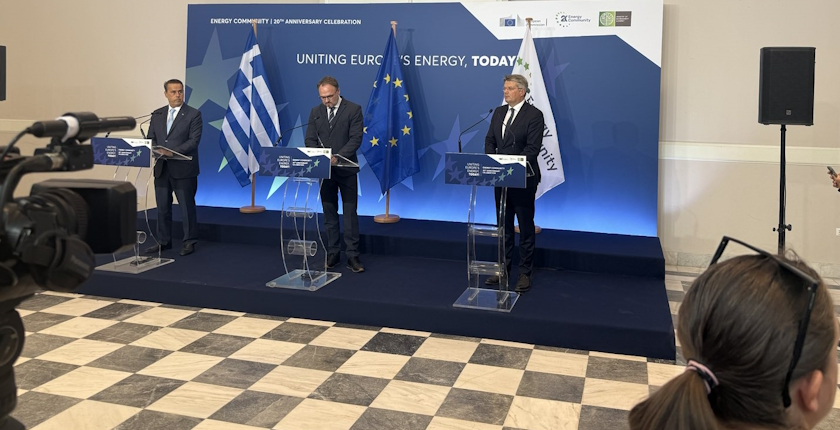
Energy Community marks 20th anniversary as integration pillar for Southeastern Europe

The Energy Community Ministerial Council held its annual informal meeting in Athens, where the organization was founded twenty years ago. No contracting party is expected to meet the criteria for exemption from the Carbon Border Adjustment Mechanism (CBAM) in the electricity sector – the European Union is due to start charging the CO2 tax on January 1 – but the European Commission could propose amendments.

The Energy Community promotes integration, reforms and investments across the region, top officials stressed.

Ministers from the Energy Community contracting parties convened today at the Informal Ministerial Council in Athens to mark the organization’s 20th anniversary. The Energy Community Treaty, establishing the Energy Community, was also signed in the Greek capital. The purpose of the organization is to create a more integrated market, help attract investment and speed up decarbonization by aligning with the European Union’s rules on energy, environment and competitiveness.

In recent years, close cooperation has enabled the contracting parties to strengthen the security of supply, particularly against the backdrop of the ongoing Russian war in Ukraine, the Energy Community Secretariat said. During the annual gathering, hosted by the Greek Ministry of the Environment and Energy, the ministers underlined the need for an accelerated integration with the EU, grounded in delivering a secure, resilient energy transition.

Ministers agreed to revise capacity calculation regions

Many contracting parties are close to completing the reforms needed to launch the 18-month countdown to electricity market coupling – including full legal alignment under the Energy Community’s Electricity Integration Package and the appointment of nominated electricity market operators (NEMOs). If transposition is verified as compliant by the European Commission and the Energy Community Secretariat, integration will be initiated with the EU’s Single Day-Ahead Coupling (SDAC) and Single Intraday Market Coupling (SIDC).

Ministers made a breakthrough in regional coordination, backing a proposal by EU transmission system operators to revise capacity calculation regions (CCRs), now under review by the EU energy regulator ACER – Agency for the Cooperation of Energy Regulators. Recognizing the proposal’s importance for an effective operation of the interconnected grid, they called for swift follow-up, including the operationalization of regional coordination centers (RCCs) and system operation regions (SORs).

The aim is to boost electricity flows and grid security, especially along the north-south corridor of the Balkans, while laying the groundwork for full EU market coupling.

Decarbonization must accelerate ahead of CBAM implementation in 2026

To avoid disruptions to regional electricity trade, clarifying CBAM rules for electricity is a priority for the ministers, the secretariat pointed out. The EU is set to begin charging the carbon border tax on January 1.

Lorkowski: Electricity market integration and decarbonisation are two sides of the same coin

As no contracting party is expected to meet the exemption criteria by then, a proportionate and context-sensitive application of the mechanism is essential, as supported by active engagement in the European Commission’s ongoing call for evidence that precedes the future amendments of the CBAM regulation to be possibly proposed by the European Commission, in the secretariat’s view.

“Electricity market integration and decarbonisation are two sides of the same coin. The green energy transition unlocks meaningful integration with the EU market – and vice versa. Only by aligning policy, infrastructure, and pricing can contracting parties fully realise the benefits of clean, secure, and affordable energy,” said Energy Community Secretariat Director Artur Lorkowski.

The ministers called for carbon revenues to support vulnerable communities and mobilize investment in clean energy, stressing that just transition financing must go hand in hand with policy reforms.

Energy Community Treaty is now cornerstone of Europe’s energy architecture

Born out of crisis and shaped by cooperation, the Energy Community Treaty has become a cornerstone of Europe’s energy architecture, Lorkowski stressed. What began as an unlikely experiment in regional integration has grown into a dynamic framework – extending the EU’s internal energy market, strengthening energy security, and advancing the clean energy transition across South-Eastern and Eastern Europe, he asserted.

Energy Community contracting parties can fully integrate their electricity markets with the EU before joining it

“Our contracting parties are now on the cusp of a major breakthrough: full electricity market integration with the EU – even ahead of accession. This is the product of two decades of reform, dialogue, and trust-building. With the right political will, we can move from transposition to transformation,” Lorkowski stated.

In his view, Greece is the window for the Energy Community contracting parties to the liquefied natural gas (LNG) market and the access point to the European electricity system. Close cooperation with the Western Balkans has economic benefits for Greece – but beyond the economy, it is also about security and stability, Lorkowski said at the event.

Energy Community pioneered extension of EU energy market

Over the past two decades, the Energy Community has brought the EU closer to its neighbours, pioneering the extension of the trade bloc’s energy market across its borders, promoting integration, reforms and investments across the region, according to European Commissioner for Energy and Housing Dan Jørgensen.

“Now it is time to look ahead at our shared future based on a greener, sustainable and resilient system which will bring cheaper energy and more security to all,” he said.

Separately, in an interview with Kathimerini, Jørgensen noted that Southeastern Europe experienced electricity price spikes last summer, mainly in the evening hours, due to a lack of cross-border capacity and sufficient flexibility. The only solution is further infrastructure and market integration, as costs are separated and benefits are multiplied, he opined.

For every EUR 2 billion invested annually in cross-border infrastructure, the potential benefits reach up to EUR 5 billion, the commissioner added.

Papastavrou: Southeastern Europe’s is at disadvantage as its electricity market is not fully integrated with EU

Southeastern Europe is still not fully integrated with the EU, which is a structural disadvantage for citizens, said Minister of Environment and Energy of Greece Stavros Papastavrou.

“I am very optimistic after the first session of the meeting, because all the contracting parties expressed commitment, a strong commitment, to market coupling,” he stated. Papastavrou said a lot of work is required in the electricity sphere to bridge the gap for the prosperity of citizens and the entire region.

Energy integration is one of the pillars of EU accession

Energy integration is not just a technical issue – it is one of the fundamental pillars of the EU accession process, the minister told his counterparts from the Energy Community.

“Greece, too, has faced the same challenges that many of you are experiencing today. Back in 2005, our energy system was almost entirely dependent on lignite, by more than 60%. Today, we have reduced lignite use by an impressive 91% – a clear demonstration of our strong commitment to a clean, sustainable, and resilient energy future,” he stated.

Serbia’s Đedović Handanović sees possibility for market coupling with Hungary already next year

Serbia was the first in the region to fulfill the conditions for market coupling with the EU, the country’s Minister of Mining and Energy Dubravka Đedović Handanović said. She urged for the verification process to be accelerated, so that Serbia can connect with the Hungarian market in 2026 and, through it, with the other EU member states.

The minister acknowledged the challenge of the upcoming full implementation of CBAM.

Photo: Minister Dubravka Đedović Handanović (Nenad Kostić / Ministry of Mining and Energy)

Serbian institutions analyzed the available options from the study that the European Commission published. “We think that carbon pricing should be introduced gradually, in phases and fairly, with support from funds from the European Union,” she said.

The minister stressed that revenues from carbon taxes would be directed, like in the EU, to decarbonization, renewables, energy efficiency, just transition and support to companies.

“Without an adequate period of time for the transition from coal to renewable energy sources, without modernizing the network, increasing RES capacities and adjusting the industry, higher carbon costs can only increase the financial pressure on our industry and consumers, which is already happening in the EU, instead of resulting in a significant emissions reduction in the short term. Solving these issues requires careful planning, a phasein and the EU’s targeted financial support, so that climate goals would be aligned with the economic reality,” Đedović Handanović said.

She recalled that EU member states had more than two decades to gradually adjust to carbon emission levies. Đedović Handanović affirmed that Serbia is willing to continue its alignment with the EU’s energy and climate policy.

“All the reform measures that we are conducting are primarily for the benefit of our citizens and companies, and we won’t make decisions overnight that would jeopardize our energy stability,” she said.

by in News

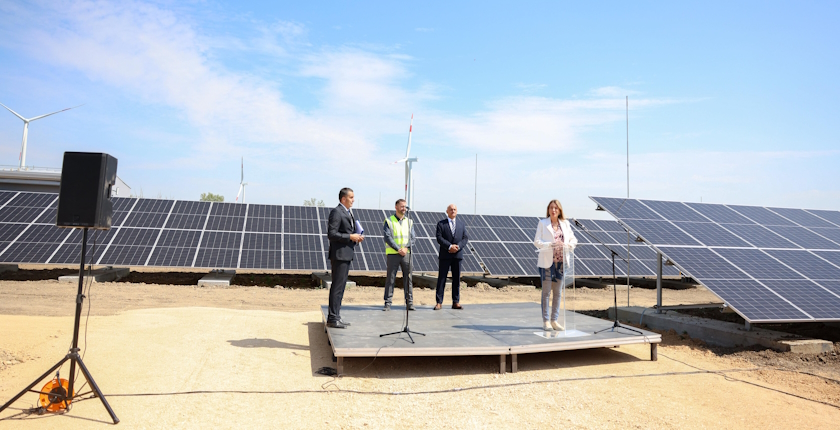
Serbia’s EPS starts trial operation of its Petka PV plant on coal tailings dump

Serbian state-owned power utility Elektroprivreda Srbije, EPS, connected its first larger photovoltaic unit to the grid. The new solar power plant is called Petka and it has a 10 MW grid connection. It is located in the Kostolac coal mining complex east of Belgrade, next to a wind park that is nearing completion. Each new megawatt is important, according to Minister of Mining and Energy Dubravka Đedović Handanović and the company’s Chief Executive Officer Dušan Živković.

After many years of planning and launching numerous solar power projects, EPS launched the trial operation of its first larger facility of the kind. The Petka PV system has 10 MW in connection capacity. It is located on a former tailings dump of the Ćirikovac open pit coal mine in the Kostolac complex.

“It is another important pioneering milestone in our energy sector. We are now producing clean, green energy on the site of an old mining dump, which is a turning point and the beginning of the energy transition of Elektroprivreda Srbije and an example how we can use old energy for new energy,” Minister of Mining and Energy Dubravka Đedović Handanović stated.

Of note, EPS recently installed solar panels of 948 kW total on the buildings within the Termoelektrana Nikola Tesla A (TENT A) coal power plant and of TENT’s rail transportation arm. Another photovoltaic system is on the Lazići dam in Zaovine, belonging to the state-owned utility’s Bajina Bašta hydropower plant.

EPS to connect adjacent wind park Kostolac to grid next month

There are no big or small projects, as every megawatt is important for Serbia’s energy security and it means greater security, Đedović Handanović pointed out.

“In addition to the Petka solar power plant, wind generators of EPS’s first wind park stand tall today in the mining area. They are also built mainly on recultivated tailings dumps. We expect the connection to the grid in August and a testing phase, when the blades will start spinning. That way we will strengthen our electricity system here in Kostolac by 76 MW of green energy,” the minister said.

The ministry’s priorities are the projects for the Bistrica pumped storage hydropower plant and battery-backed solar power plants of 1 GW in total connection capacity

She recalled that the strategic goal of the Government of Serbia is defined by the Energy Development Strategy, to reach a 45% share of renewable energy sources by 2030.

“We have much more to do and put in maximum efforts, because ahead of us are strategic projects which will change Serbia’s electricity bloodflow to a significant extent. They primarily entail the construction of the Bistrica pumped storage hydropower plant and the project for solar power plants of 1 GW with battery storage units. Energy investments necessary in the next ten years are estimated at about EUR 14 billion. Therefore, we must make up for all the delays and be up to the task, to secure energy tranquility for the future generations”, Đedović Handanović added.

EPS continuing with other green projects in its coal mining areas

EPS’s Chief Executive Officer Dušan Živković said each new megawatt is important for the company and the electricity system, especially in tropical days, when electricity demand is getting higher and higher.

“Not only are we strengthening our green portfolio that way, but also the reliability of the entire energy system, while citizens and companies have a secure supply, the same as until now. Projects like this one are concrete steps toward decarbonization and a sustainable energy development, which are also our goals for the decades to come. We will continue with the similar projects both here in Kostolac and also at dumping and landfilling sites in other parts of EPS,” he asserted.

Petka is one of the first PV facilities in the Western Balkans on former coal exploitation locations.

In addition, the construction of the Kostolac B3 coal plant in the same complex was finished last year. It was EPS’s first big energy production system in more than three decades.

by in News

Serbia’s EMS starts construction of third section of Trans-Balkan Corridor

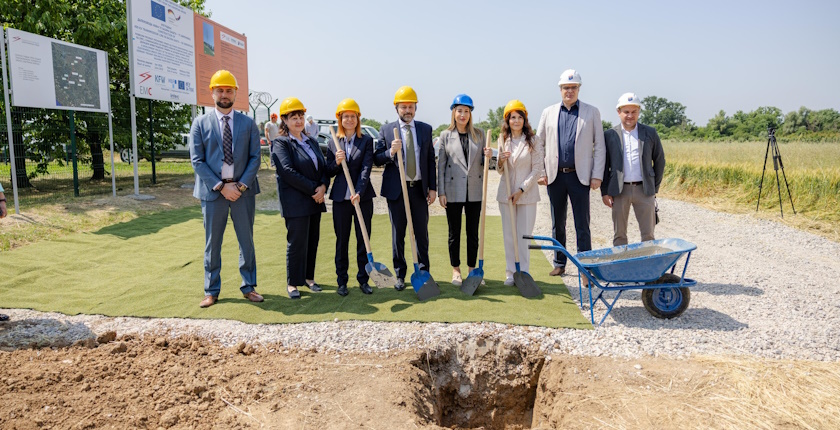
The foundation stone was laid today in Serbia for the third section of the Trans-Balkan Electricity Corridor. The investment amounts to EUR 100 million. It entails a high-voltage overhead power line of 109 kilometers between Obrenovac and Bajina Bašta, equipping two new switchyards in the Obrenovac transformer substation and upgrading the Bajina Bašta substation to 400 kV. The fourth and last section, with the interconnections with Bosnia and Herzegovina and Montenegro, is planned to be completed in 2028.

Serbian Minister of Mining and Energy Dubravka Đedović Handanović said at the groundbreaking ceremony for the third section of the Trans-Balkan Corridor that it is the most important project for the transmission system not only in the country but in Southeastern Europe.

“What highways are for transportation, high-voltage power lines are for energy, and today we are beginning the works on the new part of the most important energy highway,” she said in Obrenovac and added that the segment would enhance the security of supply for consumers in western Serbia.

The third section of the Trans-Balkan Electricity Corridor involves the construction of an overhead power line of 109 kilometers on 309 towers, equipping two new switchyards in the Obrenovac substation and lifting the voltage level in the Bajina Bašta substation to 400 kV.

The project is financed with a EUR 64.5 million loan from Germany’s KfW Development Bank, a grant from the European Union via its Western Balkans Investment Framework (WBIF) of approximately EUR 21 million, and own funds of the Serbian transmission system operator Elektromreža Srbije (EMS), according to the state-owned company’s announcement. The third section is worth EUR 100 million, of which EUR 71 million is for the overhead power line.

“With the completion of the entire project, we will additionally strengthen the links with Bosnia and Herzegovina and Montenegro and beyond, with Italy,” Đedović Handanović stated.

She recalled that significant transmission grid investments are planned in the next five years, including the construction of the Pannonian Corridor toward neighboring Hungary. The priority projects in the segment are worth EUR 500 million in total, the minister revealed.

“I expect the contractors not to be late with the works, so that the project is completed within two and a half years, as it is planned,” Đedović Handanović stressed.

Matejić: Final section to be finished in 2028

General Manager of EMS Jelena Matejić said the construction of the entire Trans-Balkan Corridor is worth more than EUR 200 million. She noted that it includes 323 kilometers of 400 kV power lines, voltage level upgrades for two transformer stations and switchyards in three of them.

The investments in the Trans-Balkan Corridor are estimated at more than EUR 200 million altogether

“Except this section, the third one, we will also have the fourth, for which the funds have been secured, and it will be finished in 2028,” Matejević asserted.

The old lines in western Serbia of 220 kV will be replaced with new, 400 kV systems, which will create possibilities for connecting the planned Bistrica pumped storage hydropower plant to the grid, according to EMS. The contractor is Kodar Energomontaža, and the works are expected to be completed by 2027.

EU donated EUR 38.3 million for Trans-Balkan Electricity Corridor

Head of the EU Delegation in Serbia Emanuele Giaufret pointed out that the funds the EU has earmarked for the current section are part of wider support.

“The EU has secured a EUR 38.3 million donation for the whole Trans-Balkan Corridor, together with KfW’s favorable loans. Over the years, the EU has earmarked more than EUR 1 billion for the energy sector in Serbia. This project is important for the rest of Europe as well, because it will contribute to the creation of a wider, integrated system, which will enable a more stable supply to consumers on the entire continent, as well as to avoid problems in the future,” he stated, as quoted by EMS.

The first section of the Trans-Balkan Corridor, from the city of Pančevo near Belgrade to the Romanian border, was finished in 2017. The second one, between Kragujevac and Kraljevo in central Serbia, is operational since 2022. It included substation upgrades in the two cities. The fourth section needs to connect Bajina Bašta with nearby Višegrad in Bosnia and Herzegovina, and with Pljevlja in Montenegro.

by in News

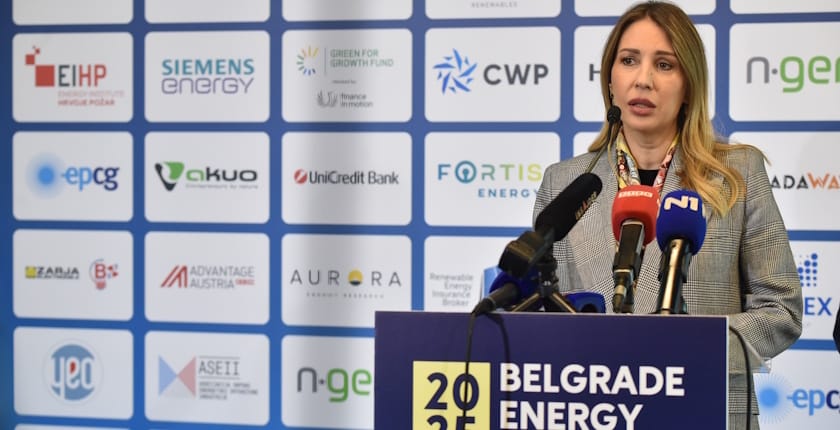
Belgrade Energy Forum 2025 – energy market reforms accelerate integration into EU

Electricity market coupling with neighbors in the European Union is a major factor in the EU integration of Energy Community contracting parties and the Western Balkans, alongside deeper coordination within the region, the establishment of energy interconnections, investments in renewables and progress in carbon pricing, top officials pointed out at the opening of Belgrade Energy Forum – BEF 2025.

Founder and Editor of Balkan Green Energy News Branislava Jovičić said the current changes in the energy sector can already be called an energy revolution.

The third Belgrade Energy Forum, BEF 2025, started today in Serbia’s capital city, welcoming four hundred participants from more than 30 countries from the region, Europe and beyond. The two-day conference, organized by Balkan Green Energy News, features eight panels with over 50 officials, executives and prominent energy experts.

Serbia was the first in the region to meet the preconditions for electricity market coupling with neighboring countries in the European Union and Energy Community, said Minister of Mining and Energy Dubravka Đedović Handanović. She added that the technical process would be completed within 18 months after the EU Agency for the Cooperation of Energy Regulators (ACER) and European Network of Transmission System Operators for Electricity (ENTSO-E) conduct the necessary steps.

Electricity market coupling will be completed within 18 months when the technical process starts

“It will be a historic event for our country for its benefits for citizens and companies, as it will ensure a more stable electricity supply and access to more affordable energy prices. It will turn us into an equal member within the region but also the EU as concerns the energy sector,” Đedović Handanović stated.

The SEEPEX power exchange has already prepared implementation projects with its counterparts in Hungary and Bulgaria for market coupling on their borders, the minister stressed.

Up to EUR 15 billion needs to be invested in energy

Đedović Handanović also pointed out that domestic and European regulators certified Serbia’s gas transmission system operator Transportgas for the first time. The start of construction of the Serbia-Hungary oil pipeline is expected to begin early next year at the latest, the minister said.

The baseline for the development plan for energy infrastructure and energy efficiency should be completed by the end of May, she revealed. It identifies the need for EUR 14 billion to EUR 15 billion in investments in the next ten years, according to Đedović Handanović. Renewables and new hydropower potential account for EUR 7 billion, she said.

Serbia will double the electricity transmission capacity with Hungary and increase it with Bulgaria, the minister asserted.

Serbia is frontrunner in region with its progress toward market coupling

As the Western Balkan region confronts the trailing trilemma of decarbonization, affordability, and energy security, the need for an accelerated integration with the European Union has never been more urgent, Energy Community Secretariat Director Artur Lorkowski said.

The organization provides a platform for the process, a strategic window of opportunity to inspire market confidence now, not in years or months to come, he explained. Lorkowski said it implies deeper coordination among Energy Community contracting parties in removing cross-border bottlenecks and harmonizing market operations.

Above all, there is an urgent need to move forward on electricity market integration with the EU, so the region can fully benefit from it in 2027, he noted, underscoring that Serbia is the frontrunner.

Exporters of electricity to the EU can attend a technical consultative meeting in Brussels on July 1

The Carbon Border Adjustment Mechanism (CBAM) is another urgent priority, Lorkowski said. He announced that the Energy Community Secretariat and European Commission would organize a technical consultative meeting in Brussels on July 1 for electricity exporters to the EU.

The establishment of domestic carbon pricing mechanisms is inevitable, Lorkowski warned. The question is how to introduce domestic carbon pricing and keep energy prices affordable for households and competitive for businesses, he told the audience at BEF 2025.

“The way forward is clearly defined, and the conditions linked to energy market reform and decarbonization are well known. And I’m, frankly speaking, very optimistic that progress on these issues can be substantive in months and years to come,” the secretariat’s head stressed.

Jovičić: Energy revolution underway

Energy and climate issues are among the most important ones in the world today, as well as in Southeastern Europe, Founder and Editor of Balkan Green Energy News Branislava Jovičić said. All stakeholders, aware of the necessity of rapid changes and prudent solutions, are working toward a secure energy supply and decarbonization, she added.

“Last year we spoke about the energy transition. This year we can freely call the changes in the energy sector an energy revolution,” Jovičić stated. The five pillars of the energy revolution are solar and wind power, battery storage, digitalization, nuclear energy and decentralized generation and consumption, she stressed.

Balkan Green Energy News is a leading energy media website in the region and one of the top 50 in the world, Branislava Jovičič said.

by in News

Belgrade Energy Forum 2025 – top delegations coming from EU, Southeast European countries

Final preparations are underway for the third Belgrade Energy Forum, BEF 2025. Energy Community Secretariat Director Artur Lorkowski and Serbian Minister of Mining and Energy Dubravka Đedović Handanović will open the event. One of the key speakers is Director Christian Zinglersen of the EU Agency for the Cooperation of Energy Regulators (ACER). The ministerial panel consists of ministers and representatives of the governments of Montenegro, Croatia, Hungary, Serbia and the Republic of Srpska, which is one of the two entities making up Bosnia and Herzegovina.

Senior delegations from the European Union and five countries in the region, eight panel discussions and more than 50 distinguished speakers – energy experts and representatives of energy companies – all prove that the third Belgrade Energy Forum (BEF 2025) will host key stakeholders in Southeast Europe’s energy transition on May 14 and 15.

The conference, organized by the region’s leading energy portal Balkan Green Energy News, will be the meeting point of the representatives of regional and international institutions and organizations as well as the representatives of the business community from the region, Europe and the world. Register in time via this link.

The participants in the first panel at BEF 2025, called ‘High-ministerial panel on SEE regional cooperation and energy transition strategies’, are:

  • Petar Đokić, Minister of Energy and Mining, Government of Republic of Srpska
  • Admir Šahmanović, Minister of Energy and Mining, Government of Montenegro
  • Dr. Illés Boglárka, State Secretary for Bilateral Relations, Ministry of Foreign Affairs and Trade, Government of Hungary
  • Jovana Joksimović, Assistant Minister, Ministry of Mining and Energy, Republic of Serbia
  • Marija Pujo Tadić, Special Envoy for Climate Action, Government of the Republic of Croatia
  • Dario Liguti, Director, Sustainable Energy, UNECE

Director of EU Agency for the Cooperation of Energy Regulators (ACER) Christian Zinglersen will deliver one of the keynote speeches. It is one of the European Union’s most important institutions in the energy sector. He is coming to BEF 2025 at a very important moment for the Energy Community contracting parties and the transposition of the EU’s energy regulations into national law.

Đedović Handanović: The energy transition knows no borders

Ahead of her participation at BEF 2025, Minister Dubravka Đedović Handanović stressed that the energy transition knows no borders and that it is why regional cooperation is of key importance.

“I am glad that energy experts from the entire region will convene in Belgrade, as only through a coordinated approach we can secure a more stable energy market, faster decarbonization and greater investments in renewable energy sources,” Đedović Handanović stated.

In addition to participating in the high-ministerial panel, Montenegrin Minister of Energy and Mining Admir Šahmanović will hold several bilateral meetings in Belgrade.

Šahmanović: The goal is not only clean energy, but just transition as well

“The energy transition is not just a technical challenge – it is a development opportunity and a civilizational leap. For the Western Balkans it is a chance for us to build an economy based on sustainability, connectivity and responsibility toward future generations. Montenegro believes that a successful transition depends on our capability to act together – through the planning of joint capacities, exchanging green energy surpluses and a coordinated approach toward partners and investors”, he said.

Šahmanović underscored that the goal is not only clean energy, but also a just transition – one that creates jobs, lowers poverty and brings growth to every part of the region. “We are ready to be a reliable partner in that joint future,” he added.

Đokić: Through joint efforts to an energy future that is economically stable, environmentally acceptable and socially responsible

The Ministry of Energy and Mining of the Republic of Srpska is again an institutional partner of BEF 2025, which, in the words of Minister Petar Đokić, represents proof of the ministry’s dedication to promoting energy sustainability, improvement of regional cooperation and attracting investments in the energy sector.

“The ministry and I have been actively contributing from the start to the work and discussions of this significant event, which gathers the most important players in the energy sector – institutions, investors, experts and other stakeholders. The forum stands out as a platform bolstering the exchange of ideas and experiences, and the results of these discussions contribute to identifying concrete solutions for challenges in energy,” Đokić pointed out.

He expressed confidence that joint efforts can result in the creation of an energy future that is economically stable, environmentally acceptable and socially responsible.

by in News

Serbian Minister of Mining and Energy Dubravka Đedović Handanović gets third mandate; Sara Pavkov takes over environment

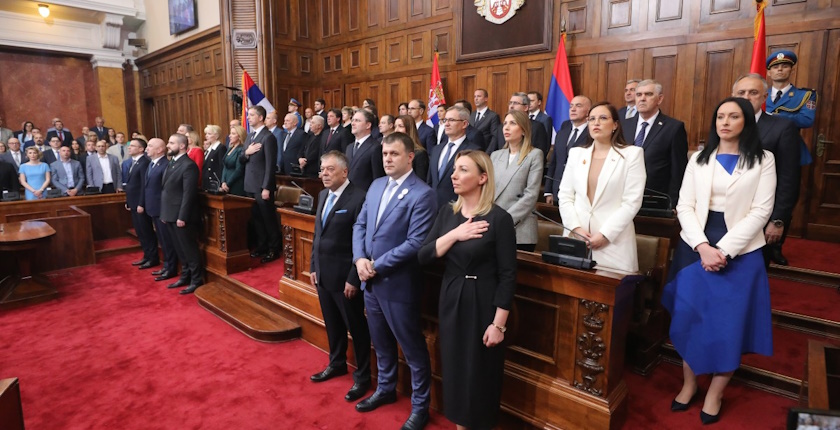
The National Assembly of Serbia reelected Minister of Mining and Energy Dubravka Đedović Handanović for her third term. The youngest member of the new cabinet, led by Prime Minister Đuro Macut, is the new Minister of Environmental Protection – Sara Pavkov.

Members of parliament voted in the new Government of Serbia today with 153 in favor and 46 against the proposal, while 51 lawmakers were absent from the session. The lineup under Prime Minister Đuro Macut, who has just entered the political arena now, includes Sara Pavkov, responsible for environmental protection. At 33, she is the youngest member of the cabinet.

Minister of Mining and Energy Dubravka Đedović Handanović was elected for her third mandate.

At 33 years old, Sara Pavkov is the youngest minister in the team of new Prime Minister Đuro Macut

Pavkov holds a graduate and master’s degree from the biology and ecology department of the University of Novi Sad Faculty of Sciences (FTN). She is a doctoral candidate and research intern at the faculty, according to her official biography.

Since 2022, she has served as a state secretary at the Ministry of Environmental Protection. Before that, she was the chief of staff since June 2021, after holding the position of special advisor for environmental protection from November 2020.

As one of the vice-presidents of the Bureau of the United Nations Framework Convention on Climate Change (UNFCCC), Sara Pavkov participated in the UN Climate Change Conference COP26 in Glasgow in 2021.

From 2013 to 2020, she coordinated more than 20 civil society projects for environmental protection. The new minister has authored or coauthored 11 scientific and professional papers in the same field.

She joined the ruling Serbian Progressive Party (SNS) since 2012. Since November 2021, Sara Pavkov has been a member of its presidency.

Third run for Dubravka Đedović Handanović as minister of mining and energy

Dubravka Đedović Handanović was first elected minister of environment and energy in October 2022 in the cabinet of Prime Minister Ana Brnabić. She was reappointed last May, when Miloš Vučević became the prime minister of Serbia.

Before becoming minister, she was a member of the Executive Board of NLB Komercijalna banka, responsible for corporate and investment banking. She has an international experience in banking of more than 16 years.

Minister Đedović Handanović, who remained in position in the new government, has worked in the EIB

Đedović Handanović has graduated in banking and finance from the Faculty of Economics in Belgrade and obtained her master’s degree in finance and management from SDA Bocconi University in Milan and the Anderson School of Management at the University of California in Los Angeles (UCLA).

She headed the Regional Office of the European Investment Bank (EIB) for the Western Balkans from 2016 to 2021, before moving to NLB Komercijalna banka.

Until the start of her tenure in Belgrade, Dubravka Đedović Handanović was the manager for Albania, North Macedonia and Serbia at the headquarters of the EIB in Luxembourg. It is the European Union’s main lending institution. She was also in charge of public-private partnership projects and project financing in countries including Ireland, France, the United Kingdom and the Benelux.

Before starting her career in banking, the reelected minister of mining and energy worked in the media and communications sector.