by in News

Greece outlines long-term investment plan to solve water crisis

The Greek government presented a plan to maintain water supply as drought has reduced reserves to worrying levels in certain areas.

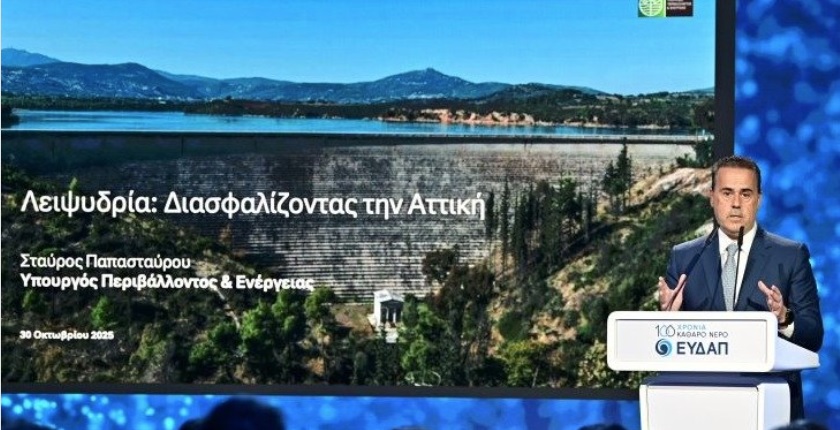
The Ministry of Environment and Energy outlined short-term and long-term measures, with a focus on Attica, the peninsula where Athens is located. The area consumes by far the most water in Greece. This year, the level in the nearby Mornos lake in Fokida has dropped to just 152.9 million cubic meters, with its area reduced to 8.3 square kilometers. It marks a 15-year low for the major reservoir and a steep 45% drop in reserves from 2024.

For the long term, the government has launched the Evrytos project for using water from the Evinos river in Aetolia-Acarnania. It will provide Attica with 220 million cubic meters annually, for a cost of EUR 500 million. Necessary infrastructure will become operational by 2029, according to Minister Stavros Papastavrou.

Desalination plants to increase power demand

In the meantime, the government and the Athens Water Supply and Sewerage Company (EYDAP) are examining the installation of three desalination plants: in Thisvi, Nea Peramos and Lavrion. Papastavrou said they can together provide 87.5 million cubic meters annually.

However, such units are both expensive and energy hungry. An average desalination plant consumes about 3.5 kWh of electricity for every cubic meter of water it produces. Therefore, the total for all three is about 600 GWh per year.

The new energy demand has not been anticipated in the ten year development plan of Independent Power Transmission Operator (IPTO or ADMIE) nor the National Energy and Climate Plan (NECP). The 600 GWh is not much compared to a national consumption of 52 TWh, but it would be concentrated in Attica and needs to be taken into account.

Demand is already expected to rise in the region, as a result of electrification and new large-scale construction works in places like Ellinikon.

by in News

Greece outlines long-term investment plan to solve water crisis

The Greek government presented a plan to maintain water supply as drought has reduced reserves to worrying levels in certain areas.

The Ministry of Environment and Energy outlined short-term and long-term measures, with a focus on Attica, the peninsula where Athens is located. The area consumes by far the most water in Greece. This year, the level in the nearby Mornos lake in Fokida has dropped to just 152.9 million cubic meters, with its area reduced to 8.3 square kilometers. It marks a 15-year low for the major reservoir and a steep 45% drop in reserves from 2024.

For the long term, the government has launched the Evrytos project for using water from the Evinos river in Aetolia-Acarnania. It will provide Attica with 220 million cubic meters annually, for a cost of EUR 500 million. Necessary infrastructure will become operational by 2029, according to Minister Stavros Papastavrou.

Desalination plants to increase power demand

In the meantime, the government and the Athens Water Supply and Sewerage Company (EYDAP) are examining the installation of three desalination plants: in Thisvi, Nea Peramos and Lavrion. Papastavrou said they can together provide 87.5 million cubic meters annually.

However, such units are both expensive and energy hungry. An average desalination plant consumes about 3.5 kWh of electricity for every cubic meter of water it produces. Therefore, the total for all three is about 600 GWh per year.

The new energy demand has not been anticipated in the ten year development plan of Independent Power Transmission Operator (IPTO or ADMIE) nor the National Energy and Climate Plan (NECP). The 600 GWh is not much compared to a national consumption of 52 TWh, but it would be concentrated in Attica and needs to be taken into account.

Demand is already expected to rise in the region, as a result of electrification and new large-scale construction works in places like Ellinikon.

by in News

Water shortages in Southeastern Europe point to desalination as strategic approach

Former Minister of Environment and Water of Bulgaria Borislav Sandov is urging the country’s authorities to deploy alternative water supply solutions, including desalination, to counter shortages. Greece is preparing a radical change in its water management model. Turkey got its first floating seawater purification platform, running on solar and wind power.

Southeastern Europe is among the most jeopardized regions in the world in the context of global warming. The lack of water has the most drastic effect on everything from wildlife to food production, energy and public health. Bulgaria’s former Minister of Environment and Water Borislav Sandov warned that over half a million people in the country are at risk of water shortages.

Eastern and northeastern Bulgaria have a persistent issue with droughts and lack of water, necessitating a switch toward alternative forms of supply in the next five to 10 years, including seawater desalination plants, he recently told bTV.

In addition to climatic factors, there are serious shortcomings in water management, together with theft and corruption, Sandov claimed. He pointed to an example where drastically undersized pipes of poor quality were installed in one area, resulting in constant breakdowns and supply interruptions.

Sandov attributed some of the water stress to fragmented management between different local, regional and national institutions. In his words, as much as 10% of all settlements in Bulgaria, though mostly small ones, aren’t covered by waterworks and sewerage systems. Moreover, 44% of the water in the network isn’t measured in volume terms at the entry point and 50% of the water sources don’t have a valid permit from the competent authority, he added.

Notably, a quarter of the population in neighboring Serbia occasionally or permanently lacks safe drinking water from waterworks systems.

Greece to radically change its water management system

Greece decided to get ahead of the droughts and heatwaves. The government has promised radical change in water management: a more functional system with more investments and new technologies, including desalination, but also recycling.

Tourism in the summer months exacerbates the water stress. On some islands, demand surges by up to 30 times. It creates conflict with the needs for irrigation for food production. Greek islands mostly use underground aquifers with easily exhaustible capacity.

Rainfall and snowfall in the country are gradually decreasing.

Similar to Bulgaria, water management is spread across hundreds of operators and institutions, lacking coordination. Losses in drinking water supply amount to as much as 40%, in comparison with up to a staggering 60% in irrigation.

The government in Athens promised water would remain a public good

According to a study by Deloitte with data from 2022, more than EUR 10 billion is necessary for investments in the two segments, excluding Attica. It is where Athens is located. Another EUR 500 million to EUR 700 million is needed for the peninsula.

Government-controlled power utility Public Power Corp. (PPC) will reportedly enter the game, not least because municipal water and sewerage firms owe it more than EUR 400 million. The company would convert debts into minority stakes in three centralized entities: for the regions of Athens and Thessaloniki and the rest of the country, the media learned.

PPC can contribute with its knowhow and experience in the construction and operation of dams and hydropower plants.

Importantly, the government vowed to keep water a public good.

Floating desalination platform with hybrid power plant put into operation in western Turkey

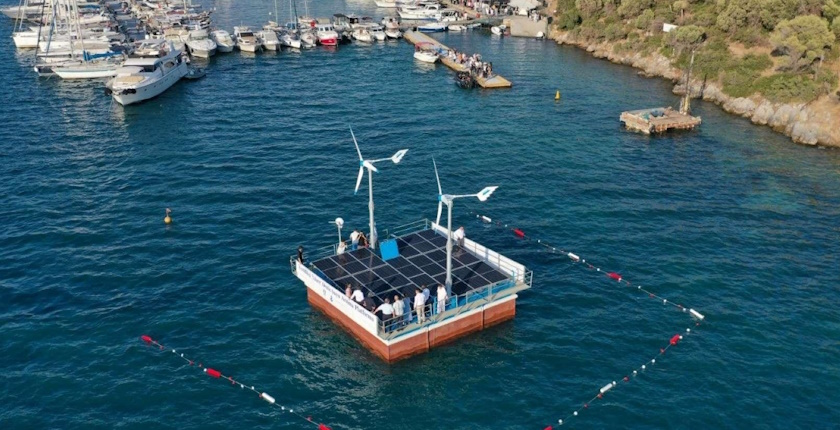
Right opposite the Greek island of Kos, offshore Bitez Marina, the Bodrum Municipality inaugurated Turkey’s first floating seawater purification platform. It runs entirely on renewable energy, producing 20 cubic metres of clean, non-potable water every day.

The project was developed in partnership with Istanbul-based company Blue Hybrid Solutions. The facility is powered by solar panels and two small wind turbines. It delivers water to an onshore tank for irrigation, emergency needs and, when required, public consumption, the local authority said.

Greece is already conducting a massive project for energy independence of numerous non-interconnected islands, including investments in desalination powered by renewables. It is also working to link other islands to the mainland grid.

[wpcc-iframe title=”BODRUM BELEDİYESİNDEN BİR İLK YÜZER DENİZ SUYU ARITMA PLATFORMU TANITILDI” width=”500″ height=”281″ src=”https://www.youtube.com/embed/KApvKHO8OS4?feature=oembed” frameborder=”0″ allow=”accelerometer; autoplay; clipboard-write; encrypted-media; gyroscope; picture-in-picture; web-share” referrerpolicy=”strict-origin-when-cross-origin” allowfullscreen=””]