by in News

North Macedonia Launches Intraday Electricity Market as Regional Power Trading Evolves

North Macedonia has taken another significant step toward deeper integration with the European electricity market following the launch of its intraday power market by the National Electricity Market Operator (MEMO). The development represents a major advancement in the country’s electricity market liberalization process and strengthens operational flexibility within the regional energy system.

The official launch ceremony gathered senior representatives from the government, energy institutions, market participants, and international partners. The intraday trading platform and clearing infrastructure were delivered by Slovenia’s BSP Energy Exchange, continuing its cooperation with MEMO after supporting the establishment of North Macedonia’s day-ahead market. Intraday trading operates through Deutsche Börse’s M7 trading system, one of Europe’s widely adopted electricity trading platforms.

The introduction of intraday trading comes three years after the launch of the country’s day-ahead market and reflects the increasing sophistication of North Macedonia’s power sector. Intraday markets play a critical role in modern electricity systems by enabling market participants to adjust positions closer to the actual delivery hour. This improves balancing efficiency, reduces imbalance costs, and enhances the integration of variable renewable energy sources such as solar and wind.

Prime Minister Hristijan Mickoski described the launch as evidence of tangible reform progress in the national energy sector. According to him, energy security and resilience have become strategic priorities for all European economies amid accelerating market transformation and geopolitical uncertainty.

“At a time when energy is one of the most critical issues for every country, our obligation is to create a system that is secure, competitive, and resilient to global challenges,” Mickoski stated during the event.

He emphasized that North Macedonia intends to actively participate in European energy flows and policy frameworks rather than remain on the periphery of the continent’s ongoing energy transition.

Minister of Energy, Mining and Mineral Resources Sanja Božinovska underlined that the intraday market is only one phase of a broader market integration strategy. She reiterated the government’s commitment to future market coupling with the European Union and the continued development of regional electricity trading mechanisms.

“This is just the starting point for our full integration into the European energy family,” Božinovska said, adding that authorities will continue advancing regional cooperation and aligning domestic market structures with EU standards.

MEMO Chief Executive Officer Zoran Gjorgjievski highlighted the operational significance of intraday trading in a rapidly changing electricity environment increasingly shaped by renewable generation and real-time balancing requirements.

“From today, our market not only plans for tomorrow – it operates in real time. The intraday market is a direct response to the dynamics of the modern energy sector,” Gjorgjievski noted.

He stressed that transparent and efficient price formation remains essential for optimal resource allocation, prudent investment decisions, and effective risk management across the electricity value chain.

Gjorgjievski also warned that emerging European regulatory frameworks, particularly the Carbon Border Adjustment Mechanism (CBAM), could introduce additional pressure on domestic electricity producers and potentially affect regional market liquidity. While supporting decarbonization objectives, he argued that the energy transition must remain economically sustainable and carefully managed to avoid undermining market competitiveness.

The launch of the intraday market is also viewed as an important preparatory step toward integration into the single European electricity market. Chairman of the Management Board of ADEX Group and CEO of BSP Energy Exchange Anže Predovnik said the project reflects strong institutional cooperation, strategic government support, and MEMO’s operational commitment.

“What lies ahead is integration into the single European market. Together, we will build a more connected and competitive future,” Predovnik stated.

North Macedonia’s intraday market currently includes 21 participants, demonstrating growing interest among regional traders and electricity companies.

According to Martin Martinovski, electricity and statistics expert at the Energy Community Secretariat, the operational intraday market strengthens North Macedonia’s role within the regional balancing framework. As integration with the EU electricity market progresses, the country could increasingly contribute low-carbon flexibility to neighboring systems while benefiting from cross-border balancing support.

Market growth figures indicate a rapid expansion in trading activity since the launch of organized electricity trading in the country. Trading volumes increased from 335 GWh by the end of 2023 to nearly 970 GWh in 2024, before surpassing 1.37 TWh last year. MEMO currently counts forty active market members, while first-quarter 2026 trading volumes were 19% higher compared to the same period a year earlier. 

by in News

Albania’s Day-Ahead Power Market Is Operational, but Still Not Mature Enough for CfD Support

Albania’s electricity market is making measurable progress, but it is not yet ready to serve as the reference price for modern renewable support mechanisms. That is the central conclusion of ERE’s first assessment of the ALPEX day-ahead market (DAM), which evaluates whether the market is sufficiently liquid and competitive to underpin the future conversion of renewable PPAs into contracts for difference (CfDs). Under Albania’s renewable energy law, ERE is required to carry out such periodic assessments, and it approved the market-readiness methodology in November 2025.

The report’s logic is straightforward: a day-ahead market can only act as a reliable CfD benchmark if it produces a frequent, stable, and credible price signal. To test that, ERE examined price availability, churn, bid-ask spreads, market depth, competition, and the effect of Albania’s coupling with Kosovo. It also benchmarked ALPEX against selected EU markets at the stage when those countries first introduced CfDs, choosing Poland, Hungary, and Croatia as comparators. This approach places Albania in a relevant policy context rather than comparing it with the most mature European exchanges.

The assessment does contain important signs of institutional progress. ALPEX generated a market-clearing price in every hour of the 12-month review period, from 1 November 2024 to 31 October 2025, which satisfies ERE’s criterion for continuous price availability over at least 10 months. The market also appears to be functioning as a shared Albanian-Kosovar trading platform, with coupled prices in more than 99% of hours. In policy terms, that is a meaningful achievement: the market is operational, regional, and capable of producing a continuous price signal.

Yet the core liquidity indicators show that ALPEX remains materially underdeveloped relative to the comparison markets. The churn factor is only 0.102, below HUPX, CROPEX, and TGE, indicating that the ratio of traded volume to total consumption is still weak. The bid-ask spread is also wide: the median is 9.7% of the average market-clearing price, the mean is 17.4%, and the 75th percentile reaches 19.2%. By contrast, the report shows that HUPX had a median spread of just 1.2% and a mean of 3.7%. These figures point to a market that can clear prices, but still struggles to do so efficiently and consistently.

Market depth provides the same message in a different form. ERE finds that in 25% of hours, ALPEX would not have been able to absorb more than about 146 MW of new zero-marginal-cost supply while still maintaining a positive clearing price. That is a critical limitation for a power system that is expected to integrate more renewable generation, especially as photovoltaic capacity continues to expand. In practical terms, the report suggests that the market may face stress at times of low demand or high renewable output, when additional capacity needs a deeper and more resilient trading environment.

Competition is stronger than the liquidity indicators alone might suggest. ERE reports 32 sellers and 33 buyers, with an HHI of 853 on the sell side and 1,220 on the buy side. It interprets this as a competitive sell-side structure and a moderately concentrated buy side. That is an important distinction: the market has participants, but participation has not yet translated into the degree of depth and turnover required for a robust reference price.

The broader policy conclusion is therefore cautious but clear. ALPEX is moving in the right direction, but it is not yet sufficiently liquid to support the transition to CfD-based renewable support. ERE explicitly concludes that the ALPEX DAM is not yet ready to be used as the reference price for support contracts in Albania. At the same time, the report treats this not as a failure, but as a transitional stage: the market has a continuous price signal, a reasonable participant base, and a functioning regional coupling, which are all necessary foundations for future readiness. ERE is expected to continue periodic assessments as the market deepens and matures.

In strategic terms, the report captures Albania’s power-market transition at an important midpoint. The system is no longer at the stage of market creation, but it has not yet reached the level of liquidity, depth, and price stability that would allow it to anchor modern renewable support instruments. For policymakers, the message is that market coupling and institutional setup are advancing faster than commercial liquidity. For investors, especially in renewables, the implication is equally clear: Albania’s market architecture is improving, but the price environment is still not mature enough to be treated as a fully reliable CfD benchmark.

by in News

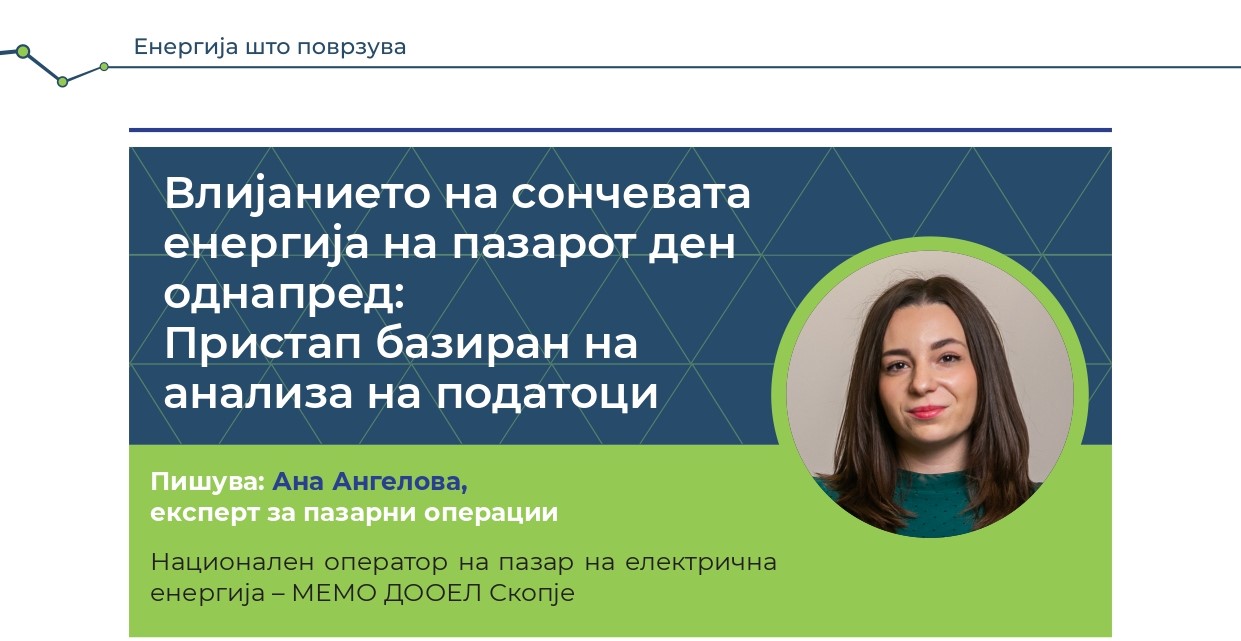
MEMO Analysis Links Solar Output to Lower Day-Ahead Power Prices in North Macedonia

Electricity generation from solar power plants tends to push prices down on the power exchange, while reduced solar output is associated with price increases, according to an analysis by Ana Angelova, a market operations specialist at the National Electricity Market Operator (MEMO).

The analysis aimed to identify seasonal trends and highlight the relationship between photovoltaic (PV) generation, electricity consumption, traded volumes, and day-ahead prices on the North Macedonian power exchange. MEMO noted that the day-ahead market operates in an isolated mode.

Angelova used official power exchange data for 2024, focusing on hours when PV plant efficiency exceeded 30%.

Consumption remains broadly stable across the year

The findings point to a clear seasonal pattern. Electricity consumption stays relatively steady throughout the year, with only minor declines during spring and summer. PV generation, however, shows a pronounced seasonal swing—peaking in summer and reaching its lowest levels in winter.

Angelova also stressed that higher PV output coincides with increased traded volumes on the day-ahead market.

Prices bottom out in April, rise toward winter

According to the analysis, day-ahead prices are lowest in April, a period linked to milder weather, lower demand, and stronger solar production. From summer onward—and particularly during winter—prices trend higher, peaking in November.

The November price peak aligns with a combination of weak PV generation and higher consumption.

“Increased electricity generation from photovoltaic plants is associated with lower prices, while low generation leads to higher market prices, emphasizing the impact of renewable energy availability on price formation. The trend indicates that energy policies should focus on addressing weaknesses during the winter period and harnessing the potential of solar energy in summer,” Angelova wrote.

Proposed measures to strengthen renewables integration

north macedonia solar analysis memo power exchange ana angelova

Photo: MEMO

Angelova outlined several options to improve the integration of renewables—especially solar—into the power system. The proposed mechanisms include:

  • Flexible market mechanisms: introduction of a 15-minute trading interval, creation of an intraday market, dynamic tariffs, and guarantees of origin.

  • Energy storage technologies: battery energy storage systems (BESS) and pumped-storage hydropower plants.

  • Alignment with the European energy framework: adoption of ENTSO-E grid codes, coupling with the single European electricity market, deployment of smart meters, and use of financial instruments such as contracts for difference (CfD) and power purchase agreements (PPA).

by in News

EPS to help SEEPEX strengthen Serbia’s intraday power market

Serbia’s power exchange, SEEPEX, has reached an agreement with state-owned utility Elektroprivreda Srbije to work together on strengthening the intraday electricity market.

SEEPEX is proud to announce the signing of a strategic agreement with Elektroprivreda Srbije (EPS), Serbia’s largest power utility company, aimed specifically at securing its support for the organized intraday continuous (IDC) electricity market, the power exchange said.

SEEPEX is part of ADEX, which was established in 2022 through a corporate merger between Slovenian energy exchange BSP SouthPool and its Serbian counterpart. In December 2024, ADEX Group completed a merger with the Hungarian Power Exchange (HUPX).

The agreement between SEEPEX and EPS marks an important step forward in strengthening SEEPEX’s organized IDC electricity market, which will also help improve the integration of renewable energy sources, according to the update.

EPS will actively support and participate in the SEEPEX IDC market

Through this partnership, EPS will actively support and participate in the SEEPEX IDC market, enhancing its liquidity and encouraging engagement from all 32 IDC members.

“We believe this collaboration will position the SEEPEX IDC market as a trusted and dynamic platform for electricity trading across the region and beyond,” SEEPEX stressed.

SEEPEX launched the intraday market in July 2023

The contract aims to secure daily offers from EPS to encourage other participants to access the market and start trading, Balkan Green Energy News has learned.

In October 2023, SEEPEX signed a market-maker agreement with EPS for the intraday continuous market.

SEEPEX launched the intraday market in July 2023, with 16 out of 20 registered participants active on the first trading day. The participants came from Serbia, neighboring countries, and the European Union. The SEEPEX intraday market now has 32 participants.

With the launch of the IDC market, SEEPEX became the first organized market in the region to fully implement all aspects of an organized market, according to company’s CEO Miloš Mladenović.

by in News

Electricity exchange kicks off in Cyprus with 17 participants

The liberalization of the power market in Cyprus took effect alongside the launch of the electricity exchange, with day-ahead, forward and balancing markets.

The island country is one of the most isolated energy systems of the European Union. It relies on expensive oil plants to cover its power needs. Cyprus has no electricity or gas interconnections, and the rate of curtailments of renewables is high.

It translates to the highest wholesale prices in Europe, as well as high retail tariffs for consumers. The project for the Great Sea Interconnector linking the electricity systems of Cyprus and Greece would ease the strain, but it is suffering massive delays due to geopolitical and economic factors.

With the liberalization, 17 participants can submit offers and form prices in the day-ahead, forward and balancing markets, which the Transmission System Operator of Cyprus (TSOC) operates.

Specifically, there are two conventional producers, two suppliers, nine aggregators and three renewable energy producers, according to the Cypriot Electricity Market Association (CEMA). Trading works in 30-minute intervals, instead of the monthly settlements until September 30 and today.

TSOC reported that prices in the day-ahead market for October 1 ranged from zero to 180 per MWh. The level cratered from EUR 150 per MWh to nothing for the interval for delivery from 11:00, and remained there through 14:30. The price was EUR 1 per MWh for the next half hour, only to jump to EUR 151 per MWh in the next time segment.

The daily high was registered at 19:30. Most intervals were at EUR 160 per MWh to EUR 170 per MWh.

Consumers will gain from flexible tariffs

The operator and the Ministry of Energy, Trade and Industry are hopeful that new markets would remove market distortions. Furthermore, flexible tariffs can be offered to final consumers.

“Independent suppliers can now form their own energy mix, combining conventional and renewable sources. This allows them to offer flexible tariffs with reduced prices during the hours of increased renewable production and at night,” CEMA stressed.

EAC: A chance for the green transition

“Our organization is ready and committed to continue being a reliable pillar for electricity in Cyprus… The opening of the market is not just an institutional change, but a chance for growth, for the green transition and improving everyday life for citizens,” state-owned Electricity Authority of Cyprus (AIK or EAC) said. It is the dominant producer in the island.

by in News

Severe electricity price spikes in SEE in summer 2024 could have been avoided – report

If 70% of the physical capacity of all power lines had been offered for cross-zonal trade by transmission system operators, half of the most severe price spikes or 147 spikes could have been avoided in South-East Europe in the summer of 2024, according to the latest report of the EU Agency for the Cooperation of Energy Regulators (ACER).

The 2025 Monitoring Report examines the role of cross-zonal electricity trade in shaping a more integrated and efficient European Union electricity market. It also tracks progress, challenges and benefits in the implementation of the 70% requirement.

During the summer of 2024, the EU saw a significant increase in electricity prices, affecting mostly bidding zones in central and south-eastern Europe. Some countries experienced an unseen price increase on power exchanges, from 50% to 170%.

ACER noted that prices particularly spiked during the evening hours, reaching up to EUR 1,000 per MWh.

The prices were highest in Hungary, Romania, Bulgaria and Greece

Prices were the highest in Hungary, Romania, Bulgaria and Greece. At the time, Prime Minister of Greece Kyriakos Mitsotakis wrote to European Commission President Ursula von der Leyen. Greece, Romania and Bulgaria were preparing a proposal for an intervention mechanism.

According to ACER’s report, during the high-price events, spreads at several bidding zone borders in central Europe rose to unprecedented levels, signalling insufficient availability of cross-zonal capacity to accommodate the market’s need for cross-zonal exchanges.

The 70% requirement would have enabled an average reduction of peak prices by up to EUR 78 per MWh

The authors’ comparison of the average realized day-ahead prices during the evening peaks with the counterfactual scenario showed a considerable mitigation of prices.

It revealed that the implementation of the 70% requirement would have enabled an average reduction of peak prices by up to EUR 78 per MWh in central and south-east bidding zones, underlining the dampening effect of cross-zonal trade, the document reads.

According to ACER, higher availability of cross-zonal capacities in central Europe would have mitigated both the frequency and the severity of the high price events, as cross-zonal trade provides flexibility to the system.

End-2025 deadline is at risk

The 2019 Clean Energy Package introduced a legal requirement on EU electricity transmission system operators (TSOs) to offer at least 70% of their physical capacity on all lines of relevance for cross-zonal trade.

The obligation is intended to maximise cross-zonal trade and mitigate its discrimination over internal trade, ACER explained.

The 70% requirement ensures that domestic electricity flows are not prioritized over cross-border trade, mitigates price spikes, such as those seen in summer 2024 across South-East Europe, and brings significant additional welfare to EU electricity markets, it added.

The agency stressed that the end-2025 deadline is at risk.

by in News

Energy Community says it will call two tenders under WB6 electricity market

The Energy Community Secretariat has published service prior information notices regarding two upcoming tender procedures under WB6 electricity market integration initiative which are to be launched at the end of August or beginning of September 2017.

The tenders will be launched for technical assistance in the implementation of the Western Balkan six day-ahead market coupling (WB6 DA MI) Program, and for technical assistance to the implementation of cross-border electricity balancing, the statement said.

The first technical assistance will consist of providing project management support to the related governance bodies and expert support needed throughout different phases of the implementation of any individual market coupling project that will be defined in the WB6 DA MI roadmap for the implementation of regional market coupling.

The technical assistance for the implementation of cross-border electricity balancing will consist of providing expert support needed to develop a consistent and feasible roadmap for cross-border balancing cooperation in the WB6 region and its integration into the pan-European market.

The tender documents will be published on the website of the Energy Community and Wiener Zeitung, the official publication body of Austria. The launch of the tenders is intended for end August/beginning September 2017 and will follow an “open procedure” as defined by Austrian public procurement law.

The tenders are part of the project activities set out in the work program for the provision of technical assistance to Western Balkan 6 Contracting Parties under the project “Technical Assistance to Connectivity in the Western Balkans – Component 2: Regional Energy Market” funded by the European Union and implemented by the Energy Community Secretariat.

by in News

WB6 electricity report: Slow progress in establishing day-ahead markets

The Western Balkan Six (WB6) countries have been progressing in developing their electricity markets at different pace, while the regional market is still to take shape, the Energy Community Secretariat assessed in its WB6 Electricity Monitoring Report.

Spot Market Development (status 07/2017)

Spot Market Development (status 07/2017)

The report was presented at the WB6 Summit in Trieste on July 12. It analyses progress made at national and regional level in the implementation of energy soft measures since last year’s Summit in Paris.  Those measures were agreed in 2015 within the WB6 initiative which aims to enhance cooperation between the countries in the region. Since then, the Western Balkan countries have implemented more than half of the energy soft measures, the report says.

“To speed up the process, governments will have to adopt decisions that will remove the remaining blocking points, as well as to step up regional cooperation of both Western Balkan 6 parties and EU Member States towards an efficient integration of their day-ahead and balancing markets”, the report concludes.

SEEPEX only functional day-ahead market in region

Cross-border Balancing (status 07/2017)

Cross-border Balancing (status 07/2017)

Western Balkans countries have been still slowly progressing in establishing day-ahead markets and their coupling.

The report states that the power exchange SEEPEX in Serbia remains the only functional day-ahead market in the Western Balkan 6 although other countries have taken activities for starting a day-ahead market. Montenegro stands out in this regard with the establishment of the power exchange company in June 2017.

The report notes that countries have mainly opted for the establishment of national power exchanges in spite of the fact that their markets are small in size, rather than to look for adhering to existing power exchanges.

The Energy Community recommends to the countries to carefully consider financial viability of the future power exchanges and measures that will contribute to boosting their liquidity, including through an efficient market coupling process.

Further steps needed towards balancing cooperation

The Energy Community estimated that truly regional balancing cooperation has still not taken off in the Western Balkans. The countries in the region have been developing models for cross-border exchange of balancing energy, but the activities are limited to bilateral cooperation, or within control blocks, such as trilateral cooperation of transmission system operators of Bosnia and Herzegovina, Croatia and Slovenia.

Serbia still not participate in regional capacity allocation

Regional Capacity Allocation (status 07/2017)

Regional Capacity Allocation (status 07/2017)

The progress in regional capacity allocation has also been slow. The only improvement is the inclusion of the cross-border capacities on the interconnection between Macedonia and Greece into the common regional auctioning performed by SEE CAO.

Serbia remains the only WB6 country that is not allocating any of its cross-border capacities through the regional auction office.

No initiative was taken towards Bulgaria’s membership of SEE CAO, for the purpose of allocation of capacities on the interconnection with Macedonia.

Progress achieved in unbundling

Cross-cutting Measures (status 07/2017)

Cross-cutting Measures (status 07/2017)

The most prominent progress since the Paris Summit was made in the area of price deregulation and unbundling of system operators. In four of the Western Balkan 6 countries, the transmission system operators applied for certification. The process was finalized successfully in Albania, where the transmission system operator was certified and subsequently became a member of ENTSO-E.

The report reminds that Serbian transmission system operator had not fulfilled the unbundling requirements of the Third Package.

Overall Implementation of Soft Measures (status 07/2017)

Overall Implementation of Soft Measures (status 07/2017)

Legal unbundling of the distribution system operator has still not been finalized in Albania and Bosnia and Herzegovina while functional unbundling is not yet complete in Macedonia, Montenegro and Serbia.

In Kosovo, price regulation was terminated for generation prices as well as the supply price for high voltage customers and the price for network losses.

For more information go to full report.