by in News

Energy Community: Serbia best in Western Balkans in alignment with EU regulations

Integration with the European Union is advancing in practice, and the decade ahead must sustain the momentum with focus and determination, Energy Community Secretariat Director Artur Lorkowski pointed out in this year’s Annual Implementation Report.

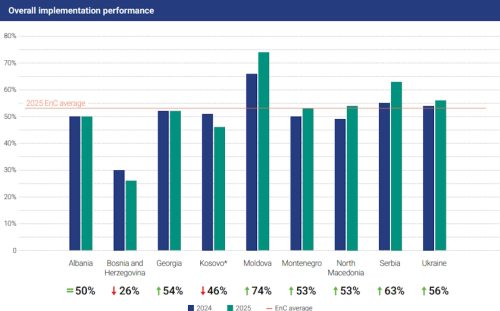
Serbia fares best in the Western Balkans, as it advanced to 63% from 55%. Bosnia and Herzegovina is at the bottom of the entire Energy Community chart, with alignment at just 26%.

Following the 2025 CBAM Readiness Tracker, the Energy Community Secretariat also published its Annual Implementation Report 2025. The international organization marked its 20th anniversary this year.

“The message from Athens was clear: integration with the European Union is advancing in practice, and the decade ahead must sustain this momentum with focus and determination. The 2025 Implementation Report reflects this direction. It shows a region taking decisive steps toward alignment with the EU acquis and strengthening the foundations required for accelerated integration. It also highlights where further effort is needed for gradual integration with the EU energy markets – completing the electricity market coupling, boosting the cross-border trade in renewables, eliminating bottlenecks for gas flows, synchronising energy infrastructure development and gradual alignment of carbon pricing mechanisms,” Energy Community Secretariat Director Artur Lorkowski stressed.

He added that electricity integration remains central. Several contracting parties completed the required transposition of the European Union’s Electricity Integration Package (EIP), while others advanced significantly.

Deadline for requests for 2028 market coupling to expire in seven months

Intensive market coupling efforts throughout 2025 by contracting parties and EU stakeholders have laid the groundwork for a compliant and sustainable integration process, according to the Annual Implementation Report. Of note, market coupling is the requirement for an exemption from the EU’s Carbon Border Adjustment Mechanism (CBAM) for electricity.

Contracting parties aiming to go live in 2028 must submit a formal request by July, the secretariat warned.
Energy Community Serbia best score Western Balkans
Photo: Energy Community Secretariat

Montenegro, North Macedonia advance slightly to match average

Five main indicators measure the integration with the EU energy markets and they are combined into an overall score. The Energy Community as a whole is at 53%.

Moldova has advanced the most in the process by far, climbing eight points from last year to reach 74%. Serbia fares best in the Western Balkans, as it advanced to 63% from 55%. It ranked the highest last year as well. Bosnia and Herzegovina is at the lowest level again. It retreated four points, to just 26%.

Montenegro and North Macedonia advanced slightly, both to 53%, to match the Energy Community average. Kosovo* has weakened to 46% while Albania remained at 50%.

At 61%, North Macedonia is in the lead in the Western Balkans in the markets and integration segment. Serbia reached the highest level in the Energy Community in energy sector decarbonization, 83%.
* This designation is without prejudice to positions onstatus and is in line with UNSCR 1244/99 and the ICJ Opinion on the Kosovo declaration of independence.
by in News

EU considering Montenegro’s proposals for changes to CBAM

Minister of Energy and Mining of Montenegro Admir Šahmanović met with several senior officials of the European Commission. The messages in Brussels regarding the Carbon Border Adjustment Mechanism (CBAM) were encouraging – changes in the regulation are being considered, including Montenegro’s demands, according to the ministry.

Minister of Energy and Mining of Montenegro Admir Šahmanović led a delegation that visited the European Commission’s headquarters. They met with Director General for Taxation and Customs Union Thomas Gerassimos, Deputy Director-General for Climate Action Jan Dusík and Director for Western Balkans Valentina Superti and Head of the Unit for Bosnia and Herzegovina and Montenegro Barbara Jésus-Gimeno, both from the Directorate-General for Enlargement and Eastern Neighbourhood.

The focus of the discussions was on key processes in the energy sector and especially on the Carbon Border Adjustment Mechanism (CBAM), which is currently Montenegro’s main priority, the ministry said. Šahmanović presented the reforms that the country conducted and stressed that the government is almost entirely aligned with its European requirements in the legal and strategic sense.

CBAM is now Montenegro’s priority

Over the last eight months, Montenegro adopted a new Law on Energy alongside dozens of bylaws, including some tied to the Law on the Use of Energy from Renewable Sources. The government launched the first renewable energy auction, for solar power, and signed a memorandum of understanding on market coupling with Italy, with which talks continue on the construction of the second wire in the undersea cable. Laws on cross-border energy exchange and the construction of cross-border energy assets are drafted, the update adds.

The minister said Montenegro is finalizing its National Energy and Climate Plan.

More flexible models for CBAM to be considered

The European Commission’s representatives acknowledged Montenegro’s progress and asserted that it is in the lead in the region as concerns the degree of compliance in the energy sphere, the ministry said.

“Within the same context it was agreed that discussions would be continued on a technical level in the following weeks to consider the possible, more flexible models of applying CBAM and to enable candidate states to adjust to the mechanism faster and more efficiently. A special focus will be on the elaboration of compromise solutions – especially the ones that enable a gradual, just and predictable implementation, with a minimal burden on the Montenegrin energy sector, which is significantly reliant on electricity exports,” the update reads.

EU’s cross-border tax on greenhouse gases to have weaker impact than in earlier projections

The European Commission conveyed encouraging messages: a smaller impact from CBAM is expected than in earlier projections, and amendments to the regulation are being considered, including demands from Montenegro from the consultations, according to the ministry.

Minister Šahmanović said Montenegro is remaining fully dedicated to its European obligations, but that it expects an acknowledgment of the results that it achieved, so that the implementation of CBAM is harmonized with the realities of the country’s energy system and its strong renewables investment cycle.

by in News

Serbia adopts Just Energy Transition Plan until 2030

Serbia now has a Just Energy Transition Plan until 2030. The document contains suggested measures for the mitigation of the impact of reducing fossil fuel use, primarily coal, so that workers, firms and communities aren’t left behind.

Following last month’s completion of the public consultation process regarding the proposed Just Transition Action Plan, the Government of Serbia passed, at its last session, the Just Energy Transition Plan of the Republic of Serbia until 2030. The document leans on the Integrated National Energy and Climate Plan (INECP or NECP)

It lays out sustainable energy policy measures that would need or could be undertaken. The point is in reducing fossil fuel dependence and improving security and efficiency of electricity supply by switching to renewable energy sources, and in an energy efficiency boost.

A just transition aims to promote environmentally sustainable economies in a way that is fair and inclusive for all

“A just transition aims to promote environmentally sustainable economies in a way that is fair and inclusive for all – workers, businesses and communities – by creating opportunities for decent work and leaving no one behind. This initiative should not be seen as a fixed set of rules, but as a dynamic process based on dialogue with a focus on addressing the concerns and needs of local populations and affected stakeholders,” the plan reads.

The approach is based on mitigating the negative effects of the energy transition process. It implies significant investments in retraining and reskilling, to assist workers in adjusting to new industries, as well as education, the plan adds.

It highlights the importance of incentivizing the development of new industries, and supporting small and medium-sized enterprises, which can enable alternative sources of income and employment.

Electricity system collapse in December 2021 marked as turning point?

Until December 2021, domestic electricity production met domestic needs, although even before that, the power system had been making maximum efforts for many years to provide sufficient amounts of electricity or, rather, provide sufficient amounts of coal for the operation of thermal power plants, the document notes.

There is no elaboration on the time reference, but that’s when a major outage struck coal-fired thermal power plants of state-owned power utility Elektroprivreda Srbije (EPS). Of note, it was one in a string of serious incidents in the electricity system.

Coal plants are old and they mostly don’t comply with environmental standards

“The fact is that existing electricity generation plants are old and most of them are not in line with new operating conditions and standards when it comes to environmental protection. Therefore, it is quite clear that in the case of the Serbian energy sector, the energy transition should lead to a radical change in the structure of sources and methods of electricity production,” according to the plan.

Coal plants, open pit mines could be replaced with wide range of activities from culture to gas power plants

Listed among the possibilities for repurposing coal plants and coal mine land after shutting them down are green power plants (but also gas-fueled energy facilities), launching industrial production, logistical and commercial activities, together with sports, culture, education, agriculture, tourism and waste management.

In 2023. there were 25,288 employees in thermal power plants (22.2%) and coal mines (77.8%), the document notes. The oldest coal plant, Kolubara A of 239 MW, was built in 1956, and the newest unit is Kostolac B3, of 350 MW. It came online last year.

“Social dialogue mechanisms should be established to ensure that the voices of all stakeholders are heard and their concerns are addressed. This includes consultations with trade unions, local self-governments and civil society organisations,” the Just Energy Transition Plan of the Republic of Serbia until 2030 suggests.

Expenses are envisaged at EUR 75.4 million, of which EUR 12 million would be for incentives for entrepreneurship and self-employment and EUR 60 million for improving business structure at existing industrial parks.

Carbon pricing system to make coal power plants in Serbia increasingly uncompetitive

One section covers the upcoming rollout of charges within the European Union’s Carbon Border Adjustment Mechanism (CBAM). The tax affects imports of a group of raw materials and electricity. Third countries can be exempted if they establish their own carbon pricing and emissions trading systems.

“In order to balance the economic and environmental impacts of the introduction of domestic carbon pricing in Serbia, a phased approach could be adopted, starting with a modest carbon price and gradually increasing it. Support for affected industries, such as subsidies for low-carbon technologies and worker retraining programs, along with recycling revenues to finance green projects and providing direct rebates to citizens, can mitigate negative effects,” the plan adds.

NGOs have criticized the action plan draft for only describing preparatory activities

Actually, proceeds from greenhouse gas emissions allowances in the EU are used only for the green economic transition, and it is similar with most environmental levies.

The introduction of a carbon tax mechanism will make domestic coal-fired power plants increasingly uncompetitive, especially in regional electricity markets, the government warned.

Nongovernmental organizations and associations earlier criticized the draft, arguing that it delays the energy transition until 2030, only lists preparatory activities and that, inter alia, there is no targeted date for ending the use of coal for electricity production.

In any case, a just energy transition requires defining deadlines and projects and securing funds exclusively for the said purposes. Otherwise the market will trample coal plants and mines, and it will probably happen abruptly, which would jeopardize energy security and employment. Such effects are already tangible in Southeastern Europe, especially in Bosnia and Herzegovina, as well as in Bulgaria and Slovenia.