by in News

Montenegro Achieves Regulatory Milestone: Full Alignment with EU Electricity Integration Package

In a significant leap toward European energy integration, Montenegro has officially completed the transposition of the European Union’s Electricity Integration Package (EIP). According to the Energy Community Secretariat, this regulatory alignment positions Montenegro alongside Moldova and Serbia as frontrunners in the Western Balkans’ effort to merge with the European single electricity market.

The move is designed to catalyze Montenegro’s energy transition by enhancing market competitiveness and ensuring the country can participate in regional power exchanges even before formal EU accession.

The Gateway to Market Coupling: SDAC and SIDC

The primary objective of transposing the EIP is to enable Market Coupling. By harmonizing its domestic laws with EU standards, Montenegro is preparing to join two critical pillars of the European energy infrastructure:

  • Single Day-Ahead Coupling (SDAC): A mechanism that optimizes electricity prices and cross-border flows across Europe for the following day.

  • Single Intraday Coupling (SIDC): A continuous trading environment that allows market participants to adjust their positions as close to real-time as possible.

This integration is expected to lower costs for consumers, provide clearer signals for renewable energy investors, and significantly bolster the security of the national supply.

The Legislative Roadmap

The finalization of this process occurred on February 15, 2026, when the Montenegrin government adopted two pivotal decrees governing:

  1. System Operation: Establishing technical rules for grid stability.

  2. Emergency and Restoration: Outlining protocols for grid recovery during unforeseen outages.

These decrees complement existing legislation, including the Law on Energy and the Law on Cross-Border Exchanges in Electricity and Natural Gas. Together, these legal frameworks form the “four pillars” identified by the Secretariat as essential for a cost-efficient clean energy transition:

  • Clear investment signals.

  • Strengthened regional cooperation.

  • Reinforced fair competition.

  • Enhanced security of supply.

The Path to Verification

While the legislative work is complete, Montenegro now enters the Verification Phase. This process involves a rigorous audit by the Energy Community Secretariat and the European Commission to ensure that the laws on paper translate into functional market practices.

Country Status of EIP Transposition Verification Phase
Serbia Completed In Progress (Started Oct 2025)
Moldova Completed Initiating
Montenegro Completed Pending Request
North Macedonia Partial Pending Legislation

“Montenegro is now stepping up efforts to submit a formal request initiating the verification process,” the Secretariat noted, echoing recent sentiments from Director Artur Lorkowski regarding the rapid progress of the “Vienna Group” of energy reformers.

Expert Analysis: What This Means for the Region

For a small economy like Montenegro, market coupling is a “force multiplier.” By removing the barriers to cross-border electricity trade, the country can better manage the intermittency of new wind and solar projects. This regulatory bridge to the EU not only modernizes the grid but also makes Montenegro a more attractive destination for “green” capital, as energy produced domestically can now be more easily sold into the massive European market.

by in News

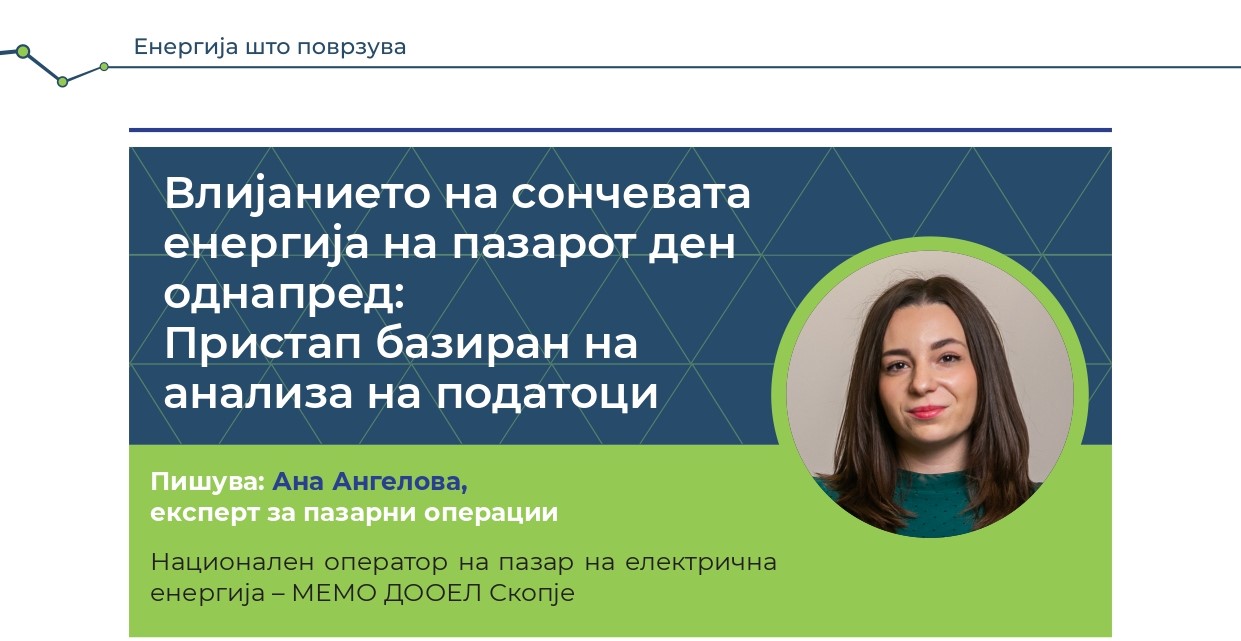
MEMO Analysis Links Solar Output to Lower Day-Ahead Power Prices in North Macedonia

Electricity generation from solar power plants tends to push prices down on the power exchange, while reduced solar output is associated with price increases, according to an analysis by Ana Angelova, a market operations specialist at the National Electricity Market Operator (MEMO).

The analysis aimed to identify seasonal trends and highlight the relationship between photovoltaic (PV) generation, electricity consumption, traded volumes, and day-ahead prices on the North Macedonian power exchange. MEMO noted that the day-ahead market operates in an isolated mode.

Angelova used official power exchange data for 2024, focusing on hours when PV plant efficiency exceeded 30%.

Consumption remains broadly stable across the year

The findings point to a clear seasonal pattern. Electricity consumption stays relatively steady throughout the year, with only minor declines during spring and summer. PV generation, however, shows a pronounced seasonal swing—peaking in summer and reaching its lowest levels in winter.

Angelova also stressed that higher PV output coincides with increased traded volumes on the day-ahead market.

Prices bottom out in April, rise toward winter

According to the analysis, day-ahead prices are lowest in April, a period linked to milder weather, lower demand, and stronger solar production. From summer onward—and particularly during winter—prices trend higher, peaking in November.

The November price peak aligns with a combination of weak PV generation and higher consumption.

“Increased electricity generation from photovoltaic plants is associated with lower prices, while low generation leads to higher market prices, emphasizing the impact of renewable energy availability on price formation. The trend indicates that energy policies should focus on addressing weaknesses during the winter period and harnessing the potential of solar energy in summer,” Angelova wrote.

Proposed measures to strengthen renewables integration

north macedonia solar analysis memo power exchange ana angelova

Photo: MEMO

Angelova outlined several options to improve the integration of renewables—especially solar—into the power system. The proposed mechanisms include:

  • Flexible market mechanisms: introduction of a 15-minute trading interval, creation of an intraday market, dynamic tariffs, and guarantees of origin.

  • Energy storage technologies: battery energy storage systems (BESS) and pumped-storage hydropower plants.

  • Alignment with the European energy framework: adoption of ENTSO-E grid codes, coupling with the single European electricity market, deployment of smart meters, and use of financial instruments such as contracts for difference (CfD) and power purchase agreements (PPA).

by in News

EU’s amendments to CBAM: possibility of relief, but January 1 brought market uncertainty

Long-awaited implementing acts and amendments to the CBAM Regulation brought only a minor relief for the Western Balkans, investors in renewables, and electricity traders. Balkan Green Energy News has analyzed the documents that the European Commission published in December 2025, and the impact of the proposed measures on Energy Community contracting parties – Albania, BiH, Kosovo*, Montenegro, North Macedonia and Serbia.

From January 1, European firms importing aluminum, cement, electricity, iron and steel, hydrogen and fertilizers are obliged to pay a carbon price within the European Union’s Carbon Border Adjustment Mechanism (CBAM).

Last year, the CBAM Regulation was criticized by experts from the Western Balkans (Ljubo Maćić, Zoran Gjorgjievski), European think-tanks (Bruegel), and organizations (Energy Traders Europe). Even the European Network of Transmission System Operators for Electricity (ENTSO-E) requested that the transitional period be prolonged.

They said charging the tax, which started on January 1 as scheduled, would harm countries outside the EU, but also EU member states, market coupling of Western Balkan countries, and electricity trade.

Uncertainty surrounding electricity transit and trade remains high

The analysis showed that the European Commission is proposing changes to the CBAM regulation that would introduce a more favorable method for calculating the national emissions factor and actual emissions values. This benefits non-EU countries that export electricity to the EU, owners of operational renewable energy power plants in these countries, and future green energy investments.

The proposal foresees amendments to the procedure for market coupling, but it is unclear whether these will bring any concrete changes. The commission didn’t propose changes regarding transit, and consequently, electricity trading.

Provided that the proposal is accepted as proposed, it will bring the said positive changes in calculating the national emissions factor and actual emissions values only by the end of the year, meaning that uncertainty in the market will persist until then.

Uncertainty surrounding electricity transit and trade remains high. The impact on the Western Balkans, as well as on the EU member states Bulgaria, Croatia, Greece, Hungary, Romania, and Slovenia, will become clear in the coming weeks and months.

There are two legislative streams

There are two relevant streams currently ongoing in EU legislation for CBAM for electricity. The first are the so-called implementing acts, which are similar to secondary legislation in national law. They further define the technical details of the CBAM regulation.

The other part is the commission’s proposal to amend the CBAM Regulation itself. It will become part of the law when the other co-legislators in the EU – the Council of the EU, which includes the member states, and the European Parliament – together agree on it.

Nobody can say exactly when that process will be finished, but most likely not before the autumn.

National emissions factors, actual emission values: improvement

eu western balkans cbam electricity market coupling amendments
Photo: iStock

There is a proposal to change the way the national emission factors are calculated in the main CBAM Regulation. Currently it only includes the part of the electricity mix based on fossil fuels, regardless of their share in the country’s power generation mix.

For example, for Serbia, a contracting party of the Energy Community, this factor is 1.04. If the national power mix is taken into account, it would go down to 0.7, making the cost of CBAM about 40% lower.

The commission proposed to replace the electricity mix based on fossil fuels, in its accounting system, with one encompassing all energy sources.

The commission also intends to change the requirements for switching to actual emission values

The commission also intends to change the requirements for switching to actual emission values. These are relevant for the producers of renewable energy in non-EU countries. Current conditions are very strict and, to some stakeholders, not achievable.

For example, if a wind farm in the Western Balkans, owned by a domestic or foreign investor, cannot meet these conditions the CBAM payments for the electricity from the facility exported to the neighboring Croatia would be calculated based on the national emissions factor.

The commission suggested that an importer shouldn’t need to have a power purchase agreement (PPA) with a producer directly, which is one of the conditions, but that it could be done through intermediaries. It also proposed the removal of the requirements related to congestion.

These proposals could remove negative impacts on renewable electricity exports and development in non-EU countries, including contracting parties.

Transit: nothing new

The issue of transit hasn’t been addressed in the acts and amendments.

Under the CBAM Regulation, it is unclear how electricity transit costs would be calculated. For example, from Bulgaria to Hungary via Serbia, and who would be required to cover them.

The commission clarified several times that transit isn’t subject to CBAM. However, the physical, practical implementation is the problem.

For example, a trader buys electricity from Greece, transits it through North Macedonia, and puts it on the Serbian SEEPEX power exchange. Somebody else buys it and sells it in Hungary.

It would be very difficult or impossible to say that electricity from Greece was sold into Hungary.

This is why stakeholders take a conservative approach and say that they cannot prove. So, most likely they wouldn’t opt for these countries – non-EU countries, like contracting parties – for transit.

Retroactivity: possibility for improvement

eu western balkans electricity market cbam amendments
Photo: iStock

One of the provisions in the commission’s proposal to amend the CBAM Regulation is that the changes in the electricity sector could apply retroactively, starting from January 2026.

Just as a reminder, EU firms are obliged since the start of this month to pay a CBAM fee for importing designated goods and raw materials and electricity via purchasing so-called CBAM certificates.

Obviously, an importer will try to pass on this cost partly or fully to its counterparts in the third countries. But, importantly, EU firms won’t be able to purchase CBAM certificates yet this year, but only from February 1, 2027.

If the amendment on national emissions factor is adopted, for example in October, this could mean lower CBAM costs for EU importers of electricity from non-EU countries.

Without details on the path forward, market participants lack certainty about the level of CBAM costs

The commission intended to remedy some of the negative impacts on the electricity markets with amendments with retroactive effect. But without details on the path forward, market participants lack certainty about the level of CBAM costs to be paid for 2026.

Based on the current rules, CBAM costs for countries which have lignite in their generation mix could be EUR 70 per MWh to EUR 80 per MWh if the EU ETS price is around 80 EUR per ton of CO2. In some cases, the fee is almost 100% above the electricity price itself.

It is clear that it would rarely make sense to import electricity to the EU from third countries. The price difference, let’s say between Hungary and Serbia, would need to be more than EUR 70 per MWh to EUR 80 per MWh to make the business case.

Market coupling: nothing new or possibility for improvement

eu cbam western balkans electricity market amendments
Photo: Sergio Cerrato – Italia from Pixabay

There are several references to market coupling in the proposal. Energy Community contracting parties are in different phases of market coupling with EU countries.

The commission has proposed signing memoranda of understanding with third countries. It would set out the timeline and conditions for an exemption from CBAM on electricity.

This could be done after the commission approves the so-called verification process of a contracting party’s transposition of the Electricity Integration Package (EIP). It would be a green light for the next stage, which entails the technical tests, leading up to the completion of market coupling.

The current wording in the proposal leaves room for various interpretations

The current wording in the proposal leaves room for various interpretations, one being that the MoU may open the door for an exemption already when the “point of no return” is reached. It is when the contracting party has done all its homework and only the technical tests remain.

However, the commission didn’t propose the other conditions for CBAM exemption to be changed, such as the development of a roadmap on the introduction of a CO2 price that would be equivalent to the level in the EU’s Emissions Trading System (EU ETS).

The question is what the MoU would exactly be about, and if “equivalent” could be defined more precisely.

Why is this important?

No contracting party has yet met the conditions to receive a CBAM exemption in the electricity sector. A critical requirement is to agree to charge an emissions price from 2030 equivalent to the EU ETS.

The CBAM regulation says that the tax cannot technically be implemented on a market which is coupled with the EU internal energy market

If equivalent means the same price, here is the outcome for Serbia, for example: The current CO2 price in the EU is EUR 80 per ton of CO2 equivalent, but is expected to rise to above EUR 100 by 2030, or even reach EUR 150. It would raise prices to consumers by about EUR 75 per MWh and EUR 110, respectively.

The CBAM regulation says that the tax cannot technically be implemented on a market which is coupled with the EU internal energy market. This is why there is a possibility for an exemption for electricity for imports from those countries which are coupled until a technical solution is found how to implement CBAM.

Starting from January 1, any country that is ready to be coupled would in parallel also need to qualify for and receive an exemption from CBAM for electricity. If you fulfil the conditions, you get coupled and get an exemption and CBAM will disappear.

What next?

It could be said that CBAM implementation as of January 1 will certainly affect market integration in the sense that people, businesses would react to market uncertainty.

Trade will be impacted; imports from contracting parties to the EU will be expected to disappear. Of course, contracting parties will continue to import electricity from the EU member states.

The weeks and months ahead will show to what extent the prices and liquidity would be affected in the contracting parties and neighboring EU member states Bulgaria, Croatia, Greece, Hungary, Romania, Slovenia.

For example, Greece would have only the Bulgaria-Romania route to export electricity, and it is already congested. Greece could face curtailments in renewable electricity.

We will also see what the effect on the renewables deployment in contracting parties will be. Are investors going to postpone investments until they see if the changes proposed by the commission are adopted, or are they going to leave for other markets?


Pozsgai: Amendments point in the right direction

Péter Pozsgai, Lead of the EU Carbon Border Adjustment Mechanism Readiness Task Force in the Energy Community Secretariat:

“The European Commission’s proposed amendments point in the right direction, reflecting a consideration of the progress of contracting parties in electricity market coupling, and better outlining the operational details of an exemption via an MoU. The refinement of the rules on national emission factors and the conditions for using actual emission values also demonstrate the intention to minimize the unintended impacts of CBAM on renewable development in contracting parties”.


by in News

EU’s amendments to CBAM: possibility of relief, but January 1 brought market uncertainty

Long-awaited implementing acts and amendments to the CBAM Regulation brought only a minor relief for the Western Balkans, investors in renewables, and electricity traders. The documents has been analyzed that the European Commission published in December 2025, and the impact of the proposed measures on Energy Community contracting parties – Albania, BiH, Kosovo*, Montenegro, North Macedonia and Serbia.

From January 1, European firms importing aluminum, cement, electricity, iron and steel, hydrogen and fertilizers are obliged to pay a carbon price within the European Union’s Carbon Border Adjustment Mechanism (CBAM).

Last year, the CBAM Regulation was criticized by experts from the Western Balkans (Ljubo Maćić, Zoran Gjorgjievski), European think-tanks (Bruegel), and organizations (Energy Traders Europe). Even the European Network of Transmission System Operators for Electricity (ENTSO-E) requested that the transitional period be prolonged.

They said charging the tax, which started on January 1 as scheduled, would harm countries outside the EU, but also EU member states, market coupling of Western Balkan countries, and electricity trade.

Uncertainty surrounding electricity transit and trade remains high

The analysis showed that the European Commission is proposing changes to the CBAM regulation that would introduce a more favorable method for calculating the national emissions factor and actual emissions values. This benefits non-EU countries that export electricity to the EU, owners of operational renewable energy power plants in these countries, and future green energy investments.

The proposal foresees amendments to the procedure for market coupling, but it is unclear whether these will bring any concrete changes. The commission didn’t propose changes regarding transit, and consequently, electricity trading.

Provided that the proposal is accepted as proposed, it will bring the said positive changes in calculating the national emissions factor and actual emissions values only by the end of the year, meaning that uncertainty in the market will persist until then.

Uncertainty surrounding electricity transit and trade remains high. The impact on the Western Balkans, as well as on the EU member states Bulgaria, Croatia, Greece, Hungary, Romania, and Slovenia, will become clear in the coming weeks and months.

There are two legislative streams

There are two relevant streams currently ongoing in EU legislation for CBAM for electricity. The first are the so-called implementing acts, which are similar to secondary legislation in national law. They further define the technical details of the CBAM regulation.

The other part is the commission’s proposal to amend the CBAM Regulation itself. It will become part of the law when the other co-legislators in the EU – the Council of the EU, which includes the member states, and the European Parliament – together agree on it.

Nobody can say exactly when that process will be finished, but most likely not before the autumn.

National emissions factors, actual emission values: improvement

eu western balkans cbam electricity market coupling amendments
Photo: iStock

There is a proposal to change the way the national emission factors are calculated in the main CBAM Regulation. Currently it only includes the part of the electricity mix based on fossil fuels, regardless of their share in the country’s power generation mix.

For example, for Serbia, a contracting party of the Energy Community, this factor is 1.04. If the national power mix is taken into account, it would go down to 0.7, making the cost of CBAM about 40% lower.

The commission proposed to replace the electricity mix based on fossil fuels, in its accounting system, with one encompassing all energy sources.

The commission also intends to change the requirements for switching to actual emission values

The commission also intends to change the requirements for switching to actual emission values. These are relevant for the producers of renewable energy in non-EU countries. Current conditions are very strict and, to some stakeholders, not achievable.

For example, if a wind farm in the Western Balkans, owned by a domestic or foreign investor, cannot meet these conditions the CBAM payments for the electricity from the facility exported to the neighboring Croatia would be calculated based on the national emissions factor.

The commission suggested that an importer shouldn’t need to have a power purchase agreement (PPA) with a producer directly, which is one of the conditions, but that it could be done through intermediaries. It also proposed the removal of the requirements related to congestion.

These proposals could remove negative impacts on renewable electricity exports and development in non-EU countries, including contracting parties.

Transit: nothing new

The issue of transit hasn’t been addressed in the acts and amendments.

Under the CBAM Regulation, it is unclear how electricity transit costs would be calculated. For example, from Bulgaria to Hungary via Serbia, and who would be required to cover them.

The commission clarified several times that transit isn’t subject to CBAM. However, the physical, practical implementation is the problem.

For example, a trader buys electricity from Greece, transits it through North Macedonia, and puts it on the Serbian SEEPEX power exchange. Somebody else buys it and sells it in Hungary.

It would be very difficult or impossible to say that electricity from Greece was sold into Hungary.

This is why stakeholders take a conservative approach and say that they cannot prove. So, most likely they wouldn’t opt for these countries – non-EU countries, like contracting parties – for transit.

Retroactivity: possibility for improvement

eu western balkans electricity market cbam amendments
Photo: iStock

One of the provisions in the commission’s proposal to amend the CBAM Regulation is that the changes in the electricity sector could apply retroactively, starting from January 2026.

Just as a reminder, EU firms are obliged since the start of this month to pay a CBAM fee for importing designated goods and raw materials and electricity via purchasing so-called CBAM certificates.

Obviously, an importer will try to pass on this cost partly or fully to its counterparts in the third countries. But, importantly, EU firms won’t be able to purchase CBAM certificates yet this year, but only from February 1, 2027.

If the amendment on national emissions factor is adopted, for example in October, this could mean lower CBAM costs for EU importers of electricity from non-EU countries.

Without details on the path forward, market participants lack certainty about the level of CBAM costs

The commission intended to remedy some of the negative impacts on the electricity markets with amendments with retroactive effect. But without details on the path forward, market participants lack certainty about the level of CBAM costs to be paid for 2026.

Based on the current rules, CBAM costs for countries which have lignite in their generation mix could be EUR 70 per MWh to EUR 80 per MWh if the EU ETS price is around 80 EUR per ton of CO2. In some cases, the fee is almost 100% above the electricity price itself.

It is clear that it would rarely make sense to import electricity to the EU from third countries. The price difference, let’s say between Hungary and Serbia, would need to be more than EUR 70 per MWh to EUR 80 per MWh to make the business case.

Market coupling: nothing new or possibility for improvement

eu cbam western balkans electricity market amendments
Photo: Sergio Cerrato – Italia from Pixabay

There are several references to market coupling in the proposal. Energy Community contracting parties are in different phases of market coupling with EU countries.

The commission has proposed signing memoranda of understanding with third countries. It would set out the timeline and conditions for an exemption from CBAM on electricity.

This could be done after the commission approves the so-called verification process of a contracting party’s transposition of the Electricity Integration Package (EIP). It would be a green light for the next stage, which entails the technical tests, leading up to the completion of market coupling.

The current wording in the proposal leaves room for various interpretations

The current wording in the proposal leaves room for various interpretations, one being that the MoU may open the door for an exemption already when the “point of no return” is reached. It is when the contracting party has done all its homework and only the technical tests remain.

However, the commission didn’t propose the other conditions for CBAM exemption to be changed, such as the development of a roadmap on the introduction of a CO2 price that would be equivalent to the level in the EU’s Emissions Trading System (EU ETS).

The question is what the MoU would exactly be about, and if “equivalent” could be defined more precisely.

Why is this important?

No contracting party has yet met the conditions to receive a CBAM exemption in the electricity sector. A critical requirement is to agree to charge an emissions price from 2030 equivalent to the EU ETS.

The CBAM regulation says that the tax cannot technically be implemented on a market which is coupled with the EU internal energy market

If equivalent means the same price, here is the outcome for Serbia, for example: The current CO2 price in the EU is EUR 80 per ton of CO2 equivalent, but is expected to rise to above EUR 100 by 2030, or even reach EUR 150. It would raise prices to consumers by about EUR 75 per MWh and EUR 110, respectively.

The CBAM regulation says that the tax cannot technically be implemented on a market which is coupled with the EU internal energy market. This is why there is a possibility for an exemption for electricity for imports from those countries which are coupled until a technical solution is found how to implement CBAM.

Starting from January 1, any country that is ready to be coupled would in parallel also need to qualify for and receive an exemption from CBAM for electricity. If you fulfil the conditions, you get coupled and get an exemption and CBAM will disappear.

What next?

It could be said that CBAM implementation as of January 1 will certainly affect market integration in the sense that people, businesses would react to market uncertainty.

Trade will be impacted; imports from contracting parties to the EU will be expected to disappear. Of course, contracting parties will continue to import electricity from the EU member states.

The weeks and months ahead will show to what extent the prices and liquidity would be affected in the contracting parties and neighboring EU member states Bulgaria, Croatia, Greece, Hungary, Romania, Slovenia.

For example, Greece would have only the Bulgaria-Romania route to export electricity, and it is already congested. Greece could face curtailments in renewable electricity.

We will also see what the effect on the renewables deployment in contracting parties will be. Are investors going to postpone investments until they see if the changes proposed by the commission are adopted, or are they going to leave for other markets?


Pozsgai: Amendments point in the right direction

Péter Pozsgai, Lead of the EU Carbon Border Adjustment Mechanism Readiness Task Force in the Energy Community Secretariat:

“The European Commission’s proposed amendments point in the right direction, reflecting a consideration of the progress of contracting parties in electricity market coupling, and better outlining the operational details of an exemption via an MoU. The refinement of the rules on national emission factors and the conditions for using actual emission values also demonstrate the intention to minimize the unintended impacts of CBAM on renewable development in contracting parties”.


by in News

Serbia is first Energy Community contracting party to enter verification phase of market coupling

Serbia is the first Energy Community contracting party to enter the verification phase of the market coupling procedure, the Energy Community Secretariat said after the annual meeting of the Ministerial Council in Vienna.

At the Energy Community Ministerial Council, ministers addressed energy security, market integration, climate policy, and environmental protection, confirming a shared EU–contracting parties direction for Europe’s energy future, according to the secretariat.

Ministers and representatives of the secretariat also discussed the amendments to the Carbon Border Adjustment Mechanism’s regulation revealed by the European Commission yesterday. The meeting was attended by European Commissioner for Energy Dan Jørgensen.

The secretariat underlined that several contracting parties are now approaching a decisive stage in electricity market integration ahead of accession, having fully or nearly transposed the Electricity Integration Package (EIP).

The two-step verification phase for Serbia kicked off on October 22

Subject to verification of compliance by the European Commission, this progress opens the door to electricity market coupling with the EU internal market ahead of accession, it added.

“Serbia has already entered the verification phase, while Moldova has fully transposed the package. In this context, ministers underlined that the CBAM, entering into force in January,  should not pose an issue for cross-border electricity trade,” the update reads.

eu region ministerial council 2025 meeting
Photo: Energy Community Secretariat

Full electricity market integration ahead of accession offers a clear pathway to safeguarding decarbonization gains, supporting fair and efficient cross-border electricity exchanges, and attracting clean energy investment, according to the secretariat.

The two-step verification phase for Serbia kicked off on October 22. The first step is the verification by the secretariat, and the second by the commission.

The secretariat must complete the verification within three months, by January 22. The process is in the final stage, Balkan Green Energy News has learned.

The European Commission has five months to do its part

Once this is finished, the commission has five months to do its part. If the commission’s verification is positive, Serbia could meet the end-July deadline to apply for market coupling. The next phase involves technical activities, and it lasts 18 months.

“We are very deep in the process of verifying what Serbia has adopted. Now we are about to start this process for Moldova. And soon, I hope, after the remaining elements of the legislative package are adopted by Montenegro and North Macedonia, the verification can start in these two cases,” stressed Artur Lorkowski, Director of the Energy Community Secretariat.

He added that it has taken two decades of cooperation to build the momentum toward market coupling that ministers today have consolidated.

Lorkowski: The voice of the Energy Community ministers on CBAM has been heard by the commission

eu region ministerial council 2025 artur lorkowski
Artur Lorkowski (photo: Energy Community Secretariat)

Regarding the European Commission’s amendments to the CBAM regulation, he recalled that, on behalf of the ministers, the secretariat has sent a list of 11 different issues that needed to be addressed.

“The voice of the Energy Community ministers has been heard by the commission, and the progress which has been made in the contracting parties has been recognized. We see that in different amendments which are proposed. The proposal is going in a good direction. If you ask me whether this is satisfactory and whether it solves all of the problems, no, for two reasons,” he underscored.

The first reason is that it requires time, and the damage will be done from January 1, 2026, when the CBAM implementation starts.

Jørgensen: A lot of progress has happened

“We already see that, for example, the allocations of the cross-border power lines between the contracting parties and the EU member states for next year are dropping significantly,” Lorkowski explained.

The second reason is the issue of completeness. “We are still not certain whether, for example, renewables in the contracting parties can be treated equally as those in the EU,” he said, and added that the secretariat is in communication with the commission on these issues.

According to European Commissioner for Energy Dan Jørgensen, it is clear that a lot of progress has been made in what will hopefully be future EU member states or neighbors, especially in the transposition of EU energy law.

Focus on four issues

According to the secretariat, the ministers further committed to advancing a coherent and predictable framework to sustain electricity market integration while creating the enabling conditions for the clean energy transition.

The secretariat highlighted four issues.

First, contracting parties will individually pursue national carbon pricing models according to their domestic circumstances, while work continues to explore coordination possibilities and ensure coherence between national carbon pricing systems in view of their gradual alignment with the EU ETS.

Second, the Energy Community framework will further incorporate core EU legislation on nature conservation, biodiversity, and water protection into the Energy Community Treaty.

Third, to keep momentum behind the rapid growth of renewables, the contracting parties will step up efforts to secure mutual recognition of guarantees of origin with the EU.

Finally, effective coordination and implementation of national energy and climate plans (NECPs) is critical, participants agreed.

The EU’s recent agreement on the 2040 climate targets sets a clear direction, and contracting parties must follow this pathway as they develop their long-term energy and climate policies, the update reads.

by in News

Bruegel: Without refining or delaying CBAM for electricity, EU risks market integration, security of supply

Unless the rules are refined for the electricity sector, the Carbon Border Adjustment Mechanism (CBAM) risks undermining the European electricity market integration and security of supply, Brussels-based think tank Bruegel warned.

Bruegel has analyzed the impacts of the application of CBAM, set for January 1, 2026. The tax will apply to steel, cement, iron, aluminium, fertilizers, hydrogen, electricity, and also to the cross-border trade in electricity.

The think tank proposes the application of CBAM in the electricity sector to be reconsidered, or at least for it to be postponed until 2028.

“Including electricity from January 2026 risks undermining European electricity market integration and security of energy supply, while the climate benefits are unclear. A delay could form part of a constructive compromise in an ongoing CBAM revision,” Ben McWilliams, Rouven Stubbe and Georg Zachmann wrote.

Ukraine and the Western Balkans will face implied export penalties of EUR 70-80 per MWh

The trading partners affected by CBAM on electricity are the United Kingdom, Morocco, the Western Balkans – Albania, BiH, Kosovo*, Montenegro, North Macedonia, and Serbia – Ukraine, Moldova and Turkey.

According to the analysis, Ukraine and the Western Balkans will face implied export penalties of EUR 70 per MWh to EUR 80 per MWh. It will significantly reduce trade with the EU, the authors stressed.

Ukraine’s electricity exports to the EU are expected to drop more than 60% from the level in a scenario without CBAM – from 6 TWh to 2.5 TWh, they added.

Additional trade barriers on the EU’s eastern borders would slow electricity market integration.

The export of solar power from Greece to other EU countries could also be affected by CBAM

“Falling average electricity prices, lower market values for renewables and increased price volatility would also reduce incentives to invest in renewable assets in these countries. Moreover, the Western Balkans is an important transit region for intra-European electricity trading. The export of solar power from Greece to other EU countries, for example, could also be affected by CBAM,” the analysis reads.

The authors said the policy goal of integrating Energy Community countries into the EU’s internal energy market is strategically more important than addressing carbon leakage and argued that, in the long run, it is more important from a climate perspective, too.

Not clear whether the application of CBAM to the electricity trade will deliver

They recalled that the purpose of CBAM is to reduce the risk of so-called carbon leakage, as well as to encourage third countries to implement domestic carbon pricing.

“However, it is not clear that the application of CBAM, as currently designed, to the electricity trade will deliver on either front,” the authors said. They named two reasons why carbon leakage in the electricity sector is problematic. The free allowances issued to electricity producers under the ETS were already phased out in 2013 – implying that electricity is not considered by the European Commission to be a sector at serious risk of carbon leakage.

The current CBAM legislation is not clear enough

Secondly, the current CBAM legislation is not clear enough. Unless hard-to-fulfil conditions apply, the Regulation (EU) 2023/956, which established CBAM, proposes that default carbon emission values be applied.

The outcome is that the values in question are calculated according to the last five-year average CO2 intensity of electricity produced from fossil fuels. It is problematic because electricity is exported when prices in one grid are lower than in another, which typically happens when renewables output is high, the think tank underlined in its analysis.

It is also unfair because power systems are evolving – production from fossil fuels is decreasing and renewables generation is increasing.

The coupling of the electricity markets of Energy Community countries is unlikely before 2028

Regarding CBAM’s intention to push third countries to introduce carbon pricing, the authors said that the first developments indicate some results.

However, they explained that an exemption for the electricity sectors of third countries is available under certain conditions, including electricity market coupling and the introduction of an ETS with an equivalent price to the EU ETS by 2030.

The CBAM charge sets off in January 2026, and the coupling of the electricity markets of Energy Community countries is unlikely before 2028, which means that an exemption for electricity cannot be secured before that date under current rules, the analysis underlined.

The solution

The authors pointed out that the potential gains from including electricity in CBAM are limited, compared to the frictions it will create. They suggested to the EU to follow the lead of the UK, which doesn’t plan to include electricity in its own CBAM, and thus to drop electricity from its sectoral coverage.

Otherwise, the authors proposed a revision of the calculation of default carbon emissions, and application delay until 2028 with additional analysis on the risk of carbon leakage in the electricity sector.

Regarding the default carbon emissions, five-year average CO2 intensity should be substituted for average grid emission factors calculated on an hourly or 15-minute basis, administered by the European Network of Transmission System Operators for Electricity (ENTSO-E) and national transmission system operators.

The application of CBAM to electricity should be delayed until 2028 to avoid disruption to the electricity trade and to give more time for the introduction of domestic carbon pricing and the coupling of electricity markets, the authors of the analysis concluded.

* This designation is without prejudice to positions onstatus and is in line with UNSCR 1244/99 and the ICJ Opinion on the Kosovo declaration of independence.
by in News

Serbia eyes last quarter of 2027 for power market coupling with EU – SEEPEX CEO

Serbia is targeting the last quarter of 2027 for coupling with the European Union’s single day-ahead market, Serbian power exchange SEEPEX’s Managing Director Miloš Mladenović said.

Miloš Mladenović was one of the speakers at the Energy Connectivity, Resilience and Security in Southeastern Europe panel at the 14th International Forum on Energy for Sustainable Development in Skopje.

He recalled that a few weeks ago, the European Commission finally published the governance for the verification process regarding the transposition of the Electricity Integration Package (EIP) for market coupling by the contracting parties of the Energy Community.

SEEPEX would try to reduce the required time

Also, he added, it would took up to six months starting from the new year to implement the Market Coupling Operator Integration Plan (MCO IP).

“I think that in the middle of next year, we can start with this famous 18 months, which is regular time to implement the single day-ahead coupling (SDAC),” Mladenović stressed.

He underlined that within the extended ADEX family, with EPEX Spot and the transmission system operators (TSOs), which are shareholders, they would try to reduce the required time at the market coupling steering committee.

“Our common goal now is to try to catch this time slot, the last quarter of 2027,” he stated.

Mladenović noted that it is usual to use the first quarter of a year for the single day-ahead coupling (SDAC), and the last quarter for single intraday coupling (SIDC).

SEEPEX plans to proceed with intraday coupling with Hungary

“I hope that we would have understanding within the nominated electricity market operators (NEMOs) and the TSOs community to catch this thing and to have this last quarter of 2027 as a time slot for SDAC coupling,” he explained.

After that, SEEPEX plans, in his words, to proceed with intraday coupling with Hungary.

He pointed out that a few days ago, SEEPEX received positive feedback from the Italian Border Working Table (IBWT) regarding its initiative to couple Serbia with Bulgaria.

Now the request will be provided to national regulators for a confirmation letter, he added.

“I hope that for all other neighboring contracting parties of the Energy Community, the Serbia-Hungary coupling could be a vehicle to speed up the process,” Mladenović asserted.

European Commission to allow acceleration of market coupling

Mladenović also highlighted the experience Serbia had with the legal and regulatory side of the coupling process. “I will put business and technical parts aside, because I’m sure that my colleagues, both the power exchanges and the TSOs, are ready to implement all that is needed for the coupling,” he added.

The legal and regulatory process is, in his words, very demanding, because there are 10 grid codes to be transposed to align all the rules with the country’s market rules, with the transmission codes and with the legal framework.

He expressed doubt that the neighboring countries could achieve such speed.

“It could be some joint request to the European Commission to try to make coupling processes parallel. We insisted on this from the beginning. I hope that our colleagues from the region will get the green light to implement the project even before the legal and regulatory framework are in place,” Mladenović stressed.

He said he believes that the Serbia-Hungary coupling and the future Serbia-Bulgaria coupling could be a shiny start, leading soon to the entire region’s coupling with the EU internal market.

by in News

Western Balkans power markets: hope for coupling with EU, concerns about CBAM

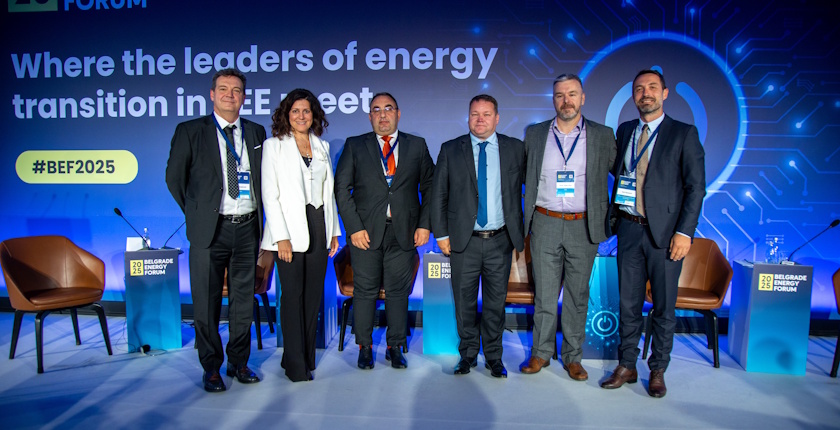
Energy Community contracting parties are doing their best to meet the challenging requirements and use the opportunity to couple their electricity markets with the European Union in Q4 2026 or Q1 2027. Apart from other benefits, coupling could represent a strong incentive for investment in renewables. However, the introduction of CBAM could be a step back for electricity markets, investments and energy transition in the region, according to representatives of transmission system operators, regulators, and power exchanges who spoke at Belgrade Energy Forum 2025.

The third Belgrade Energy Forum, BEF 2025, organized by Balkan Green Energy News, welcomed four hundred participants from more than 30 countries from the region, Europe, and beyond.

Participants in the panel called Integration of Western Balkans electricity markets into internal European market through market coupling were:

  • Anže Predovnik, ADEX Group, CEO,
  • Jasmina Trhulj, Energy Community Secretariat, Head of Electricity Unit,
  • Ivan Asanović, TSO Crnogorski Elektroprenosni Sistem (CGES), CEO,
  • Marko Bislimoski, Energy, Water Services and Municipal Waste Management Services Regulatory Commission of the Republic of North Macedonia (RKE or ERC), President,
  • Zoran Vujasinović, EU Agency for the Cooperation of Energy Regulators (ACER), Policy Officer.

They discussed very hot topics including market coupling, the Carbon Border Adjustment Mechanism (CBAM), and blackouts.

Market coupling: The first go-live window scheduled for Q4 2026 or Q1 2027

Dejan Stojčevski and Jasmina Trhulj (photo: Balkan Green Energy News)

In his opening remarks, panel moderator Dejan Stojčevski, CTO of the SEEPEX power exchange, emphasized the importance of integrating the electricity markets of the Energy Community contracting parties (EnC CPs) with the EU internal electricity market as a key element in the energy transition process.

“Market coupling, which is a prerequisite for a successful energy transition, brings about greater transparency, increased competition, the establishment of a unified regional reference price, and stronger incentives for investment in renewable energy sources,” he stressed.

However, in his words, the integration is not without challenges. Countries in the region must address several issues, including the transposition of relevant regulations, the designation of nominated electricity market operators (NEMOs), and the operational connection process through the implementation of local projects, Stojčevski underlined.

Trhulj: The transposition of EIP enables accelerated electricity market integration into the single EU electricity market

The most important regulation is the Energy Integration Package (EIP). Jasmina Trhulj, Head of Electricity Unit of the Energy Community Secretariat, recalled that the transposition of EIP by the contracting parties enables their accelerated electricity market integration into the single EU electricity market before accession into the EU takes place.

To achieve that, EnC CPs have to adopt and implement the laws in a compliant manner, including extending ACER’s jurisdiction to the cross-border issues between EU member states and EnC CPs, she noted.

With regard to regional methodologies, ACER is competent to the extent that neighboring EU countries are involved, which is most often the case.

The preparation of the Market Coupling Operator Integration Plan is underway

Another important piece of the puzzle is the Market Coupling Operator Integration Plan (MCO IP), which will set guidelines and timelines for the implementation of the day-ahead and intraday market coupling of EnC CPs. Trhulj confirmed that the preparation is currently underway.

According to the draft MCO IP, the first go-live window is scheduled for Q4 2026 or potentially by Q1 2027, provided that the following prerequisites are met, she revealed.

The prerequisites are the transposition of the EIHP completed and its compliance verified; NEMO designated in a compliant manner; operational readiness of transmission system operators (TSOs) and NEMOs confirmed; and full contractual adherence completed.

“Provided that the legislation is transposed and its compliance verified and MCO IP approved by ACER, a NEMO may submit requests for accession to market coupling. This is followed by an accession process lasting up to 18 months,” Trhulj explained.

Serbia, Montenegro “locked and ready” for the first go-live window

Anže Predovnik and Zoran Vujasinović (photo: Balkan Green Energy News)

ADEX Group CEO Anže Predovnik shared Slovenia’s experience in various market coupling processes within the internal European electricity market, including different products such as day-ahead, intraday continuous, and intraday auction market coupling.

He particularly emphasized the importance of market coupling and its impact on liquidity, transparency, competition, and increased investments in renewable energy sources.

Predovnik presented HUPX’s integration into the ADEX Group, which was completed in late 2024, and highlighted the benefits ADEX brings to the market and its participants through the unification of the power exchanges of Slovenia, Serbia, and Hungary.

Enhanced transparency, the use of a unified trading and clearing technology, a single market operation, a harmonized market access process across the ADEX markets, alignment of rules, and improved client services are just some of the advantages offered by the formation of ADEX Group, he pointed out.

One immediate benefit already implemented is that market participants active in one ADEX market do not pay entry fees when accessing another market within the group.

Predovnik: Market participants active in one ADEX market don’t pay entry fees when accessing another market within the group

“Additionally, all resources within the group are contributing to the implementation of the local project for coupling the Serbian and Hungarian day-ahead markets, with the project expected to be completed at the first available slot, anticipated for Q4 2026 or Q1 2027,” Predovnik noted.

CEO of Montenegro’s TSO Crnogorski Elektroprenosni Sistem (CGES) Ivan Asanović also spoke about the market coupling project timeframe.

After compliance of the transposition of EIP is verified and provided that the necessary adaptations of the Day-ahead Operations Agreement (DAOA) and the Intraday Operations Agreement (IDOA) regarding the extension to the price zones of EnC CPs are adopted at the Market Coupling Steering Committee (MCSC) level, CGES and power exchange BELEN could sign these contracts, becoming non-operating parties in the MCSC, he revealed.

According to Asanović, obtaining the status in MCSC is a precondition for the submission of a request for change, and it is extremely important to carry it out in a timely manner, to complete the process, which lasts 18 months, until Q4 2026 or Q1 2027.

Of note, a week ago, North Macedonia’s Minister of Energy, Mining and Mineral Resources Sanja Božinovska said it is realistic to aim for coupling in the fourth quarter of 2026 or the first quarter of 2027.

CBAM and blackouts are looming

Anže Predovnik, Zoran Vujasinović and Ivan Asanović (photo: Balkan Green Energy News)

Apart from market coupling, the stakeholders in the region are also concerned about the developments regarding the Carbon Border Adjustment Mechanism (CBAM) as well as about blackouts.

Dejan Stojčevski (SEEPEX) sees the potential effect of CBAM on the electricity sector, starting on January 1, 2026, as a major issue.

The mechanism could pose a serious threat to the overall energy transition in the region, he added.

In addition, it is crucial to discuss system security and the root causes of the blackouts that recently occurred across Europe, Stojčevski pointed out.

“As there was no announcement that the application of CBAM will be postponed, we are operating under the assumption that it will apply to electricity as of January 1, 2026, given that the contracting parties will not be ready for market coupling by that date,” Jasmina Trhulj (Energy Community Secretariat) underlined.

Trhulj: There is a risk that certain stakeholders may shift their trading activities and renewable investments away from the region

In her words, it creates a number of risks to the functioning of the regional electricity market and the energy transition process that the secretariat has been raising on behalf of the contracting parties, electricity traders, power utilities, renewable energy developers, and other stakeholders.

She warned of a risk that certain stakeholders shift their trading activities and investments in renewables away from the region, thereby potentially undermining integration and decarbonization efforts.

Dejan Stojčevski, Jasmina Trhulj and Marko Bislimoski (photo: Balkan Green Energy News)

In addition, market participants are raising the issue of the considerable uncertainty regarding the exact technical implementation of CBAM for electricity – inherently unique within a group of goods, Trhulj recalled.

It is crucial for the countries in the region to speak openly with Brussels, said Marko Bislimoski, president of the Energy, Water Services and Municipal Waste Management Services Regulatory Commission of the Republic of North Macedonia. In addition, they need to come up with an action plan, together with the Energy Community Secretariat, defining the phases for the introduction of carbon pricing, in his view.

Bislimoski: We need to define the items for which we need financial assistance from the EU

“We need a serious approach and to say what we can do ourselves, and then immediately make it happen. At the same time, we need to define the items for which we will need financial assistance from the EU,” Bislimoski asserted.

The panelists agreed the region needs to present a single coordinated position on CBAM at an upcoming meeting on July 1 in Brussels.

Bislimoski recalled that North Macedonia recently adopted the new Law on Energy and added that bylaws would follow. The end goal is to provide security and stability in the transmission and distribution of electricity like in the EU, but also to lower the prices of electricity for consumers, he added.

Asanović: It is necessary to take urgent measures to improve coordination in the region

Regarding the issue of blackouts, Ivan Asanović (CGES) emphasized the importance of coordinating transmission capacities and maintenance plans for transmission lines across the wider Balkan region.

He recalled the challenging operational conditions experienced last winter, when exchanges planned along the Greece-Bulgaria-Romania-Hungary corridor were largely physically realized via the southwestern Balkans, leading to significant network stress. Such situations must be avoided through more comprehensive coordination, he warned.

It is necessary, in his words, to take urgent measures to improve coordination in the region to alleviate the current problems until the establishment of the mechanisms and structures prescribed in the CACM and SOGL regulations.

“These rules will fully harmonize the operation of the system in the region with the rest of Europe and significantly improve the security of functioning and create the necessary preconditions for connecting the markets of the WB6 countries with the single European market,” Asanović stressed.

Vujasinović (ACER): Full operational readiness of CCRs is not a prerequisite for market coupling

Zoran Vujasinović and Ivan Asanović

TSOs made a breakthrough in December. They agreed on a Joint Declaration on Regional Coordination. The declaration, facilitated by ENTSO-E, outlined a new comprehensive cooperation framework for the Western Balkans TSOs within South-East Europe.

Zoran Vujasinović, Policy Officer at the EU Agency for the Cooperation of Energy Regulators (ACER), mentioned that in January the body submitted a request to the TSOs to propose the configuration of capacity calculation regions (CCRs), incorporating the bidding zone borders of EnC CPs within the framework of the EU CCR methodology.

The TSOs’ proposal is expected by the end of July, after which ACER will issue a decision within six months, he said.

The current TSO proposal envisions:

  • the inclusion of the southeastern bidding zone borders in the Balkans into the South East Europe (SEE) region, which already includes the borders between Romania, Bulgaria, and Greece.
  • the formation of a separate region in the northwestern part (covering the mutual borders of bidding zones of Serbia, Bosnia and Herzegovina, and Montenegro, as well as their bidding zone borders with the EU), with a perspective of integration into the Central Europe region.
  • the Italy-Montenegro region and the Eastern Europe region (including Ukraine, Moldova, Poland, Slovakia, Hungary, and Romania) to remain unchanged, as defined by the CACM Regulation of the Energy Community.

According to Vujasaninović, ACER’s position is that the entire region should, over time, transition to flow-based capacity calculation and allocation methodologies. However, the initial step will be participation in market coupling based on Net Transfer Capacity (NTC) values.

“It is important to note that full operational readiness of CCRs is not a prerequisite for market coupling. The coupling can proceed based on existing NTC calculation procedures, provided that regional operational security is not compromised at any time and that maximum coordination in capacity calculation is ensured,” Vujasinović stressed.

by in News

North Macedonia aims for market coupling with EU by first quarter of 2027

North Macedonia plans to finish market coupling with Greece and the European Union in the fourth quarter of 2026 or in the first quarter of 2027, according to Minister of Energy, Mining and Mineral Resources Sanja Božinovska.

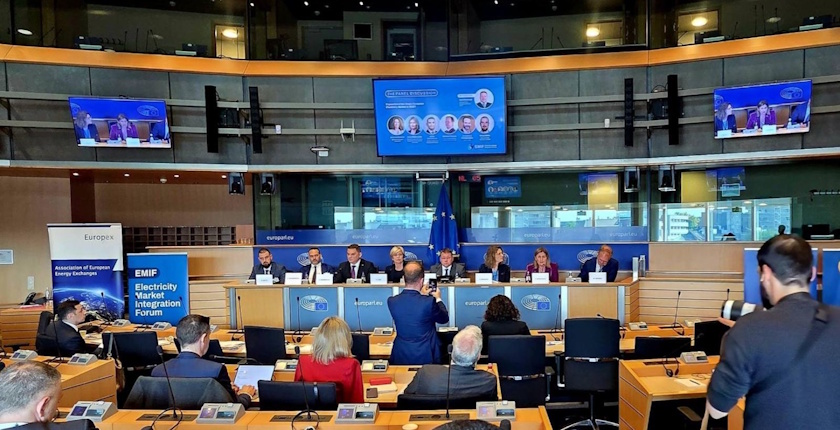
“The integration of the North Macedonian organized electricity market into the Single European Market is of strategic importance for the country,” Sanja Božinovska stressed during the second edition of the Electricity Market Integration Forum – Taking Implicit Electricity Market Coupling Beyond EU Borders, held at the European Parliament in Brussels.

The coupling, in her words, would increase market liquidity and secure competitive prices and greater security of supply. It will directly impact economic stability and predictability, Božinovska added.

Additionally, the minister noted that integration with the European market could provide protection from the financial effects of the EU’s Carbon Border Adjustment Mechanism (CBAM), which would bring significant economic benefits for North Macedonian companies.

The market coupling process began in 2017-2018

She recalled that the market coupling process began back in 2017-2018, adding it is now in a delicate phase, focusing on the transposition of EU legislation and the implementation of the market coupling operator implementation plan (MCO IP) under the jurisdiction of the European Union Agency for the Cooperation of Energy Regulators (ACER).

“Due to uncertainties surrounding the impact of CBAM, it was imperative for market coupling to occur before 2026. Although we are now beyond that timeframe, it is realistic to aim for coupling between the fourth quarter of 2026 and the first quarter of 2027,” Božinovska noted.

During the panel session dedicated to the expansion of the European electricity market by 2026, Božinovska engaged in discussions with high-level representatives from the European Parliament, ACER, regional power exchanges, and institutions from the Western Balkans.

Of note, a week ago North Macedonia adopted the Law on Energy.

It will bring numerous benefits including a liberalized electricity market ensuring fairer prices and more choice for consumers, the introduction of smart meters for more accurate consumption measurement, and daily insight for consumers into their electricity usage, according to the Government of North Macedonia.

Artur Lorkowski, director of the Energy Commnunity Secreatariat , Sanja Božinovska i Zoran Gjorgievski, MEMO CEO
by in News

Montenegro’s TSO CGES achieves EUR 25 million profit in 2024

Montenegro’s transmission system operator CGES recorded a profit of EUR 24.8 million last year.

The net income of TSO CGES compares to EUR 35.7 million from 2023. In 2022, the company’s profit amounted to EUR 20.3 million, after EUR 16.9 million in the previous year.

President of the Board of Directors of CGES Aleksandar Mijušković noted in a statement to Mina news agency that the total since his appointment is almost EUR 100 million.

He recalled that the company’s operations are regulated by the Energy and Water Regulatory Agency of Montenegro (REGAGEN), pointing out that the profit is subject to revision, in line with the regulatory mechanism.

Implementation of visionary projects led to income growth

Implementation of crucial infrastructure projects, investments in new technologies, and improvement of work processes were the decisive factors for the success, Mijušković underlined.

In his words, conducting important, visionary projects has led to a significant increase in income from electricity transit. In addition, by applying new technologies and improving work processes, the company achieved a more efficient and reliable system with the lowest grid loss rate so far, despite a much higher transit and flow of energy through the system, Mijušković pointed out.

He added that good business results secure multiple benefits for shareholders and users of the transmission system in Montenegro. CGES’s results have contributed to lowering the transmission tariff paid by citizens and businesses, Mijušković said.

The company plans to continue the investments within its five-year plan, worth EUR 207 million. It envisages significant infrastructure projects.

The Trans-Balkan Corridor will facilitate market coupling with Europe

He singled out the Trans-Balkan Corridor among the largest infrastructure projects. Its completion will significantly increase the capacity for power transit from the Balkans to Italy.

It will enable coupling the Montenegrin electricity market with the Italian one and, with it, the single European electricity market, Mijušković said.

The green transition brought great challenges for the European power system, he stressed. The production of electricity from renewable sources cannot be controlled, so large, uncontrolled electricity flows began appearing in the system, threatening its stability, Mijušković said.

The issues can be effectively solved only by strengthening the internal grid and interconnections with neighbors, which CGES has envisaged in its plans, he asserted.