by in News

Strategic Pivot: Greece Formalizes Offshore Exploration Agreements with Chevron and HELLENiQ Energy

Greece is signaling a decisive shift toward “energy realism” as the Ministry of Environment and Energy formalizes major concession agreements for hydrocarbon exploration. Minister Stavros Papastavrou announced the signing of deals with a consortium led by U.S. major Chevron (70%) and HELLENiQ Energy (30%), covering four offshore blocks.

The move is framed not just as an energy play, but as a pillar of national confidence. Minister Papastavrou emphasized that these agreements bolster Greece’s economic, energetic, and geopolitical standing, effectively positioning the nation as a potential natural gas producer for both domestic and European markets.

Geopolitics and the “New Era” of Energy

The government’s strategy aims to balance sustainable development with the country’s strategic advantages. This includes heavy investment in LNG terminals, cross-border interconnections, renewables, and grid digitalization. Notably, Greece has recently transitioned into a net electricity exporter for the first time in nearly 25 years.

The major pipeline projects in the area are the Trans-Adriatic Pipeline (red), the Trans- Anatolian Pipeline (orange) and the East Med pipeline (red arrows), this last currently under discussion.

The major pipeline projects in the area are the Trans-Adriatic Pipeline (red), the Trans- Anatolian Pipeline (orange) and the East Med pipeline (red arrows), this last currently under discussion.

Beyond the balance sheet, the entry of a global giant like Chevron carries significant geopolitical weight. Minister Papastavrou suggested that the partnership serves as a “de facto” counter-manoeuvre to the controversial maritime memorandum between Turkey and Libya, reinforcing Greece’s sovereignty and role in the Eastern Mediterranean.

Exploration Roadmap: Blocks and Timelines

The four lease agreements, which span a combined 47,000 square kilometers, are slated for parliamentary ratification next month.

  • Target Areas: The concessions include Lot A2 (bordering the South of Peloponnese block) and two blocks south of Crete (South of Crete 1 and 2).

  • Operational Schedule: Preliminary exploration activities are expected to commence in the second half of this year.

  • Deepwater Expertise: While monetizing deepwater resources remains capital-intensive, Chevron’s track record in technically challenging offshore environments is seen as a critical asset for the consortium.

Expanding the Footprint: Block 10 and Beyond

Industry insiders suggest the Chevron-HELLENiQ partnership may soon expand. Reports indicate the two companies are evaluating cooperation for Block 10 in the Gulf of Kyparissia. Currently held solely by HELLENiQ Energy, Block 10 borders Lot A2 and covers 2,400 square kilometers. Exploration drilling there is tentatively scheduled for the second quarter of 2028.

Greece’s offshore blocks

Greece’s offshore blocks

The strategy appears to favor the creation of large, unified exploration zones. By grouping these blocks, the consortium can manage the high costs and logistical complexities of deepwater extraction more efficiently.

Regional Upstream Activity

The broader Greek upstream sector is also gaining momentum:

  • ExxonMobil: Preparing for its first exploratory drilling in over 40 years, targeted for the first half of 2027.

  • Energean: Currently operating the Prinos, Prinos North, and Epsilon fields (Greece’s only active complex), the company is pivoting toward decarbonization. Its subsidiary, EnEarth, is progressing with plans to convert the Prinos field into a permanent carbon dioxide storage reservoir.
by in News

Energy system based on renewables is cheapest solution to achieve net zero by 2050 – study

A European energy system based on a high share of renewable energy is the cheapest scenario until 2050 for achieving the net-zero goal, when compared to an increased use of nuclear capacity, or hydrogen, or carbon capture and storage, and against a delayed energy transition, according to a study produced by Hitachi Energy for WindEurope.

Costs for each scenario include not only generation facilities, but investments in grids, storage and back-up systems, according to WindEurope.

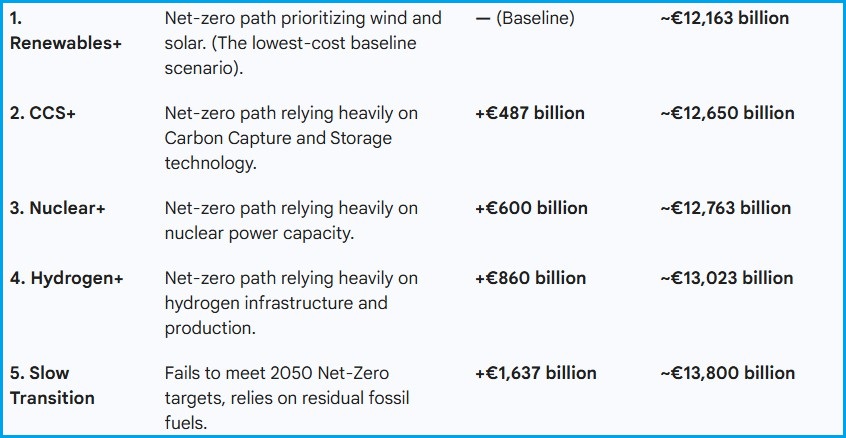
The study has mapped out the total system costs of five energy scenarios. Four scenarios deliver net zero and the remaining one is for a slow transition, where Europe doesn’t meet its climate targets, wind power advocacy group said.

The difference between the cheapest net zero path (Renewables+) and the most expensive path (Slow Transition) is EUR 1.64 trillion, the study reveals.

eu energy system 2050 scenarios costs hitachi study

The study’s authors calculated the total societal cost of building, operating, and adapting to the required energy system across electricity, transport, heat, and industry to meet or fall short of the 2050 climate targets.

The total system costs have three major groups of expenses.

The first group are new infrastructure investments in generation assets, as well as in grid, hydrogen, storage and carbon capture and storage (CCS) infrastructure.

Operational expenses are represented by fuel and CO2 costs, while the third group are electrification and demand shift costs.

The Renewables+ scenario drastically lowers import dependency

The Renewables+ scenario achieves net zero by 2050 through a massive deployment of variable renewable energy, primarily wind and solar power, leading to high electrification across the energy mix.

The renewables share reaches 85% of total electricity and nearly 70% of total gross available energy. Dependency on imported energy fuels falls drastically from 71% in 2030 to just 22% in 2050, the report reads.

“As Europe looks ahead to 2050, it is revealing to think what our energy system looked like 25 years ago. Back in 2000 the share of wind and solar in Europe’s electricity was a combined 0.8%. It’s 30% today. And Europe’s emissions are down by nearly 1/3 compared to 2000 while the economy has grown 45%. Let’s build on this success,” WindEurope stressed.

It is an inception report for the Energy System Costs Study, a project commissioned by WindEurope.

by in News

Energy Community calls for nominations of PECI energy infrastructure projects

Developers of cross-border energy infrastructure investments within the Energy Community or internal ones with significant cross-border dimensions can nominate them by January 19 within the selection process for projects of Energy Community Interest (PECI). In line with the Trans-European Networks for Energy (TEN-E) regulation, the mechanism is for electricity transmission and energy storage including protection, monitoring and control systems, together with smart power and gas grids, hydrogen and carbon dioxide.

The Energy Community Secretariat opened a call for promotors to submit their projects for evaluation within the 2026 PECI selection. EU regulation 2022/869 – revised TEN-E, which the Energy Community Ministerial Council adopted as 2023/02/MC-EnC, stipulates the approval of the second list of projects of Energy Community Interest (PECI) by December 31, 2026.

Nominations are received until January 19. The proposals concern the electricity and gas sectors.

In the first group are high- and extra-high-voltage overhead transmission lines and underground and submarine transmission cables. It includes equipment and installations for offshore renewable electricity.

Eligible electricity segment investments are also for energy storage, as well as protection, monitoring and control systems for all of the above and at all voltage levels.

Projects for smart power and gas grids are both in the scope of the PECI selection process. Hydrogen-based technologies, electrolyzers and CO2 projects are within the gas infrastructure list as well, the call reads.

PECIs are for cross-border energy infrastructure within the Energy Community or internal endeavors with significant cross-border dimensions.

Proposal forms are available at the call’s webpage.

Ministries, regulatory authorities and transmission system operators will be among the institutions evaluating nominated projects. The group also consists of the European Commission, Energy Community Secretariat, Energy Community Regulatory Board, the ECDSO-E entity of Energy Community distribution system operators, the European Network of Transmission System Operators for Electricity (ENTSO-E) and European Network of Transmission System Operators for Gas (ENTSOG).

The Energy Community comprises the Western Balkans, Moldova, Georgia and Ukraine.

by in News

Cement maker Holcim gets EU grant for carbon capture project in Romania

A carbon capture and storage (CCS) project developed by cement maker Holcim Romania has been awarded financing under the European Union’s Innovation Fund. The European Commission has selected 61 cutting-edge net-zero technology projects across the EU to receive a total of EUR 2.9 billion in funding, covering sectors such as oil refining, hydrogen, transportation, chemicals, iron and steel, and the manufacture of components for renewable energy plants and batteries.

Holcim’s project at its plant in Câmpulung, Argeș county, involves capturing CO2 from cement and lime production and storing it underground. The first large-scale onshore CCS project of its kind in Eastern Europe is expected to produce an estimated two million tons of near-zero cement annually from 2032, according to a press release from Holcim.

The project will enable Holcim Romania to produce two million tons of near-zero cement annually

Carbon Hub CPT 01 will use proven carbon capture technology to separate CO2 from flue gases, which will then be compressed and transported for permanent, safe storage underground, the company said.

The Switzerland-based cement producer now has eight large-scale EU-supported carbon capture projects – in Germany, Poland, Belgium, France, Croatia, Greece, and Romania, according to the press release.

Decarbonizing energy-intensive industries across the EU

The European Commission said that the EUR 2.9 billion in grants follow its first call for net-zero technologies (IF24 Call), launched in December 2024, aiming to strengthen the EU’s technological leadership and accelerate the deployment of innovative decarbonization solutions.

The selected projects span 19 industrial sectors in 18 countries, focusing on energy-intensive industries, renewable energy and energy storage, net-zero mobility and buildings, cleantech manufacturing, and industrial carbon management.

The largest number of selected projects is in the cement and oil refining sectors

The largest number of awarded projects is in the refineries sector, with 11, followed by 10 in the cement and lime sector, 6 in the manufacturing of components for renewable energy, and 4 in the manufacturing of components for energy storage.

Other sectors on the list include chemicals, solar, maritime, road transportation, aviation, non-ferrous metals, hydrogen, buildings, construction materials, geothermal energy, and the manufacturing of components for energy-intensive industries.

The 61 selected projects have the potential to cut some 221 million tons of CO2 equivalent over their first decade of operation, supporting the EU’s objective of achieving climate neutrality by 2050, according to a press release from the European Commission.

by in News

Northern Lights launches world’s first commercial carbon storage services

Northern Lights has injected the first CO2 volumes below the seabed of the Norwegian North Sea. The firm claims it is the first to offer commercial carbon storage services.

Northern Lights is owned by oil and gas giants Equinor, TotalEnergies, and Shell.

The first CO2 volumes have now been transported through the 100-kilometer pipeline and injected into the Aurora reservoir 2,600 meters below the seabed of the Norwegian North Sea, according to the company.

Northern Lights JV Managing Director Tim Heijn said the company has reached an exciting milestone – the very first CO2 volumes have now been injected and stored safely in the reservoir. “Our ships, facilities, and wells are now in operation,” he said.

From the capture sites to the injection well (photo: Northern Lights)

Northern Lights will transport and store CO₂ from Norway for the remainder of 2025, with CO2 volumes from Denmark and the Netherlands expected to be added in 2026, according to the firm.

The company will transport and store CO2 from two Norwegian industrial sites: Heidelberg Materials’ cement factory in Brevik and Hafslund Celsio’s waste-to-energy plant in Oslo. In addition, commercial agreements have been signed with Yara in the Netherlands, Ørsted in Denmark, and Stockholm Exergi in Sweden.

The operation is part of Longship, the government’s full-scale CCS project

The first phase of Northern Lights is part of Longship, the Norwegian government’s full-scale carbon capture and storage project (CCS).

According to the government’s website, Longship is Europe’s first complete value chain for the capture, transport, and storage of industrial CO2 emissions and the largest climate initiative in Norwegian industrial history.

Longship involves government support for developing the Northern Lights transport and storage infrastructure, according to the website.

CO2 is transported by specially designed ships from the capture sites to an onshore reception terminal in Øygarden. From there, it is transported by a pipeline to the injection well, where it will be pumped into the subsea reservoir.

Heidelberg Materials and Celsio are expected to deliver approximately 400,000 tons of CO2 each annually, according to the website.

The project is expanding

Storage tanks for phase 2 at the reception terminal in Øygarden (photo: Northern Lights)

In March this year, Northern Lights made the final investment decision for the expansion project, which will increase the transport and storage capacity from 1.5 million tons of CO₂ per year to a minimum of five million tons, following the signing of a commercial agreement with Stockholm Exergi.

The expansion was enabled by a EUR 131 million grant from the Connecting Europe Facility for Energy (CEF Energy) funding scheme, the company said.

The expansion leverages existing infrastructure and includes additional onshore storage tanks, pumps, a new jetty, injection wells, and more CO₂ transport ships to enable an increased injection rate and volume.

Photo: Northern Lights