by in News

Bulgaria’s BEH wants direct link to future Black Sea cable to participate in project

Executive Director of Bulgarian Energy Holding (BEH) Valentin Nikolov hinted that the country would opt for the alternative electricity corridor to the Caucasus, via Turkey, if the proposed interconnector under the Black Sea doesn’t include a direct link to the Bulgarian grid.

Turkey, Azerbaijan, Georgia and Bulgaria formalized an initiative in April for an electricity corridor that would run through Turkey. It appeared to rival the Black Sea Submarine Cable (BSSC) project for a submarine cable between Georgia and Romania. The investment is managed by the Green Energy Corridor Power Co. (GECO), founded by transmission system operators of Romania, Georgia, Azerbaijan and Hungary.

Bulgaria has expressed the intention to join the project for the link under the Black Sea. However, state-owned BEH wants a direct connection to the country’s grid, Executive Director Valentin Nikolov says, hinting that otherwise Bulgaria wouldn’t participate.

Nikolov: Political interests are beginning to prevail

The options are for the cable to branch out and land in both countries or only in Romania, Economic.bg reported.

It is important for deciding whether to participate in the project, Nikolov pointed out. “There is no great interest” for Bulgaria if the interconnector enters Romania and extends to Bulgaria from there, and to Hungary, he claimed. Then it is better to go through Turkey, the power utility’s CEO said.

Route through Bulgaria would enable access to European funds for national grid

The feasibility study underway will lay out options and information on where it would be most profitable to lay the cable. According to Nikolov, it is through Bulgaria.

“If we want to develop our grid and use European funding, it must go through Bulgaria, and the connection with Romania can be paid for with European funds,” he added.

“Political interests are beginning to prevail,” in his words.

Black Sea interconnector to consist of three cables

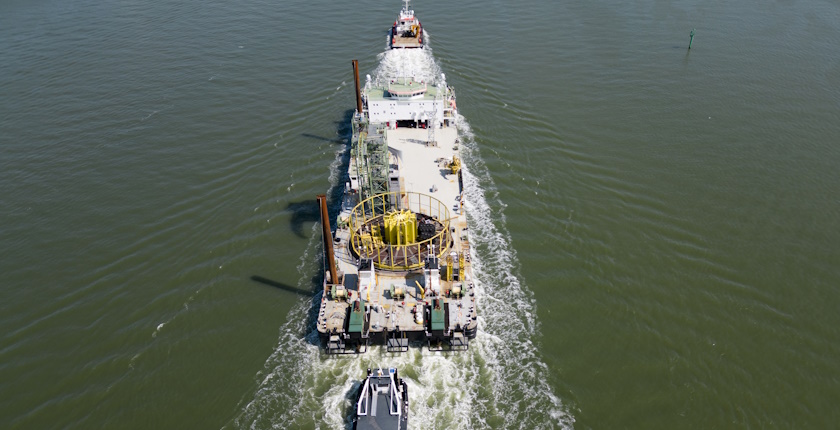
Azerbaijan is planning to export 4 GW through the corridor from the Caspian Sea via the Black Sea to Europe. The idea is for the link to consist of three cables, in fact, the article reads. Only a handful of manufacturers in the world can manufacture them for depths of up to 2,000 meters, and the number of ships that can lay them is limited, the news website added.

Kazakhstan and Turkmenistan and other Central Asian countries are interested in producing renewable electricity for exports to Europe, too.

The Black Sea submarine link project is valued at EUR 3.5 billion and it is expected to require up to four years, the media outlet noted. The European Commission is considering to fund the investment with EUR 2.3 billion.
by in News

Bulgaria’s TPP Maritsa East 2 coal plant posts EUR 52 million loss for 2024

Even with a quota for the regulated electricity market in Bulgaria, low electricity prices pushed TPP Maritsa East 2 into a loss last year. It is the only state-owned coal power plant.

The financial report for 2024 showed a loss of EUR 52 million for TPP Maritsa East 2 (Maritsa-iztok 2), Kapital reported. It compares to a modest net income of EUR 29 million achieved one year earlier. Notably, the subsidiary of state-owned Bulgarian Energy Holding (BEH) had a record profit of some EUR 600 million in 2022, during the energy crisis.

Operating income plunged almost 15% to EUR 614 million last year. The only government-controlled coal power plant sold more electricity than in 2023, but at lower prices.

Moreover, liabilities surged to EUR 358 million from EUR 127 million, mainly due to greenhouse gas emission certificates. The gap between liabilities and assets reached EUR 1.18 billion, against EUR 920 million one year before, the report reads.

Regulated market keeps Maritsa East 2 afloat

Interestingly, almost 86% of the output was sold on the regulated electricity market, which covers households. For the past few years, TPP Maritsa East 2 has been operating under a quota determined by the Ministry of Energy, even though it doesn’t have the right, in principle, to work for the regulated market, the article notes.

Even with the market liberalization that was introduced on July 1, the facility keeps supplying households, the news outlet added. It was enabled through a new segment at the electricity exchange, for long-term contracts, with so-called non-standard products. They are intended for all sellers, but in practice the sellers are state-owned power plants: Kozloduy Nuclear Power Plant, TPP Maritsa East 2 and National Electricity Co.’s hydroelectric facilities.

It means the coal plant’s high production costs are passed on to household bills. It has 1.62 GW in nominal capacity, but it is utilizing much less. The enterprise sold 605 GWh in the open market and 3.23 TWh in the regulated market in 2024.

Coal plants failing to maintain competitiveness throughout EU

Slovakia and Spain officially intend to exit coal this year, followed by Greece (2026), France and Hungary (2027) and Denmark and Italy (2028). However, the dates could be pushed forward and there is a possibility that more countries will join the group in the meantime.

Several of the remaining facilities in the European Union and beyond are active just sporadically – in islands or to cover winter peaks or only until the district heating systems that they supply switch to cleaner sources.

Coal power is already uncompetitive most of the time, particularly because of emission costs. In addition, when such facilities are idle, their costs rise further because of salaries and the complex logistics, primarily mining operations. Other coal plants in Bulgaria are also affected.