by in News

Romania to take control of Lukoil’s assets

Romania wants to take control of Lukoil’s operations to prevent an imminent freeze from the sanctions imposed by the United States. Bulgaria is already putting the Russian company’s refinery, the largest in the Balkans, under a trusteeship. Serbia announced that similar measures have been proposed to exempt Gazprom-owned NIS and its refinery, the only one in the country, from the sanctions.

Minister of Energy of Romania Bogdan Ivan seems to have endorsed neighboring Bulgaria’s approach to the issue of US sanctions against Lukoil. He said the government has to take control of the Russian company’s operations, Profit.ro reported.

The minister didn’t clarify whether it would be a temporary trusteeship. But President Nicușor Dan, who took the helm half a year ago, said there is an option for Romania to assume control for a limited period.

“We protect Romania’s energy security and firmly enforce international sanctions targeting Lukoil. My colleagues in the Ministry of Energy continue to work, together with all relevant authorities, on creating legislation that will ensure, on the one hand, full compliance with the sanctions regime established by the United States, and on the other hand, the continuity of Petrotel Ploiești’s refining activities, as well as the placement of petroleum products, without jeopardizing the supply of the national fuel market,” Ivan stated.

Minister Ivan turns more hawkish regarding sanctions against Russia

The minister claimed he would not request an extension of the November 21 deadline from the US. “Moreover, I will support the replication and uniform application of the sanctions initiated by the US throughout the European Union,” he stressed.

It marks a shift from the stance that the ministry expressed late last month, saying that the EU needs to adopt a position before Romania decides to move. Notably, Ivan held talks on November 8 in Washington with senior US officials, the article notes.

Ivan held talks on November 8 in Washington with senior US officials

“Romania must take control of the company to guarantee the full implementation of international measures, to protect the jobs of the 5,000 employees and to ensure the stability and security of the national energy system,” Ivan said.

However, the Petrotel Lukoil refinery had 542 employees on average in 2023 and another 203 worked at the company’s gas stations. Altogether, its six firms have a total payroll of under nine hundred, the article notes.

Germany placed Rosneft under state administration in 2022.

Bulgaria, Serbia struggling to keep Russian-owned refineries in operation

Nationalization could backfire because of property rights, though imposing state management is also a complicated matter. Romania earlier signaled that nationalization would be the last option.

Bulgaria has urgently adopted a law facilitating a takeover of Lukoil’s refinery in Burgas, the largest in the region. The state administrator would be authorized to sell it. It is unclear whether the measure could postpone or prevent the sanctions.

President Rumen Radev refused to sign the law and returned it to the National Assembly. It would “undermine the legal order” through “indirect nationalization” and expose public finances to a high risk, he warned.

Oil refiner and service stations operator NIS in Serbia is already under US sanctions. Russian state-owned Gazprom holds a majority stake in the company through two subsidiaries.

Serbian Minister of Mining and Energy Dubravka Đedović Handanović said yesterday that the “Russian owners” sent a request to the US Office of Foreign Assets Control (OFAC) to renew the company’s license due to “negotiations with a third party.”

The government in Belgrade has supported the request, she added. The Russian side is prepared to cede control and influence over NIS to a third party, Đedović Handanović revealed.

According to media speculations, one of the candidates is Hungary-based MOL, given that the country managed to obtain a one-year exemption from the US for Russian oil and gas.

Lukoil is operating in Serbia as well, where it has a chain of fuel stations.
by in News

EU allows Romania to delay shutdown of coal plants until end-2029

Amid severe delays in projects for gas power plants, the European Commission approved Romania’s request to push back the closure of several coal-fired systems. The country is increasingly risking electricity shortages due to the lack of baseload capacity.

Romania will be able to keep three coal plants in operation until the end of 2029, following the renegotiation with the European Commission of the decarbonization calendar for electricity production, Minister of Energy Bogdan Ivan said. In a social media post, he announced that 900 MW would remain online.

Two other coal plants can operate at least until the end of August next year, Ivan revealed earlier at a press conference, where he first said the closure of 990 MW would be postponed until the end of 2029.

Turceni, Ișalnița gas power plants must be completed by 2029

State-owned Complexul Energetic Oltenia (CE Oltenia) remains fully active until the end of the summer, he added. “We will continue to have active coal-fired units in the city of Craiova, in order to continue to supply heat to the population, electricity, and steam to the Ford company. And those in Govora, which will produce heat for the inhabitants this winter, until the summer, when the municipality’s [Râmnicu Vâlcea] new energy system comes into operation,” the minister stated, as quoted by Profit.ro.

Romania was supposed to take 1.76 GW of coal power capacity offline at the end of this year. Ivan earlier warned of the risk of energy poverty and even blackouts. He explained that the European Commission accepted the 2029 deadline for the commissioning of CCGT (combined-cycle gas turbine) power plants in Turceni and Ișalnița.

Ivan: Romania will have 1.5 GW of coal power available in the winter season

The two new facilities of 1.33 GW would replace the coal plants in the same two towns. Their projects have suffered massive delays. Tender procedures are still ongoing for contracting the works.

Romania will have 1.5 GW of coal power available this winter, the minister claimed. In the amended National Recovery and Resilience Plan (NRRP or PNRR), the Rovinari and Turceni coal plants in Gorj county and one in the Jiu Valley in Hunedoara remain, together with the units in Craiova and Râmnicu Vâlcea.

Deal with EU to halve estimated nominal gap in winter

In a document from the beginning of October, National Energy Dispatcher (DEN), a unit of transmission system operator Transelectrica, said it counted on 850 MW from lignite for the upcoming winter. The season lasts from November through March. It would be one unit in Turceni, of 250 MW, with another one in technical reserve, and two units of 600 MW in total in Rovinari, having a third one as backup.

The electricity production deficit in the peak evening hours would range from 1.12 GW in the moderate scenario, to a stunning 3.8 GW.

The minimum required reserve is 1,000 MW, but only 520 MW would be available, so the expected gap was actually 1.6 MW – or 4.3 GW in the pessimistic version! The report puts transmission capacity at 4.5 GW for exports and 4.2 GW for imports.

Notably, Turceni, a small town in southwestern Romania dependent on the local coal power plant, is kickstarting a EUR 380 million project. The municipal authority is turning to agrivoltaics, energy storage and green hydrogen to replace it.

by in News

Romania risks blackouts if it shuts coal plants as scheduled

Minister of Energy Bogdan Ivan claims that energy poverty or even blackouts could hit Romania if it proceeds with the closure of coal plants. Namely, the gas power projects for replacing them are suffering severe delays.

The European Commission has become flexible for the first time in the last four years, said Romania’s Minister of Energy Bogdan-Gruia Ivan. He has asked for a postponement of the deadline for shutting down a group of coal power plants.

They need to be closed by the end of the year. If the coal plants, run by state-owned Complexul Energetic Oltenia (CE Oltenia) go before gas power plants Iernut and Mintia are commissioned, Romania is jeopardized, according to the minister.

Ivan told Digi24.ro he was negotiating with the European Commission on delaying the closure by “a few months.” Romgaz decided last week to cancel the contract with Duro Felguera, the contractor for the Iernut facility.

Energy poverty risk increasing

A study conducted with Romania’s transmission system operator Transelectrica has shown that Romania can otherwise end up in energy poverty and even risk a blackout, he underscored. “Especially in the winter, when we have no solar, when we have no wind power,” Minister Ivan explained.

Furthermore, Romania would like to keep three large coal units and another two in technical reserve for replacement them in case of damage, Ivan revealed. It would ensure a 1 GW minimum coal power supply, he asserted.

Romania requires at least 1 GW in baseload energy from coal for two more years, according to Minister Bogdan Ivan

Simulations showed that the group would need to operate for two years more, at least, until Iernut and Mintia are completed.

“We are pressed for time. We need to conclude contracts for next year. We need to conclude contracts for energy supply, contracts with suppliers, coal stocks. It is a complex of factors that must be organized very well from now on. It is already late, for Romania and for our energy companies,” Ivan stated.

Gas power projects in constant delay

Additionally, gas power plants Turceni (475 MW) and Ișalnița (850 MW) are supposed to replace some of the capacity in the Oltenia complex. The two projects suffered constant delays. The deadlines in the tenders for construction have been pushed back to September 30 and November 14, respectively.

Romania has received billions of euros from the European Union for gas power plants to substitute coal, the minister noted separately. He acknowledged that the projects are still on paper. That’s why today Romanians have almost the highest electricity price in Europe, Ivan claimed.

by in News

Romania begins overhaul to extend operating life of Cernavodă nuclear reactor by 30 years

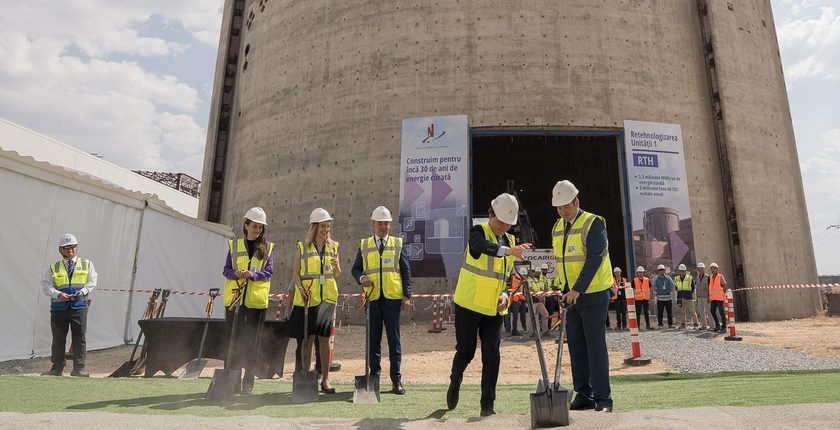
An international consortium led by South Korean state-owned Korea Hydro & Nuclear Power Co. (KHNP) has launched an overhaul of a reactor at Romania’s only nuclear power plant, Cernavodă. The refurbishment will extend the operating life of Cernavodă’s Unit 1 by 30 years.

The reactor, with a capacity of around 700 MW, has been in operation since 1996, and its 30-year license is set to expire in 2027. The reconstruction project is valued at about USD 2.01 billion, KHNP said following a groundbreaking ceremony.

Romania’s state-run Nuclearelectrica, the operator of the Cernavodă plant, signed an agreement with the consortium last December. The group of contractors includes KHNP, Canada’s AtkinsRealis, the Canadian Commercial Corporation, and Italy’s Ansaldo Nucleare, according to Romania-Insider.

The works, targeted for completion by 2030, include the complete replacement of the reactor systems and power-generating turbines, as well as the construction of new infrastructure, including radioactive waste storage facilities, said KHNP, a subsidiary of Korea Electric Power Corporation (KEPCO).

The overhaul is targeted for completion by 2030

KHNP said that four other South Korean firms – Kepco Plant Service & Engineering, Doosan Enerbility, Hyundai Engineering & Construction, and Samsung C&T- will participate as project partners.

At the groundbreaking ceremony, Romanian Minister of Energy Bogdan Ivan said the project would ensure another 30 years of on-grid, environmentally friendly electricity. According to him, it represents the future of Romania’s energy security, accoridng to a report by Profit.ro.

The overhaul will ensure another 30 years of environmentally friendly electricity

Over the last 10 years, Romania has shut down about 56% of its coal- and natural gas-fired capacity, resulting in the country now importing 22% of the electricity it consumes. According to Ivan, this has led Romania to look for alternatives, one of which is nuclear energy.

He recalled that the country was preparing to invest EUR 11 billion in the construction of Units 3 and 4 at the Cernavodă nuclear power plant, adding that “certain phases have already begun.” Ivan also said he believed that in seven years’ time, Romania could become a net exporter of electricity.

The two new reactors would each have a capacity of around 700 MW, according to earlier reports. Cernavodă’s Unit 2, which has been in operation since 2007, also has a capacity of around 700 MW.