by in News

Bislimoski urges ESM to pivot toward market procurement of electricity

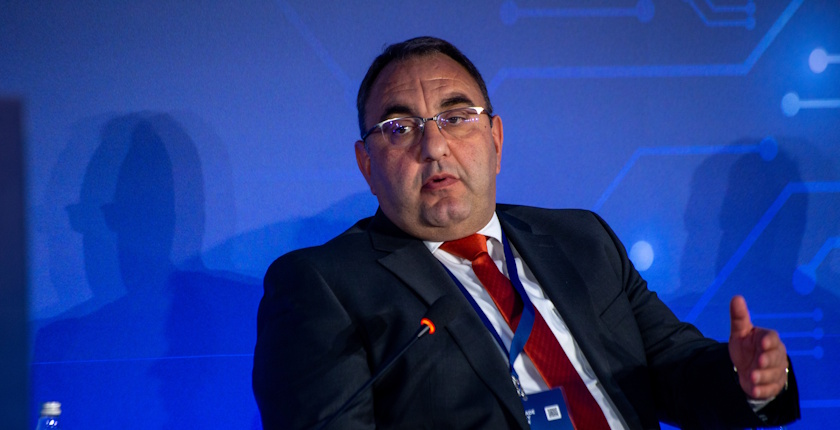
State-owned power utility Elektrani na Severna Makedonija should make the most of the opportunities when prices on the power market are lower than its production costs, according to Marko Bislimoski, President of the Energy, Water Services and Municipal Waste Management Services Regulatory Commission of the Republic of North Macedonia (ERC or RKE).

​Marko Bislimoski doesn’t see the future of Elektrani na Severna Makedonija (ESM) only in production. He expressed the belief it should also be much more active in the wholesale and retail markets.

The mindset that ESM should only produce power should be abandoned, in his view.

In times when the price of electricity in the domestic and regional market is lower than its production price, it is much more logical for the company to buy it on the market, Bislimoski underlined.

This is going to reduce costs, he added.

ESM should purchase electricity when prices are lower than its costs as well as when the level is below the one at which it sells the energy to universal supplier EVN Home, Bislimoski pointed out. The firm is responsible for all households, among other categories.

North Macedonia’s solar power capacity has reached 1,200 MW

He recalled that solar power plants with a total capacity of 1,200 MW are installed in the country.

Their owners sell electricity on the market to other suppliers and traders, who then resell it to consumers.

If ESM offers them a fair price, it would have a stable and predictable cost structure in terms of purchasing and producing electricity, Bislimoski pointed out.

He noted that ESM imports coal and mixes it with domestic coal, which has caused an increase in its power production costs. In Bislimoski’s view the company can offer a fair price over a longer period, five to 10 years.

Solar power would save water in hydropower plant reservoirs and coal for thermal power plants

It would enable, especially in the summer and spring months, the purchase of electricity from domestic photovoltaic plants at a price that should be lower than EUR 65 per MWh, avoiding losses, according to Bislimoski.

Of note, the company has offered to supply electricity to EVN Home at a rate of EUR 65 per MWh for 2026.

Purchasing electricity from photovoltaic plants would allow saving water in hydropower plant reservoirs, and only one unit in the REK Bitola coal power would be required to work during some daily hours, Bislimoski concluded.
by in News

North Macedonia’s ESM needs investments of EUR 3 billion to replace coal power

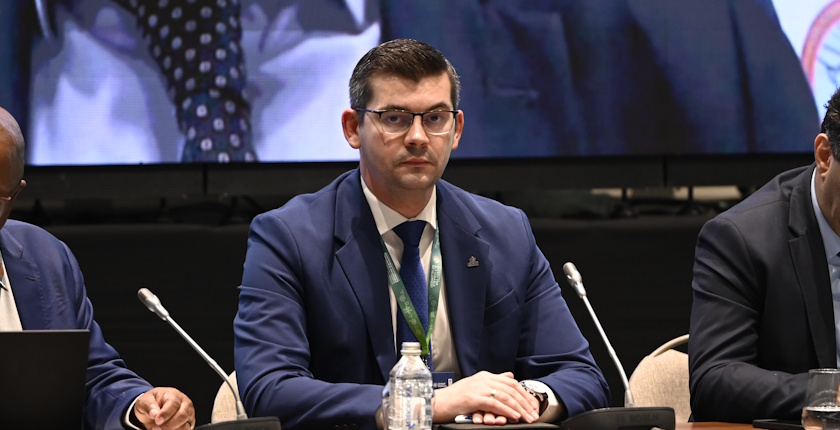
Power utility Elektrani na Severna Makedonija estimated that it requires EUR 3 billion by 2040 to replace electricity from its lignite-fired power plants. According to member of the Board of Directors Ivan Stojanovski, the state-owned company is preparing investments in gas power plants, solar, wind, hydropower and energy storage. He highlighted its plans for a 300 MWh battery and the Bogdanci hybrid energy park.

North Macedonia’s utility Elektrani na Severna Makedonija (ESM), the country’s main electricity producer, generated 60% of the 2024 output in the Bitola and Oslomej coal plants.

A rough estimate is that ESM would have to invest around EUR 3 billion in the next 15 years to replace its power production from lignite, which is baseload energy, Ivan Stojanovski, a member of the Board of Directors and the company’s Chief Financial Officer, told Balkan Green Energy News on the sidelines of the International Forum on Energy for Sustainable Development (IFESD-14).

He explained that the transition to green energy is quite expensive. ESM needs to replace the 840 MW in baseload production that the Bitola and Oslomej thermal power plants provide, the executive added.

Hydropower is a domestic electricity source, unlike natural gas

The company opted for investments in diverse energy sources to achieve it, Stojanovski stressed.

Gas power plants provide baseload energy, but at the same time, they turn the spotlight on national security as well as the security of supply, in his words.

Lignite is currently mined in North Macedonia while natural gas must be imported, so gas supply interruption is possible, ESM’s CFO added.

Gas power plants are required, but it is necessary to invest in hydropower as it is a domestic resource, Stojanovski said. On the other hand, hydroelectric plants are more expensive and it takes longer to build them, he noted.

ESM launched the Bitola 3 solar power project

ESM is developing wind and solar power projects as well. Stojanovski highlighted the planned expansion of its Bogdanci wind farm. The European Bank for Reconstruction and Development (EBRD) is participating in the development of the Miravci wind power project, of at least 100 MW, he recalled.

The company is working on solar power projects Oslomej 1 (10 MW), Oslomej 2 (10 MW), Bitola 1 (20 MW) and Bitola 2 (60 MW), Stojanovski asserted. Bitola 3 endeavor is underway, too, and the financing contract is expected to be signed by the end of the year, he revealed.

The photovoltaic system will have at least 100 MW, Stojanovski asserted.

“We plan to sign a contract next year with Agence Française de Développement (AFD) for a solar power plant in Bogdanci of at least 30 MW and to create a hybrid energy park there – wind, solar, and a battery,” he stated.

According to Stojanovski, the company is developing a battery energy storage project with the EBRD, for up to 300 MWh in capacity. The site is within the REK Bitola coal complex and the facility will be a systemic solution for all the solar power plants there, he explained.

Blended financing as a solution

“EUR 1 billion to EUR 1.3 billion is needed just for solar, wind and batteries. We will need between EUR 500 million and EUR 700 million for gas power plants. Another EUR 1 billion to EUR 1.3 billion would be for large hydropower plants such as Čebren and Vardar Valley, and some smaller projects,” Stojanovski explained.

Asked how the company plans to secure financing, he pointed to blended financing – own sources combined with some participation from international financial institutions. It is important to diversify the sources by opening cooperation with as many financial institutions as possible, in Stojanovski’s view.

ESM traditionally cooperates with the EBRD and KfW. Stojanovski announced that the company would diversify financing by launching cooperation with the World Bank, Italy’s development bank Cassa Depositi e Prestiti, and AFD.

“It will enable us to access more sources and complement them with financing from local banks. We also tend to obtain support from the state budget over a longer period, 10-15 years, and state guarantees, but also additional funds. This is a financial model that can secure long-term and sustainable financing of infrastructure projects,” Stojanovski said.