by in News

European Commission proposes easing 2035 car emissions rules

The European Commission has proposed a new Automotive Package that aims to give carmakers greater flexibility in meeting emissions reduction requirements. The new rules would lower the emissions cut target from 100% to 90%, allowing the sale of hybrid and internal combustion vehicles after 2035.

From 2035 onwards, carmakers will need to comply with a 90% emissions reduction target, while the remaining 10% emissions will need to be compensated through the use of low-carbon steel produced in the European Union, or from e-fuels and biofuels, according to a press release from the commission.

“This will allow for plug-in hybrids (PHEV), range extenders, mild hybrids, and internal combustion engine vehicles to still play a role beyond 2035, in addition to full electric (EVs) and hydrogen vehicles,” reads the announcement.

Carmakers will be incentivized to produce affordable EVs

The commission is also proposing “super credits” to incentivize carmakers to produce small, affordable electric cars made in the European Union. This measure would be in place until 2035.

Hoekstra: The EU is staying the course towards zero-emissions mobility

European Climate Action Commissioner Wopke Hoekstra has said the EU is staying the course towards zero-emissions mobility, but introducing some flexibilities for manufacturers to meet their CO2 targets in the most cost-efficient way.

The move comes amid pressure from car manufacturers, who claim their business is threatened by competition from China and the United States, according to reports.

The move comes amid pressure from European carmakers

Several EU member states – Germany, Italy, Bulgaria, the Czech Republic, Hungary, Poland, and Slovakia – say their automakers are struggling with high energy prices, a shortage of components, including batteries, and weak demand for electric vehicles.

The proposal includes a EUR 1.8 billion package to help develop a fully EU-made battery value chain and tackle competition from outside the bloc. As part of the accompanying Battery Booster package, EUR 1.5 billion will be disbursed in interest-free loans to European battery manufacturers, according to the press release.

by in News

Montenegro seeks contractor for marking liquid oil-derived fuel, biofuel

With approval from the Government of Montenegro, the Ministry of Energy and Mining issued a public call for the selection of a legal person that would conduct the obligatory marking of liquid fuel and biofuel in the Montenegrin market.

The introduction of fuel marking is an important step in the fight against the gray economy and illegal trade, but also a measure strengthening fiscal discipline and the state’s energy system, according to the announcement. The ministry added that Montenegro is introducing the practice in line with its Fiscal Strategy 2024-2027, to secure greater transparency and the security of supply.

The selected legal person will be obligated to use a unique marker for the Montenegrin market – type A for fuel subject to excise tax and type B for fuel exempted from excise tax, as well as to establish an information system accessible to all relevant instutions. This is the way to secure a total control of fuel trade and consumer protection, the explanation reads.

The maximum price of the fuel marking service amounts to EUR 0.008 per liter, which is EUR 8 per 1,000 liters of fuel, the Government of Montenegro stipulated in its decision from September 18.

Offers are received every workday between 10:00 and 14:00, through October 31, 2025. The address of the Ministry of Energy and Mining is Rimski trg 46, Podgorica.

The tender documentation with all the details and criteria is available on the ministry’s website.

With the new measure, Montenegro strengthens the control over the energy market, protects citizens and the country’s budget and builds additional trust in the energy system, the update adds.

by in News

Turkish oil company Tüpraş to produce sustainable aviation fuel

Oil refiner Tüpraş is working on a technology for biofuel from algae and yeasts, using solar energy. The Sunfusion project involves processing into sustainable aviation fuel – kerosene – and green alternatives for vessels. It received EU support and includes partners from Greece, France, Germany, Norway and Serbia.

Istanbul-based Türkiye Petrol Rafinerileri AŞ (Tüpraş) has several decarbonization projects underway, counting on the expansion of green energy markets. One of the endeavors is Sunfusion – advancing biofuel production from purified microalgae and oleaginous yeasts by utilizing state-of-the-art solar technologies.

The project, which runs until the end of 2028, received EUR 3 million through the European Union’s Horizon Europe program. Centre for Research and Technology Hellas (CERTH), known also by its Greek acronym EKETA, is the coordinator.

Ten partners include the Middle East Technical University (METU/ODTÜ), located in Ankara, Aristotle University of Thessaloniki (AUTH) and Foodscale Hub (FSH), which is in Novi Sad, Serbia. The rest are from France, Germany and Norway.

Solar-to-biocrude efficiency must top 50%

Tüpraş, the largest oil refiner in Turkey, is majority-owned by Koç Holding and its related businesses. It launched Sunfusion to develop the conversion of microalgae and oleaginous yeasts using the hydrothermal liquefaction (HTL) method. Among the goals is to minimize costs, emissions and waste and achieve a solar-to-biocrude efficiency target of more than 50%.

The company and its partners intend to cultivate high-lipid, low-nitrogen microalgae and yeasts

The initiative involves photobioreactors, open raceway ponds and a solar thermal system supplying energy for the process. The company and its partners intend to cultivate high-lipid, low-nitrogen microalgae and yeasts.

Hydrotreatment units would have fractionation capabilities, for refining the biocrude into high-value fuels such as sustainable aviation fuel – kerosene – and alternative marine fuels.

First SAF supply deal in Turkey already in scope

In June, Tüpraş signed a letter of intent with Turkish Airlines for a sustainable aviation fuel (SAF) supply arrangement. They claimed that carbon emissions would be up to 87% lower than from conventional jet fuel.

“We will begin SAF production next year at our Izmir Refinery by leveraging our existing facilities. We aim to finalize the investment decision for a new unit that will increase our SAF production capacity to 300,000 tons by the end of this year. The use of SAF is becoming a necessity under both international and local regulations for the decarbonization of the aviation sector,” General Manager of Tüpraş Ibrahim Yelmenoğlu stated.

It would be both the first production and supply operations in Turkey. The company revealed at the time that it would make the SAF from bio-based feedstocks.

Tüpraş has seven projects with support from Horizon Europe

Tüpraş said it has completed 17 projects under Horizon 2020 and that seven are ongoing through Horizon Europe. The company updated its strategic transformation plan in April, placing the focus on sustainable refining, SAF, zero-carbon electricity and green hydrogen.

In the Horizon portfolio, it is conducting the Eastern Lights project for geological storage of carbon dioxide. ICO2nic is in the same segment, with carbon capture and electrochemical conversion of CO2, while the Hermes initiative is for the separation and purification of hydrogen with innovative membranes.

Also of note, one of the oil refiner’s subsidiaries took over a major solar power project in Romania early this year.

by in News

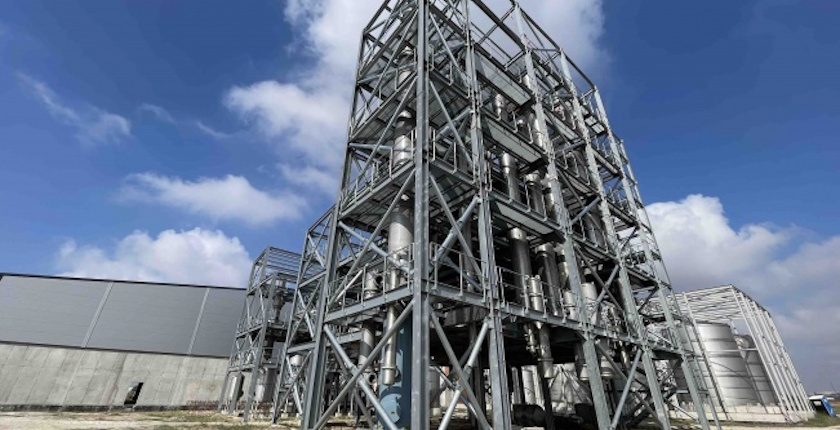
Insa Oil building Bulgaria’s first bioethanol plant

Bulgarian oil company Insa Oil plans to finish its bioethanol plant by the end of 2026. The company claims the plant under construction will be the country’s first to produce renewable fuel from biomass.

The construction of the Insa Spirit plant began in June 2022 and is already in an advanced phase, according to an announcement by Insa Oil. Bioethanol is a renewable fuel produced primarily from grains and often blended with gasoline.

The plant, estimated to cost EUR 56 million, spans about 45,000 square meters. It includes production facilities and a high-tech laboratory.

The biorefinery will produce ethyl alcohol, part of which will be converted into bioethanol for the Bulgarian energy market.

The plant’s capacity is 41,000 liters of ethyl alcohol per day

The plant’s capacity is 41,000 liters of ethyl alcohol per day, the company said, adding that the facility is expected to be operational in the second half of 2026.

Bulgaria has set the minimum required amount of bioethanol to be added to gasoline at 9%. It is regulated by the European Directive on the Promotion of the Use of Energy from Renewable Sources and the Renewable Energy Law, which came into force in the first half of this year.

“Our ambition is to turn Bulgaria into a regional factor for bioethanol production. We believe that this investment will be important for our economy and will increase our energy independence, while also taking care of environmental protection,” said Insa Oil manager Georgi Samuilov.

The plant uses technology from India

Following the launch of Insa Spirit, the company plans to develop technologies for second-generation bioethanol produced from biomass.

The technology for the plant was developed by India-based PRAJ.

The equipment was supplied by leading producers such as Bühler Group (Germany), Alfa Laval (Sweden), Bosch (Germany), Siemens (Germany), Hydro-Thermal (USA), and Solar Turbines (USA), according to Insa Oil.

by in News

Croatia changing law on renewables – new rules for prosumers, decentralized power production

The Government of Croatia has adopted the amendments to the law on renewable energy sources and high-efficiency cogeneration. They change rules for consumers producing electricity for self-consumption, facilitate the establishment of citizen energy communities and regulate decentralized energy production.

The amendments align the Croatian legislation with the European Union’s Renewable Energy Directive and bring benefits to citizens, entrepreneurs, and investors, the Ministry of Economy said.

One of important innovations is a new scheme for the production of energy for self-consumption. Instead of the current net metering mechanism, the new law introduces net billing. It values more fairly the surplus electricity that prosumers deliver to the grid, according to the ministry.

The grid costs charged to prosumers will be aligned with the actual amount of electricity that they take from the grid

Consumers – citizens and entrepreneurs that produce energy for their own needs, will pay grid costs matching the amount of electricity they actually take from it, enabling a sustainable and fair system for all users, the ministry added.

Existing prosumers will have ten years for the transition to the new scheme.

The bill enables the production of electricity for self-consumption in remote locations, provided that all metering points are registered with the same consumer. The ministry expects the measure to pave the way for greater investments, flexibility, and decentralized energy production.

Waste separation is a condition for granting incentives for waste incineration

The rules for establishing citizen energy communities have been simplified, to further strengthen their role in the energy transition. The amendments stricten the criteria for the sustainability of biofuels and they prohibit incentivizing the incineration of waste not from a system of separate collection.

The upcoming law sets the basis for a plan for the development of electricity infrastructure and storage capacities. It will create the conditions for greater integration of renewable energy sources into the grid, the ministry stressed.

“With this law we are taking an important step forward in the energy transition, ensuring a balance between the interests of citizens, the economy, and the energy system, and creating the foundations for a sustainable development of the Croatian energy sector in the long term,” Minister Ante Šušnjar stated.