by in News

Environmental monitoring in 2026 put to the test: Albania has 59 stations on paper, only 9 operational

The government-approved National Environmental Monitoring Program for 2026 promises a nationwide network of measurement stations for air, water, soil and biodiversity but the gap between design and reality is stark. On paper the plan foresees 59 urban air-quality monitoring stations; in practice only nine are currently functioning, concentrated mainly in Tirana and a handful of other major cities. That shortfall makes 2026 a decisive year for whether the monitoring system will deliver real, transparent environmental data to the public and policy-makers.

Map of the distribution of monitoring stations for environmental indicators in the territory of Albania

Under the Program, urban air monitoring is to cover the principal pollutants: PM10 and PM2.5 (particulate matter), benzene, nitrogen oxides, sulfur dioxide, ozone and carbon monoxide, along with priority heavy metals such as lead and arsenic. Noise monitoring is also a component: a planned national network of 67 noise-monitoring stations contrasts with current coverage of 43 stations across 11 urban centers; noise measurements will follow 14-day and continuous 24-hour cycles to assess daytime and nighttime population exposure.

Surface-water monitoring (rivers, lakes, lagoons, coastal waters) and groundwater are included in the Program with standard indicators — total suspended solids, dissolved oxygen, total phosphorus, heavy metals and other priority substances and a monitoring frequency calibrated to basin and water-type characteristics. The Program also calls for an annual emissions inventory by economic sector (industry, energy, transport, services) following international methodologies under the Convention on Long-Range Transboundary Air Pollution, plus greenhouse-gas emission tracking for 2020–2030. Biodiversity and forest monitoring components list systematic sampling plots for threatened species, migration monitoring for key bird species, wildlife surveillance in protected areas and targeted monitoring where chemical or heavy-metal concentrations are high.

Crucially, the Program states that collected data will be processed and incorporated into an annual State of the Environment Report to serve both national policy formulation and reporting obligations to the European Environment Agency. Whether the monitoring network can be brought up to its planned capacity and whether the resulting data will be published with full transparency and timely accessibility remains the central test for 2026
by in News

Europe’s Environment 2025 report: Not good

Biodiversity is declining and water stress is affecting one third of Europe’s population and territory, while the frequency and magnitude of climate-related disasters are increasing. In short, this is the message from the report Europe’s Environment 2025.

​Europe’s Environment 2025 is the most comprehensive analysis on the current state and outlook for the continent’s environment, climate, and sustainability, building on data from across 38 countries, according to the European Environment Agency (EEA).

The outlook for most environmental trends is concerning and poses major risks to Europe’s economic prosperity, security, and quality of life, the authors warned. The agency said climate change and environmental degradation pose a direct threat to Europe’s competitiveness, pointing out that it depends on natural resources.

Progress on a range of factors that enable the shift towards sustainability – such as innovation, green employment, and sustainable finance – gives cause for hope, EEA added.

​More than 80% of protected habitats are in a poor or bad state

The report shows biodiversity is declining across terrestrial, freshwater, and marine ecosystems in Europe due to persistent pressures driven by unsustainable production and consumption patterns, demonstrated most notably in the food system.

More than 80% of protected habitats are in a poor or bad state, with 60% to 70% of soils degraded, the document reads.

On a positive note, the extent of protected areas increased over the past decade – by 2022, 26.1% of the European Union’s land and 12.3% of its seas were protected. However, designating protected areas alone does not guarantee that biodiversity is effectively protected, the authors wrote.

​Water stress is affecting one third of Europe’s population and territory

The report’s findings point to severe pressure on water resources: water stress is affecting one third of Europe’s population and territory.

Only 37% of surface water bodies had a good or high ecological status in 2021, with the degradation of aquatic ecosystems threatening Europe’s water resilience. Agriculture is responsible for the most significant pressure on both surface and groundwater, data revealed.

EEA recalled that Europe is the fastest-warming continent on the planet.

Weather- and climate-related extremes caused economic losses of assets estimated at EUR 738 billion in the EU’s 27 member states over the period 1980-2023, with over EUR 162 billion in costs from 2021 to 2023 alone, the report reads.

Over 70,000 people in Europe are estimated to have died from heat in 2022.

The average annual economic losses in the 2020‑2023 period were 2.5 times as high as in the preceding decade, from 2010 to 2019, according to the report.

Downpours are increasing in severity, with several regions subject to catastrophic floods in recent years, while extreme heat, once rare, is becoming more frequent, with deadly consequences: over 70,000 people in Europe are estimated to have died from heat in 2022.

The greatest challenges call for a need to rethink the links between the economy and the natural environment, land, water and natural resources, EEA underscored.

“We cannot afford to lower our climate, environment and sustainability ambitions. Our state of environment report, co-created with 38 countries, clearly sets out the science-based knowledge and demonstrates why we need to act. In the European Union, we have the policies, the tools and the knowledge, and decades of experience in working together towards our sustainability goals. What we do today will shape our future,” EEA Executive Director Leena Ylä-Mononen said.

Bright spots

The report also highlighted the good results of environmental protection policies in Europe.

The EU has cut its domestic greenhouse gas (GHG) emissions by 37% since 1990, largely driven by reducing fossil fuel use and doubling the share of renewables since 2005.

All member states have reduced their reliance on fossil fuels and shifted towards more sustainable energy sources over the last decade, while increased energy efficiency has brought down demand.

In 2023, renewable energy sources represented over 24% of the EU’s final energy use, a record high.

The bloc’s industrial system has managed to reduce emissions by more than 35% from 2005 to 2023, while emissions from buildings fell by more than 35% between 2005 and 2023.

Significant progress has been made in reducing pollution in Europe. EU policies led to improvements in air quality and reduced premature deaths attributable to fine particulate matter from 2005 to 2022 by 45%, according to the Europe’s Environment 2025 report.

by in News

Deep Adriatic temperatures already hit end-of-century estimates

For centuries, the Adriatic Sea has cooled the Mediterranean, but today it is sending warmer waters down south as it heats up much faster than projected. Deep water temperatures forecast for the end of the century are already being recorded, threatening ecosystems, the climate, and coastal communities, according to a study by scientists from Croatia, Italy, and Slovenia.

Data collected in the South Adriatic Pit, the deepest part of the Adriatic Sea, suggest the seawater temperature at a depth of 1,000 meters has increased 0.8°C over the past decade, with salinity rising by 0.2 PSU (Practical Salinity Units), according to Croatia’s Ruđer Bošković Institute (RBI).

This may signal a permanent shift in the region’s climate patterns, RBI said. Importantly, the trend is accelerating: deep-water warming rates were once around 0.2°C per century, but between 2012 and 2024 they jumped to 0.8°C per decade, it stressed.

The Adriatic drives currents that ensure stability and oxygen supply to the depths of the Mediterranean

RBI explains that the Adriatic Sea acts as a natural “thermostat,” regulating temperature patterns throughout the Mediterranean basin. In winter, cold, dense waters in the shallow northern Adriatic sink to the seafloor and then flow through the Strait of Otranto into the deep Mediterranean. This process drives currents that ensure stability and oxygen supply to the depths of the Mediterranean Sea.

Today, however, the traditionally cold water formed along the Croatian coast is becoming increasingly warm and salty before beginning its southward journey. Instead of cooling the deep Mediterranean, the Adriatic now sends warmer waters that further heat the entire system, RBI explains.

Warmer waters threaten deep-sea fish and attract species from the eastern Mediterranean

The changes are already affecting biodiversity, particularly species adapted to life in deep, cold waters. Unlike terrestrial animals that can migrate north as the climate warms, deep-sea species remain stuck on the seafloor, according to Dr. Ivica Vilibić, co-author of a study based on the international research project.

At the same time, the warmer waters are attracting tropical species from the eastern Mediterranean, altering the entire ecosystem, he warns.

The problem is not just local – it could affect all of Europe

Moreover, these changes are not just a local Adriatic issue. They could affect the entire European climate system while contributing an additional 3.3 millimeters of sea-level rise per year, scientists estimate.

“Nature is warning us that something significant is happening,” says Vilibić, adding that scientists’ task is to understand these processes and help society prepare for the changes ahead.

by in News

Supreme Court of Federation of BiH annulls urban permit for Poklečani wind farm

The Supreme Court of the Federation of Bosnia and Herzegovina has annulled the urban planning permit for the proposed Poklečani wind farm on Štitar mountain, located in the municipality of Posušje in Herzegovina. The project is being developed by Elektroprivreda HZHB, one of the three state-owned power utilities in Bosnia and Herzegovina.

Wind power investments in BiH are facing increasing opposition. For example, in November last year, the Orlovača project was halted.

The Supreme Court has ruled in favor of a complaint of local activist Iva Miličević, who challenged the urban planning permit for the project, according to Aarhus Centre in Bosnia and Herzegovina.

The plaintiff has raised concerns about the impact on the environment, cultural and historical heritage, and implications regarding human rights if the 132 MW wind farm were built. The investment is estimated at EUR 200 million.

The court has mandated a revision. The outcome creates an opportunity for further legal review of all aspects of the project to ensure environmental protection and compliance with legal standards, Aarhus said.

The process for awarding urban permit was illegal and irregular

According to the ruling, the Federal Ministry of Spatial Planning made procedural and legal errors when issuing the urban permit. It was the crucial reason to annul the decision and order a reevaluation of the case.

The Supreme Court did acknowledge that the approval issued to the investor, EPHZHB, contained numerous conditions regarding environmental protection, infrastructure safety, and other technical and administrative requirements.

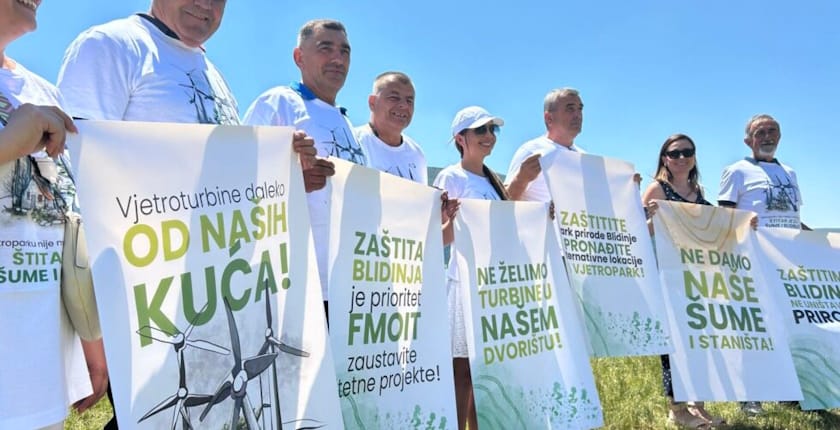
The Aarhus Centre and residents of Poklečani have opposed the project from the start

Nevertheless, it determined that the process was conducted unlawfully and irregularly in some aspects, the organization added.

Aarhus Centre and the locals in Poklečani have opposed the project from the start, citing concerns about its impact on the environment, health, and the quality of life within the community.

The proposed wind farm’s location near a protected area has raised fears regarding its potential effects on biodiversity and the local economy.

Poklečani is the second wind project of EPHZHB. The company operates BiH’s first one – the 50.6 MW Mesihovina facility. The utility is also developing its first solar power project, Hodovo, for 150 MW.

Miličević: There is a possibility of balancing energy needs with nature conservation

Iva Miličević, the representative of a group of citizens in Poklečani, underlined that the court’s ruling demonstrates there are still institutions in BiH that uphold the law and protect citizens’ interests.

“We, the residents of Poklečani, ask for nothing else except to respect the law and rulebooks that protect our environment and resources. Green energy is, of course, important and necessary, but it shouldn’t cost the destruction of natural resources, forests, protected landscapes, and especially drinking water. There are values that, once lost, can never be regained. This ruling is a victory for us and for everyone who believes it is possible to balance energy needs with nature conservation,” Miličević stressed.

Emina Veljović, executive director of the Aarhus Center in BiH, pointed out that the judgment highlights the need for strict compliance with a law regulating the temporary prohibition of using state property.

“Currently, state property is being defended by activists and the judiciary. Other institutions are waiting for something, and we wonder what they are waiting for,” she stated.