by in News

Bankers Petroleum in Albania: Production Halt, Tax Dispute, and Rising Labour Anger Converge

Bankers Petroleum Albania—operator of the Patos-Marinzë oilfield—has been hit by a fast-moving convergence of crises that now threatens both output and stability in one of Albania’s most strategic industrial zones. Within the space of roughly 24 hours, the company’s production activity was effectively frozen by customs authorities, while workers and subcontractors intensified protests over pay and working conditions, raising fears of a wider operational breakdown and renewed political escalation.

Customs blockade stops extraction at Patos-Marinzë

The most immediate shock came from the General Directorate of Customs, which—according to multiple Albanian media reports citing the company—ordered the blocking of Bankers Petroleum’s production and financial activity at the Patos-Marinzë extraction facilities. The stated trigger is an excise-tax dispute tied to the “diluent” used in heavy-oil production: customs authorities argue the company has not paid excise obligations for this input.
Bankers Petroleum

Bankers Petroleum’s response frames the action as arbitrary and procedurally unlawful, arguing that the diluent should not be subject to excise because it is not consumed in Albania and is used as a technical input in extracting and transporting crude that is exported. The company also points to a long-running legal conflict over this same issue, describing it as a matter still in court rather than one that should be enforced via an immediate operational shutdown.

Report TV links the current enforcement move to a much larger historical penalty: a fine totaling €120 million, reportedly assessed in 2019 after a customs investigation concluded Bankers had avoided at least €30 million in excise obligations related to diluent, with a further €90 million calculated as a penalty.

A technical shutdown with high-stakes consequences

Beyond the legal argument, Bankers and sector officials warn the stoppage is not a simple “pause.” Heavy crude at Patos-Marinzë requires continuous handling; once cooling begins, viscosity rises sharply and oil can solidify inside pipelines and storage infrastructure. In the company’s account—also quoted by Gazeta Shqip—Albania’s National Agency of Natural Resources (AKBN) has warned that extraction must run continuously (24/7) to avoid the crude becoming unusable in pipelines and tanks, and that storage constraints can force a full field shutdown with wider safety and environmental risks.

This is a critical point because it redefines the customs decision from a financial enforcement measure into an operational hazard: if the field is shut in abruptly, restarting can be technically difficult, expensive, and in some wells impossible—an argument Bankers uses to portray the blockade as disproportionately damaging to the Albanian state as resource owner, not only to the operator.

Labour unrest: “unpaid November” and a protest that is no longer isolated

While the customs dispute escalated at the institutional level, the social front has also heated up. The protest on 16 December 2025 did not appear in a vacuum. Earlier reporting through 2025 describes repeated mobilisations—demands for wage increases, implementation of collective agreements, improved working conditions, and recognition of oil-worker status. In October, workers were also reported to have entered a hunger strike, urging the state to mediate more actively. Bankers, for its part, previously acknowledged industrial action and union pressure but insisted production had continued normally during the strike period and pointed to planned increases in allowances while rejecting further wage hikes due to “financial pressures,” including oil-price weakness and exchange-rate effects.  The risk is that each pressure point amplifies the other: when workers fear wages are at risk, a state-ordered shutdown looks like confirmation; when the state sees instability, enforcement can harden.

A broader legal cloud hangs over the operator

Layered onto the operational and labour crisis is an expanding legal narrative around Bankers Petroleum’s finances.

Albania’s Prosecutor’s Office in Fier described an investigation alleging Bankers Petroleum Albania Ltd engaged in fraudulent schemes related to VAT, concealment of income, money laundering, and other offenses, with precautionary measures taken against multiple individuals and others declared wanted. The same source release claims the company reported losses consistently from 2004 through 2024, despite large volumes of exports and domestic sales, and alleges damages to the state budget linked particularly to fraudulent VAT claims.

This backdrop matters because it shapes how every new development is interpreted. For critics, the customs blockade and wage protests reinforce a narrative of a politically protected operator now facing overdue accountability. For the company, aggressive enforcement is portrayed as premature, legally questionable, and capable of destroying assets that ultimately belong to the Albanian public.

What is happening now—and what happens next

As of 16 December 2025, the situation around Bankers Petroleum can be summarised as a three-front confrontation:

  1. Institutional enforcement: Customs has moved to block operations over a contested excise obligation tied to diluent, with references in reporting to a much larger unresolved fine dating back to 2019.

  2. Operational risk: AKBN warnings cited in media coverage underline that halting heavy-oil production can cause technical damage and safety risks if the system is not managed carefully.

  3. Workforce instability: Protests and claims of unpaid wages—especially among subcontractors—indicate growing social stress at the field level, with political actors amplifying the message and demanding state intervention.

The immediate next steps are likely to unfold across institutions rather than at the wellhead: pressure on the Ministry of Finance to intervene, continued court and prosecutorial actions, and negotiations (formal or informal) over how the field can be kept safe and technically stable while legal disputes continue. The deeper question—still unresolved—is whether Albania’s largest onshore oil operation can sustain output and social peace while sitting at the intersection of labour conflict, tax enforcement, and criminal investigation.

If the blockade persists, the costs will not be measured only in barrels lost, but also in jobs, contractor liquidity, community safety, and the credibility of the state’s ability to regulate strategically vital assets without triggering destabilising shocks.


Bankers Petroleum Albania — operatori i fushës naftëmbajtëse Patos-Marinzë — është goditur nga një përqendrim krizash me zhvillim të shpejtë, që tashmë kërcënon si prodhimin ashtu edhe stabilitetin në një nga zonat industriale më strategjike të Shqipërisë. Brenda rreth 24 orëve, aktiviteti prodhues i kompanisë u ngrirë praktikisht nga autoritetet doganore, ndërsa punëtorët dhe nënkontraktorët intensifikuan protestat për pagat dhe kushtet e punës, duke rritur frikën për një prishje më të gjerë të operacioneve dhe një përshkallëzim të ri politik.

Bllokada doganore ndal nxjerrjen në Patos-Marinzë

Goditja më e menjëhershme erdhi nga Drejtoria e Përgjithshme e Doganave, e cila — sipas disa raportimeve të mediave shqiptare që citojnë kompaninë — urdhëroi bllokimin e aktivitetit prodhues dhe financiar të Bankers Petroleum në impiantet e nxjerrjes në Patos-Marinzë. Shkaku i deklaruar lidhet me një mosmarrëveshje për akcizën, që ka të bëjë me “diluentin” e përdorur në prodhimin e naftës së rëndë: autoritetet doganore argumentojnë se kompania nuk ka paguar detyrimet e akcizës për këtë input.

Reagimi i Bankers Petroleum e paraqet veprimin si arbitrar dhe procedurialisht të paligjshëm, duke argumentuar se diluenti nuk duhet t’i nënshtrohet akcizës, sepse nuk konsumohet në Shqipëri dhe përdoret si input teknik në nxjerrjen dhe transportin e naftës së papërpunuar që eksportohet. Kompania thekson gjithashtu se ekziston një konflikt ligjor i kahershëm për të njëjtën çështje, duke e përshkruar si një materie ende në gjykatë dhe jo diçka që duhet zbatuar përmes një mbylljeje të menjëhershme të operacioneve.

Report TV e lidh këtë lëvizje aktuale të zbatimit me një penalitet historik shumë më të madh: një gjobë totale prej 120 milionë eurosh, e cila thuhet se është vendosur në vitin 2019, pasi një hetim doganor konkludoi se Bankers kishte shmangur të paktën 30 milionë euro detyrime akcize që lidhen me diluentin, ndërsa 90 milionë euro të tjera u llogaritën si penalitet.

Një ndalim teknik me pasoja të mëdha

Përtej argumentit ligjor, Bankers dhe zyrtarë të sektorit paralajmërojnë se ndalimi nuk është një “pauzë” e thjeshtë. Nafta e rëndë në Patos-Marinzë kërkon trajtim të vazhdueshëm; sapo fillon ftohja, viskoziteti rritet ndjeshëm dhe nafta mund të ngurtësohet brenda tubacioneve dhe infrastrukturës së depozitimit. Sipas përshkrimit të kompanisë — i cituar edhe nga Gazeta Shqip — Agjencia Kombëtare e Burimeve Natyrore (AKBN) ka paralajmëruar se nxjerrja duhet të funksionojë pandërprerë (24/7) për të shmangur bërjen të papërdorshme të naftës në tubacione dhe depozita, si dhe se kufizimet e magazinimit mund të detyrojnë mbyllje të plotë të fushës, me rreziqe më të gjera për sigurinë dhe mjedisin.

Ky është një element kritik, sepse e riformulon vendimin e doganave nga një masë zbatimi financiar në një rrezik operacional: nëse fusha mbyllet papritur, rifillimi mund të jetë teknikisht i vështirë, i kushtueshëm dhe në disa puse i pamundur — një argument që Bankers e përdor për ta paraqitur bllokadën si proporcionalisht dëmtuese edhe për shtetin shqiptar si pronar i burimit, jo vetëm për operatorin.

Pakënaqësia e punës: “nëntor i papaguar” dhe një protestë që s’është më e izoluar

Ndërsa mosmarrëveshja me doganat u përshkallëzua në nivel institucional, edhe fronti social është tensionuar. Protesta e 16 dhjetorit 2025 nuk u shfaq në boshllëk. Raportime më të hershme gjatë vitit 2025 përshkruajnë mobilizime të përsëritura — kërkesa për rritje pagash, zbatim të marrëveshjeve kolektive, përmirësim të kushteve të punës dhe njohje të statusit të punëtorit të naftës. Në tetor, punëtorët raportohet se hynë edhe në grevë urie, duke i kërkuar shtetit të ndërmjetësonte më aktivisht. Bankers, nga ana e vet, më parë e pranoi ekzistencën e veprimeve industriale dhe presionin sindikal, por këmbënguli se prodhimi kishte vijuar normalisht gjatë periudhës së grevave dhe përmendi rritje të planifikuara të dietave/kompensimeve, ndërsa hodhi poshtë rritje të mëtejshme pagash për shkak të “presioneve financiare”, përfshirë dobësinë e çmimeve të naftës dhe efektet e kursit të këmbimit. Rreziku është që secili presion ta amplifikojë tjetrin: kur punëtorët druhen se pagat janë në rrezik, një mbyllje e urdhëruar nga shteti shihet si konfirmim; kur shteti sheh paqëndrueshmëri, zbatimi i masave mund të ashpërsohet.

Një re më e gjerë ligjore mbi operatorin

Mbi krizën operative dhe të punës shtresohet edhe një narrativë ligjore në zgjerim rreth financave të Bankers Petroleum.

Prokuroria e Fierit përshkroi një hetim që pretendon se Bankers Petroleum Albania Ltd është për leaving në skema mashtruese të lidhura me TVSH-në, fshehje të të ardhurave, pastrim parash dhe vepra të tjera penale, me masa sigurie ndaj disa personave dhe të tjerë të shpallur në kërkim. E njëjta deklaratë pretendon se kompania ka raportuar humbje në mënyrë të vazhdueshme nga 2004 deri në 2024, pavarësisht volumeve të mëdha të eksportit dhe shitjeve brenda vendit, dhe ngre pretendime për dëme në buxhetin e shtetit, veçanërisht të lidhura me kërkesa të rreme për rimbursim/kompensim të TVSH-së.

Ky sfond ka rëndësi, sepse formëson mënyrën se si interpretohet çdo zhvillim i ri. Për kritikët, bllokada doganore dhe protestat për paga forcojnë një narrativë se një operator i mbrojtur politikisht po përballet më në fund me llogaridhënie të vonuar. Për kompaninë, zbatimi agresiv paraqitet si i parakohshëm, i diskutueshëm ligjërisht dhe i aftë të shkatërrojë asete që në fund i përkasin publikut shqiptar.

Çfarë po ndodh tani — dhe çfarë mund të ndodhë më pas

Që nga 16 dhjetori 2025, situata rreth Bankers Petroleum mund të përmblidhet si një përballje në tre fronte:

  • Zbatim institucional: Doganat kanë lëvizur për të bllokuar operacionet mbi një detyrim të kontestuar akcize të lidhur me diluentin, me referenca në raportime për një gjobë shumë më të madhe të pazgjidhur që daton nga viti 2019.

  • Rrezik operacional: Paralajmërimet e AKBN-së të cituara në mbulim mediatik nënvizojnë se ndërprerja e prodhimit të naftës së rëndë mund të shkaktojë dëme teknike dhe rreziqe sigurie nëse sistemi nuk menaxhohet me kujdes.

  • Paqëndrueshmëri e fuqisë punëtore: Protestat dhe pretendimet për paga të papaguara — veçanërisht nga nënkontraktorët — tregojnë rritje të stresit social në nivel fushe, me aktorë politikë që e amplifikojnë mesazhin dhe kërkojnë ndërhyrje të shtetit.

Hapat e menjëhershëm ka gjasa të zhvillohen më shumë nëpër institucione sesa te pusi: presion mbi Ministrinë e Financave për të ndërhyrë, vijim i proceseve gjyqësore dhe veprimeve prokuroriale, si dhe negociata (formale ose joformale) për mënyrën se si fusha mund të mbahet e sigurt dhe teknikisht e qëndrueshme ndërsa mosmarrëveshjet ligjore vazhdojnë. Pyetja më e thellë — ende e pazgjidhur — është nëse operacioni më i madh tokësor i naftës në Shqipëri mund të ruajë prodhimin dhe paqen sociale, teksa gjendet në kryqëzimin e konfliktit të punës, zbatimit tatimor dhe hetimit penal.

Nëse bllokada vazhdon, kostot nuk do të maten vetëm me fuçi të humbura, por edhe me vende pune, likuiditet të kontraktorëve, siguri komunitare dhe me besueshmërinë e aftësisë së shtetit për të rregulluar asete strategjikisht jetike pa shkaktuar tronditje destabilizuese.
by in News

Albania’s Oil Sector Under Scrutiny: Arrests, Tax Evasion Allegations, and Geopolitical Shifts.

Albania’s oil and gas industry has a long and complex history that dates back to the early twentieth century. During World War I, in September 1917, the Italian government became particularly interested in Albania’s natural riches, awarding some of the first concessions for their use. In the decades that followed, businesses from the UK, France, Russia, and other countries were interested in Albania, intending to develop its oil and gas extraction industry.

When the Albanian government started talks with the British company Premier Oil in 1993, a new era after the fall of communism began. As a result, an agreement to develop the Patos-Marinza oil field was signed in 1994. As part of the agreement, Premier Oil and the state-owned Albpetrol sh.a formed Anglo-Albanian Petroleum, a joint venture that was charged with managing operations at one of Europe’s biggest onshore oil fields, Patos-Marinza.

In addition to starting research and investigations, Premier Oil’s experts worked on some of the Patos-Marinza wells that were operational. This company kept up its operations until 2004, when it unexpectedly left Albania after ten years of involvement.

But less than a month after the withdrawal, a new company, Saxon Energy International, was registered in the Cayman Islands. And two months later, it signed an agreement with Albpetrol sha and took the place of the British company Premier Oil in Patos-Marinza oil field.

Although Premier Oil had only formally withdrawn, it had registered in the Cayman Islands tax haven, merely changing its name and posing as a Canadian business in the interim. The representative, Richard Uofsorth, who had been in Albania since 2001 to oversee Premier Oil’s Patos-Marinza project, remained the same.

The problem was that the Albanian government of the time under Prime Minister Fatos Nano ignored the hydrocarbon law, which states that in these cases of agreements, the company must have experience and submit the balance sheets of the last 5 years. The agreement was ‘blessed’ by the minister of the time, Viktor Doda.

Three years after its founding, Saxon Energy International decided to change its name and became Bankers Petroleum, which is also the name of its parent company in Canada.

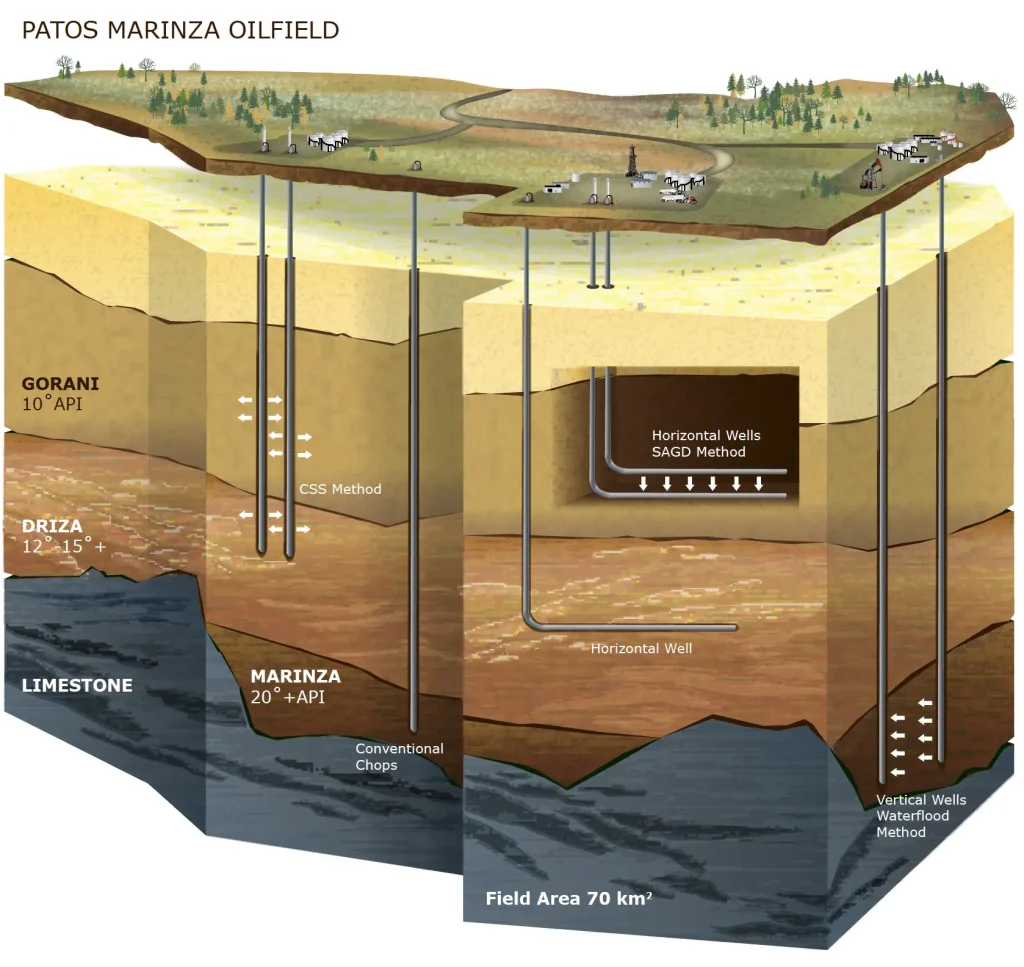
Patos Marinza Oilfield

Because the business was registered in the Cayman Islands, its owners were shielded and also enjoyed tax exemptions. Since there is no corporate income tax on profits, capital gains, or dividends, companies in this nation function more like middlemen, purchasing the “product” from one company and reselling it to another.

In the contract signed with Premier Oil in 1994, the division of oil production was 15% for Albpetrol sh.a (Albanian state oil and gas company) and 85% for Premier Oil, while in the contract signed in 07/06/2004, AlbPetrol sh.a received only 1% gross overriding royalty (ORR) on new production, while Saxon or Bankers Petroleum received 99%.

Reports from first 10 years later showed that Bankers Petroleum Ltd had paid 0 profit tax and for 2013 alone, the company’s revenue was over $540 million.

In 2006, then-Minister of Economy Genc Ruli signed a development plan with Bankers Petroleum, which outlined that the cost recovery phase would conclude in 2009. From that point forward, the company was expected to begin paying profit tax to the Albanian state. However, this obligation was never fulfilled.

Patos-Marinza oil field.

The critical question remains: Why did the Albanian government allow this deviation to go unchecked for so long, without initiating any enforcement or corrective action?

Bankers Petroleum Albania and Genc Ruli, the then-Minister of Economy, worked together to revise the “Petroleum and License Agreements” in 2008. The modification significantly decreased Bankers Petroleum’s long-term tax obligations in Albania by enabling the business to exclude royalties from future income taxes.

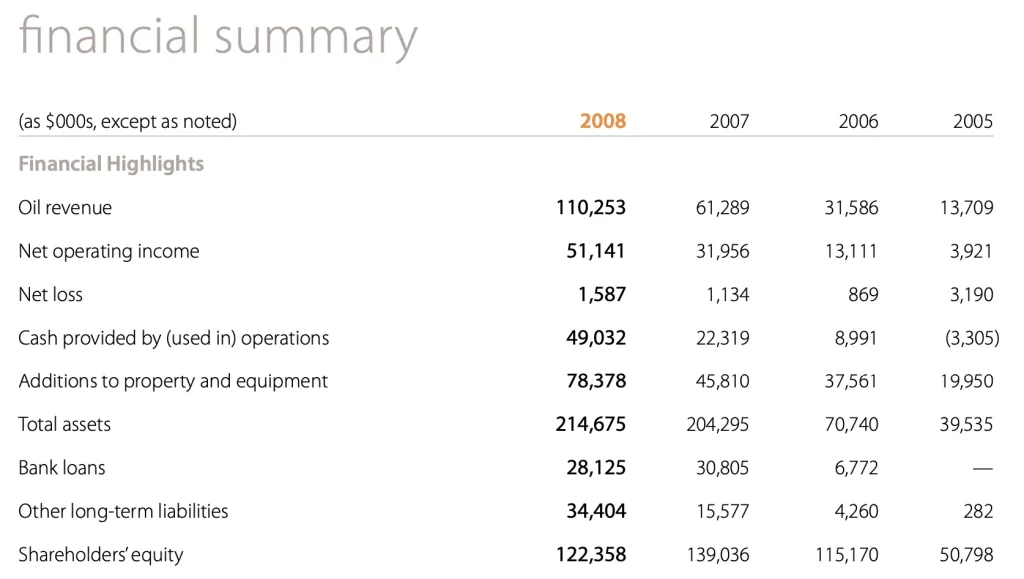
Bankers Petroleum financial summary for years 2008-2005

In the same year, the company added retired U.S. General Wesley Clark, who led Operation Allied Force during the Kosovo War and served as NATO Supreme Allied Commander, to its board of directors. Many saw the action as a calculated attempt to protect the company’s business interests in Albania and exert political pressure on the government.

This again avoided paying the profit tax, but at least, the government of the time made Bankers Petroleum pay the mining royalty, 10% royalty tax (RT) on net production.

Things changed again with the arrival of the socialist government and Prime Minister Edi Rama, on June 23, 2013, when Bankers Petroleum was added three taxes: Excise Tax, Turnover Tax and Carbon Tax.

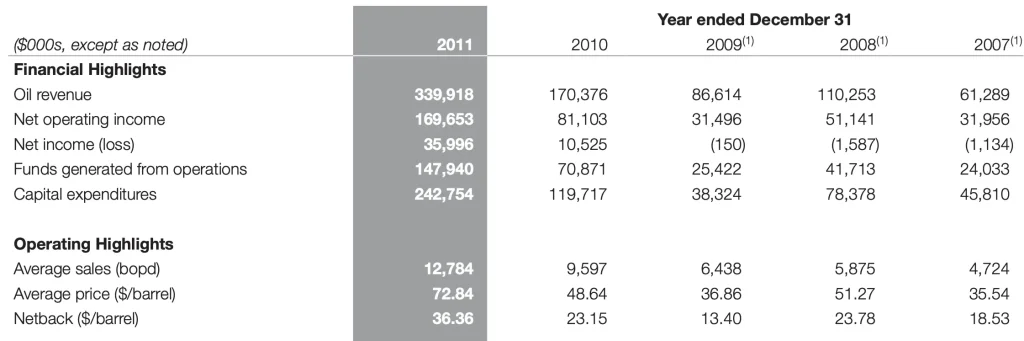
Bankers Petroleum financial summary for the years 2011-2007.

This came after the Rama first government decided to heavily tax the hydrocarbon sector and the concession companies did not have to make an exception. The agreement was reviewed, and the necessary modifications were made. But did Bankers Petroleum started paying taxes?

Oil production Patos-Marinza

Although the 2008 amendment to the “Petroleum and License Agreements” allowed Bankers Petroleum to offset royalty payments against future income taxes—effectively reducing its projected tax burden—this provision was further reinforced years later. In 2015, the AKBN National Agency of Natural Resources ( Agjencia Kombëtare e Burimeve Natyrore ), under a decision issued by then-Minister Damian Gjiknuri, officially classified these three key taxes as “hydrocarbon costs.” This designation allowed Bankers Petroleum to fully recover those costs—100%—from oil production revenues, effectively nullifying the expected fiscal contribution.

Throughout its operational period, Bankers Petroleum has consistently reported using approximately 20% of its net oil production for diluent injection—a process required to optimize extraction in its heavy oil fields. This technical justification, included in the company’s official filings with the National Agency of Natural Resources (AKBN), has been used to support large volumes of tax-exempt fuel imports.

However, investigations and market observations suggest that a significant portion of this imported commercial fuel—initially declared for operational use—was instead diverted into the domestic market. Through local partners, including BOLV Oil, this fuel reportedly entered Albania’s monopolized fuel sector without being subjected to any taxes or duties.

Estimates indicate that this practice may have resulted in the evasion of hundreds of millions of dollars in taxes, raising serious concerns about regulatory oversight, enforcement, and the broader implications for public revenue.

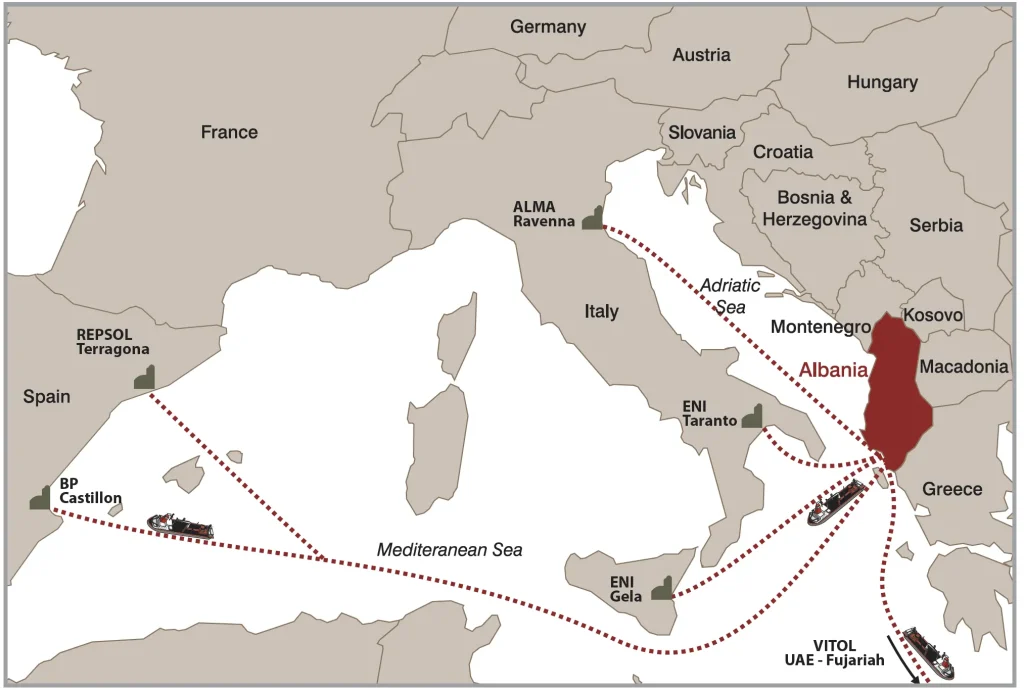
Bankers Petroleum oil exports towards refineries.

All subsequent agreements signed by the Albanian state with companies in the hydrocarbon sector followed a similar model to the one established with Bankers Petroleum. In 2008, the government entered into a production-sharing agreement with Stream Oil for the Ballsh, Gorisht, and Koçul oil fields—an arrangement that mirrored the same unfavorable terms, leaving the Albanian state with limited benefits from its own natural resources. Notably, Stream Oil was registered in the Cayman Islands, raising further concerns about transparency and accountability.

A similar pattern emerged in Kuçova, where the rights were granted to Sherwood—a company that, despite operating independently on paper, was in fact owned by Bankers Petroleum. Like Stream, Sherwood was also registered in the Cayman Islands, reinforcing a trend of offshore-registered entities operating Albania’s key oil fields under opaque corporate structures.

Albpetrol sh.a. has also come under scrutiny for a lack of transparency, particularly in its dealings with state oversight institutions. The company reportedly refused to provide the Albanian Supreme Audit Office with access to contracts concluded with private oil companies, citing confidentiality clauses as justification for withholding key information. This deliberate obstruction has raised serious concerns about accountability and the oversight of public resources in the country’s hydrocarbon sector.

In 2016, a significant shift occurred in Albania’s oil sector when Bankers Petroleum came under Chinese ownership. The company publicly announced that it had entered into a definitive agreement with “1958082 Alberta Ltd” and “Charter Power Investment Limited” for the acquisition of all outstanding shares of Bankers Petroleum Ltd at a price of $2.20 per share. Both purchasing entities were subsidiaries of Geo-Jade Petroleum Corporation , one of China’s largest independent oil and gas exploration and production companies.

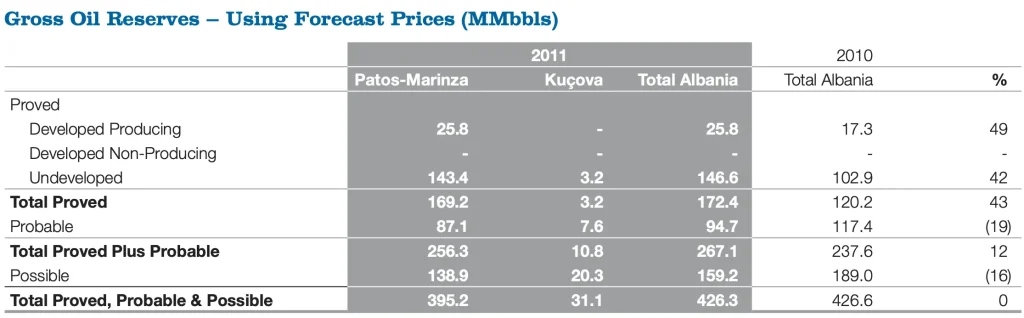
Gross Oil Reserves

The transaction, structured under the laws of the Canadian province of Alberta, valued Bankers Petroleum at approximately $575 million, excluding liabilities. This marked a major turning point, placing one of Albania’s most strategic energy assets under Chinese corporate control.

But a year before the sale was finalized, the owners of Bankers Petroleum sued Albania in International Arbitration after requesting that $236 million be recognized as expenses, all amounts generated from the production of the Patos Marinza field through the cost recovery procedure.

Through a notice, the Ministry of Energy announced at the time that the arbitration had stated that the costs claimed by Bankers were rejected and declared irrecoverable. Therefore, the state is not obligated to recognize this value.

Following this decision in favor of the Albanian state, Bankers Petroleum was obligated to begin paying profit tax on its operations. Under hydrocarbon contracts like Bankers’, the applicable profit tax rate is 50%. Accordingly, on revenues exceeding $236 million, a thorough audit was to be conducted to verify actual costs and determine the company’s true tax liability to the Albanian government.

However, recent reports indicate that Bankers Petroleum has once again failed to meet its tax obligations, paying little to no profit tax to the state—significantly less than what is owed.

Prosecutors in Fier, Albania announced 14 security actions, including 9 arrests. Five foreign nationals are still at large. Bankers Petroleum CEO Hongping Xiao and former director Leonidha Çobo were arrested during a raid on the company’s offices. The six-month investigation, which began in December 2024, alleges that the company falsified financial reports, inflated operating costs, and laundered funds through a network of contractors in order to consistently declare losses and benefit from fraudulent VAT refunds — all while avoiding corporate income tax.

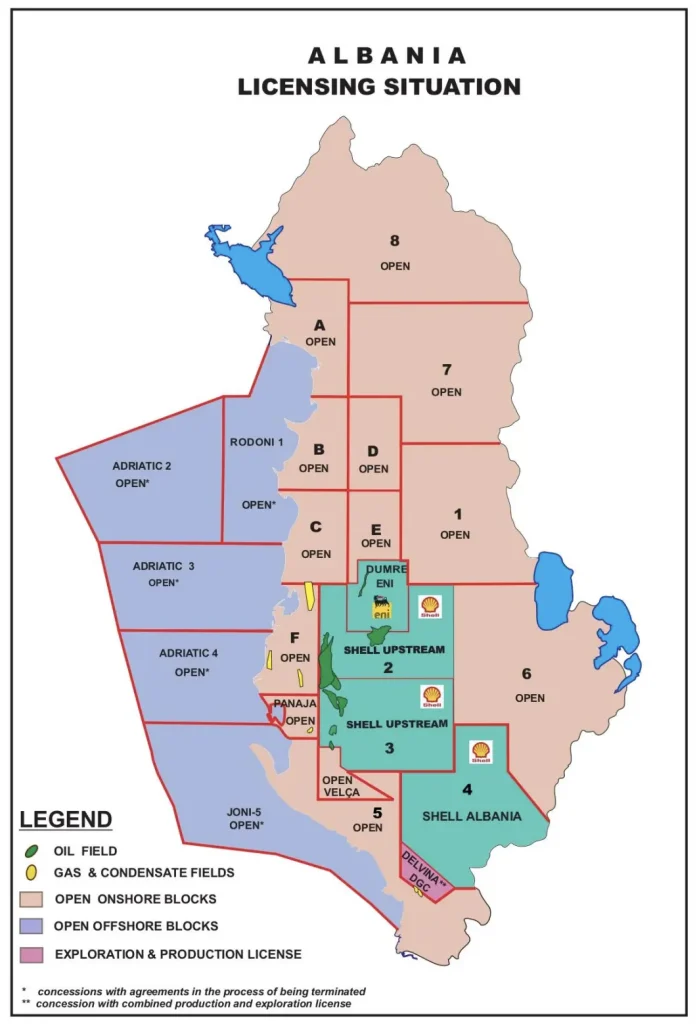
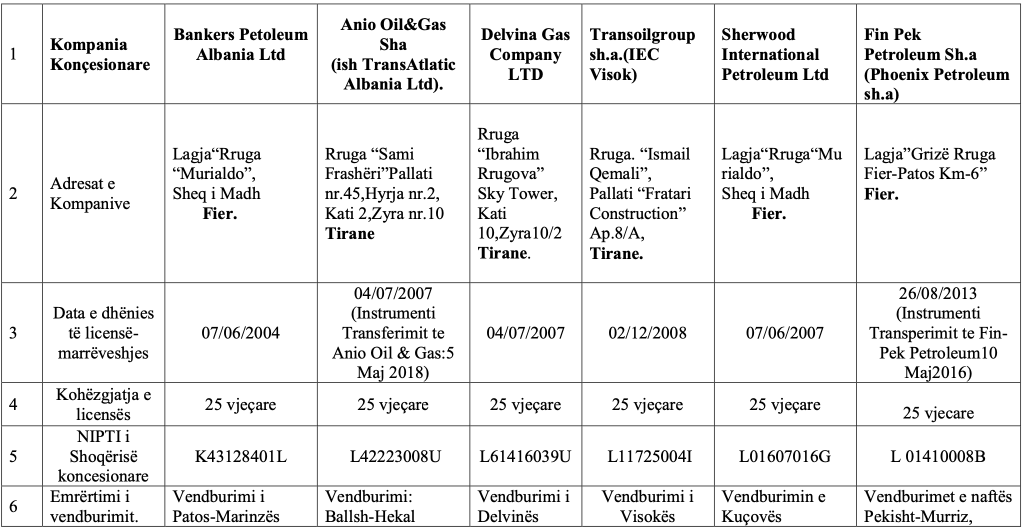
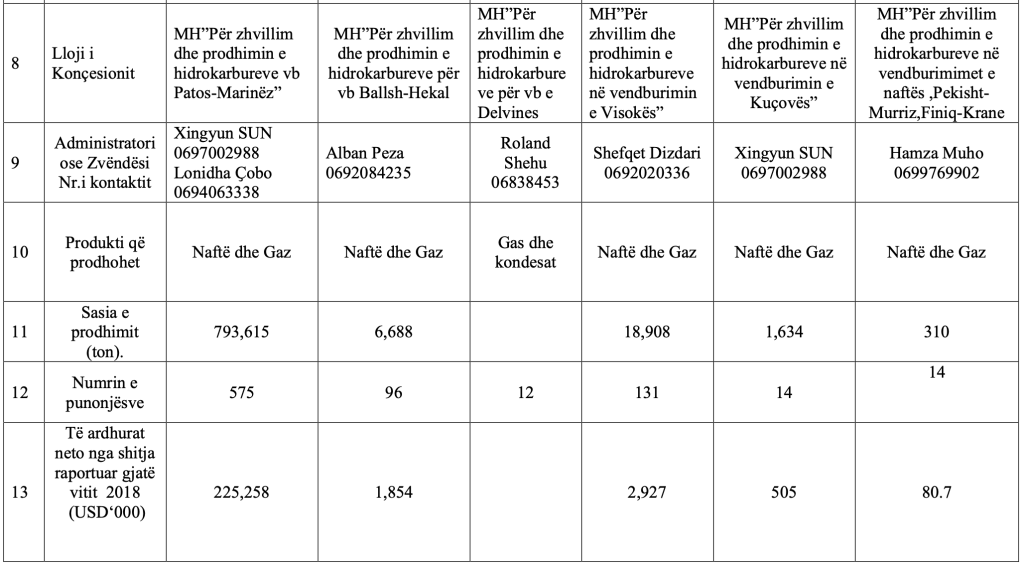
List of oil and gas concession companies.

List of oil and gas concession companies.

Between 2004 and 2024, Bankers Petroleum reported over 532 billion lek in revenue (approx. €5 billion). However, according to investigators, the company simultaneously declared losses and avoided paying a single euro in profit tax, exploiting a controversial clause in its concession agreement known as the “R-Factor.”

The allegations brought against Bankers Petroleum executives include “creation of fraudulent VAT schemes,” “concealment of income,” “money laundering,” “abuse of office,” and “failure of tax authorities to perform duties.” These are the result not just of the company’s internal operations, but also of suspected coordination with contractors and potentially complicit tax officials. To prevent evidence tampering, prosecutors took corporate data and personal devices during raids earlier this week. According to insiders, the inquiry is broadening to include offshore benefactors and contractor networks that contributed to financial imbalances.

Even more alarming, the corporation recorded €800 million in net profits, including €110 million in only the previous two years, despite stating that it had yet to return its investment. Critics believe that this is due to manipulative accounting and overstated expenditure declarations, which are supported by a labyrinth of offshore firms and favourable contractor connections. The Supreme State Auditor (KLSH) had warned for years that the R-Factor had been altered, but no action was taken.

Why did it take the Albanian government and prosecutors so long to take action, despite these facts being known since the early stages of Bankers Petroleum’s operations?

The most serious issue with the “Bankers” case besides the overdue tax debt or the standard balance-sheet manipulation. These are unquestionably significant criminal violations. The central issue of this case is the true ownership of the oil wells, as well as the destiny of billions of euros taken from Albanian underground without leaving a trace in the public budget.

The same method has been used for all the country’s natural wealth and industrial assets: demolition, transfer into unknown hands, use as a means of developing, sale, and silence. All of Albania’s natural resources are in the hands of invisible shells, as are the industrial assets.

The prime minister Rama government seems to have indicated that it intends to hand over management of the Patos-Marinza oil field to other lobbying groups as the license that Bankers Petroleum currently holds is about to expire. This is allegedly an attempt to discredit Chinese interests. Corruption, and geopolitical factors are thought to be the main drivers of this change, which is reminiscent of other contentious attempts like the stated offer of Sazan Island, a National Natural Park, to US President Donald Trump’s son-in-law, Jared Kushner, for the construction of luxurious hotels.

Bankers Petroleum a social-environmental bomb.

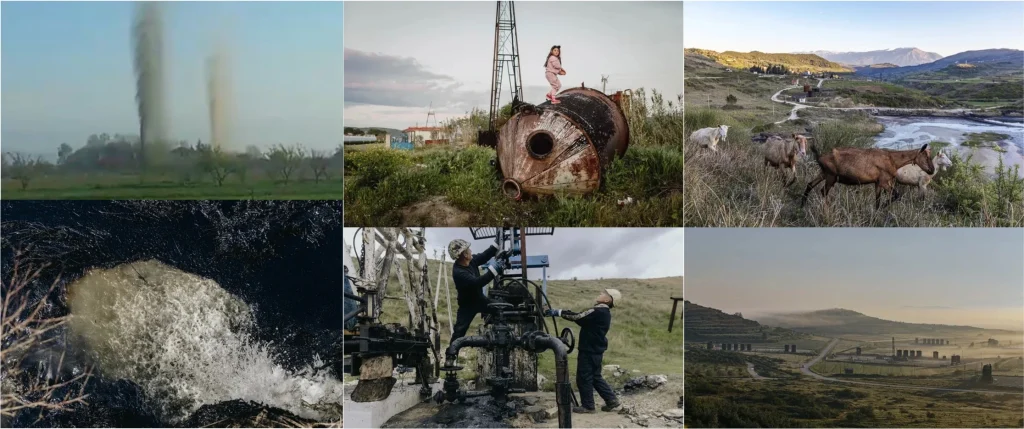
Although capitalism has gained ground, the region of Ballsh and Fier seems to be stuck in the past, environmental issues seem secondary, neglected, profit and the black legacy of the past erases them and has turned into an apocalyptic landscape of the oil region. Poorly managed oil and inadequate extraction technology which results also in explosion of wells, leave behind polluted lakes and destroyed rivers.

Patos-Marinza oil field.

Residents of the Patos-Marinza area have expressed major concerns about environmental degradation caused by protracted oil extraction activity. Local water wells have apparently become toxic, leaving the town without access to safe drinking water, as oil appears to have contaminated the groundwater. In many regions, soil health has been irreversibly harmed—the land was rendered black by oil, leaving it unsuited for agriculture or livestock.

Air quality has also deteriorated due to industrial pollution, and the surrounding environment is littered with abandoned oil tanks, rusted equipment, leaking pipelines, and pools of stagnant oil. The outcome is a once-inhabitable countryside that residents now characterize as essentially unlivable, with consequences for not only the environment but also the social structure of entire communities. Despite these circumstances, Bankers Petroleum has demonstrated a stunning lack of corporate social responsibility (CSR), failing to address even the most fundamental environmental concerns in its business locations.

By Ranier della Vecchia

by in News

Albania seeks investors for shuttered Ballsh, Fier refineries.

The Albanian government said it is willing to lend its full support to any private initiative that would redevelop Ionian Refining & Trading Co.’s (IRTC) recently shuttered 20,000-b/d Ballsh and 10,000-b/d Fier refineries in eastern Albania.

Albania’s government remains committed to detail to support any serious investor who will come up with a project for business development in Ballsh and Fier refineries, or a bid from an investor to develop a business plan in the sector, involving restart of both refineries, Arben Ahmetaj, Albania’s minister of finance and economy (MOEI) said in a release.

The statement follows in the wake of the shutdown of both refineries in late 2017 due to a lack of crude supplies and IRTC’s outstanding $60-million tax debt to the government, according to reports from Albanian media.

As of May 2017, with the cooperation of MOEI and Bankers Petroleum Ltd.—Albania’s main crude oil producer—the Ballsh refinery was operating at 100% capacity, according to a Dec. 29, 2017, release from GOMG Holdings Ltd. announcing the sale of its minority interest in the Ballsh refinery to Delvina Investment Partners Ltd.

According to an Aug. 31, 2016, release from Bankers Petroleum, the outfit agreed to sell up to 65% of its crude oil production to IRTC to process at the Ballsh and Fier refineries from Oct. 1, 2016, through Dec. 31, 2017, with the balance of production to be sold to the export market.

The crude supply contract, however, was not renewed, with Bankers Petroleum now exporting the totality of its Albanian crude production to buyers abroad, according to Albanian media reports.

by in News

Why Albania is THAT important to the Balkans

A couple of weeks ago, Director of IN-VR, Chryssa Tsouraki published an article on Albania’s importance to the Balkans region that went viral: “Albania is far too important for Europe’s energy security to be ignored or even underestimated. Some quick facts about Albania to familiarise yourselves:

–  Patos Marinza: The largest oil field in Europe, operated by Bankers Petroleum, Official Sponsor of Balkans Petroleum.

– Delvina Gas Field: a proven gas condensate field. It lies on one of the largest gas structures in southeastern Europe

– TAP:Trans-Adriatic Pipeline will start bringing natural gas from the Caspian Sea to Europe in 2020. Albania has recently formed Albagaz to handle the transmission and distribution of TAP natural gas in the country and its neighbours. IAP is another fascinating Gas project to watch out for.

– Shell’s already invested: in Shpirag-2 and 3, with some very encouraging results.

If you are wondering how you could get involved in Albania, other than obtaining an exploration license, here are some great opportunities still available to a wide range of service providers:

  • Offshore and onshore oil and gas exploration and production equipment and services
  • Gas pipeline and Gas station equipment
  • Oil pipeline equipment (transportation from oil fields to oil terminals and refineries)
  • Oil storage equipment and underground gas storage equipment
  • Oil and gas terminal products

Besides its prolific proven oil and gas resources, Albania is a great place to do business in. Led by the wonderful Dorina Cinari, EITI is monitoring all energy activities and makes a great partner to the Ministry of Energy and Industry (MEI).
The MEI has shown incredible stability and progress and has received increased interest from IOCs since we first met in 2012.
Dritan Spahiu, former Director at the MEI, currently on a new powerful role within the state-owned Albpetrol, has been a cornerstone in these efforts.
The entire MEI cabinet and the AKBN have been working really hard to attract foreign investors by continuous education, favourable licensing terms and excellent staff for the IOCs to work with.

I personally view Albania is one of the most promising (yet very under-explored) regions in terms of oil and gas exploration and production, and I’m sure we haven’t seen its full potential yet. There is just so-much-more we should expect from Albania.

Have you visited the MEI or its subsidiaries yet? You will be overwhelmed by the kindness of its people, making them one of the most professional and active Ministries I’ve had the pleasure to work closely with.

Balkans Petroleum and IN-VR Oil & Gas are proud partners of the Albania Energy Association.

So yes, Albania is THAT important to Balkans Petroleum, and we are looking forward to hearing more about potential changes (if any) in the MEI and welcome them at Balkans Petroleum!

Even if there will be post-election changes in the MEI and its affiliates or not, one thing is certain; Albania is open for business.

If you would like to meet with Bankers Petroleum, the Ministry of Energy and Industry, AKBN, Albpetrol, Abkons, Shell and many more important Albanian leading organisations, secure your place at the Balkans Petroleum summit, taking place 3-4 October at Royal Olympic Athens.

by in News

Pennine signs Velca Block PSA, anticipates into Albania’s energy industry.

 “Pennine” is pleased to announce that it has signed a Production Sharing Agreement (“PSA”) with Albpetrol Sh.A (“Albpetrol”) for the exploration and development of the Velca Block in Albania.

The finalized PSA contains a license agreement signed by Pennine, Albania’s Ministry of Energy and Industry, and Albpetrol, the country’s state-owned energy firm, for a six(6)-year exploratory lease-convertible to a 25-year production lease, upon discovery of oil and/or natural gas accumulations.

“This is a very exciting day for Pennine. Albania has a long history of oil and gas development dating back nearly a century, and Pennine is excited to bring its expertise to this region” says Chief Executive Officer N. Desmond Smith.

“Albania has mature energy infrastructure, established legislation and regulations, and a recent history of significant foreign investment for the development of its energy sector,” adds Mr. Smith. “We look forward to working in the Republic of Albania, providing value to Pennine shareholders, and bringing prosperity to the people of Albania.”

Pennine intends to initiate a Technical Report in the next 60 days, and with existing data, identify potential drilling targets within the Velca Block.

Pennine is currently working with industry experts from Albpetrol and the Ministry of Energy and Industry in an advisory committee, with Pennine acting as operator.

“Our understanding and experience with Albania has enabled us to develop a partnership with the Albanian government and Albpetrol through a new production sharing agreement. We believe this agreement provides a balanced risk-and-reward contract for the exploration and development of the Velca Block-and, we hope, many other opportunities in Albania,” says Pennine chairman Richard Wadsworth, who led Bankers Petroleum Ltd. in re-developing the Patos Marinza oilfield as its president from 2004 through 2008.

“We look forward to a seamless integration of Pennine into Albania’s oil and gas exploration and development landscape.”

The PSA consists of an Exploration Phase and a Drilling Phase. Under the Exploration Phase, Pennine and Albpetrol will conduct an examination of all currently existing geological, geophysical and well data on the Velca Block, and conduct any processing or re-processing of data to select drilling targets. The Drilling Phase will consist of a commitment to drill a minimum of two (2) wells, to a minimum depth of 2,500 metres.

Pennine will recover all exploration and development costs from 90% of the net operating revenue, after the state’s 10% royalty tax, then subject to an R-factor revenue sharing with Albpetrol, ranging from 2% to 15% of net operating revenue, depending on the multiple of cost recovery to the project. After payout of all costs, the interest in the revenue stream is shared, with 50% earmarked for the Albania Ministry of Energy and Industry and 50% for the participants of the PSA (a 100% working interest before payout and a 50% working interest after payout).

Main terms and conditions of the Velca Block PSA were signed in February 2016. Pennine and Albpetrol agreed in April 2016 to the terms of the PSA and submitted the document to Albania’s Ministry of Energy and Industry for approval. Pennine reviewed the License Agreement, an integral component of the PSA, in December 2016.

In connection with this transaction, Pennine will pay a finder’s fee to an arm’s-length entity through the issuance of up to 7,000,000 common shares subject to TSX Venture Exchange policy.

by in News

Audit finds in favour of Bankers Petroleum in tax dispute with Albanian government

Canada-based Bankers Petroleum said on August 29 it has finally resolved a tax dispute with the Albanian government and it will be reimbursed for “excessive payments” made to the Albanian tax authorities. The binding third-party audit report on the 2011 tax dispute said that Bankers “correctly stated its 2011 expenses as cost recoverable”, Bankers said in a statement.

In February Bankers, which is mainly active in Albania, suspended its arbitration procedure against Tirana after reaching an agreement with the country’s energy ministry on the appointment of an international expert audit team to resolve the $75mn tax dispute. China’s Geo-Jade Petroleum Corporation is in the process of acquiring Bankers in a deal due to close at the end of September. 

The third-party audit was conducted by a joint panel of individuals from PricewaterhouseCoopers and Navigant Consulting Company. Its decision is a final resolution, as previously agreed to by the Albanian National Agency for Natural Resources (AKBN), the ministry of energy and industry and Bankers.

The audit obliges the Albanian tax authority to recalculate Bankers’ tax obligations for 2011 and determine the appropriate mechanism to settle or reimburse Bankers for the payments made to date, said the statement.

Bankers said it had paid a total of $37mn to the Albania tax authorities as deposits for the 2011 profit tax assessment as of June 30. 

Bankers operates the Patos-Marinza oilfield and has a 100% interest in both the Kucova oilfield and in Exploration Block F in Albania.

by in News

Bankers Petroleum Ltd. to be acquired by an affiliate of Geo-Jade Petroleum

Geo-Jade PetroleumCALGARY, March 20, 2016 /PRNewswire/ – Bankers Petroleum Ltd. (“Bankers”) (TSX: BNK, AIM: BNK) is pleased to announce that it has entered into a definitive agreement (the “Arrangement Agreement”) with 1958082 Alberta Ltd. (the “Purchaser”) and Charter Power Investment Limited (“Charter Power”) for the purchase of all the issued and outstanding common shares of Bankers (“Bankers Shares”) at a cash price of C$2.20 per Bankers Share.  The Purchaser and Charter Power are affiliates of Geo-Jade Petroleum Corporation (“Geo-Jade”), one of the largest independent oil and gas exploration and production companies in China. The transaction will be effected by way of a plan of arrangement under the Business Corporations Act (Alberta) (the “Arrangement”).  The Arrangement values Bankers at approximately C$575 million before the assumption of the outstanding indebtedness of Bankers.

Highlights

  • Cash price of C$2.20 per Bankers Share
  • The Arrangement has received the unanimous approval of the Board of Directors of Bankers (the “Bankers Board”) and carries the full support of Bankers’ management team
  • The Purchaser brings a considerable new investment focus to the Bankers portfolio of assets
  • Bankers’ corporate and technical headquarters will remain based inCalgary, Canada, with operational offices in Albania, Hungary and Romania

The transaction price represents a premium of 98% over Bankers’ closing share price on the Toronto Stock Exchange (“TSX”) of C$1.11 on March 18, 2016, and 109% over the 30-trading day volume weighted average trading price of Bankers Shares of C$1.05 per share ending on March 18, 2016.

David French, President and Chief Executive Officer of Bankers commented: “The proposed transaction provides Bankers with the opportunity to return value to our shareholders at a significant premium to the current market valuation, while offering Bankers added financial resources to accelerate our activity inAlbania and capitalize on the potential created by the current commodity price environment.  This transaction will generate substantial economic benefit forAlbania and the local communities in which Bankers operates. We look forward to working alongside our new investors to deliver the asset possibilities before us.”

Following a successful transaction, the Purchaser will support the Bankers’ leadership and employee base to capitalize on the experience and depth of the Bankers team.  The Purchaser plans to realize the joint vision of both companies to grow the business with enhanced investment into its Albanian operations, while concurrently focusing on growth opportunities in the global marketplace.

Information on the Transaction

Following an extensive review and analysis of the proposed transaction and consideration of other available alternatives, the Bankers Board has unanimously determined that the Arrangement is in the best interests of Bankers and its shareholders. The Bankers Board has unanimously approved the Arrangement and determined to recommend that Bankers’ shareholders vote in favour of the Arrangement.  Each of the senior officers and directors of Bankers, representing in aggregate approximately six percent of the outstanding Bankers Shares (on a fully diluted basis), have entered into voting support agreements with the Purchaser in connection with the transaction, pursuant to which they have agreed to vote in favour of the approval of the Arrangement. The Bankers Board has received from its financial advisor, FirstEnergy Capital LLP, an opinion that, as of the date of the Arrangement Agreement, and subject to the assumptions and qualifications contained therein, the consideration proposed to be paid to Bankers’ shareholders is fair from a financial point of view (the “Fairness Opinion”).

The Arrangement Agreement provides for, among other things, a non-solicitation covenant on the part of Bankers, subject to “fiduciary out” provisions that entitle Bankers to consider and accept a superior proposal and a right in favour of the Purchaser to match any superior proposal. The Arrangement Agreement also provides for a mutual non-completion fee of US$20 million if the Arrangement Agreement is terminated in certain circumstances. This includes payment in favour of the Purchaser if Bankers enters into an agreement with respect to a superior proposal, or if the Bankers Board withdraws or modifies its recommendation with respect to the Arrangement.  Payment in favour of Bankers would occur if the Purchaser is unable to complete the funding of its obligation to acquire the Bankers Shares or in other circumstances.     

Completion of the Arrangement is subject to customary closing conditions, including receipt of court, shareholder and regulatory approvals, such as those required under the Investment Canada Act and approvals required by the People’s Republic of China. Bankers’ shareholders will be asked to vote on the Arrangement at a special meeting of the shareholders of Bankers (the “Special Meeting”) and the completion of the Arrangement will require the approval of two-thirds of the votes cast by shareholders in person or by proxy at the Special Meeting.

As a result of this Arrangement, the previously announced Annual General Meeting will be deferred. An information circular regarding the Arrangement is expected to be mailed to the shareholders of Bankers in April for a Special Meeting anticipated to be held before the end of May. Further details will be announced as they become available. Provided the Arrangement is approved at the Special Meeting and necessary regulatory approvals obtained, closing is expected to take place by the end of June. Following a successful transaction, the Purchaser intends to apply for the cancellation of Bankers’ listing on both the TSX and AIM exchanges.

A copy of the Arrangement Agreement and the information circular and related documents will be filed with Canadian securities regulators and will be available at www.sedar.com.

Recommendation of the Bankers Board

Based on the Fairness Opinion and the recommendation of the Special Committee of the Bankers Board and after consulting with its financial and legal advisors, among other things, the Bankers Board has unanimously: (i) determined the Arrangement is in the best interests of Bankers and its shareholders; (ii) resolved to recommend that Bankers’ shareholders vote in favour of the Arrangement; and (iii) determined that the consideration to be received by Bankers’ shareholders pursuant to the Arrangement is fair, from a financial point of view, to the Bankers’ shareholders.

Advisors

Dentons Canada LLP is acting as legal counsel to the Purchaser and Charter Power.

FirstEnergy Capital LLP is acting as exclusive financial advisor to Bankers and has provided the Bankers Board with a fairness opinion regarding the Arrangement for its shareholders. A copy of such opinions will be included in the information circular to be sent to Bankers shareholders in connection with the Special Meeting. McCarthy Tétrault LLP is acting as legal counsel to Bankers.

————

About Geo-Jade

Geo-Jade is one of the largest independent exploration and production companies listed in Shanghai Stock Exchange (SH:600759) with a market capitalization larger than C$3.6 billion. Geo-Jade has made successful oil and gas investments worldwide with its main assets located in Central Asia, North America and China.

About Bankers Petroleum Ltd.

Bankers Petroleum Ltd. is a Canadian-based oil and gas exploration and production company focused on developing large oil and gas reserves in Albaniaand Eastern Europe.  In Albania, Bankers operates and has the full rights to develop the Patos-Marinza heavy oilfield, has a 100% interest in the Kuçova oilfield, and a 100% interest in Exploration Block “F”.  In 2015 Bankers acquired an 85% interest in the rights to explore the Püspökladány Block concession within the Pannonian Basin located in north eastern Hungary.  Bankers’ shares are traded on the Toronto Stock Exchange and the AIM Market in London, Englandunder the stock symbol BNK.

Caution Regarding Forward-looking Information

Certain information set forth in this press release, including information and statements which may contain words such as “could”, “plans”, “intends” “should”, “anticipate”, “expects”, “will”, “propose”, “opportunity”, “future”, “continue”,  and similar expressions and statements relating to matters that are not historical facts, contain forward-looking statements, including but not limited to statements regarding: the proposed Arrangement and the anticipated timing of closing; mailing of the information circular related to the Special Meeting and the timing thereof and timing of the Special Meeting; the benefits of the Arrangement for Bankers, its stakeholders, employees and the countries in which it operates; the delisting of the Bankers Shares following completion of the Arrangement and the Purchaser’s plans for Bankers following the completion of the Arrangement. By their nature, forward-looking statements are subject to numerous risks and uncertainties, some of which are beyond Bankers’ control. Completion of the Arrangement is subject to a number of conditions, including receipt of the approval’s required by the Investment Canada Act (Canada) and approvals required by the People’s Republic of China, and other conditions which are typical for transactions of this nature. Failure to satisfy any of these conditions, the emergence of a superior proposal or the failure to obtain approval of Bankers’ shareholders may result in the termination of the Arrangement Agreement. The foregoing list is not exhaustive. Additional information on these and other risks that could affect completion of the Arrangement will be set forth in the information circular in respect of the Special Meeting, which will be available on SEDAR at www.sedar.com. Readers are cautioned that the assumptions used in the preparation of such information, although considered reasonable at the time of preparation, may prove to be imprecise and, as such, undue reliance should not be placed on forward-looking statements. The actual results, performance or achievement of Bankers could differ materially from those expressed in, or implied by, these forward-looking statements and, accordingly, no assurance can be given that any of the events anticipated by the forward-looking statements will transpire or occur, or if any of them do so, what benefits that Bankers will derive therefrom. Bankers disclaims any intention or obligation to update or revise any forward-looking statements, whether as a result of new information, future events or otherwise, except as required by applicable securities laws.

by in News

Bankers Petroleum, Albania to pick auditor to settle tax spat

Canada’s Bankers Petroleum has agreed with Albania’s national resources watchdog to pick a third-party auditor to resolve a tax dispute over its 2011 spending, the company and Albanian officials said on Monday.

Bankers Petroleum has been extracting oil for 11 years in the Patos-Marinza oil field under an output-sharing contract which allows it to recover costs before paying profit tax. It has paid royalties and other taxes but no profit tax.

An audit of Bankers’ books for 2011 by the Agency for National Resources (AKBN) disputed some $250 million dollars in expenditure, triggering a $57 million profit tax demand by the Finance Ministry.

The international auditor is expected to be selected in a matter of weeks but its ruling will take several months.

“This represents a significant step towards enhancing transparency in the administration and regulation of oil and gas activities in Albania,” David French, President and Chief Executive Officer of Bankers Petroleum, said in a statement.

“Bankers views this commitment by the authorities as an important milestone in the ongoing improvement of our operations,” French said, adding he expected it to resolve the tax demand dispute.

Dael Dervishi, the head of Albania’s National Resources Agency, said the two sides had agreed to turn to a third-party and take all other steps before taking the dispute to an international arbitration court.

“We agreed to allow a third party to review all the audit findings for 2011 to advise both parties, because either we were too harsh or the company was not diligent enough”, Dervishi told Reuters. The third party would tell them “which of us should give in,” he added.  //Reuters


by in News

Bankers Petroleum provides operational update for Q2 2015

Bankers-petroleum
Bankers Petroleum Ltd. (TSX: BNK, AIM: BNK) is pleased to announce the Company’s second quarter operational update.

Production

Average production from the Patos-Marinza and Kuçova oilfields in Albania for the second quarter of 2015 was 20,045 barrels of oil per day (bopd), an increase of 1.4% compared to the first quarter 2015 average of 19,767 bopd.

The Bubullima reservoir continues to exceed expectations, with four producing wells averaging 220 bopd at an 85% water cut, over the last thirty days of the quarter. The average API of the Bubullima production is 15 – 17 degrees, helping to further offset diluent costs. The production history of these four wells ranges from four months to over two years, with minimal decline rates to date. Bankers has one additional well to be tied-in pending the completion of sour treating facilities in Q3 and plans to drill up to three additional Bubullima wells in the second half of 2015.

Sales and Oil Prices

Oil sales during the quarter averaged 19,599 bopd, 3.4% lower than the previous quarter average of 20,283 bopd. Crude oil inventory at June 30, 2015, was 307,000 barrels, up from 270,000 barrels at March 31, 2015.

The Patos-Marinza second quarter average oil price was approximately $47.98 per barrel (representing 77% of the Brent oil price of $61.92 per barrel), as compared with the first quarter average oil price of $39.66 per barrel (representing 74% of the Brent oil price of $53.94 per barrel). Sales to the export market during the second quarter of 2015 represented 78% of total sales, at an average export price of 80% of the Brent oil price. Domestic sales were lower in the quarter as Bankers targets the seasonally higher demand of the export market.

For the six months ended June 30, 2015, average oil sales were 19,899 bopd compared to 20,036 bopd for the first six months of 2014. The six month average oil price was approximately $43.74 per barrel (representing 75% of the Brent oil price of $57.95 per barrel) as compared to $87.00 per barrel (representing 80% of the Brent oil price of $108.93 per barrel) for the first six months of 2014.

Bankers realized $9.9 million (representing $5.53 per barrel) during the second quarter in proceeds from corporate hedge proceeds. Additionally, Bankers received $1.4 million (representing $0.76 per barrel) in legacy accounts receivable realization as part of its domestic sales program.

For the six months ended June 30, 2015, Bankers realized $24.0 million (representing $6.66 per barrel) in proceeds from corporate hedge proceeds. Additionally, Bankers received $4.9 million (representing $1.37 per barrel) in legacy accounts receivable realization as part of its domestic sales program.

Bankers has hedged 6,000 bopd at a Brent price of $80.00 per barrel for 2015. The remaining 2015 hedge program at June 30, 2015 is valued at $21.3 million.

Drilling Update

Bankers drilled a total of twelve wells in the second quarter: ten horizontal producers, one water disposal well, and one suspended well following the release incident at the beginning of the quarter. Five of the producing wells are on production, the remaining five will be placed on production early in the third quarter following the completion of drilling on the same well pad.

In the second half of 2015, Bankers plans to drill the remaining twenty-six of the total sixty wells planned in 2015, including one multilateral and one Kuçova well. As previously reported, Bankers reduced its active rig count to two in February in response to decreased commodity prices.

Secondary Recovery Program

The twenty-six polymer and five water flood patterns operational in the Patos-Marinza oilfield at the end of the second quarter 2015 continue to meet or exceed model expectations, producing an incremental 2,390 bopd in the month of June, 12% of Bankers total production.

In Q2, Bankers converted seven additional wells to injectors: 6 polymer flood and 1 water flood. As of June 30, 2015, four of these wells are currently injecting with the remaining three wells expected to begin injection early in the third quarter, pending facilities tie-in. The Company continues to be strongly encouraged by the results to date and Bankers plans to convert an additional eleven to sixteen patterns in the second half of the year.

Infrastructure Development

Bankers infrastructure projects in the second quarter continued to focus on margin expansion with construction of the northern gathering system. This construction is nearly complete and will be commissioned in the third quarter following the completion of the associated increase in the inlet capacity at the Satellite 3 treating facility. Construction on the west gathering system, previously delayed due to the commodity price environment, has now commenced along with the expansion of the inlet facilities at Pad D for which equipment is now being sourced and procured. This project has been re-initiated to accommodate sour production from the Bubullima and to further reduce trucking and operating costs.

The installation of vapor recovery units at Pad H and Pad D commenced late in the second quarter and are expected to be commissioned late in the third quarter. These projects target a reduction in energy costs by utilizing produced gas to create electricity thereby reducing the need for external fuel sources.

The majority of the equipment associated with the polymer secondary recovery program arrived in country during the second quarter and installation is now underway in conjunction with the remaining planned conversions in 2015. These facilities expansions will allow for up to 28 additional conversions.

by in News

Bankers Petroleum – An Overlooked Gem In An Otherwise Floundering Industry

Summary

Bankers is extracting crude from continental Europe’s largest onshore oilfield; Patos-Marinza in Albania.

Growing production with the move from old, reactivated, vertical wells to efficient, horizontal wells.

Thriving in the recent crude price slump due to improving efficiencies, netbacks, and market price of crude extracted.

Target price of $4.50 based on DCF & Comps.


Analyst: Keegan Taberner

Business Summary

Bankers Petroleum (OTCPK:BNKJF) is a heavy oil producer based in Calgary, AB, with all extraction operations in south-western Albania. Bankers began exploration and operation in Albania in 2004 to revive the then defunct Patos-Marinza oilfield. The Patos-Marinza field is the largest onshore oil field in continental Europe. Bankers is Albania’s largest oil producer and foreign investor.

What do they do?

Bankers Petroleum controls two oilfields and an oil and gas exploration holding in Albania. Using a combination of pre-existing, low-cost, vertical wells and new horizontal wells, Bankers has been able to effectively reactivate continental Europe’s largest oilfield; the once defunct Patos-Marinza oilfield (191 million barrels proven plus probable).

Why does the opportunity exist?

Bankers Petroleum has been a seemingly undervalued company for a number of years. The market discredited the young and risky company after an inability to meet overenthusiastic early predictions of 20,000 barrels of oil per day in 2011 due to liner issues on a number of old Albpetrol wells it restarted. Since this hiccup, Bankers has had large capital expenditures and has seen significant increases in production growth. Additionally, the oil and gas market has seen a recent jump in volatility, a significant drop in Brent crude oil prices, and oil and gas stock prices (including Bankers Petroleum) have plummeted. With an expected rise in Brent crude prices during coming months, today represents an extraordinary time to invest in an undervalued stock in an undervalued market.

What’s changed?

Bankers is growing their production significantly with the move from vertical wells to horizontal wells. The new wells are much more efficient, and are able to achieve higher yields than the old, reactivated, Albpetrol wells. Bankers is also currently exploring the option of hydraulic fracturing through water and polymer injection to further improve recovery rates.

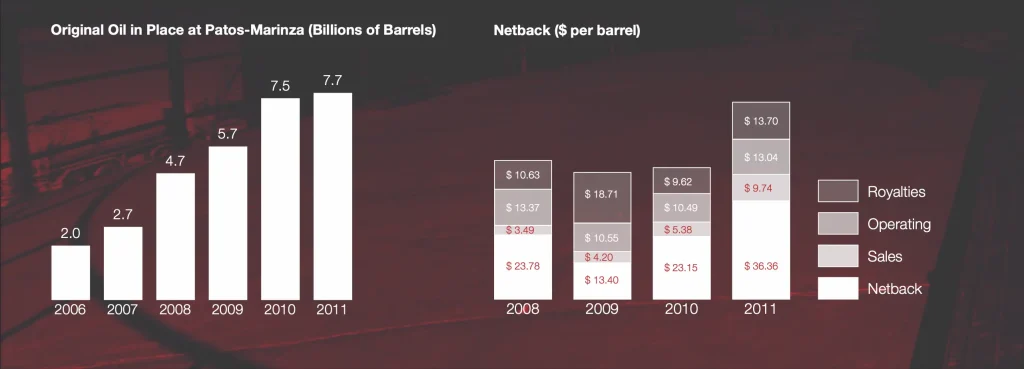
As the company becomes more efficient, netback per barrel (revenues from oil sales, less all costs associated with getting the oil to market) is also increasing significantly.

Continued increases in efficiency will allow Bankers Petroleum to survive during periods of extremely volatile and low Brent prices; and flourish in the coming months as Brent prices rise to an estimated $70 per barrel (as estimated by Bankers Petroleum in 2015 capital budget).

Valuation Summary

Our $4.50 target price for Bankers Petroleum is based on our DCF (discounted cash flow) valuation of $3.98, which uses historical trends, and a $70 per barrel Brent crude price going forwards. These cash flows are then discounted back to present day using a calculated WACC of 10.85%; this is similar to the oil and gas industry standard discount rate of 10%.

In addition to the DCF valuation, we also used a comparable valuation. In the comparable valuation, we compared Bankers with four oil and gas companies with similar market capitalization using three multiples: price to earnings ratio, enterprise value to proven plus probable reserves, and enterprise value to barrels of oil equivalent per day. We found that Bankers was being valued at approximately half of the mean. Were Bankers to trade at the level of its peers, it would imply a $5.50 valuation.

Our target price of $4.50 is the mean of these two valuations ($4.74) rounded down.

Business Description

Bankers Petroleum is a Calgary, Alberta, based oil production company with all extraction operations taking place in south-western Albania.

In Albania, Bankers operates and has the rights to develop the Patos-Marinza heavy oilfield under a contract established in 2004 from Albpetrol: Albania’s state oil company. The contract initially awarded exploration rights, then control of part of the oilfield, and finally, control of the entire oilfield in 2011. The Patos-Marinza oilfield is the largest onshore oilfield in continental Europe, holding approximately 5.1 billion barrels of oil initially in place, and 191 million barrels proven plus probable.

Additionally, through the indirect ownership of all common shares of Sherwood International Petroleum, Bankers holds a 100% interest in the Kuçova oilfield located in Albania, providing it with the right to explore and redevelop the area. Bankers initially acquired 50% of Sherwood’s shares in January 2008, and after an evaluation of the oilfield, acquired the remaining 50%. The Kuçova oilfield has approximately 297 million barrels of oil initially in place and 12 million barrels proven plus probable.

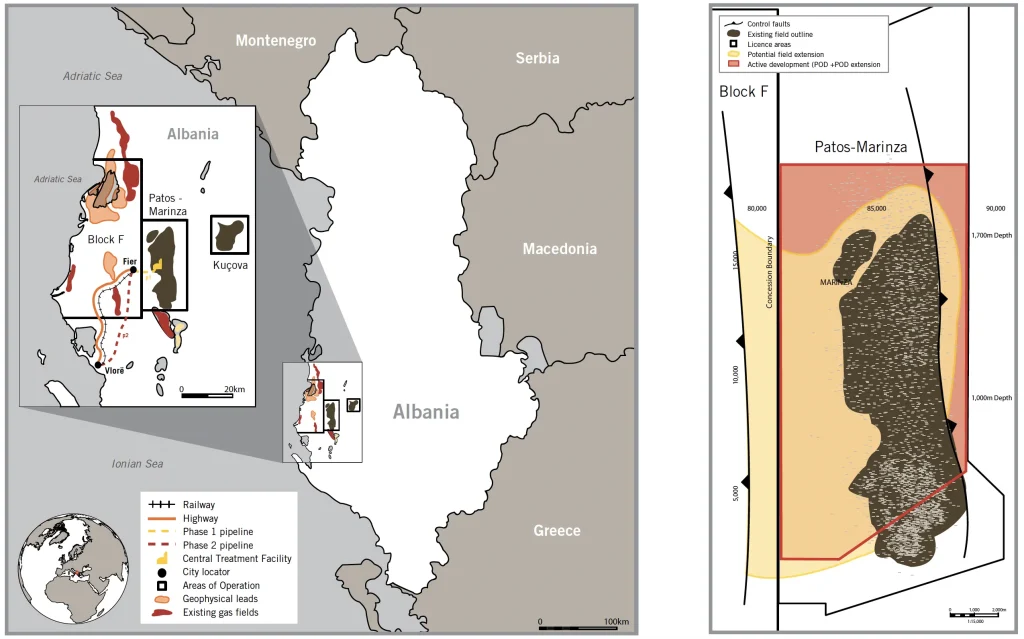
In December 2009, Bankers agreed to a contract with the National Agency of Natural Resources regarding future exploration and development of a 740 square kilometer area located directly west of the Patos-Marinza oilfield known as Block “F”. This area omits three gas fields currently operated by Albpetrol within the boundary of Block “F”.

Bankers Petroleum has significant control over Albania’s oil and gas sector. The company is Albania’s largest oil and gas company, and largest foreign investor. At the end of 2013, Bankers employed 522 people in Albania.

Industry Overview

Albania’s energy industry is relatively small when compared against giants such as Russia, Saudi Arabia, or the United States, but Bankers control of Albania’s market is a highly strategic move that allows Bankers to command lower prices for consumables, and influence infrastructure development in the nation.

According to the U.S. Energy Information Administration, in 2013, Albanian crude production was 17.01 million barrels, and Bankers produced 6.63 million barrels of that total. This represents 39% of the total Albanian crude production; a significant market share that has only been bolstered by the acquisition of Sherwood International Petroleum, and an attempted privatization of Albpetrol by Bankers. This behaviour shows that Bankers is certainly interested in becoming a consolidating force and growing its share of the Albanian crude market.

As Albania is not a member of the European Union, the country sets its own environment and commodity regulations. Currently, regulation is remarkably lenient to encourage foreign investment. However, be advised that this leniency is at risk of Albania joining the European Union and adopting much stricter regulation.

Business History

In June 2004, Bankers acquired an interest in the Patos-Marinza heavy oilfield in Albania.

The Patos-Marinza License and Petroleum Agreements provided 24 months to evaluate the Patos-Marinza field and propose a plan of development to Albpetrol and the Albanian National Agency of Natural Resources.

Bankers completed the evaluation phase of the field in December 2005, and submitted a proposal of development. Albpetrol and the National Agency of Natural Resources approved the proposal of development in March 2006.

These approvals allowed Bankers to take over the existing wells in the field within the development area and sell oil for a period of 25 years with options to extend for further five-year increments, subject to approvals.

Additional proposals were submitted in March 2008, and December 2008 to provide supplementary detail for the infill vertical and horizontal drilling, water and polymer injection, and thermal (steam) programs that were planned. The amendments were approved in December, 2008.

During 2008, Bankers acquired a 100% interest in Sherwood International Petroleum, which holds the rights to the Kuçova oilfield in Albania that has approximately 297 million barrels oil initially in place, and 12 million proven plus probable. Bankers now operates the Kuçova oilfield. The Kuçova Petroleum Agreement became operational in September 2007 and has a 25-year development term after the evaluation phase, with options to extend for further five-year increments.

During 2010, Bankers completed negotiation of the Block “F” Production Sharing Agreement. Block “F” is located nearby the Patos-Marinza oilfield, and covers an area of approximately 740 square kilometers. The area contains several areas defined by natural structural rock anomalies prospective for oil and natural gas.

In March, 2011, Bankers reached an agreement with Albpetrol to take control of all remaining Albpetrol wells in the area that is already controlled, and expand the contract area to include all of the Patos-Marinza oilfield.

In September, 2012, Bankers announced its participation in a proposition for the privatization of Albpetrol. Bankers’ bid was a combination of cash and future programs funding social programs and the remediation of inherited environmental issues.

While the bid was ultimately unsuccessful, the winning bid enhances Bankers oilfields’ valuation and demonstrates Bankers commitment to expand its business activities in Albania.

Patos-Marinza Oilfield History

The Patos-Marinza oilfield is the largest on-shore oil field in Europe, the proven plus probable reserves are approximately 191 million barrels. The oilfield was discovered in 1928, and production by state-run Albpetrol began shortly after, in 1930. Albpetrol was in control of the Patos-Marinza oilfield for the entire period spanning 1928 to 2004, before Bankers took control.

However, the field has not been producing to capacity the entire time. Initially, World War II led to a decline in output. Consequently, the 1948 production was just 1.37 million barrels per year. Maximum production was achieved in 1974 with 17.38 million barrels per year. Production gradually began to decline as instability plagued the country. In 1989, total annual production was 7.9 million barrels per year and in March 1994 it was just 3.75 million.

In 1994, Anglo-Albanian Petroleum Ltd. a joint venture of Albpetrol and Premier Oil Plc. was formed as a new company and operated a small portion of the field with just 20 wells until 2004

Capital Structure

Receivables

At December 31, 2014, total receivables consisted of $81 million. $48 million from Albanian petroleum refineries, $30 million for Albanian VAT, and $3 million for miscellaneous in Canada.

Prepaid Expenses

Of the total deposits and prepaid expenses of $45 million, $35 million was paid to the Albanian court as deposits for procedure purposes on a number of legal cases. The recoverability of these amounts is dependent on the outcome of these cases. As of December 31, 2013, these amounts were considered recoverable. The company expects to collect the full amount of deposits paid to the Albanian court and has classified the full amount as current.

Credit Facilities

Bankers has credit facilities totaling $223 million, of which $99 million was being used at fiscal year 2014 end. The facilities consist of a $20 million operating loan from Raiffeisen Bank, a $3 million environmental term loan, and $200 million in revolving loans, equally funded by the International Finance Corporation and European Bank for Reconstruction and Development.

Bankers approach to managing liquidity is to ensure a balance between capital expenditure requirements and funds generated from operations, available credit facilities and working capital.

Capital Expenditures

Bankers’ capital expenditure budget of $313 million for 2014 was funded by a mix of cash flows, existing credit lines and existing cash. The budget focused on continuing to increase production in Patos-Marinza, with exploration of profitability of Kuçova, and mapping and testing of Block “F” to determine if reserves of oil or natural gas exist.

Major capital outlays included the continued reactivation program of old wells, the acquisition of 6 drilling platforms, and the conversion of 14 existing wells for water and polymer injection.

Bankers typical horizontal well costs approximately $1.2 million (down from $1.3 million in 2012) and produces about 150,000 barrels. With a 50% drop in initial production over the following 12-18 months the company recovers its capital cost of a well on average in about 10 months during which some 28,000 barrels of oil are produced. This leaves the well with an additional 128,000 barrels of reserves to be produced over another ten years with annual declines of 15%.

Additional expenditures include 3D seismic graphing of rock formations in Block “F” and horizontal test wells in Kuçova.

Expanding Margins

As Bankers production continues to grow rapidly, management is seeking methods to reduce costs and increase netback on a low price Brent. This will be achieved through a number of controllable costs, which include diluent costs, in-field transportation costs, cost of energy to operate wells, and well servicing costs.

Diluent costs

Bankers uses diluent extensively throughout the Albanian operations. Beyond the most common use, diluting the thick crude before being brought to market, it is also used to help break out water content at smaller and older well operations, as well as at Bankers central treating facility, and is used to flush out wells clogged with sand and to reduce the viscosity of well contents to lower pump labouring.

The Patos-Marinza oilfield has traditionally produced very thick, viscous oil from the older vertical wells. Before this oil can be brought to market, it must be diluted to become salable. Unfortunately for Bankers, the process of dilution is expensive, and accounted for $7.12 per barrel of oil in 2013.

Bankers is currently making improvements regarding the consumption of diluent, and the cost of diluent. Bankers is experimenting with the ratio of produced oil to diluent for flushing of wells; hoping to find a higher ratio to reduce the amount of diluent required per barrel. Similarly, Bankers is drilling in new zones with horizontal wells that are producing oil with lower viscosity. This is vital to a reduction in quantity of diluent consumed. Finally, Bankers has negotiated a contract with a new chemical supplier at a reduced price.

Future initiatives include optimizing treating chemicals to reduce water content, and continued exploration for lower viscosity oil through the expanded horizontal well drilling program.

Energy Consumption

Diesel generators power the majority of Bankers operations due to remote locations, and lack of local power infrastructure. In the past, all of Bankers single wells and wells on a pad were powered by diesel generators. Energy accounted for $3.13 per barrel in 2013; a significant improvement in the consumption of energy, or an improvement in the cost of the energy will generate in significant savings for Bankers.

Energy costs vary widely depending on the power type for the wells. Single diesel wells currently cost approximately $220 a day to operate, electric wells cost $70, and natural gas wells cost $10. A pilot project has been started with the intention of testing the viability of natural gas and electric wells. The cost to convert from diesel to electric is $15K, and to natural gas costs $20K. Current well drives consist of 61% diesel, 32% natural gas, and 7% electric.

Current pad setups include many diesel generators, with many fuel tanks, and many heaters to keep the fuel liquid in low temperatures. This set-up is not very efficient, and Bankers is improving by consolidating fuel tanks and heaters, and trapping vented combustible gas produced from heating the fuel.

Future initiatives are focused on the expansion of current improvements. Bankers hopes to increase the number of natural gas, and electric wells. In addition, Bankers hopes to have their operational field electrified to further reduce costs.

Finally, Bankers is exploring the option of capturing gas from produced oil to power the field. This gas is expected to power 70 wells at current output.

Well Servicing

Servicing of Bankers large inventory of numerous types of wells is a costly operation. Servicing accounted for $4.11 per barrel in 2013. In the past, Bankers pumps were a “one size fits all” design that was a high efficiency, tight running pump that coped poorly with the heavy Albanian crude. Generic repair programs were implemented, and production lost as a result was minimal.

Currently, Bankers is running a low efficiency pump that handles the thick crude much better. Future initiatives include fitting a specialized pump to each well to further improve longevity and efficiency. Additionally, Bankers is developing optimizing the metallurgy of its rods and tubing as well as implementing a chemical coating program to reduce corrosion.

In-Field Transportation

As Bankers continues to scale from a small operation with a handful of single wells, to a large operation with hundreds of wells and a half-a-dozen pads, transportation of oil, water, diesel and other commodities within the field is an important infrastructure to keep scaled and efficient. In-field transportation accounted for $2.41 per barrel in 2013.

Previously, single wells required trucking of oil, water, diesel and emulsion to and from individual wells to treating facilities.

Now, Bankers is focusing on pad site optimization. A portion of the field has been tied in with flow lines (small pipelines). Focus is currently on development surrounding high volume routes near major treating facilities and on setting up a header system as multi-well pads to allow easy connection to the flow line system. Finally, despite a desire to move away from trucking, it still exists in some extent. The current goal is to optimize in-field trucking system within the field to reduce number of truck movements.

Future initiatives consist of a single goal: significant expansion of the flow line system between well pads and treating facilities.

During the period from 2005 – 2014 netback increased from $6.44, to $45.36. Over the same period, barrels of oil per day output increased from 1,668 to 20,630 (as is shown below). However, we can see that these increases have a positive correlation with average Brent prices and average realized Brent prices.

During this period we see average Brent prices rose from $55.19, to $98.95 and average realized price rises from $22.52, to $77.26. This suggests that Bankers has spent much of its capital expenditures improving the quality of oil it brings to market, which increases the average realized price. It also suggests that Bankers has not done much to significantly reduce costs, as the rise in netback is mostly associated with the rise in realized Brent price.

Going forwards we can expect to see a large effort for reductions in cost of bringing the oil to market as the company contends with low Brent prices to maintain a reasonable netback.

WestPeak-Research-Association_origin

Revenue Model

Bankers revenue is directly associated with Brent crude prices, production levels, and costs. Bankers significantly increased its oil revenue and net income in 2013. This was primarily achieved due to continued success in the horizontal drilling program. Note this was less significant in 2014 to due lower Brent prices.

 bankers graph2

In 2014 revenue from oil and gas sales was $583 million which was an increase of 3% on 2013. In 2013, revenue from oil and gas sales increased by 31% to $566 million, up from $432 million in 2012.

Part of this revenue increase in 2013 can be attributed to an increase in the average realized price of Bankers’ oil, which climbed to 79% of average Brent, up from 71% of average Brent in 2012 because of Bankers’ new focus on higher quality, lower viscosity oil. In addition, Banker’s has continued to increase production, with 2014 production of 20,690 boe/day, compared to 18,169 boe/day, and 15,020 boe/day in 2013 and 2012, respectively. This represents production growth of over 20% year over year.

During Bankers early years, focus was on increasing growth and quality of oil being extracted. Going forwards, we expect to see a continued focus on increasing growth and quality, with an additional focus on decreasing costs due to a lower Brent price.

Brent Crude Pricing

Bankers preference for Brent crude stems from the fact that it is a better indicator of global oil prices. Brent crude draws its oil from more than a dozen oil fields located in the North Sea. Although most Brent is destined for European markets, it is used as a price benchmark for other grades.

Bankers has forecasted Brent oil prices to average $70 per barrel in 2015. We see this as a valid price and have incorporated it into our predictions.

Bankers is currently commanding an average price per barrel that represents approximately 78% of Brent oil price, due to the heavy nature of the oil. During 2014 Bankers achieved a netback of $45.36, with costs of $31.90 on a $98.95 Brent. This shows that even at $70 per barrel, netback will be $22.70: a positive net income.

Royalty Structure

The terms of the Petroleum Agreement include a 1% gross overriding royalty payable to Albpetrol which increases to 3% (based on an incremental sliding scale) after payout of funds by Bankers.

In addition, Bankers pays a royalty to Albpetrol for the share of pre-existing or base production from the Albpetrol wells taken over by Bankers. This royalty is calculated on a per well basis using 70% of the average production for the preceding six months declining at 15% per year. For the original 28 oil wells taken-over in July 2004, a fixed pre-existing production rate was applied and is declined at 10% per year; 20 of the 28 wells have no pre-existing production liability as they were newly drilled wells by the previous operator, Anglo-Albanian Petroleum.

In 2008, a new royalty tax of 10% was implemented on sales volumes payable directly to the Government of Albania. The tax is applied to gross sales amounts net of pre-existing production royalties in a fashion similar to the share of production royalty payable to Albpetrol.

Overall royalties for the 2013 fiscal year represented 17% of oil revenue, down from 18% the year before; Bankers expects this to continue decreasing to 14% over the next 5 years as pre-existing well production drops.

NI51-101 Summary

bankers data


Patos-Marinza

The proven and probable undeveloped reserves are being put on stream by a program of 203 attempted vertical well reactivations, with an average success rate of 65%, resulting in 132 successful reactivations.

The success rate for any given reactivation attempt is uncertain, therefore has been treated probabilistically. Historically, the average success rate is estimated at 65%, which is carried forward in future well reactivation development forecasts.

In addition to vertical reactivations, the program consists of 995 horizontal wells. For the first four years, this program includes successful vertical well reactivations numbering 11 in 2014, 14 in 2015, 16 in 2016 and 17 in 2017. The horizontal well program is comprised of 139 wells in 2014, 143 wells in 2015, 155 wells in 2016 and 160 wells in 2017 (see graph below).

The development programs are scheduled to maximize and maintain the capacity of production facilities for as long as is feasible.

 bankers fical year


Kuçova

The Kuçova oilfield was discovered in 1928 and was developed with the drilling of 1,722 wells in 5 major crude oil pools (Kozare, Gege, Ferme, Arreza, and Kucova Sector 1). As of the end of fiscal year 2013, approximately 357 wells were producing on primary production at approximately 170 barrels of oil per day from the four main pools that Sherwood is planning development on (Kozare, Gege, Ferme, and Arreza).

The proven plus probable reserves are currently estimated at 12 million barrels of oil. The future redevelopment forecast for the field involves the implementation of secondary recovery schemes (water flooding) to improve recovery. All future reserves recovery assigned to Bankers, proven undeveloped and probable, is based upon the successful implementation of the secondary recovery projects. Production forecasts are based on performance of similar type reservoirs under secondary recovery processes located in Western Canada. Initial fieldwork was commenced in 2011 and production was commenced in 2012.

Investment Risk

Operations in Albania

Currently, nearly all activities are conducted in, and all assets are located in south-western Albania. This represents some risk, as Albania transitioned from a communist regime to a modern economy in 1992. While the change has brought economic stability to the country, significant challenges still exist.

Nationalization is often a major risk facing investors in many emerging markets. However, in over two decades since breaking the communist regime it appears the nationalization risk in Albania is low. In fact, the previously state-owned Albpetrol was recently privatized in a sale that Bankers placed a bid on. As Albania’s modern economy continues to develop, we can expect any nationalization risk to continue to drop.

Nevertheless, there is no guarantee that Albania’s government won’t implement different policies in regards to development and ownership of petroleum resources by foreign companies. Any changes could negatively affect both the ability to undertake exploration and development of future properties, and the ability to continue to extract resources from current properties.

The government of Albania encourages direct financial investment to aid the country’s economic development. However, it provides little incentive to encourage this much-needed investment, and Albania’s energy and transportation infrastructure is continuing to deteriorate as a result.

Bankers Petroleum is Albania’s largest oil producer and foreign investor. Albania has treated resource extraction companies well over the past two decades, especially Bankers, and we expect this trend to continue as Albania continues to develop and as Bankers continues to grow.

Volatility in Oil Prices

As with any petroleum company, profitability is directly linked to the price and demand for oil. The sales of oil will be affected by numerous factors beyond Bankers’ control, including general demand for crude oil by the refineries in the Mediterranean region. In addition, prices for petroleum products are affected by numerous factors beyond control including international economic and political conditions, weather, levels of supply and demand, pipeline capacity, and currency exchange rates.

Bankers has confidently predicted a $70 per barrel Brent for 2015 and we feel this is a valid prediction. However, significant movements in the price of oil could render any of the exploration and production activities unprofitable. Costs were last reported at $32.77 per barrel in Q3; therefore, the company will continue to have a positive net profit for any price Brent higher than $32.77.

However, this does not represent a positive cash flow, as the company has and will continue to have significant capital expenditures. Capital expenditures were $234 million for 2013, which resulted in a negative change in cash of $9.1 million.

If we see a lower Brent price than predicted, Bankers will see significant losses and share price will fall, which could render this valuation invalid.

Environmental Risk

Environmental laws and regulations affect all of the operations in located in Albania. These laws and regulations set standards regarding certain aspects of health and environmental quality, and establish obligations to remediate current and former facilities.

Bankers could face significant penalties for discharges into the environment or environmental damage caused by non-compliance. These penalties could have adverse effects on the financial condition of the company.

Additionally, Albania’s aspiration to join the EU may result in the adoption and enforcement of tighter environmental laws and regulations. In October 2012, the European Commission recommended that Albania be granted EU candidate status, subject to key changes in political stability, economic stability, integration and the ability to assume the obligations of a member state.

Loss of right to Oilfields

In 2011, Albania voided an agreement for exploring oil and gas with Sky Petroleum. The license affected would have given the Texas company exclusive rights to three exploration blocks totaling approximately 5,000 square km. In May 2013, the International Court of Arbitration rejected all claims by Sky Petroleum and ordered them to pay Albania 383,000 Euros to cover expenses.

Bankers right to extract oil from the Patos-Marinza field is administered by the Patos-Marinza Licence Agreement, the right to redevelop the Kuçova heavy oilfield is administered by the Kuçova Petroleum Agreement, and the right to explore Block “F” is administered by the Block “F” exploration contract.

If Bankers is unable to finance capital expenditures and it is unable to obtain the agreement to a reduction in such expenditures in its annual plan, Bankers could be forced to relinquish some or all of its oilfield areas.

Should a dispute arise, there is no assurance that it would be resolved in a manner acceptable to Bankers, and if a decision were made that would reduce the rate at which Bankers is able to develop the field or increase production, or that would require a reduction in production from the field, it will have adverse effects on the earning potential of Bankers.

Investment Summary

Bankers Petroleum represents a lucrative opportunity for investors to participate in the turnaround of a once defunct oilfield by a small, Alberta based underdog in the petroleum business.

Production has improved significantly over the past year, and is set to increase going forward with new wells about to go on line. This will be coupled with a rise in netback due to significant reductions in cost being currently being put on line. As these changes continue to take place and as Brent begins to rise in the coming months, the market is likely to take notice of the company it brushed off. Bankers is thriving, and continues to meet or exceed expectations.

Keen investors will long the stock now, as shares are undervalued. Bankers is easily worth $4.50 per share as per our valuations.

Discounted Cash Flow Analysis

WACC

For the DCF analysis we calculated the weighted average cost of capital, rather than using the oil and gas industry standard of 10%.

The cost of debt was found by taking a weighted average of the yield to maturity rate on current debt. We then calculated the after-tax cost of debt using the historical tax rates which Bankers has experienced. This resulted in an after-tax cost of debt of 4.3%.

The cost of equity was found next. The risk free rate is the yield on a five year United States Treasury bond (1.63%). Next, the risk premium was found to be5.32% on Aswath Damodaran’s website. Finally, the Beta of Bankers was taken directly from Google finance (2.71). This results in a cost of equity of (.16).

Finally the WACC was calculated using the fully diluted number of shares (256,440,664), and was found to be 10.85%, which is strikingly similar to the industry standard of 10%.

WACC Calculation from DCF model

Figure 1: WACC Calculation from DCF model


DCF Assumptions

The most vital part of any discounted cash flow valuation is the integrity of the assumptions of growth and costs. We believe these assumptions to be as reasonable as possible given current price volatility of Brent, the previous performance of the company, the age of the company, and any indications of future growth and costs as given by the company.

Revenue

Revenue for Bankers Petroleum is based on two variables; the price of Brent, and the quantity of Brent that Bankers can extract and sell. Going forwards, Bankers has estimated the price of Brent to average $70 per barrel; we have used this estimate for 2015 through to perpetuity.

Bankers Petroleum has provided no future predictions for production, so we have estimated production based on number of vertical and horizontal wells being drilled and put on line and aging of wells. Production growth is expected to peak over 2015 and 2016, and growth will slow thereafter as all reserves are employed using the most efficient methods. This will allow Bankers growth to follow a natural bell curve shape due increases in efficiency and then finally an increased marginal cost and effort required to extract oil as the wells and reserves start to reach capacity.

Our next prediction is average realized prices. Bankers wells have traditionally produced very heavy, viscous oil that traded at a reduced cost from true Brent prices. As Bankers continues to transition more of their wells to horizontal wells, they expect viscosity to drop and quality to rise. From this, we can infer a gradual climb to higher quality oil. This is slowed from historical growth in marginal realized prices, as this reflects a strengthened effort to reduce costs rather than rapidly increase oil quality.

Costs

Our assumptions regarding cost are mainly derived from previous performance and a stated effort to further reduce costs rather than focusing on oil quality.

Cost of revenue (as a percent of revenue) since Bankers inception has been decreasing at a decreasing rate due to increasing economies of scale, and we can expect this continue over the years forecasted. In perpetuity this will reach a constant value as maximum economies of scale are realized.

Selling, general and administrative expenses have been relatively consistent as a percent of revenue for Bankers, with only a slight decline over the past four years. We can expect this trend to continue as Bankers growth continues; as all systems, offices, staff, and other miscellaneous items are already in place and will require little upgrading as oil production is increased.

Depreciation and amortization as a percent of revenue has been relatively consistent over the life of the company, and we expect this trend to continue as old equipment is phased out. There is no suggestion that this will change.

Capital expenditure as a percent of revenue is in slow decline as reserves begin to reach full capacity with the maximum number of wells active. The 2015 budget shows a relatively small $153 million dollar capital expenditure commitment, which reflects the recent drop in oil prices. However, Bankers still expects oil production to stay relatively close to 2014 levels, as new wells are put online and hydraulic fracturing programs are put online.

Next, we expect taxes to stay constant at previous rates given that Albania remains excluded from the European Union.

Finally, we expect the increase in working capital as a percent of revenue to drop slightly as production climbs as it has consistently been over the past few years.

Growth Rate in Perpetuity

We expect the company to grow at the rate of GDP growth into perpetuity. We understand that this is unreasonable after a certain number of years given the nature of oil reserves depleting over time, but this estimate is valid for upwards of twenty years given Bankers’ estimate of a 27 year proven plus probable reserve life. The average GDP growth of Albania for the 10 years from 2004 through 2013 is 4.24%.

Conclusion

Using the above assumptions, our DCF returned a valuation of $3.98. We feel this forecast is conservative and takes current market volatility properly into consideration. See the figures below for the full DCF model.

Figure 2: Assumption table from DCF model

Figure 2: Assumption table from DCF model

Figure 3 DCF Model Bankers Petroleum

Figure 3: DCF Model


Comparable Analysis

Comparing Bankers Petroleum against four similar companies using three metrics results in a $5.50 dollar valuation. The companies selected were TORC Oil and Gas, Bellatrix Exploration Ltd., Parex Resources Inc., and Gran Tierra Energy Inc. These companies were compared against Bankers using the price to earnings ratio, enterprise value to proven plus probable reserves, and enterprise value to barrels of oil equivalent per day. These metrics were selected due to their commonplace use in oil and gas valuations.

Comparable Companies

Bankers Petroleum produces 39% of Albania’s petroleum, the remainder is produced by a handful of publicly traded exploration firms and a handful private firms. This leaves no comparably sized oil and gas production companies in Albania to compare valuations with. Therefore, publicly traded companies had to be found around the world to compare against.

TORC Oil and Gas

TORC Oil & Gas Ltd. produces crude oil and natural gas in Western Canada. The company was founded in 2010 and is growing production and reserves rapidly. The company was selected due to a similar market capitalization and growth that mimics Bankers in the early years. The reserves reflect the size of Bankers’ during the same period of growth.

Bellatrix Exploration Ltd.

Bellatrix Exploration Ltd. is engaged in the production of oil and natural gas reserves in Canada. It focuses on developing light oil and liquids-rich natural gas on its two development properties. The company was founded in 2000. Bellatrix was selected based on a similar market capitalization, similar daily production, and similar reserve sizes.

Parex Resources Inc.

Parex Resources Inc. is engaged in the production of oil and natural gas in South America and the Caribbean region. It holds interests in onshore exploration and production blocks. Parex Resources Inc. was incorporated in 2009. The company was selected due to a similar market capitalization, similar political environment, and similar daily production.

Gran Tierra Energy Inc.

Gran Tierra Energy Inc., an independent energy company, is engaged in the production of oil and gas properties in Colombia, Peru, and Brazil. The company has 17 exploration and production contracts in Colombia, 5 exploration licenses in Peru, and 7 exploration blocks in Brazil. The company was incorporated in 2003. The company was selected due to a similar market capitalization, similar political environment, and similar daily production.

Figure 4: Comparables Valuation

Figure 4: Comparables Valuation

Editor’s Note: This article discusses one or more securities that do not trade on a major U.S. exchange. Please be aware of the risks associated with these stocks.