by in News

Alteo’s Chikán: Aggregators have AI solutions for grid stability, production optimization (video)

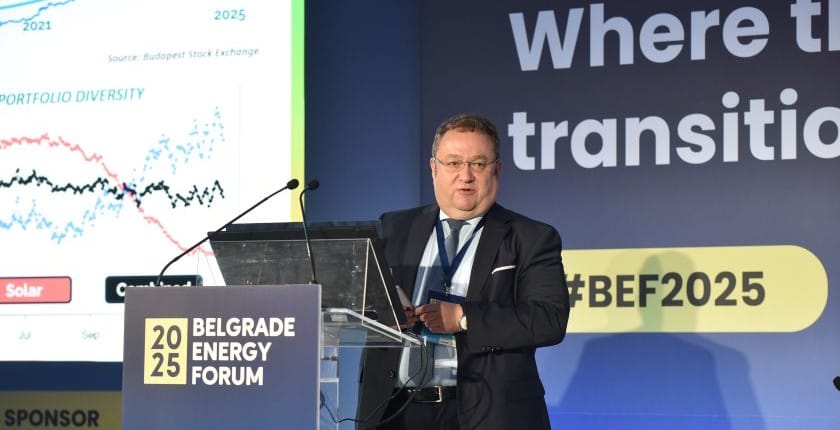
Factors like power price volatility, the global shift in policy making and the need for flexible solutions for the integration of renewables are creating an important momentum for developers and aggregators, Chief Executive Officer of Alteo, Attila Chikán, said at Belgrade Energy Forum 2025. The company is expanding in Central and Southeastern Europe with investments in power plants and its AI-backed platform for operating third-party assets.

The electricity system needs to become more and more flexible to accommodate weather-dependent, intermittent sources – solar, wind and hydropower, Alteo’s CEO and Chairman of the Board Attila Chikán said and pointed out that the outage in Spain and Portugal on April 28 highlighted the need for investing in grid stability and upgrades.

In his keynote speech at Belgrade Energy Forum (BEF 2025), he stressed that a global shift in policy making in the sector, particularly in the United States and Europe, is bringing both challenges and opportunities. In Chikán’s view, the situation creates an important momentum for developers and aggregators.

[wpcc-iframe title=”Belgrade Energy Forum 2025 – Attila Chikan Jr., CEO and President of the Board, ALTEO Plc” width=”500″ height=”281″ src=”https://www.youtube.com/embed/FZCrhx8yh6E?feature=oembed” frameborder=”0″ allow=”accelerometer; autoplay; clipboard-write; encrypted-media; gyroscope; picture-in-picture; web-share” referrerpolicy=”strict-origin-when-cross-origin” allowfullscreen=””]

“In the past five years we have seen a great deal of price volatility on the markets in the region. If you look into the future, taking into account the impact of the ambitious plans of regional countries to expand renewable power, one might expect even more pressure on balancing price volatility,” he asserted.

Role of international initiatives

Alteo’s CEO said tailored incentive mechanisms are essential for developing a balanced energy mix. There are also major endeavors on an international scale, Chikán added: connecting markets with diverse geographical characteristics, power plant portfolios and different supply-demand balances.

He explained that cross-border initiatives such as PICASSO and the Blue Sky project bring electricity exchanges in the region closer together. Interconnectors like the Pannonian Corridor and the proposed Black Sea green cable contribute to balancing and the management of energy price volatility, Chikán noted.

Future-proof tech solutions required for risk mitigation

In risk mitigation, the energy system’s stability benefits from future-proof technological solutions as well, namely smart metering, advanced weather forecasting and artificial intelligence–based production optimization, he said. This is where aggregator companies like Alteo come into the picture, its chief underscored.

As for its hardware, the company based in Budapest operates a diverse and balanced production portfolio of gas power plants and renewables, combined with storage, Chikán added.

Alteo runs a portfolio of gas power plants, renewables and storage facilities

“Sounds good, but without a well-designed and functional software, any hardware is purely a collection of materials. And even if they do operate, for sure they operate in a suboptimal way, without synchronization,” he stated.

That’s why Alteo developed its own production management platform, which it offers as a software-as-a-service (SaaS) solution as well. The company also supports the operation of 2 GW in third-party capacity, mostly photovoltaics.

“We optimize production in an automated way, using artificial intelligence, integrating real-time weather forecast data, capacity data and market data,” Chikán stressed.

The platform includes executing trading activities. The partners don’t have to deal with scheduling and the balancing energy costs, he said. The company makes a renewable electricity product closer to baseload, Alteo’s head asserted.

Slovakia, Croatia, Serbia are primary investment destinations in Alteo’s regional expansion

Early this year, the company unveiled a strategy for expansion in Hungary as well as into Slovakia, Croatia and Serbia as primary investment destinations. Alteo revealed it is interested in Poland, Czechia, Slovenia, Bosnia and Herzegovina, Montenegro and North Macedonia, too.

Chikán said it also aims to position itself in operations and maintenance (O&M), among other segments. Alteo is particularly seeking stable and reliable AI-based aggregator partnerships, he noted. The company has an investment target of up to EUR 3.5 billion by the end of the decade.
by in News

Negative prices threaten future payments to Greek renewable energy producers

Greece’s special account for renewables, which covers support payments to renewable energy producers, turned positive again in 2024 after years of instability.

The account is currently manageable, according to data from the Renewable Energy Sources Operator & Guarantees of Origin (DAPEEP). The update is bringing certainty to the market and reassures investors that their power plants won’t come up short.

For the end of 2025, initial projections show a deficit of EUR 173 million, which would be covered by a EUR 70 million reserve and proceeds from the taxation of diesel sales.

Lower wholesale prices reduce income

However, DAPEEP’s leadership is concerned about the future balance. The reason is the effect of zero or negative wholesale power prices as they are becoming more common than before.

In the trading session for May 1 on the day-ahead market of the Hellenic Energy Exchange (HEnEx), a record low hourly price was registered, EUR 50 per MWh below zero. The event occurred amid high solar production in combination with low demand on a holiday, and similar conditions in neighboring markets. The authorities are expected to allow the formation of negative prices in the balancing market, starting in June. It is expected to lead to more common zero and negative prices.

Low market prices harm the special renewables account, according to DAPEEP’s new CEO Dimosthenis Voivontas. Consumers benefit in such situations but they reduce income for the operator.

So far, the exact effect of negative prices remains to be seen, as there is limited data to analyze. Nevertheless, energy storage must be brought online quickly, together with demand response capabilities, says Viovontas.

Producers switch off to avoid negative prices

Negative hourly prices have led producers to switch off their renewable energy plants lately in order to avoid a financial loss. It is making it more difficult for the Independent Power Transmission Operator (IPTO or ADMIE) to conduct daily scheduling. The authorities are worried that a sudden disconnection of large capacities could result in instability, in light of the recent blackout in Spain and Portugal.

The focus is on aggregators, which represent groups of renewable electricity facilities in the market. Currently they lack the means to completely control their production in real time. Discussions are underway about a mutually acceptable solution.

by in News

CWP Europe signs PPA, CfD for its Solarina PV project with Serbia’s EPS

CWP Europe signed a power purchase agreement (PPA), including balancing responsibility, and a contract for difference (CfD) for its Solarina photovoltaic project, with Serbia’s state-owned power utility Elektroprivreda Srbije (EPS).

Solarina is a special purpose vehicle or SPV for a photovoltaic park of 150 MW in connection capacity. Its site is near the city of Zaječar in eastern Serbia. The developer, CWP Europe, won a CfD in February for 105 MW at the country’s second solar power auction. All other projects were for 10 MW at most.

Executive Vice President of CWP Europe Maja Turković signed a PPA and the contracts for difference and balancing responsibility for Solarina with Assistant to CEO of EPS for Power Portfolio Management David Žarković.

Largest single PPA ever signed for solar power with EPS

The agreement marks a major milestone in Serbia’s energy transition – it is the largest single PPA ever signed for a solar project with EPS, Turković pointed out. “We thank the Ministry of Mining and Energy and EPS for their trust and another opportunity to jointly contribute to a more stable and greener energy future for Serbia,” she added.

CWP Europe has a project pipeline of more than 10 GW in Southeastern Europe, Moldova and Ukraine

All green electricity generated by the Solarina solar park will be supplied to the domestic market at a competitive price, enhancing the stability and sustainability of the country’s energy supply, CWP Europe added. Of note, the CfD is for EUR 52.89 per MWh.

“The continuation of the cooperation confirms once more that EPS is a reliable partner and associate to everyone whose business activity involves green energy. In addition, this way we also confirm the joint dedication to Serbia’s energy transition and the development of renewable energy sources, as EPS will offtake all produced energy and it will remain in our country,” Žarković stated.

PPAs for projects Solarina, Vetrozelena are both for entire output

Serbia’s state-owned power utility has the same arrangement since 2023 for the Vetrozelena wind power project, which was developed by CWP Europe and also won market premiums, at the first round of renewable energy auctions. Both PPAs are for the entire output.

The company has a project portfolio of more than 10 GW in total for wind and solar power and battery energy storage systems in Serbia, Bulgaria, Romania, Montenegro, Albania, North Macedonia, Croatia, Moldova and Ukraine.

CWP is a silver sponsor of the two-day Belgrade Energy Forum – BEF 2025, which is starting tomorrow. Maja Turković will participate in the panel discussion ‘Energy revolution underway – uniting efforts to deliver green, intelligent and sustainable energy solutions’.

by in News

Serbia’s EPS signs PPAs for wind parks Alibunar 1, Alibunar 2

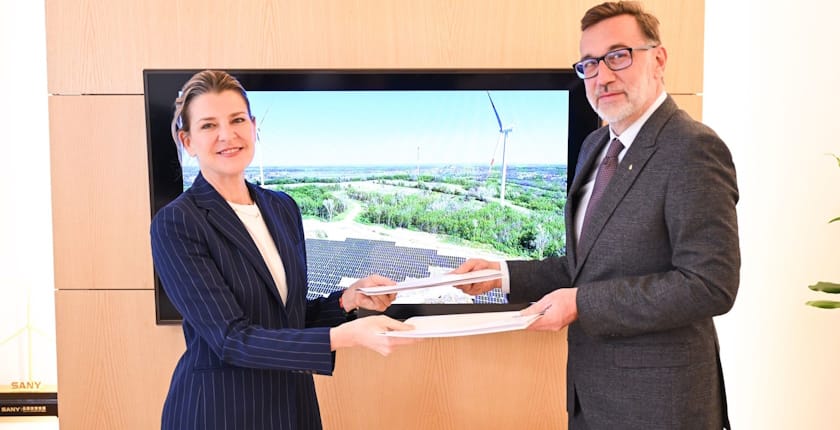
Serbian state-owned power utility Elektroprivreda Srbije will offtake electricity from future wind parks Alibunar 1 and Alibunar 2, of 168 MW in combined capacity. EPS’s Chief Executive Officer Dušan Živković and Project Director of WV-International in Serbia Lazar Lazendić signed today the power purchase agreements (PPAs) and the contracts for difference (CfD) and balancing responsibility.

Wind power projects Alibunar 1 (96.6 MW) and Alibunar 2 (71.4 MW) are among the winners from the latest round of auctions for market premiums for renewable energy in Serbia.

CEO of state-owned power utility Elektroprivreda Srbije (EPS) Dušan Živković signed the power purchase agreements (PPAs) and the contracts for difference (CfD) and balancing responsibility for the two planned facilities with Project Director of WV-International in Serbia Lazar Lazendić.

“EPS is committed to investing in the construction of power plants running on renewable sources, and this way we are strengthening our production portfolio and market position, and we actively support all investors in renewable energy sources. EPS will offtake all the generated electricity, the energy remains in Serbia, and the purchase and balancing price is set according to market principles, which incentivizes investors and enables additional profit for EPS. This energy will also give a substantial, additional security to the operations of our electricity system and to supplying citizens and companies,” Živković asserted.

Commitment to domestic market solidified

At the signing ceremony, Lazar Lazendić pointed out that the said success in auctions represents the materialization of important objectives in the development of the projects Alibunar 1 and Alibunar 2.

“Today’s signing of the contract with Elektroprivreda Srbije, encompassing market premiums, the purchase of electricity, and balance responsibility for our future wind farms solidifies our strong commitment to this market and plays a crucial role in driving Serbia’s energy transition forward,” he added.

Alibunar 1 and Alibunar 2 are SANY Renewable Energy’s first investment in Serbia

The special purpose vehicles, SPVs, or project firms for the two facilities are called Windvision Windfarm A and Windvision Windfarm B, respectively. They are majority owned by SANY Renewable Energy.

“The Alibunar 1 and Alibunar 2 wind farm projects are crucial for our company. SANY Renewable Energy is entering the Serbian market and the Western Balkans region through these projects. This will be the first installation of our wind turbines in these wind farms, serving as a model for our future expansion. We are eager to collaborate with local stakeholders and partners to enhance the country’s energy security,” said Zhou Fugui, Chairman of SANY Renewable Energy and member of the Board and Executive President of SANY Group.

WV-International is the gold sponsor of the Belgrade Energy Forum – BEF 2025, which will be held on May 14 and 15 in Serbia’s capital city, and SANY Renewable Energy is an exhibitor.

Živković: EPS obtained additional 2.6 GW from renewable sources

Živković also said that in the two rounds of auctions facilitated 850 MW of wind and solar power capacity and that, with investors that participated in the two rounds of auctions and other independent producers in Serbia, it already has an additional 2.6 GW from renewable energy sources.

The level will increase by 1 GW in 2028 from the self-balancing solar power plants that the company is developing with its strategic partner, the consortium of UGT Renewables and Hyundai Engineering, he added. “That’s when we expect the production from renewable energy sources to reach 50% of the total electricity production,” the head of EPS underscored.

by in News

Investors in BiH developing 3,800 MW of wind, 12,500 MW of solar

Wind farms with a capacity of 3,800 MW and solar power plants with a capacity of 12,500 MW are currently in various stages of development in Bosnia and Herzegovina, according to the indicative plan for the development of production  2026-2035, published by the Independent System Operator in Bosnia and Herzegovina.

The goal of the ten-year plan is to provide information on projects initiated for the construction of new production capacities to be connected to the transmission system, according to the transmission system operator (TSO), Independent System Operator in Bosnia and Herzegovina (NOSBiH).

The plan is supposed to prioritize covering domestic consumption and capacity needs with domestic resources.

NOSBiH said investors continued in 2024 to apply with their renewable energy projects. The interest in grid connections wasn’t affected by the significant reduction in electricity purchase prices, especially for the hours when solar power plants typically produce, it added in the plan

A lack of transmission capacities could become an obstacle to the export of electricity

According to the register of the applications for grid connections, which Elektroprenos BiH manages, there are about 3,800 MW of proposed wind farms and 12,500 MW of photovoltaic facilities in various stages of development, NOSBiH underlined.

Results of an adequacy assessment showed that increasing production makes it possible to increase exports. BiH’s TSO warned that in such a scenario, the currently planned transmission capacity expansion wouldn’t be sufficient.

Another 100 MW of solar is seen coming online in BiH by the end of 2025

With the current production development plans, the system could be left without sufficient balancing capacities. NOSBiH therefore called for developing balancing capacities in parallel.

The document shows that four solar power plants of 206 MW in total were added last year to the transmission network in BiH: FNE Zvizdan (28.5 MW), SE Bileća (55 MW), FNE Hodovo (92.47 MW), and FNE Deling invest 1 (29.75 MW), together with one wind farm, VE Ivovik, of 84 MW. In February of this year, the Ivan Sedlo wind farm (25 MW) was also put online.

By the end of 2025, the start of trial operation of another five PV plants is expected, the plan showed. They would have 100 MW altogether: FNE Hodovo F1-F4 (11.96 MW), FNE Brotnjo (9.98 MW), FNE Polog 1-8 (7.99 MW), FNE Plavo Sunce 1-2 (40 MW) and FNE Livno 1-6 (27.6 MW).

Batteries can bridge the period until the transmission grid capacity becomes adequate

The plan anticipates a similar tempo of grid connections for 2026, too.

In that case, along with the integration of renewables into the distribution network and similar power plants coming online in neighboring countries, a congestion can appear in the transmission network, together with complications in operating the country’s transmission system from a regulatory point of view, NOSBiH said.

Battery energy storage systems can solve both potential issues in the medium term, until investments get the transmission grid to an adequate level, it suggested.

BiH needs battery capability of 225 MW and 450 MWh in total capacity

The company recalled that a year ago it produced a study, together with the Deutsche Gesellschaft für Internationale Zusammenarbeit (GIZ), provisionally called Operational Models for Battery Energy Storage Systems in the Balancing Market of NOS BiH.

They estimated the need for additional balancing based on hour-by-hour production profiles for facilities of 1,500 MW in total photovoltaic capacity and 1,000 MW of wind. The authors said a combined 225 MW in battery operating power is required and an overall capacity of 450 MWh.

The study also explored revenue generation opportunities for BESS, particularly through participation in the ancillary services market.

by in News

Episodes of negative power prices in Slovenia, Romania spread to workdays

Romania registered the first negative day-ahead electricity price for a workday. The phenomenon, which only used to occur on holidays and weekends, has emerged in Slovenia as well.

In spring and autumn, most of Europe occasionally faces periods of excessive power grid loads. The rapid rise in solar and wind power production and the lack of accompanying energy storage and flexibility capabilities are straining the system at times when demand is low. Advanced electricity markets countered the issue by introducing negative prices.

When prices hit zero or go below zero, the seller delivers electricity without compensation or even has to pay to the buyer, respectively. The phenomenon was normally reserved for holidays and weekends, but more day-ahead markets are now experiencing it for workdays as well.

Downward pressure in Romania from strong inflow of negatively priced electricity via Hungary

Romania saw its first such episode yesterday, on Sunday, in the session for today, Profit.ro reported. Prices in its day-ahead market are negative in five out of 24 periods of one hour, between 11:00 and 16:00.

The country is importing at almost 2 GW via Hungary and exporting at up to 1.5 GW to Bulgaria, the news website added. The article notes that renewable energy producers, especially in Germany, where prices are also negative, are exporting to other markets to ease the impact. They usually benefit from subsidies, so generating electricity isn’t necessarily unprofitable even when they sell at a loss.

In addition, shutting down and restarting power plants can be more costly than paying the other side to take excess output.

The level in Romania went to as low as EUR 6.18 per MWh below zero. But the daily average is EUR 76.54 per MWh. The peak, is EUR 198.16 per MWh, between 20:00 and 21:00, when there is no sunlight and prosumers only consume.

Negative prices turn Slovenia’s HSE into electricity consumer

Prices in Slovenia for today also came in negative between 11:00 and 16:oo, which is very rare for a workday, Naš stik reported. Among other factors, the two-day May 1 holiday shortens the current workweek. The lowest, between 14:00 and 15:00, is EUR 6.18 euros per MWh below zero.

In comparison, the lowest price for Sunday on the BSP Southpool exchange was EUR 104 per MWh under zero.

At one point during the Easter holiday, virtually all HSE’s production capacities were offline and the Avče pumped storage hydropower plant was storing electricity from the grid

“Last year, we had 219 hours in Slovenia when prices were negative. This year, we are already at number 72, and we have only just entered the critical period,” said Deputy Director of System Operations of ELES Aleš Donko. The company is Slovenia’s transmission and distribution system operator.

State-owned power utility Holding Slovenske elektrarne (HSE) found itself in an unusual situation during the Easter holidays because of negative prices.

“For a while, we were actually an energy consumer, not a producer, which is our core mission… Virtually all our power plants were shut down, and the Avče pumped storage hydropower plant was pumping water into the upper reservoir at full capacity,” Head of Operation Planning and Management Jernej Brglez said.

Portugal and Spain, which suffered major outages today together with France, both registered negative prices every day in the third week of April.

Also of note, Greece is preparing to introduce negative prices in the balancing market.

by in News

Prequalification open for 170 MW of battery storage in Kosovo*

Millennium Challenge Account Kosovo invited qualified companies to respond to the prequalification call for a battery storage project. The two lots are for 45 MW and 125 MW in operating power, with a duration of two hours.

The United States, acting through its Millennium Challenge Corp. (MCC) and the Government of Kosovo*, entered into a Millennium
Challenge Compact in 2022. The project contributes to poverty reduction through economic growth. Within the mechanism, a new prequalification call is on until February 14 for the design and build of utility-scale battery energy storage systems (BESS) and transmission connection infrastructure.

The US participates with USD 202 million and the government in Prishtina allocated USD 34.7 million for the entire endeavor. Kosovo* intends to apply a portion to eligible payments under one or two contracts for BESS, the documentation shows.

The contracting authority in the prequalification process is called Millennium Challenge Account Kosovo (MCA-K). The subproject will be instrumental in enhancing the stability of the power grid and improving the management of energy imbalances, the call reads. It is the biggest investment in BESS in the Western Balkans.

Facilities to provide grid services, conduct energy arbitrage

The first lot will be for batteries with 45 MW in capability and a duration of two hours. It translates to 90 MWh in capacity. The second lot is for 125 MW and 250 MWh, respectively.

According to the project presentation MCC released earlier, the first facility will provide automatic frequency restoration reserve (aFRR) services. It would work for the Transmission, System and Market Operator (KOSTT) of Kosovo* and within the Albania-Kosovo (AL-KS) Control Block.

The site for one BESS facility is next to US Army base Camp Bondsteel

The site, near the city of Ferizaj (Uroševac), is right next to Camp Bondsteel. Led by the US Army, it is the seat of the Kosovo Force (KFOR).

The second BESS system would provide ancillary, balancing and other services and conduct energy arbitrage. It would operate under government-controlled Energy Storage Corp. (ESC or ESCorp). The location is in the municipality of Peja or, in Serbian, Peć.

The two future lithium-ion battery systems have budgets of USD 46 million and USD 125 million, respectively, the document shows.

They will be connected to 400/110 kV substations Ferizaj 2 and Peja 3, via underground cables.

Online conference scheduled for December 23

The current announcement adds there would be a prequalification webinar on December 23.

MCC expects to issue the call for bids in July and that construction would start in May 2026. The targeted commercial operation date is August 2028.

Of note, the Millennium Challenge Compact program includes the Just and Equitable Transition Acceleration (JETA) project. It consists of reskilling and the promotion of an inclusive energy sector workforce.

* This designation is without prejudice to positions onstatus and is in line with UNSCR 1244/99 and the ICJ Opinion on the Kosovo declaration of independence.
by in News

Serbia receives first two grid applications for battery energy storage systems

Serbia’s transmission system operator Elektromreža Srbije received two grid connection applications for battery energy storage systems. They are the first energy storage projects in the country.

Investments in battery energy storage systems (BESS) is ramping up around the world and Serbia is now making its first steps. Annual installations have increased more than 12 times in just four years, projects for an overall 11.5 GWh were announced in only three European countries, and last year China and Germany increased their battery capacity by 130% and 50%, respectively.

The grid connection applications in Serbia were submitted by Green BESS KV, for a 100 MW project of the same name, and MKBDP Energy, for its 50 MW project Skladište električne energije Jagodina.

Applications were submitted by Green BESS KV and MKBDP Energy

Green BESS is a special purpose vehicle (SPV) of Radiant Partners, while MKBDP Energy is part of the MK Group. Of note, there are other energy storage projects in the pipeline, but none of them are as far ahead as them. Both parent companies are registered in Serbia.

MK Group is very active in the renewable energy sector in the country. It put its Krivača wind farm into operation last year.

Serbia’s TSO Elektromreža Srbije (EMS) confirmed to Balkan Green Energy News that it has received the first applications for signing the agreement on the preparation of the connection study for standalone storage.

MKBDP Energy applied for a 50 MW facility located close to Jagodina. The site for Green BESS KV of 100 MW facility is near Kraljevo, according to EMS. Both cities are in the central part of the country.

After signing such an agreement, the TSO starts work on the study, which lasts 120 days.

The start of construction is scheduled for the first half of 2026

According to Green BESS KV, it is an SPV established by consulting firm Radiant Partners, a developer of large-scale renewable energy projects. Radiant Partners is developing one of the largest solar power projects in Serbia – Noćaj, near Sremska Mitrovica, with a capacity of 180 MW, while new solar and wind projects are in the initial phase.

“Our vision is focused on sustainability, innovation, and energy independence. The 100 MW / 200 MWh battery storage facility represents a significant step in the modernization of Serbia’s energy system, contributing to environmental protection and bringing numerous economic benefits,” CEO of Radiant Partners Nikola Ćeha told Balkan Green Energy News.

Batteries are a good market opportunity

In the next phase, the construction of a storage facility after obtaining all the permits, Radina Partners plans to cooperate with Chinese partners. The project is located in Kraljevo, in the vicinity of the TS Kraljevo 3 transformer station. The start of works is scheduled for the first half of 2026.

Asked about motives for the pioneering step, Ćeha explains there are currently no battery storage facilities in Serbia and that interest in renewable energy projects is growing.

“We see a project for supporting existing and future renewable power plants as a market opportunity, given their variability in daily production,” he stated.

Battery storage increases flexibility in the market

He stressed the importance of large-scale BESS units in Serbia, saying they are crucial for balancing production with consumption, in a situation where renewable energy production is increasing. Batteries stabilize the power grid and enable the storage of excess energy and its use in times of higher consumption or lower production.

In his words, batteries increase flexibility in the market because of their quick response to changes in energy consumption and prices, which opens up opportunities for trade and cost optimization.

Such a project attracts investments and encourages the development of energy infrastructure, which contributes to market competitiveness and technological progress, Ćeha said.

by in News

Greece’s IPTO connects to balancing energy platform PICASSO

The Independent Power Transmission Operator of Greece announced that it connected to PICASSO. It is the second transmission system operator or TSO in Southeastern Europe that joined the European platform, so now it can exchange balancing energy with its counterpart in Bulgaria. In addition, IPTO (or Admie, in Greek) has proposed the introduction of negative prices in the domestic balancing market.

The Platform for the International Coordination of Automated Frequency Restoration and Stable System Operation (PICASSO) optimizes balancing energy between control blocks in the Continental Europe synchronous area. Bulgaria’s Electricity System Operator (ESO) joined last month, but it was isolated as it didn’t share electrical borders with any other operational member. Neighboring Greece’s transmission system operator IPTO (or, in Greek, Admie), has just connected to the platform, so the two countries can now exchange balancing energy.

Denmark, Germany, Belgium, the Netherlands, Czech Republic, Slovakia, Austria and Italy are a geographically separate group within PICASSO. Lithuania’s Litgrid joined earlier this month.

Key step for common European energy market

By becoming the 14th operational member, IPTO made a key step in the process of formation of a resilient and efficient common European energy market, the statement adds. The PICASSO methodology and algorithm are intended primarily for the cross-border provision of secondary reserve so that the electricity grid’s operating frequency remains stable.

There are 29 TSOs from the European Network of Transmission System Operators for Electricity – ENTSO-E in the project. Additionally, North Macedonia’s MEPSO, which has electrical borders with both Bulgaria and Greece, is an observer in PICASSO. The platform doesn’t include the rest of the Western Balkans.

With the latest achievement, IPTO and ESO can jointly benefit from the automatic frequency restoration reserve (aFRR). Romania has been delaying its connection to PICASSO.

The platform collects and rates all available offers for balancing energy from aFRR according to their prices, placing them into a common merit order list – CMOL.

PICASSO helping reduce number of balancing price spike events

The new method for calculating cross-border marginal prices on PICASSO has greatly improved performance as the number of instances of electricity balancing price spikes dropped, according to European Union Agency for the Cooperation of Energy Regulators (ACER). Integrating balancing markets across borders lowers costs and improves efficiency by allowing TSOs to activate cheaper balancing energy bids, the body explained.

In other relevant news, IPTO has proposed the introduction of negative prices in the balancing market in Greece of EUR 50 per MWh at most for one year, Energypress reported. The change would enter into force on allocation day April 10, ahead of Easter, a critical moment for grid stability.

The TSO said the limit should be boosted to EUR 15,000 per MWh after joining PICASSO.