by in News

Serbia’s EPS inks EUR 109.7 million deal for Vlasina HPPs revamp

Serbia’s power utility Elektroprivreda Srbije (EPS) signed a contract for the modernization of its Vlasina hydropower plants with Energotehnika – Južna Bačka.

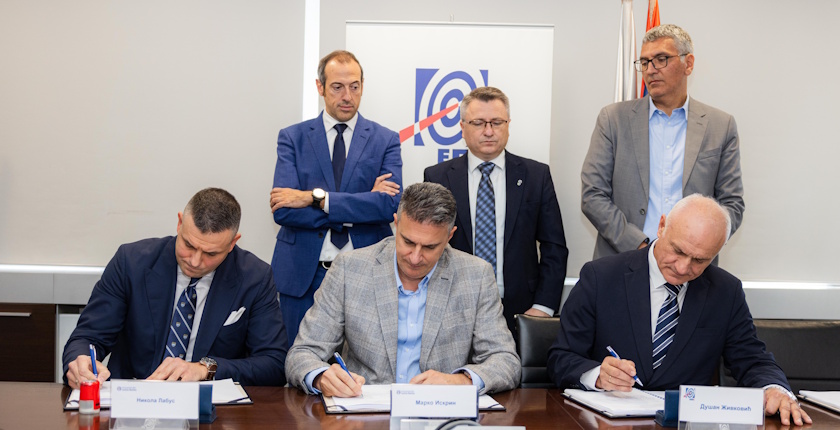
The contract for the reconstruction and modernization of the Vlasina (Vlasinske) hydropower plants (HPPs), with a capacity of 129 MW, was signed by Dušan Živković (sitting first from right), Chief Executive Officer of Elektroprivreda Srbije (EPS), and representatives of Energotehnika Južna Bačka – Marko Iskrin (second from left), Executive Director for Technical Affairs, and Nikola Labus (first from left), Deputy Executive Director for Financial Affairs.

Of note, in mid-July, Hungarian state-owned energy company MVM became the majority owner of Energotehnika – Južna Bačka.

The total value of the project is estimated at EUR 109.7 million. It envisages the reconstruction and modernization of generation units, auxiliary systems, and hydromechanical equipment. The main equipment suppliers are Andritz Hydro and Gamesa Electric, EPS said.

Financing has been secured through a EUR 67 million loan from the European Bank for Reconstruction and Development (EBRD), a EUR 15.4 million grant from the European Union via the Western Balkans Investment Framework (WBIF), and EPS’s own funds in the amount of EUR 27.2 million.

The capacity of the Vlasina HPPs would be increased by 8 MW

“On the day when the Vlasina HPPs celebrate their 70th anniversary, we officially start the project of their modernization. The result would be an increase in the installed capacity by 8 MW and reliable operation for the next three to four decades,” Dušan Živković underlined.

He recalled that the Vlasina HPPs are unique plants in the EPS portfolio. They operate in a cascade system, generating electricity four times one after the other and representing a significant source of peak energy.

The Vlasina HPPs began operating in 1955

According to Milan Aleksić (second from left in back row), advisor to the Minister of Mining and Energy for capital projects, investments are key to securing an electricity supply amid growing demand and the need to rely more on renewable energy sources.

Vlasina started its operations on November 6, 1955, with the commissioning of the first unit at the Vrla 1 hydropower plant.

The system consists of the Vlasina lake – reservoir, four cascade run-of-river hydropower plants, and the Lisina pumping station with the Lisina reservoir. Since the start of operation, the plants have produced more than 17 million GWh.

The signing was also attended by Francesco Corbo (first from left in back row), Regional Head of Energy for the Western Balkans and Croatia at the European Bank for Reconstruction and Development (EBRD).
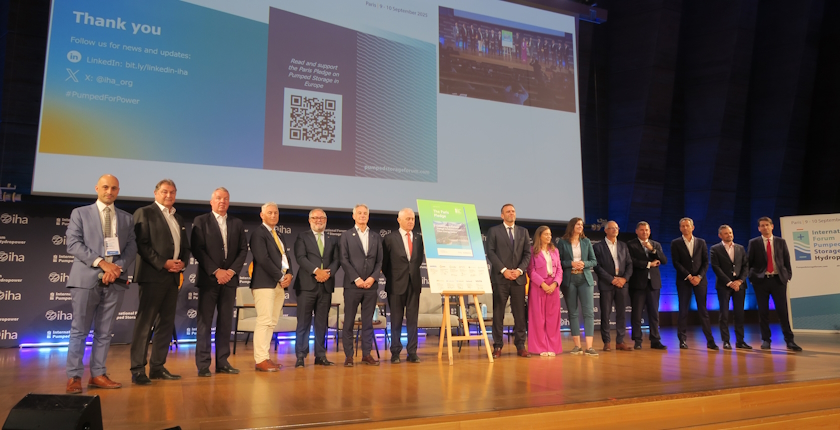
Photo: EPS/Nenad Kostić
by in News

European electricity industry issues Paris Pledge on pumped storage hydropower

The International Hydropower Association (IHA) and Eurelectric launched the Paris Pledge. It is a collective call to action, aimed at unlocking the potential of pumped storage hydropower in Europe. The signatories urge the European Union and national governments to create the right conditions for long-duration storage to meet clean energy goals.

Over 50 utilities, hydropower suppliers and energy-focused associations have signed the Paris Pledge. The document’s alternative headline is Committing to Pumped Storage to Secure Europe’s Clean Energy Future.

The International Hydropower Association (IHA) and Eurelectric – Union of the Electricity Industry launched the initiative. They warned that Europe faces an urgent and growing need for long-duration electricity storage to secure a reliable, affordable and sustainable energy future.

Amid the transition to a renewables-dominated power system, the ability to store and dispatch electricity over long periods will be critical to balance variable generation from wind and solar, ensure grid stability and resilience, and reduce reliance on imported fossil fuels, the authors stressed. They called pumped storage hydropower or PSH the most important, scalable and cost-effective long-duration electricity storage solution available today. It still provides over 90% of the world’s long-duration electricity storage capacity.

PSH is currently the most important, scalable and cost-effective long-duration electricity storage solution, the industry pointed out

By 2050, around 86% of production capacity in Europe will come from variable sources, according to the material accompanying the Paris Pledge. Encouragingly, 78 pumped storage hydropower projects are under development, for 35 GW overall. The EU accounts for over 32 GW, and the rest is in Switzerland, Norway and Turkey.

The combined pipeline would provide storage capacity in excess of 700 GWh, equivalent to more than 10 hours of consumption of Italy and Spain taken together. There is 3.9 GW in the ready-to-build phase, and 2.8 GW is under construction. Of note, an earlier report showed 52.9 GW of PSH was under development.

The existing capacity amounts to 48 GW, compared to 190 GW globally. In the EU, pumped storage hydropower systems can store 1.2 TWh overall.

Photo: Types of pumped storage (IHA, Eurelectric)

Paris Pledge calls for separate legislation for long-duration energy storage

Among other proposals, the signatories are asking the EU for a dedicated initiative to boost the rollout of electricity storage. They suggested legislation to be separate for long duration, short duration and other solutions.

The Paris Pledge calls on member states to remunerate the provision of system services and security of supply for all time frames. They should eliminate double grid fees on electricity storage technologies and accelerate permitting for PSH, the document reads.

With strong political commitment, Europe can double its pumped storage hydropower capacity in the next 25 years, according to the Paris Pledge. In-person signatories represent EDP, EDF, Iberdrola, Andritz, Enel, Statkraft, Voith, Hydrogrid, Verbund, Landsvirkjun and GE Vernova.

Pumped storage hydropower’s contribution during Iberian Peninsula blackout

During the power blackout in Spain and Portugal on April 28, pumped storage played a pivotal role in balancing and supporting the recovery of the system. In Spain, PSH generated 11 GWh of electricity in the first 12 hours, instead of the planned 12 GWh recharge. Similarly, in Portugal, hydropower and pumped storage covered 80% of the demand in the first ten hours.

Such facilities also made a major contribution to restoring the electricity grid in the entire peninsula, thanks to their so-called black start capability. It allows the power plant to be restarted without relying on external power sources and to reenergise the power system.

“Very few technologies can provide this function. As a result, within a few minutes, the first pumped storage plants were ready for synchronization and awaiting dispatch instruction” from transmission system operators, notes the report published with the Paris Pledge.