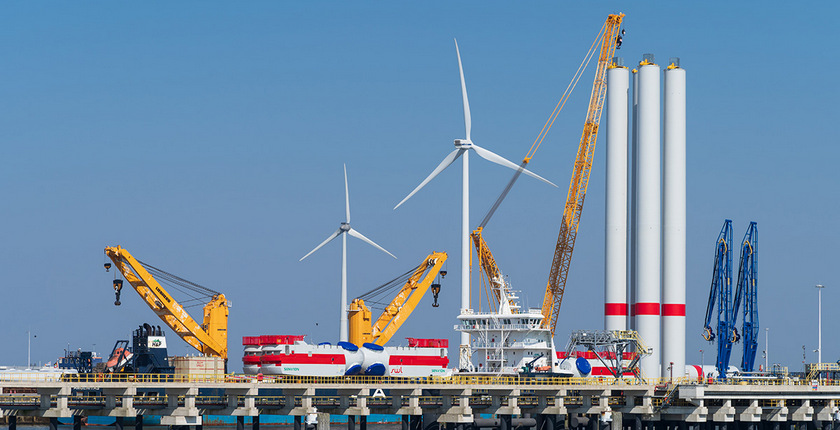
WindEurope: EU must boost investment in ports, ships to meet offshore wind targets
Europe needs to increase investment in ports and shipbuilding, which play a crucial role in offshore wind development, to achieve its goals in this energy segment, according to wind industry association WindEurope. The European Commission’s upcoming strategies for ports and the maritime industry are expected to create conditions for the necessary investment.
The European Union aims to increase its offshore wind capacity from 36.6 GW to 84 GW by 2030, but one of the most pressing challenges it faces is the lack of timely investment in vessel manufacturing and port infrastructure, WindEurope warns.
To meet its 2030 energy security targets, the EU must install at least 10 GW of offshore wind each year. After 2030, this figure will have to increase to 15 GW a year, says WindEurope, noting that robust and resilient port infrastructure and supply chain are key for the achievement of the offshore goals.
After 2030, the EU will have to install 15 GW of offshore wind a year
Over the past three years, over EUR 6.7 billion has been invested in port infrastructure and new vessels across the EU, but a further EUR 6.4 billion is required, the association explains, noting that the European Commission is now working on its EU Ports Strategy.
All offshore wind equipment is transported through ports, and they often serve as bases for the operation and maintenance of offshore wind farms. Ports also host local wind energy supply chains and offer space to store and, in the case of floating turbines, assemble large components, the association notes.
Investment in port infrastructure over the past three years has amounted to EUR 4.4 billion, which can ensure that the EU meets its offshore wind targets, but an additional EUR 2.4 billion is needed to put the bloc on track to achieve post-2030 offshore deployment goals, according to WindEurope.
To make this happen, the EU’s strategy must seek to mobilize additional funding, streamline permitting, and establish planning at the EU level, the association recommends.
A further EUR 4 billion in investment is needed for new ships to handle next-generation wind turbines
When it comes to vessels, they should be a key area of focus in the EU Industrial Maritime Strategy, which aims to enhance the competitiveness, sustainability, and resilience of Europe’s maritime manufacturing sector, WindEurope says.
In the past three years, the EU has invested at least EUR 2.3 billion in new vessels, but it will have to spend a further EUR 4 billion to keep pace with wind turbine technology innovation and handle the upcoming generation of turbines with capacities exceeding 15 MW, it explains.
The strategy should also enable the decarbonization of maritime operations by supporting the shift to clean fuels, such as electricity, ammonia, and hydrogen, and by providing funding for retrofitting vessels and building new zero-emission ships, according to WindEurope.