by in News

Saudi Arabia to build 2 GW of solar power in Turkey within 5 GW deal

After extended negotiations, Saudi Arabia has signed an agreement enabling its companies to develop solar power plants totaling 2 GW across two provinces in Turkey. The move forms part of a broader bilateral framework covering 5 GW of photovoltaic and wind capacity.

Turkey’s Minister of Energy and Natural Resources, Alparslan Bayraktar, and Saudi Arabia’s Minister of Energy, Abdulaziz bin Salman Al Saud, signed an intergovernmental agreement focused on renewable electricity generation. Bayraktar said the objective is to deliver a combined 5 GW of solar and wind power plants in Turkey with Saudi Arabian companies.

In the first phase, two 1 GW solar projects are planned: one in Taşeli in Karaman province and another in Sivas province, Bayraktar said.

Bilateral agreements positioned as a new model for large-scale projects

Bayraktar noted that tenders under Turkey’s state-backed Renewable Energy Zones mechanism (REZ/YEKA) are continuing, alongside investments in self-consumption power plants and energy storage projects. He described intergovernmental and bilateral agreements as a new model for delivering large-scale electricity generation projects, adding that such structures can secure electricity at significantly lower prices over long periods. He made the remarks in Riyadh, where the negotiations were concluded.

Bayraktar reiterated Turkey’s target to triple its combined wind and solar PV capacity to 120 GW by 2035.

He also said the investments—described as a major example of foreign direct investment in Turkey’s energy sector—would be financed externally, with loans expected from international financial institutions.

25-year offtake terms and pricing

Bayraktar stated that electricity from the Karaman solar plant would be purchased for 25 years at 1.995 euro cents per kilowatt-hour (EUR 19.95 per MWh), while power from the Sivas project would be priced at 2.3415 euro cents per kilowatt-hour. He said both levels are the lowest among Turkey’s renewable electricity plants.

He added that the projects are expected to support Turkey’s electrical equipment and services sectors through a 50% locality rate. Bayraktar estimated the first two solar power plants will require around USD 2 billion in investment and will cover the electricity needs of 2.1 million households.

According to Bayraktar, foundations are scheduled to be laid in 2027, with overall completion targeted across 2028 and 2029.

Bayraktar previously said Turkey had been in talks with Saudi partly state-owned utility ACWA.

Turkey had 25.1 GW of solar capacity and 14.8 GW of wind capacity at the end of last year, within a total installed power capacity of 122.5 GW. Bayraktar also said last week that 3.5 GW of self-consumption capacity would be allocated this year, prioritising local authorities, public institutions, and strategic and export-oriented sectors.


by in News

Turkey to launch carbon market, sign deals for large renewables projects in 2026

Turkey will launch a national carbon trade market, sign intergovernmental agreements on large-scale renewable energy projects and connect 2,000 MW of energy storage to the grid in 2026. These moves will be accompanied by the historic start of electricity production at the country’s first nuclear power plant Akkuyu, and a doubling of domestic natural gas production from the Sakarya field.

These developments represent the core of the 2026 vision for energy and mining in Turkey, revealed by Minister of Energy and Natural Resources Alparslan Bayraktar.

Large-scale projects will be launched next year through intergovernmental agreements, he stressed.

The deals include solar and other renewable energy technologies and storage, Bayraktar explained.

According to the minister, Turkey remains committed to its emission reduction targets. The government plans to launch a carbon trade center and market in 2026 within the Energy Exchange Istanbul (EXIST or EPİAŞ), he said.

Of note, Turkey’s imports of a group of goods and electricity to the European Union will be subject to the CBAM carbon border tax from January 1, 2026.

Energy storage facilities totaling 2,000 MW will be commissioned in 2026

Bayraktar recalled that the country issued permits for the installation of an overall 33,500 MW of energy storage. A very small portion has been implemented so far, but 2,000 MW will be commissioned in 2026, he underlined.

The minister said Turkey is considering the introduction of Storage Resources Zones or Depolama Alanları (DEKA) in 2026.

It would be similar to Renewable Energy Zones mechanism – REZ or YEKA – for support for solar and wind projects.

Bayraktar mentioned that a 5,000 MW solar power arrangement with Saudi Arabia-based ACWA is being discussed. Of note, it is equivalent to between 30% and 40% of Turkey’s current photovoltaic capacity.

Locations for the 2,000 MW solar project are in Sivas and Taşeli

He expressed belief that the agreement for the first phase, which envisages 2,000 MW, would be finalized in the first quarter of 2026. The plan is for 1,000 MW in Sivas and 1,000 MW in Taşeli.

A solar-plus-storage project with another company from a different country in the Persian Gulf is also under consideration, Bayraktar revealed. The investment is estimated at EUR 1.5 billion to EUR 2 billion.

A floating solar power plant of about 3,000 MW will be built as soon as possible, according to Bayraktar

In Bayraktar’s view, there is great potential in floating solar power plants. The country intends to implement a floating solar power plant of about 3,000 MW as soon as possible, the minister underlined.

The partners in this endeavour could be private companies or Turkish government-controlled Electricity Generation Corp. (EÜAŞ), the minister said. He claimed significant plans have been developed for offshore wind projects for 2026.

“We are considering a model similar to YEKA for offshore wind,” he added.

Russia to provide USD 9 billion for Akkuyu

turkey 2026 vision energy Alparslan Bayraktar brifing
Photo: Ministry of Energy and Natural Resources

The Akkuyu project is entering its final stages, according to the minister.

The country secured a USD 9 billion financing package from Russia for the investment, of which USD 4 billion to USD 5 billion is intended to be drawn in 2026.

Simultaneously, the ministry is in talks with South Korea, the US, China, and Russia for nuclear projects in Sinop and Thrace.

The Sakarya gas field is expected to double its current output in 2026, to 7.5 billion cubic meters, Bayraktar underscored.

This surge will prevent approximately USD 3.2 billion in energy imports, he explained.

by in News

Turkey to launch carbon market, sign deals for large renewables projects in 2026

Turkey will launch a national carbon trade market, sign intergovernmental agreements on large-scale renewable energy projects and connect 2,000 MW of energy storage to the grid in 2026. These moves will be accompanied by the historic start of electricity production at the country’s first nuclear power plant Akkuyu, and a doubling of domestic natural gas production from the Sakarya field.

These developments represent the core of the 2026 vision for energy and mining in Turkey, revealed by Minister of Energy and Natural Resources Alparslan Bayraktar.

Large-scale projects will be launched next year through intergovernmental agreements, he stressed.

The deals include solar and other renewable energy technologies and storage, Bayraktar explained.

According to the minister, Turkey remains committed to its emission reduction targets. The government plans to launch a carbon trade center and market in 2026 within the Energy Exchange Istanbul (EXIST or EPİAŞ), he said.

Of note, Turkey’s imports of a group of goods and electricity to the European Union will be subject to the CBAM carbon border tax from January 1, 2026.

Energy storage facilities totaling 2,000 MW will be commissioned in 2026

Bayraktar recalled that the country issued permits for the installation of an overall 33,500 MW of energy storage. A very small portion has been implemented so far, but 2,000 MW will be commissioned in 2026, he underlined.

The minister said Turkey is considering the introduction of Storage Resources Zones or Depolama Alanları (DEKA) in 2026.

It would be similar to Renewable Energy Zones mechanism – REZ or YEKA – for support for solar and wind projects.

Bayraktar mentioned that a 5,000 MW solar power arrangement with Saudi Arabia-based ACWA is being discussed. Of note, it is equivalent to between 30% and 40% of Turkey’s current photovoltaic capacity.

Locations for the 2,000 MW solar project are in Sivas and Taşeli

He expressed belief that the agreement for the first phase, which envisages 2,000 MW, would be finalized in the first quarter of 2026. The plan is for 1,000 MW in Sivas and 1,000 MW in Taşeli.

A solar-plus-storage project with another company from a different country in the Persian Gulf is also under consideration, Bayraktar revealed. The investment is estimated at EUR 1.5 billion to EUR 2 billion.

A floating solar power plant of about 3,000 MW will be built as soon as possible, according to Bayraktar

In Bayraktar’s view, there is great potential in floating solar power plants. The country intends to implement a floating solar power plant of about 3,000 MW as soon as possible, the minister underlined.

The partners in this endeavour could be private companies or Turkish government-controlled Electricity Generation Corp. (EÜAŞ), the minister said. He claimed significant plans have been developed for offshore wind projects for 2026.

“We are considering a model similar to YEKA for offshore wind,” he added.

Russia to provide USD 9 billion for Akkuyu

turkey 2026 vision energy Alparslan Bayraktar brifing
Photo: Ministry of Energy and Natural Resources

The Akkuyu project is entering its final stages, according to the minister.

The country secured a USD 9 billion financing package from Russia for the investment, of which USD 4 billion to USD 5 billion is intended to be drawn in 2026.

Simultaneously, the ministry is in talks with South Korea, the US, China, and Russia for nuclear projects in Sinop and Thrace.

The Sakarya gas field is expected to double its current output in 2026, to 7.5 billion cubic meters, Bayraktar underscored.

This surge will prevent approximately USD 3.2 billion in energy imports, he explained.

by in News

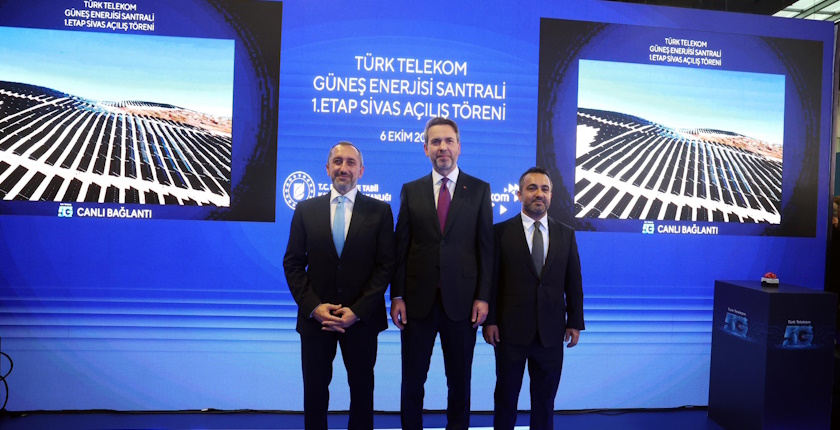
Türk Telekom puts solar power plant into operation as part of 530 MW project

Telecommunications operator Türk Telekom has inaugurated the first part of a solar power plant of 128 MW in peak capacity. The facility in Sivas province in Central Anatolia is one of the company’s three planned photovoltaic systems, totaling 530 MW.

Solar power, affordable and easy to install, is cost-effective for nearly all social and economic activity. In Southeastern Europe and beyond, it has become a mainstream technology, from municipal authorities and local institutions to industrial production. Türk Telekom stands out in the region as a major telecommunications company investing massively in photovoltaics.

The Turkish state-owned firm commissioned the first part of a solar power plant of 128 MW in peak capacity. Earlier it integrated 1.2 MW of solar energy with its 370 base stations and reached 5.5 MW overall.

The new solar park is on 130 hectares in the Zara district in Sivas province, Central Anatolia. When completed, it will cover 15% of the company’s consumption with its estimated annual output of 196 GWh.

Bayraktar: Many companies transformed from energy consumers to producers

At a ceremony at the 11th Energy Efficiency Forum and Exhibition in Istanbul, Minister of Energy and Natural Resources Alparslan Bayraktar put the completed segment into operation using a remote-controlled 5G wireless system. The energy revolution in Turkey has transformed many companies from energy consumers to producers, he pointed out.

Recalling that renewable electricity plants of more than 6 GW in total were completed last year, the minister expressed confidence that 2025 would be a record year. Turkey is heading toward 9 GW or 10 GW, striving to increase the newly installed capacity every year, Bayraktar said.

Türk Telekom to cover two thirds of its electricity needs with photovoltaics

ZTE won the tender late last year for the 128 MW project. The contractor installed mono-crystalline bifacial double-glass N-type PV panels and 350 kW inverters.

According to Türk Telekom’s Chief Executive Officer Ümit Önal, the Sivas plant and two other future solar parks, in Malatya and Ağrı, would meet 65% of the company’s electricity demand. Spanning 600 hectares, they would have 530 MW in combined peak capacity and generate an estimated 800 GWh per year.

Together with its affiliate TT Ventures, Türk Telekom has set up 114 electric vehicle charging units in 40 locations in 11 provinces. The number, within their E4 Charging project, is estimated to grow to more than two hundred this year, at more than 90 sites in 33 provinces.

by in News

Bayraktar: Dongfang plans 2 GW wind turbine factory in Turkey

China-based Dongfang Electric plans to build a wind turbine production facility in Turkey, said Minister of Energy and Natural Resources Alparslan Bayraktar. It would have an annual capacity of 2 GW.

Turkey is pushing ahead with its ambition to reach 120 GW in combined solar and wind power capacity by 2035. Following a meeting with the top executives of Dongfang Electric Corp., Minister of Energy and Natural Resources Alparslan Bayraktar pointed out that, at the same time, the domestic manufacturing potential in the two segments needs to be increased.

“We evaluated the Chinese company’s plan to establish a wind turbine production facility with an annual capacity of 2,000 MW in our country, with an initial investment of approximately USD 250 million,” he revealed.

Dongfang Electric installed the world’s largest wind turbine last month for testing. The 26 MW behemoth is on the Bohai Sea at the coast of Shandong province in China’s east.

The company is also active in the Western Balkans. Dongfang Electric is leading the consortium reconstructing the Pljevlja coal power plant in Montenegro. In Bosnia and Herzegovina, it has built solar power plant Bileća, of 60 MW in peak capacity, and the Stanari coal plant, both for EFT.

Dongfang Electric could cover Turkey’s annual wind power capacity additions by itself with future factory

At the end of July, electricity capacity in Turkey totaled 120.2 GW. Hydropower accounted for 26.9% or 32.3 GW, compared to 23.4 GW of photovoltaics (19.5%) and 13.7 GW of wind power, translating to 11.4%.

There are 150 manufacturers of wind turbine components and accompanying gear in the country, covering 65% of the technology, according to a recent report. Data from early this year showed there were seven production facilities for towers, four plants were making blades, and another four were manufacturing generators and gearboxes.

Wind power plants of 1.3 GW in total were installed last year. The annual expansion could top 2 GW in 2026.

Government conditions renewable energy auction participants with high domestic sourcing rates

While awarding large wind and PV capacities through renewable energy auctions, the Ministry of Energy and Natural Resources requires high domestic content rates from the bidders.

As for PV panels, there were 75 active manufacturers at the beginning of 2025. Put together, their annual capacity was 44.5 GW. Three were making solar cells and their overall capacity was 6.1 GW per year.

The country is also strong in other technologies, like for geothermal power plants.