by in News

Works beginning on North Macedonian side of gas interconnector with Greece

The North Macedonian section of the gas interconnector with Greece is expected to be completed by early 2027. The construction contract was signed by the Ministry of Energy, Mining and Mineral Resources, domestic contractor Rapid Build and the country’s gas transmission system operator Nomagas.

The construction of the gas pipeline connecting North Macedonia with Greece is set to begin in a month, according to officials. Land expropriation is 90% complete. The initial capacity of the interconnector would be 1.5 billion cubic meters per year, with a potential to double it. The works are expected to be completed within 22 months.

„With the signing of the contract for the construction of the Macedonian section of the gas interconnector with Greece, we are marking the beginning of the largest energy investment in North Macedonia in the last ten years. The interconnector is proof that when there is political will, regional trust, and professional dedication – the results are real and tangible,” said Minister of Energy, Mining and Mineral Resources Sanja Božinovska.

The contract was signed by the ministry, contractor Rapid bild, based in Kumanovo in North Macedonia, and the country’s gas transmission system operator Nomagas. The future pipeline would be able to carry both natural gas and hydrogen.

Repeated tender slashes price by EUR 12 million

The winning bid was EUR 59.9 million or EUR 12 million less than in the initial tender, which was annulled.

The project is worth over MKD 5.1 billion (EUR 82.9 million). It is financed by the European Investment Bank (EIB) and the European Bank for Reconstruction and Development (EBRD). It includes grants of EUR 2.5 million for technical assistance and another EUR 9.9 million via the Western Balkans Investment Framework (WBIF).

The project is financed by the EIB and EBRD

„This contract ensures diversification and access to a greater number of natural gas sources, enables economic development, progress and environmental protection, and contributes to the security of energy supply,” said Executive Director of Nomagas Muhamet Elmazi.

Gasification would significantly improve air quality, especially in areas where wood and fuel oil are currently used for heating.

Greek section of interconnector under construction since February

On the North Macedonian side, the interconnector route is 68 kilometers long, out of a total of 123 kilometers. It will run from Nea Mesimvria in Greece through Evzoni (Mačukovo) and Gevgelija at the border, to Negotino. The next phase involves building gas links from Gostivar to Kičevo (34 kilometers) and from Sveti Nikole to Veles (28 kilometers).

Greek company Terna began constructing its country’s section of the pipeline in February.

Nomagas and Greece’s National Natural Gas System Operator (DESFA) made their final investment decision a year and a half ago.

The companies leaned the investment on the project for the Alexandroupolis LNG Terminal. The liquefied natural gas facility in northeastern Greece was opened on October 1. However, due to a malfunction, it has been out of operation for more than three months. According to the latest update, gradual reactivation is expected to begin by the end of May.
by in News

Greece’s DEPA Commercial picks contractors for PV plants of 500 MW

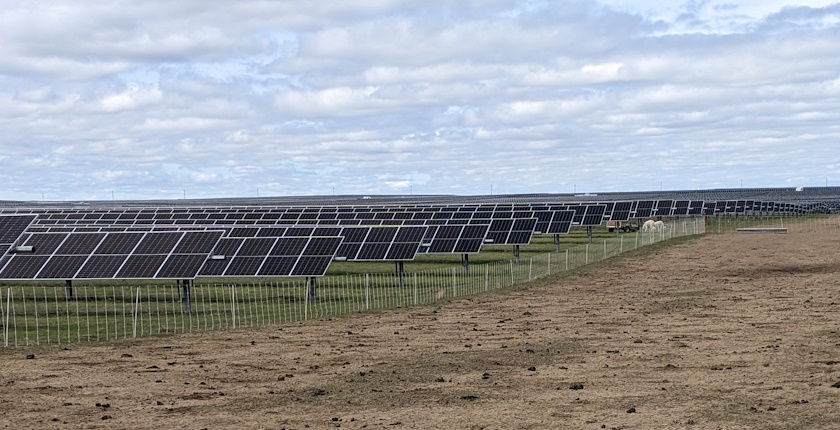
Construction companies Terna and Aktor are about to start building a solar power plant of 400 MW in northern Greece and another 100 MW near Larissa, for state-owned DEPA Commercial, according to a new report. In its switch toward cleaner sources, the gas holding has also finished the construction of its biomethane plant.

Greek state-controlled gas supplier, importer and trader DEPA Commercial has completed the tenders for photovoltaic parks of 500 MW overall, OT learned. The 400 MW facility in Kozani in the Western Macedonia province would currently be the largest in the country.

However, Lightsource bp, owned by BP, started the construction of a 560 MW solar park last summer in Central Greece and Thessaly. State-controlled Public Power Corp. (PPC or DEI) is about to finish a 550 MW photovoltaic facility in Ptolemaida, near Kozani.

DEPA Commercial is also known as DEPA Emporias (in Greek), DEPA Commerce and DEPA Trading. Both for the giant PV plant in northern Greece and another 100 MW in Farsala, Larissa, it selected the consortium of Terna, part of the GEK Terna conglomerate, and Ellaktor’s Aktor.

The turnkey deals are worth EUR 270 million in total

The turnkey agreements are worth a combined EUR 270 million. The company obtained a EUR 390 million loan in July from the European Investment Bank (EIB) for its photovoltaic projects. The portfolio amounted to 816 MW.

The projects, which are at various stages of maturity, are conducted under subsidiaries North Solar, North Solar 1 and New Spes Concept.

DEPA Commercial’s new move comes after the government bought a 35% stake from Helleniq Energy. The company is now fully owned by the Hellenic Republic Asset Development Fund (HRADF or TAIPED). The transaction was completed at the turn of the year, when the vehicle also integrated the so-called Superfund.

DEPA Commercial starts producing biomethane for its fuel stations

Within its energy transition efforts, the gas giant is entering biomethane production as well. DEPA Commercial said early this month that it produced Greece’s first quantities of the fuel.

The new pilot unit, Farma Hitas (Chitas) in Filippiada in the country’s west, makes 97% pure methane and compresses it. The bio-CNG goes to the company’s Fisikon gas stations, where it is mixed with natural (fossil) gas and sold as vehicle fuel.

Ownership stakes in Alexandroupolis gas complex, IGB pipeline

As for its conventional business operations, DEPA Commercial holds a 29% stake in special purpose firm Ilektroparagogi Alexandroupolis (Alexandroupolis Electricity Production). PPC is the majority partner, with 71%.

They are building a combined-cycle gas turbine (CCGT) of 840 MW. In addition, DEPA Commercial owns 20% of the Alexandroupolis LNG Terminal and 25% of ICGB, which operates the Interconnector Greece-Bulgaria (IGB) gas pipeline.

The company is participating in the Fier Thermoelectric project for a 174 MW gas power plant in Albania. DEPA Commercial intends to supply some of the renewable electricity that it generates to its wholly-owned subsidiary Fysiko Aerio – Hellenic Energy Co. The gas and electricity distributor has more than 530,000 customers.

Notably, DEPA Commercial already owns an aggregator license – FOSE, allowing it to trade in the wholesale power market on behalf of a group of producers.

by in News

Alexandroupolis LNG Terminal to remain out of service at least until end-March

On the day when it was supposed to get the Alexandroupolis LNG Terminal in Greece back online, its operator Gastrade extended the outage by another month. The company never revealed the details of the malfunction.

Just as gas storage in the European Union slipped below 40% of capacity, the operator of the Alexandroupolis LNG Terminal substantially pushed back the target date of restarting operations. Located offshore northeastern Greece, the facility has major potential for boosting the market in other Southeastern European countries and providing ample supply.

After several shorter delays, Gastrade extended the outage by another month, until March 31. On January 23 it reported a technical issue. Then it announced that a limited regasification service would be available, but there were virtually no gas flows for a few days. On January 28, the company declared that the liquefied natural gas facility went offline.

Gastrade was supposed to bring Europe’s newest LNG terminal back to service on February 28. Instead, it prolonged the outage for a whole month that day, fueling concerns about the severity of the malfunction and speculation about the cause.

Operators association Gas Infrastructure Europe and the European Network of Transmission System Operators for Gas (ENTSOG) noted the update.

Capacity utilization of Alexandroupolis LNG Terminal was relatively low

Put into commercial operation at the beginning of October, the facility could regasify LNG to as much as 5.5 billion cubic meters per year. The capacity of the floating storage and regasification unit (FSRU), the LNG ship, is 153,500 cubic meters.

Gastrade’s update fueled concerns about the severity of the malfunction and speculation about the cause.

Importantly, the Alexandroupolis LNG terminal has only a handful of contracts. It means the controversial breakdown doesn’t directly jeopardize gas supply in the Balkans much. In addition, Bulgaria’s Bulgargaz secured a replacement from Turkey.

Founding shareholder Elmina Copelouzou, LNG carrier fleet owner and operator GasLog, DEPA Commercial, Bulgartransgaz and Greece’s National Natural Gas System Operator (DESFA) all control 20% each in the joint venture in Alexandroupolis.

Discussions are underway in the European Union to cut back the obligatory 90% gas storage level, on November 1 each year, to 80%. The measure obviously wouldn’t help next winter’s security of supply, but there would be less demand and upward pressure on prices.

Balkan Stream pipeline is currently only direct route for Russian gas

Just before the Alexandroupolis LNG Terminal crashed, an outage at Azerbaijan’s Shah Deniz gas field disrupted the deliveries to Europe through the Southern Gas Corridor, toward the Trans Adriatic Pipeline – TAP.

Ukraine declined to renew a contract with Russia, halting the flow of gas to Central Europe at the beginning of the year. The TurkStream and Balkan Stream pipelines remained the only direct and operating route for Russian gas.

Serbia, Hungary, Bosnia and Herzegovina and North Macedonia are counting on the Alexandroupolis LNG Terminal, the new interconnectors between Greece and Bulgaria (IGB) and Bulgaria and Serbia as well as on deliveries of gas from Azerbaijan. In addition, there are plans for gas pipelines connecting North Macedonia with Greece and Serbia.

Serbia and Romania intend to build a gas link of 1.6 billion cubic meters in annual capacity. Minister of Energy Sebastian Burduja said last year that Romania has become the biggest natural gas producer in the European Union. Moreover, its Neptun Deep offshore field is due to come online in 2027.