Sarajevo rolls out fully digital system to track air-polluting emissions
Sarajevo, the capital of Bosnia and Herzegovina, has developed a register of air-polluting emissions and an information system to track pollutants. The register aims to reduce air pollution in Sarajevo, which very often tops the list of the world’s most polluted cities.
The project to develop the emissions register and the air-pollutant information system for the Sarajevo Canton took two years, according to the government of the Sarajevo Canton. During that period, comprehensive data were collected on various air pollution sources, including home fireplaces, boiler rooms, industry, traffic, and agriculture.
In creating the register, nearly 100,000 individual emission sources were analyzed. The emissions of all pollutants from those sources were calculated in line with the European Environmental Protection Agency (EPA) standards.
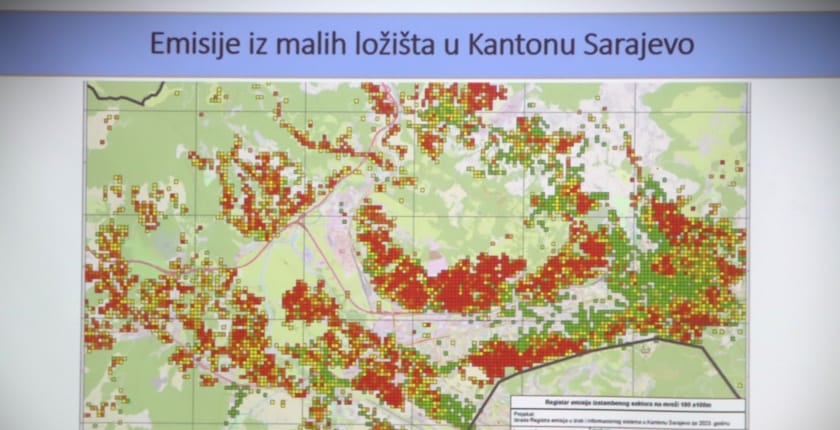
The project has created emissions distribution maps for key pollutants
Compared with previous versions, the new register offers significant improvements. It uses the latest methodologies for the spatial distribution of emissions and data verification, complemented by the establishment of a central GIS database and an interactive web portal.
For the first time, the public can compare emissions data for different pollutants on a high-resolution spatial grid (100×100 meters). In addition to the detailed register of emissions, distribution maps for key pollutants, including particulate matter (PM10), sulfur dioxide (SO2), and nitrogen oxides (NOx), are also available.
The information system is set to be publicly available within a month
According to the government, the system allows for the identification of areas with excessive air pollution. A robust emissions register serves as a foundation for strategic financing of projects aimed at improving air quality, including implementing the Strategy for Limiting the Use of Coal and Other Solid Fuels in the Sarajevo Canton (2023-2033), the government added. The strategy was adopted in February 2024.
The new emissions register and air quality categorization map will provide essential data inputs for future planning and strategies across various sectors, including spatial planning, energy, transportation, and healthcare.
Jansson: Air pollution remains one of the most urgent public health challenges in Sarajevo
Birgitta Jansson, deputy head of development cooperation at the Swedish Embassy in BiH, highlighted air pollution as one of the most urgent public health and environmental challenges in the Sarajevo Canton.
“By taking a pioneering step to make environmental data publicly accessible, the canton is enabling transparent, informed, and long-term action toward cleaner air and climate neutrality – and Sweden is proud to support this important initiative,” she noted.
The Prime Minister of the Sarajevo Canton, Nihad Uk, stressed that the new register allows the government to plan measures more accurately, apply for international funding, and make sustainable decisions based on relevant data.
Softić Kadenić: A unique project in BiH
The Minister of Justice and Administration of the Sarajevo Canton, Darja Softić Kadenić, described the project as unique in BiH, since for the first time it introduces a fully digital, accurate, and comprehensive system for monitoring annual emissions into the air.
It is placing Sarajevo Canton among the more advanced European cities, she added.
According to Raduška Cupać, head of the Energy and Environment Sector at UNDP in BiH, the system is more than a technical tool – it is a strategic asset that empowers institutions, companies, and citizens to take concrete steps toward environmental protection.
The register was developed by a consortium of companies Ceteor, E3, and GDI.