by in News

Austrian EET rolls out AI-powered device to simplify home electricity metering

Austrian startup Efficient Energy Technology (EET) has developed an electricity metering solution called the Virtual Meter, which measures residential electricity consumption through a single connection within the home’s power network. The device, powered by artificial intelligence (AI), eliminates the need for a conventional hardwired meter, reduces system complexity for home energy storage and heat pumps, and provides real-time consumption data, the company claims.

The Virtual Meter, which can be integrated directly into any home energy device through a standard socket or any point on the home’s power network, deduces the total energy consumption accurately, reliably, and in real time, according to EET.

AI-powered Virtual Meter derives and delivers consumption data in under one second

The device uses AI-powered load identification to measure the total net electrical load of the entire home on single-phase or three-phase residential grid connections, with data delivered in under one second. It can be plugged in anywhere via a standard earthed wall socket or a wired connection, requiring a physical link to only one phase.

Instead of directly measuring current, the Virtual Meter continuously observes the voltage of one phase and detects the tiny changes that occur whenever a device switches on or off on any of the three phases of a household, the company explains. In this way, it infers the home’s total consumption.

The solution reduces the costs and complexity of home batteries and heat pumps

The Virtual Meter reduces system complexity and installation and component costs for manufacturers of devices such as home batteries, EV chargers, heat pumps, home energy management systems (HEMS), and other residential energy products, delivering a smoother, more transparent experience for end-customers.

The solution is compatible with all common grid configurations and utility meter types, and its design ensures interruption-free data availability, EET says, adding that the Virtual Meter can be integrated directly into other energy products or used as a standalone solution.

by in News

Austrian EET rolls out AI-powered device to simplify home electricity metering

Austrian startup Efficient Energy Technology (EET) has developed an electricity metering solution called the Virtual Meter, which measures residential electricity consumption through a single connection within the home’s power network. The device, powered by artificial intelligence (AI), eliminates the need for a conventional hardwired meter, reduces system complexity for home energy storage and heat pumps, and provides real-time consumption data, the company claims.

The Virtual Meter, which can be integrated directly into any home energy device through a standard socket or any point on the home’s power network, deduces the total energy consumption accurately, reliably, and in real time, according to EET.

AI-powered Virtual Meter derives and delivers consumption data in under one second

The device uses AI-powered load identification to measure the total net electrical load of the entire home on single-phase or three-phase residential grid connections, with data delivered in under one second. It can be plugged in anywhere via a standard earthed wall socket or a wired connection, requiring a physical link to only one phase.

Instead of directly measuring current, the Virtual Meter continuously observes the voltage of one phase and detects the tiny changes that occur whenever a device switches on or off on any of the three phases of a household, the company explains. In this way, it infers the home’s total consumption.

The solution reduces the costs and complexity of home batteries and heat pumps

The Virtual Meter reduces system complexity and installation and component costs for manufacturers of devices such as home batteries, EV chargers, heat pumps, home energy management systems (HEMS), and other residential energy products, delivering a smoother, more transparent experience for end-customers.

The solution is compatible with all common grid configurations and utility meter types, and its design ensures interruption-free data availability, EET says, adding that the Virtual Meter can be integrated directly into other energy products or used as a standalone solution.

by in News

AI and Energy: the dynamic duo shaping the power grid

Author: Mbuwir Brida, EUSEW  Young Energy Ambassador

Have you tried asking ChatGPT what the world’s most pressing challenge is? It ranks climate change as the first challenge. So, how about we use the technology behind ChatGPT to solve that challenge?

The most significant way to mitigate climate change is to move from fossil fuels to renewable energy: the energy transition. This entails bolstering the integration of variable renewable energy sources into the power grid. Thus, more powerful and innovative tools are required to plan and operate the grid to ensure a secure and reliable grid as the energy transition progresses.

This need comes at a time when ground-breaking advancements are being made in artificial intelligence (AI), mimicking several aspects of human intelligence via large scale data analysis and relevant domain knowledge to generate outcomes. The digitalisation of the grid (e.g., via smart meters, sensors, and digital twins) provides massive amounts of data, making AI uniquely placed to support the energy transition. But will AI fix all grid challenges?

Forecasting for a more reliable power grid

Photo: Mbuwir Brida, EUSEW Young Energy Ambassador

The predictive capability of AI models is a game-changer for the energy sector, from energy generation to consumption and energy markets. One major application has been to predict and optimise energy generation of solar and wind installations: e.g., AI models use weather data together with historical measurements to predict energy production and consumption required for grid planning.

For example, the transmission network operator in Belgium, Elia, has developed an AI-based tool that reduces the system imbalance forecast error by 41% in their effort to keep the grid frequency stable with increasing renewable energy integration. This predictive capacity of AI models has also been used for predictive maintenance of wind farms and power lines. Thus, AI-based algorithms facilitate real-time monitoring and control of electricity transmission and distribution, allowing for dynamic adjustments in response to fluctuating energy supply and demand.

Moreover, AI algorithms automatically detecting faults, generating real-time power restoration strategies, and switching to backup power sources can reduce system downtime, enhancing power system reliability. Hence, AI not only facilitates grid management and renewable energy integration but also fosters a more efficient, reliable, and secure power grid.

On the energy consumption side, AI-driven energy management systems have seen significant progress. These energy management systems optimise energy usage by learning user preferences, adapting to weather conditions, and other external events such as electricity prices. For example, Belgian tech startup Pleevi has developed machine learning based algorithms to control electric vehicle charging, reducing electricity cost up to 30% while promoting the use of forecasted local energy generation. Swedish-Swiss electrification and automation company, ABB, on the other hand has developed AI-based tools for predicting and managing energy consumption peaks in commercial and industrial buildings, helping these large consumers to avoid peak demand charges.

Advanced technology comes with risks and roadblocks

While notable advancements have been made, the complexity of regulatory frameworks, ethical considerations, and the multifaceted nature of energy systems still challenge the integration of AI in the energy sector. Security concerns and data privacy issues raise important questions on the safe use of AI in the energy sector and, therefore, compliance with the European Artificial Intelligence Act. Additionally, the environmental impact of manufacturing AI hardware and the high energy and water consumption of data centres highlight some roadblocks that must be addressed for the sustainable use of AI. Moreover, the decision-making process of AI algorithms often remains unexplainable and unaccountable. All these aspects make the adoption of AI-based solutions challenging for users due to the significant energy security and financial implications.

Will AI fix all grid challenges related to the energy transition?

As the synergy between AI and the energy sector continues to unfold, interdisciplinary collaboration and a commitment to ethical and responsible AI deployment remain essential to fully unlock the potential of this intersection. However, the promise of fully autonomous systems, where AI orchestrates every aspect of the grid, is still a long way from becoming reality, considering the aforementioned hurdles. In reality, the integration is an ongoing process marked by incremental achievements and new challenges.

In 2026, the European Commission will adopt a Strategic Roadmap for digitalisation and AI in the energy sector, aiming to leverage the potential of digital and AI technologies while mitigating the associated risks.

This opinion editorial is produced in co-operation with the European Sustainable Energy Week 2026. See ec.europa.eu/eusew for open calls.

Disclaimer: This article is a contribution from a partner. All rights reserved.

Neither the European Commission nor any person acting on behalf of the Commission is responsible for the use that might be made of the information in the article. The opinions expressed are those of the author(s) only and should not be considered as representative of the European Commission’s official position.

by in News

IAEA hosts landmark symposium: Nuclear, AI to forge Atoms for Algorithms alliance 

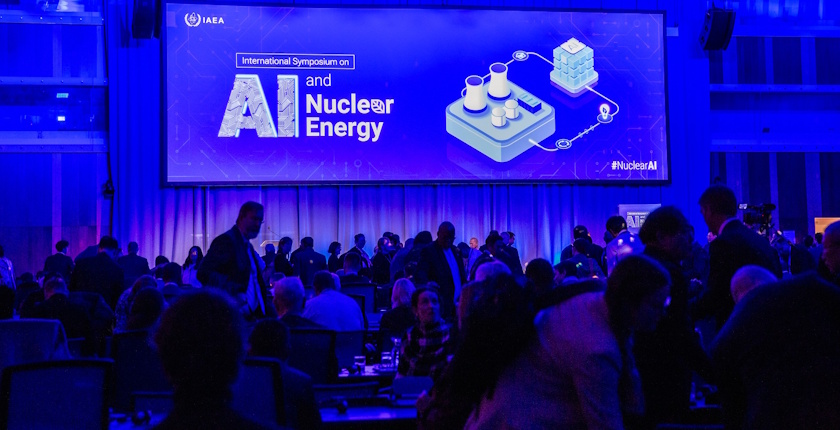
Global energy and technology leaders from over 250 organizations, including companies, nuclear operators, regulators, and research institutions, have gathered at the IAEA headquarters in Vienna for the first-ever International Symposium on Artificial Intelligence and Nuclear Energy.

The International Atomic Energy Agency (IAEA) said the two-day event brought together senior representatives from ministries, international organizations, the nuclear industry and major tech firms, including Google and Oracle.

They discussed how nuclear energy can help meet the surging electricity demand of AI data centres, and how AI can support nuclear technology development.

The first symposium on nuclear energy and AI provided a platform for governments, organizations and industry to discuss how to make the Atoms for Algorithms alliance happen, according to IAEA.

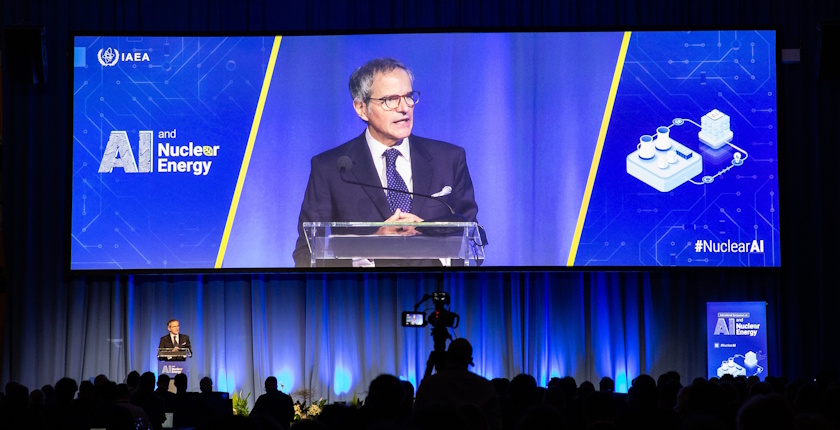
Grossi: I call it not just a partnership, but a structural alliance: Atoms for Algorithms

Director General Rafael Mariano Grossi said the two forces are reshaping humanity’s horizon at an unprecedented pace.

“The world’s energy map is being redrawn before our eyes. The essential point, our opportunity and our responsibility, is that these forces are not unfolding separately. They are converging and redefining the new global economy,” he stressed.

world iaea nuclear energy ai atoms for algorithms Rafael Mariano Grossi
Photo: IAEA

IAEA recalled that according to the International Energy Agency, data centres accounted for 1.5% of worldwide electricity demand in 2024 – a figure that could double by 2030.

“There is only one energy source that can meet combined demands of low-carbon generation, 24/7 reliability, massive power density, grid stability and genuine scalability: nuclear energy. This is why I call it not just a partnership, but a structural alliance: Atoms for Algorithms,” he stressed.

Greisinger: We are currently building the engine of the 21st century

world iaea vienna conference nuclear energy ai atoms for algorithms Manuel Greisinger
Photo: IAEA

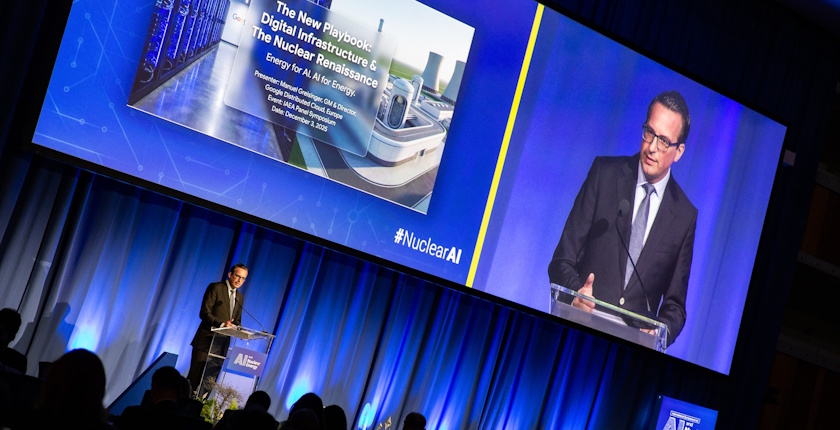
IAEA underlined that major tech companies are weighing in on the nuclear-AI conversation. Manuel Greisinger, Google Distributed Cloud Director, shared why hyperscalers are turning to nuclear energy to power their data centres.

“We are currently building the engine of the 21st century, which is artificial intelligence. But as everyone in this room knows, an engine is pretty much useless without fuel. So the digital infrastructure community is here at the symposium because we have crunched the numbers and we have realized that nuclear energy is not just an option. It is an essential, non-negotiable component of our future fuel mix,” he stressed.

Sama Bilbao y León, Director General of World Nuclear Association, pointed out that nuclear energy is a key piece of the puzzle to electrify the world, improve quality of life, and support AI’s need for 24/7 carbon-free electricity.

She welcomed the pledge by major tech companies to support the goal to triple global nuclear energy capacity by 2050, according to IAEA.

by in News

Spajić: Montenegro wants to be country of green data centers

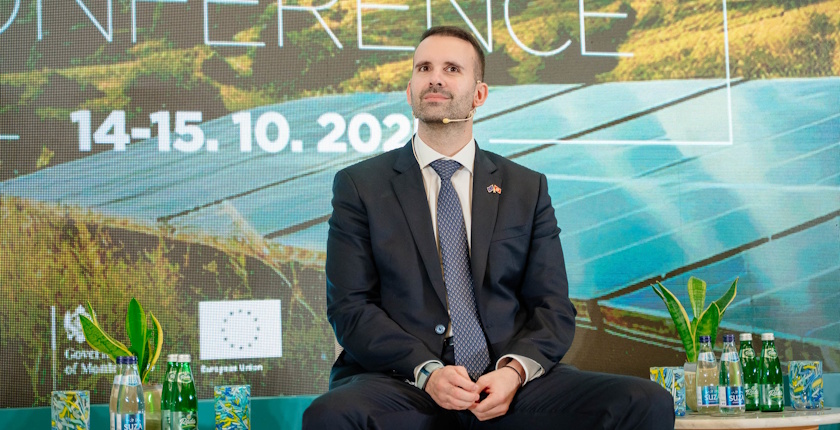
Montenegro plans to become a country of green data centers, according to Prime Minister Milojko Spajić.

Milojko Spajić was one of the speakers at the keynote panel Accelerating the Western Balkans’ Green and Smart Growth, within the European Union – Montenegro Investment Conference in Luštica, near Tivat.

Earlier, European Commission President Ursula von der Leyen and the prime minister of Montenegro opened the two-day event, titled Smart Growth, Green Future: Accelerating Investment in Montenegro.

Spajić said energy is a cornerstone of the country’s strategy for connecting the region but also something in which Montenegro could be very competitive, helping the EU become even more competitive on the global stage.

Spajić: We can offer to Europe a possibility to get inexpensive electricity and stable supply

“We have dozens of amazing projects for hydro, wind, solar energy at very competitive rates. We can offer to Europe a possibility to get inexpensive electricity and stable supply. Baseload energy as well. For example, hydro is baseload energy,” he stated.

Photo: Bojan Gnjidić / Government of Montenegro

The prime minister recalled that his country is interconnected with Italy and that the project for the installation of the second line of the subsea cable is in the pipeline. But he also highlighted the significance of digital connections with Italy, where Milan is one of the biggest data center hubs in the EU, providing connections to Frankfurt and London.

Montenegro, in Spajić’s words, intends to be a part of the data highway. Data centers are basically the hardware for artificial intelligence, he explained and added that AI is going to be strong in big markets, not in small ones.

Partners from the US, UAE, and other countries, are interested in the development of the data centers

“But where we can actually be involved as a small country are data centers providing infrastructure for the EU’s AI to be strong and competitive,” Spajić underlined.

Therefore the country intends to focus on providing a very good environment for global data center operators, to come from all around the world. Spajić revealed that partners from the United States, United Arab Emirates, and other countries are interested in joining the opportunities for the development of the data centers.

“We want Montenegro to be the country of green data centers. We have water for hydropower. We have a lot of solar potential and a lot of wind. We are very fortunate to have such diversity,” Spajić said.

He invited investors to come to Montenegro: “Don’t waste your time, come as soon as possible.”

Participants at the panel included the Director of Enlargement Coordination, Strategy and Investments at the EU’s Directorate-General for Enlargement and Eastern Neighbourhood, Mathieu Bousquet, WizzAir CEO József Váradi, Akuo President Eric Scotto, and Charlotte Ruhe, Managing Director for Central and South-Eastern Europe in the European Bank for Reconstruction and Development (EBRD).

Of note, fourteen cooperation projects between Montenegrin and European companies have been initiated at the conference. Some of them involve investments in wind farms, solar parks, energy storage, and grids.

by in News

Policy changes in US will have marginal impact on global energy transition

Policy changes in the United States introduced by the administration of President Donald Trump will have only a marginal impact on the global energy transition, according to the latest Energy Transition Outlook, produced by DNV.

Norwegian consulting firm DNV pointed out in a report that energy use by artificial intelligence may seem alarming, but that it is projected to stay below booming sectors like electric vehicle (EV) charging and cooling of buildings.

“DNV’s annual Energy Transition Outlook has consistently forecast a shift from today’s 80/20 fossil/non-fossil primary energy mix to a 50/50 mix by 2050. That is still our prediction this year. Although some aspects of the transition are supercharged and progressing rapidly, other aspects have hit turbulence and are delayed. This leads to a marginally slower transition than our forecast last year,” CEO Remi Eriksen said.

According to the report, in the US, fossil fuel promotion and the reversal of clean energy support policies are slowing the nation’s transition.

However, China continues to set renewables buildout records with 390 GW of solar PV (56% share of new global capacity) and 86 GW of wind (60% share) expected to be installed this year. The country is also fueling the transition in the rest of the world with its cleantech exports.

In the meantime, Europe is seeking to balance climate action with competitiveness, the report reads.

The continent is having a slow success with harder-to-decarbonize sectors, but renewable energy buildout remains relatively strong.

In the rest of the world, most countries are embracing competitive Chinese technologies, with year-on-year growth in installations at around 25%, data showed.

Eriksen said cheap renewable electrons stored when necessary in ever-cheaper batteries are already an unstoppable force.

“We forecast that solar – both with and without storage – and wind will be 32% of the global power mix by 2030. We expect a resurgence in offshore wind by 2030, such that variable renewables will provide more than 50% of all electricity by 2040,” he stated.

Solar power is 10% of all power produced worldwide today, and DNV projected it will be 20% in 2029 and 40% in 2045. Renewables would reach 65% in the global electricity mix by 2040, the firm added.

AI’s energy demand would be lowered by efficiency effects

According to Eriksen, soaring power demand from AI data centers is placing additional strain on already congested grids, particularly in North America.

DNV ‘s analysis finds that AI’s energy demand growth is likely to become more linear over time, outpaced, for instance, by EV charging and cooling demand, even as the cognitive services of AI expand exponentially. The main reason is growing efficiency.

AI’s energy use is forecasted at only 3% of global electricity by 2040. Data center energy use will quintuple by 2040, equalling 5% of all global electricity. AI’s share would be 3%, with the remaining 2% for general purpose data centers.

The report highlighted large regional variations – AI is the biggest driver of electricity consumption growth in North America, compared to EV charging in Europe and EVs and cooling in China and India.

For the first time, this year’s analysis extends to 2060

The report noted that this year, the world reached the milestone of more than 50 million EVs on the road. Most of them, 60%, are in China, with Europe at 21%, and North America at 13%.

The point of inflection — EVs at 50% of global new passenger vehicle sales — will be reached in 2032, the report projected.

For the first time, this year’s analysis extends to 2060 to reflect the continued transformation of the energy system after 2050. The report recalled that it is now widely acknowledged that the world will not achieve net zero emissions by 2050, meaning warming would exceed 1.5 degrees Celsius.

A decarbonization of energy mix is unstoppable but too slow, setting up grave risks for future generations, Eriksen concluded.

by in News

Google reveals Gemini AI’s energy and water consumption

Artificial intelligence (AI) is becoming increasingly important in our daily lives, but its rapid expansion is raising concerns about how much energy it consumes. Google has become the first tech company to publish a report on the energy consumption, emissions, and water use of its AI software, Gemini.

Google estimates that the median Gemini text prompt uses 0.24 watt-hours (Wh) of energy, emits 0.03 grams of CO2 equivalent, and consumes 0.26 milliliters (or about five drops) of water. “The per-prompt energy impact is equivalent to watching TV for less than nine seconds,” according to a press release from the company.

When applying a non-comprehensive methodology, which only considers the consumption of active TPU and GPU chips, the median Gemini text prompt uses 0.10 Wh of energy, emits 0.02 gCO2e, and consumes 0.12 mL of water.

On the other hand, Google’s comprehensive methodology includes the energy and water consumption of the software itself, the operation of IT equipment in data centers, the energy used by chips while idle, as well as the amount of water used to cool the equipment.

It should be noted, however, that energy consumption depends on multiple factors, including prompt length, the number of users, and the model’s efficiency.

Google’s AI is becoming increasingly efficient thanks to innovations

Google claims that its consumption of energy and water for AI is “substantially lower than many public estimates.” It also stresses that its AI systems are becoming more efficient through research innovations and software and hardware efficiency improvements.

Over a recent 12-month period, the energy and total carbon footprint of the median Gemini Apps text prompt dropped by 33 times and 44 times, respectively, while delivering higher-quality responses, the company claims.

Google has announced that it will continue investing in technologies that reduce per-prompt energy and water use, as well as emissions associated with AI systems. By 2030, the company aims to achieve net-zero emissions and to replenish 120% of the freshwater consumed in its data centers and offices.

However, despite Google’s efforts to reduce emissions, they have soared 51% compared to 2019, driven by the expansion of data center capacities needed for training and running AI models.

By 2030, data centers could be consuming 4.5% of global electricity generation

Data centers are essential for the operation of AI systems, and the International Energy Agency (IEA) estimates that their total electricity consumption could double by 2026, reaching 1,000 TWh per year, equivalent to Japan’s entire annual electricity use.

According to research firm SemiAnalysis, the expansion of AI could lead to data centers using 4.5% of total global electricity generation by 2030.

by in News

Turkish firm Astor Enerji to install 2 GWh of battery capacity at its solar projects in Romania

Swiss energy storage provider Energy Vault has signed an agreement to supply up to 2 GWh of battery capacity for the solar power projects of Turkey-based Astor Enerji in Romania. Astor Enerji, for its part, will provide transformers and high-voltage equipment for more than 1 GW of Energy Vault’s battery projects worldwide.

Astor Enerji recently entered the Romanian market through the acquisition of four photovoltaic projects with a total capacity of 279 MW, according to reports. The transactions, which require regulatory approval, were carried out in April through Astor Enerji’s Romanian subsidiary Astor RO Energy.

Astor Enerji has acquired 279 MW of solar projects in Romania

Under the global partnership agreement, Astor will receive battery energy storage systems (BESS) for the four grid-connected photovoltaic projects in Romania, with a total storage capacity of up to 2 GWh, according to a press release from Energy Vault.

Astor Enerji, for its part, will supply transformers and high-voltage equipment for Energy Vault’s BESS projects of over 1 GW overall, planned in the United States, Australia, and Europe.

Olcay Doğan, CFO of Astor Enerji, stated that Energy Vault’s innovative approach to energy storage makes it an ideal partner to support the Turkish company’s expansion into the battery sector.

According to Energy Vault’s chief revenue officer, Marco Terruzzin, the collaboration with Astor Enerji will help build the technology and supply chain capacity to meet surging power demand from artificial intelligence (AI) data centers and the rapid adoption of renewable energy.

Energy Vault has secured USD 300 million for BESS projects around the world

Energy Vault develops and deploys utility-scale energy storage solutions, including proprietary gravity-based storage, battery storage, and green hydrogen energy storage technologies. It recently announced a USD 300 million deal with an investment fund to finance the launch of a subsidiary that will develop, build, own, and operate energy storage assets, standalone or paired with generation facilities, around the world.

Astor Enerji supplies power transformers, distribution transformers, and high-voltage to medium-voltage switchgear to markets in Europe, Africa, Asia, and the United States.

by in News

Google secures 50 MW of nuclear power for data centers

Google has secured a new source of clean energy for its data centers in the US states of Tennessee and Alabama through collaboration with nuclear technology company Kairos Power and public power utility Tennessee Valley Authority (TVA). The deal involves a 50 MW advanced nuclear reactor to feed TVA’s grid, which supplies the tech giant’s data centers.

Kairos Power’s advanced nuclear facility Hermes 2, which is set to go online in 2030, will supply electricity to the grid under a power purchase agreement (PPA) with TVA. It is the first-ever offtake agreement in the United States for a generation IV reactor.

Hermes 2, located in Oak Ridge, is the first facility under Kairos Power’s broader deal with Google to enable 500 MW of new, advanced nuclear capacity to come online by 2035, aimed at supporting Google’s growing energy needs. The long-term agreement, signed in October 2024, involves the deployment of multiple small modular reactors (SMRs), Google recalled.

Google’s long-term deal with Kairos involves deploying 500 MW of nuclear capacity by 2035

Amanda Peterson Corio, Google’s Global Head of Data Center Energy, said the collaboration would speed up the deployment of innovative nuclear technologies and help support the needs of the growing digital economy while also bringing firm carbon-free energy to the electricity system.

As part of efforts to meet its growing energy needs, Google recently signed the world’s largest corporate PPA for hydropower. The agreement, signed with global investment firm Brookfield, involves developing 3 GW of hydropower capacity in the United States.

Google has signed similar deals for hydropower, geothermal, and fusion energy

Google has also signed similar agreements for next-generation geothermal energy as well as for fusion energy. The company recently revealed plans to invest over USD 25 billion in data center and AI infrastructure in the next two years.

Rapid AI development and digitalization are making power supply crucial for tech companies. Goldman Sachs Research forecasts that global power demand from data centers will increase by 165% by 2030 from the 2023 level.

by in News

EU preparing roadmap on digitalization, AI in energy

The European Commission has launched a public consultation to help shape its upcoming strategic roadmap for digitalization and artificial intelligence (AI) in the energy sector. The roadmap aims to support the rollout of digital solutions, including AI, in areas important for decarbonization.

The areas where the application of digital solutions and AI should be accelerated include electricity grid optimization, energy efficiency in buildings and industry, and demand-side flexibility, according to a press release from the commission.

The consultation should also address the increasingly heavy energy consumption of data centers and look at how they can be more sustainably integrated into the energy system.

The consultation should address the rising energy demand of data centers

Another area of interest is the need to implement safeguards to mitigate potential challenges linked to the large-scale deployment of AI solutions in the energy sector, according to the press release.

The initiative, part of the European Union’s Affordable Energy Action Plan, also aims to facilitate access to energy data via the Common Energy Data Space and unlock innovative services such as demand-side flexibility and bidirectional charging of electric vehicles, according to a LinkedIn post by former Smart Grids Team Leader at the European Commission Manuel Sánchez.

All individuals and organizations are welcome to contribute to the consultation, which is open until November 5. The adoption of the roadmap is planned for the first quarter of 2026.

The roadmap is expected to be adopted in Q1 2026

The target audience for the consultation and the accompanying call for evidence includes stakeholders from digital and energy value chains, such as grid operators, energy intensive industries, data center operators, building operators, car manufacturers, providers of e-mobility solutions, energy communities, aggregators, consumers, researchers, IT suppliers, digital solutions providers, cloud service providers, and appliance manufacturers.

  • 1
  • 2