by in News

Greece’s IPTO mulls capital increase with existing shareholders

Greece’s Ministry of Environment and Energy is reportedly nearing a final decision regarding a capital increase for Independent Power Transmission Operator. The state-controlled transmission system operator (TSO) needs EUR 1.1 billion to continue its investment projects. The government is said to be in favor of existing shareholders providing the funds. There were rumors earlier that the government was going to sell a stake, where it would become a minority co-owner but remain in the driver’s seat, like it did before with Public Power Corp.

Independent Power Transmission Operator (IPTO) needs a capital injection of some EUR 1.1 billion to keep the ten-year core growth plan worth EUR 7.8 billion on track, according to Greek media reports. The government holds a 51% stake through two entities, and the only other major shareholder is State Grid Corp. of China. It acquired 24% in 2017.

The company, also known for its Greek acronym Admie, is said to require an urgent capital increase as it can’t get loans anymore. The last one amounted to EUR 300 million, from the National Bank of Greece.

Greece aiming to keep 51% stake amid geopolitical uncertainty

Energypress learned, citing unnamed sources in the Ministry of Environment and Energy, that the government is about to make a decision. The latest unofficial information was that, due to unprecedented geopolitical uncertainty, Greece wants to keep its majority stake and raise the capital in tandem with other existing shareholders.

China’s State Grid holds 24% of IPTO since 2017

Earlier reports have indicated that the government was considering a sale of a stake and a stock market listing. It would keep some 34%, allowing it to continue running the Independent Power Transmission Operator, like it did in 2021 with Public Power Corp. – PPC Group.

Major tender already underway for Dodecanese Interconnection

Most of the capital expenditure through 2034 is scheduled for before the end of the decade, EUR 6.5 billion. The biggest projects on the current ten-year list, updated in September, are the Dodecanese Interconnection, North Aegean Interconnection and the one for the second line to Italy. They amount to EUR 5.2 billion in total. All three are for submarine cables.

Last month the TSO published a tender for a bidirectional undersea link between the mainland grid, in Corinth, and the Dodecanese island of Kos. The cable system would be 1,290 kilometers long and have 1 GW in total transmission capacity. The budget is EUR 1.35 billion.

Notably, the company froze another major tender last year after receiving the bids in April.

Interconnections with Egypt and Saudi Arabia are planned in the longer term. The Crete-Cyprus link, part of the Great Sea Interconnector endeavor, is also separate.

BlackRock, Meridiam, Fortress, Fidelity, KKR and Abu Dhabi National Energy Co. (TAQA) were rumored to have expressed interest in entering ownership, among others.
by in News

Greece’s IPTO mulls capital increase with existing shareholders

Greece’s Ministry of Environment and Energy is reportedly nearing a final decision regarding a capital increase for Independent Power Transmission Operator. The state-controlled transmission system operator (TSO) needs EUR 1.1 billion to continue its investment projects. The government is said to be in favor of existing shareholders providing the funds. There were rumors earlier that the government was going to sell a stake, where it would become a minority co-owner but remain in the driver’s seat, like it did before with Public Power Corp.

Independent Power Transmission Operator (IPTO) needs a capital injection of some EUR 1.1 billion to keep the ten-year core growth plan worth EUR 7.8 billion on track, according to Greek media reports. The government holds a 51% stake through two entities, and the only other major shareholder is State Grid Corp. of China. It acquired 24% in 2017.

The company, also known for its Greek acronym Admie, is said to require an urgent capital increase as it can’t get loans anymore. The last one amounted to EUR 300 million, from the National Bank of Greece.

Greece aiming to keep 51% stake amid geopolitical uncertainty

Energypress learned, citing unnamed sources in the Ministry of Environment and Energy, that the government is about to make a decision. The latest unofficial information was that, due to unprecedented geopolitical uncertainty, Greece wants to keep its majority stake and raise the capital in tandem with other existing shareholders.

China’s State Grid holds 24% of IPTO since 2017

Earlier reports have indicated that the government was considering a sale of a stake and a stock market listing. It would keep some 34%, allowing it to continue running the Independent Power Transmission Operator, like it did in 2021 with Public Power Corp. – PPC Group.

Major tender already underway for Dodecanese Interconnection

Most of the capital expenditure through 2034 is scheduled for before the end of the decade, EUR 6.5 billion. The biggest projects on the current ten-year list, updated in September, are the Dodecanese Interconnection, North Aegean Interconnection and the one for the second line to Italy. They amount to EUR 5.2 billion in total. All three are for submarine cables.

Last month the TSO published a tender for a bidirectional undersea link between the mainland grid, in Corinth, and the Dodecanese island of Kos. The cable system would be 1,290 kilometers long and have 1 GW in total transmission capacity. The budget is EUR 1.35 billion.

Notably, the company froze another major tender last year after receiving the bids in April.

Interconnections with Egypt and Saudi Arabia are planned in the longer term. The Crete-Cyprus link, part of the Great Sea Interconnector endeavor, is also separate.

BlackRock, Meridiam, Fortress, Fidelity, KKR and Abu Dhabi National Energy Co. (TAQA) were rumored to have expressed interest in entering ownership, among others.
by in News

Greece launches Attica-Crete subsea power interconnector

The Attica-Crete subsea power interconnector has been put into trial operation, marking a milestone for Greece’s transmission system. The country now has a high-voltage direct current (HVDC) interconnection, and its largest island is fully integrated into the national electricity system, according to an announcement by the Independent Power Transmission Operator (IPTO or Admie).

The Ariadne subsea power interconnector entered into operation on May 24 with the successful transfer of direct current electricity, said IPTO, whose subsidiary Ariadne implemented the project. The trial operation phase is expected to last throughout the summer, IPTO added.

The two submarine power links have ended Crete’s electrical isolation

Combined with the existing interconnection via the Peloponnese peninsula, the new cable has completely ended Crete’s electrical isolation, making it an energy hub with significant environmental and economic benefits for the country and the local community, according to IPTO.

The first power link between Crete and the mainland is the 174-kilometer alternating current (AC) cable linking the island with the Peloponnese. It was completed in 2021, following an investment of EUR 380 million.

The EUR 1.1 billion Ariadne interconnector is among the deepest in the world

The Ariadne interconnector, which cost over EUR 1.1 billion to build, is one of the deepest subsea power cables in the world. It consists of two 500 kV cables of 500 MW each, laid at depths of up to 1,200 meters. The construction lasted 4.5 years.

Greek Minister of Environment and Energy Stavros Papastavrou stated that the new power link has made Crete a “central pillar in the country’s energy transition,” and IPTO CEO Manos Manousakis claimed it is opening “a new chapter for the island’s energy security.”

The project was co-financed through the National Strategic Reference Framework (NSRF 2014-2020 and NSRF 2021-2027), via the European Union, with up to EUR 535.5 million.

IPTO recalled that the project consisted of many large subprojects, with contractors including Siemens, Terna, Nexans, Prysmian, NKT, and Hellenic Cables.

by in News

Second HVDC link from mainland Greece to Crete coming online

Greece’s Independent Power Transmission Operator (IPTO) is completing the last elements of the Ariadne Interconnection project, one of the deepest subsea links in the world. The company plans to switch on the double high-voltage direct current (HVDC) cable between Attica and Crete by the end of the month. In addition, IPTO and its Italian counterpart Terna are developing a project for a second interconnector between them.

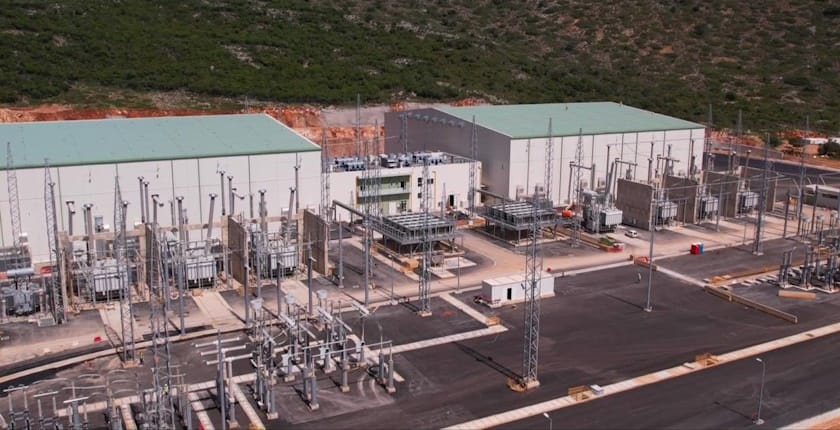
Final tests and equipment checks are being completed at the Damasta Converter Station in Heraklion ahead of the start of the trial operation of the Crete-Attica electricity link. The management of IPTO, also known by its Greek acronym Admie, and the HDVC Ariadne Interconnection project firm inspected the site.

The transmission system operator said it plans to energize it this week by injecting reactive power into the electricity system in the country’s biggest island.

The transmission of active power from Attica to Crete is set to begin in late May, the update adds. Ariadne consists of two 500 kV cables of  500 MW each. One end is in Pachi in the city of Megara, between Athens and Corinth, and the other one in Korakia in Crete. The submarine and underground cables were tested earlier.

Line on mainland is under trial electrification

At the same time, on the Attica side, a trial electrification of a 400 kV cable system is taking place between the Koumoundouros Converter Station and the adjacent Extra High Voltage Center. Ariadne Interconnection is the largest and most complex electricity transmission project in Greece so far, IPTO underscored.

Furthermore, a 150 kV transmission line between Chania and Damasta recently received the decision on the approval of environmental conditions (AEPO), the company added. It is considered necessary for an optimal combined use of Crete’s two interconnections with the mainland, the announcement reads. The first one, from Peloponnese, was established in 2021.

Ariadne, worth more than EUR 1.1 billion, is one of the three deepest interconnections in the world. The HVDC line’s capacity matches the interconnector to Sardinia, the strongest power link so far with an island.

The project is co-financed through the National Strategic Reference Framework (NSRF 2014-2020 and NSRF 2021-2027), via the European Union, with up to EUR 535.5 million. The idea for the endeavor dates back to the 1990s.

The contractors are Nexans and Prysmian. Each was responsible for one of the two cables while the latter also laid two submarine telecommunication lines.

Erdoğan again taunts Great Sea Interconnector by promising alternative cable

Ariadne is part of a proposed corridor with the Great Sea Interconnector project, formerly EuroAsia Interconnector, envisaged going to Cyprus and Israel. The Crete-Cyprus investment has been suffering heavy delays amid financing issues, ownership disputes and Turkey’s threats.

In early May, President Recep Tayyip Erdoğan visited the Cypriot Turkish breakaway republic, recognized only by Turkey, and promised an interconnection with his country. He compared it to an existing water pipeline.

“Did we bring water from under the sea to Northern Cyprus from Turkey? Now we are in the second stage. God willing, we will bring electricity and with that we will cover the needs of Northern Cyprus in water and electricity,” Erdoğan stated.

Notably, IPTO denied yesterday a press report that it is considering the possibility, together with Nexans, the contractor, to alter the route and connect Crete with the Dodecanese Islands instead of with Cyprus. The archipelago includes Rhodes, Astypalaia (Astypalea), Kos and Tilos.

EBRD is providing a grant for the first studies for an interconnection between Greece and Egypt

In other news, the European Bank for Reconstruction and Development (EBRD) and Elica Interconnector, a member of the Copelouzos Group, signed a grant agreement for the first studies for the planned Egypt-Greece (GREGY) electricity interconnection.

IPTO and its Italian counterpart Terna signed today a memorandum of understanding to install a second undersea HDVC power line. The GR.ITA 2 project is for a double cable, two times 500 MW, scheduled for completion in 2031. The two sides earmarked a total of EUR 1.9 billion.

The existing 500 MW interconnector, in operation since 2002, is temporarily down due to a malfunction.

by in News

Cypriot minister not optimistic about cable project with Greece amid Turkish intimidation

Cypriot Minister of Finance Makis Keravnos said the Great Sea Interconnector (GSI) project still faces very serious political obstacles. He highlighted the pressure from Turkey, alongside the financing disputes with Greece regarding the EU-backed bilateral investment to lay an undersea electricity cable that would connect the two countries.

Following a second incident this month when Turkish navy intimidated ships researching the seabed, Minister of Finance of Cyprus Makis Keravnos expressed doubt in the feasibility of the Great Sea Interconnector (GSI). It is a project to connect his country’s electricity system with Greece’s through Crete, by laying a cable under the sea.

“I can’t say I’m optimistic, especially when there are still very serious political obstacles, namely those posed by Turkey,” the official said, as quoted by domestic media. Namely, Turkish corvette TCG Bartın has approached Ievoli Relume and NG Worker, Italian vessels conducting research for the interconnection, in international waters just north of Crete.

GSI investment concerns now have to be addressed

Nevertheless, a recent due diligence study by a hired foreign consultancy showed the draft bilateral deal heavily favors Greece’s Independent Power Transmission Operator (IPTO or, in Greek, Admie). The authors warned of an “unnecessary additional layer of risks for any equity investors in GSI.”

Keravnos said the document confirms his concerns and that they must be discussed. While the two sides are working to overcome their financing dispute, the project is suffering delays, increasing the risk of cancellation.

Keravnos said in October that the total cost could well surpass EUR 2 billion. The Crete-Cyprus part is substantially leaning on funding from the European Union. The idea was to later extend the interconnector to Israel.

Turkey has been obstructing both GSI surveys and hydrocarbon exploration around Cyprus. There were several incidents involving gunboats.

Cyprus craves interconnections, flexibility sollutions

Meanwhile, Cyprus is struggling to maintain the stability of its isolated electricity system. Oil-fired power plants are increasingly working near their upper limits in peak hours. Conversely, storage capacities, flexibility systems and digital controls are needed for mitigating the pressure on the grid at times of weather-induced jumps in the production of wind and solar power, but also sharp drops.

It is the only noninterconnected country in the European Union. Moreover, Cyprus has no access to natural gas yet.

GSI was formerly known as EuroAsia Interconnector.

by in News

Race against time for Greece to avoid a blackout on Easter

Greek authorities are rushing to secure the electricity system against a possible blackout during Easter.

Greece currently produces much more electricity than it needs on certain days due to a high renewables penetration and insufficient energy storage. It should be noted that in 2024 the country became a net power exporter for the first time after two decades. Usually, extra power is no problem, as it is exported and curtailments ensure nominal system operation with no danger of a blackout.

However, this year there will be days when low demand combined with high renewable electricity production creates a problem. At Easter, demand traditionally craters.

Independent Power Transmission Operator (IPTO or Admie) estimates that on Easter Sunday the country’s interconnections would operate near their maximum safety limits. If even a single line goes offline, it would lead to a domino effect and the possible loss of all the connections with neighboring countries. As a result, the frequency will rise beyond safe limits in the Greek system, triggering the desynchronization of power plants and a blackout.

To avoid such a scenario, authorities have imposed adding telemetry systems in recent months to photovoltaic units of over 400 kW connected to the distribution network. Currently, the Hellenic Electricity Distribution Network Operator (HEDNO or DEDDIE) can curtail 1.9 GW of solar power capacity, but another 6 GW is unswitchable.

Telemetry must be enabled by April in small PV units

A deadline was given until February 13 to the owners within the latter category to add telemetry equipment so that HEDNO can curtail their production when needed. However, very few complied and the rest said they are still waiting for the systems to be delivered.

HEDNO estimates that 5,700 plants with capacities of 400 kW to 1 MW must be added to curtailments, as well as 600 plants with more than 1 MW apiece.

Based on the above, owners of solar power units and the two grid operators must add the ability by April to ensure system stability.

Gradual installation of energy storage facilities is expected to help significantly and bring curtailments down.

by in News

Greek renewables sector slams curtailments bill for not including compensation

Power network operators won’t need to compensate renewable energy producers in Greece for curtailments, according to the latest bill of law. It prompted reactions in the renewable energy market.

The bill, submitted for public consultation, received damning remarks from the Hellenic Wind Energy Association (HWEA or ELETAEN) and various other bodies and corporations for the provisions regarding curtailments.

The country’s two operators wouldn’t be obligated to pay compensation. It should be noted that last year curtailments rose by 277% and reached 3.3% of all renewable production in Greece. They are projected to reach new highs in 2025.

The issue primarily plagues larger plants including wind farms, as they have the technical ability to respond to curtailment orders from the Independent Power Transmission Operator (IPTO or Admie). Conversely, smaller photovoltaic facilities connected to the grid of the Hellenic Distribution Network Operator (HEDNO or DEDDIE) have no such telemetering equipment, so they produce freely at all times.

Indeed, Greek authorities aim to make such systems mandatory in smaller renewables plants to be able to curtail them, to maintain system stability, especially during the days of Easter. If an owner fails to make necessary changes, they would be subject to a high penalty, yet to be determined.

Producers point to European law for compensation

HWEA expressed the belief operators should be exempted from compensation only if a proper framework is established that compensates larger producers for curtailments. In practice, it means any revenue collected from the penalties should be used as compensation for other producers.

HWEA: Producer compensation mechanism is necessary

The association added that compensation is obligatory under European law and therefore needs to be included in the regulatory framework.

“The only right way is for the government to conclude the long-awaited framework and introduce a specific producer compensation mechanism,” HWEA pointed out.

Cero Generation Holdings Greece said it is very concerned about proposals for IPTO and HEDNO not to be obliged to provide any compensation.

Curtailment responsibility shifted to aggregators

Another issue concerns the role of renewable energy aggregators, which represent groups of smaller producers in the market. Both HWEA and Elpedison said it is the operators that need to enforce and manage curtailments, and not aggregators, as in the proposed law.

With such measures, aggregators will face increased costs as well as the possibility of having their license recalled if they cannot carry out their new duties, the company pointed out.

by in News

Greece’s IPTO connects to balancing energy platform PICASSO

The Independent Power Transmission Operator of Greece announced that it connected to PICASSO. It is the second transmission system operator or TSO in Southeastern Europe that joined the European platform, so now it can exchange balancing energy with its counterpart in Bulgaria. In addition, IPTO (or Admie, in Greek) has proposed the introduction of negative prices in the domestic balancing market.

The Platform for the International Coordination of Automated Frequency Restoration and Stable System Operation (PICASSO) optimizes balancing energy between control blocks in the Continental Europe synchronous area. Bulgaria’s Electricity System Operator (ESO) joined last month, but it was isolated as it didn’t share electrical borders with any other operational member. Neighboring Greece’s transmission system operator IPTO (or, in Greek, Admie), has just connected to the platform, so the two countries can now exchange balancing energy.

Denmark, Germany, Belgium, the Netherlands, Czech Republic, Slovakia, Austria and Italy are a geographically separate group within PICASSO. Lithuania’s Litgrid joined earlier this month.

Key step for common European energy market

By becoming the 14th operational member, IPTO made a key step in the process of formation of a resilient and efficient common European energy market, the statement adds. The PICASSO methodology and algorithm are intended primarily for the cross-border provision of secondary reserve so that the electricity grid’s operating frequency remains stable.

There are 29 TSOs from the European Network of Transmission System Operators for Electricity – ENTSO-E in the project. Additionally, North Macedonia’s MEPSO, which has electrical borders with both Bulgaria and Greece, is an observer in PICASSO. The platform doesn’t include the rest of the Western Balkans.

With the latest achievement, IPTO and ESO can jointly benefit from the automatic frequency restoration reserve (aFRR). Romania has been delaying its connection to PICASSO.

The platform collects and rates all available offers for balancing energy from aFRR according to their prices, placing them into a common merit order list – CMOL.

PICASSO helping reduce number of balancing price spike events

The new method for calculating cross-border marginal prices on PICASSO has greatly improved performance as the number of instances of electricity balancing price spikes dropped, according to European Union Agency for the Cooperation of Energy Regulators (ACER). Integrating balancing markets across borders lowers costs and improves efficiency by allowing TSOs to activate cheaper balancing energy bids, the body explained.

In other relevant news, IPTO has proposed the introduction of negative prices in the balancing market in Greece of EUR 50 per MWh at most for one year, Energypress reported. The change would enter into force on allocation day April 10, ahead of Easter, a critical moment for grid stability.

The TSO said the limit should be boosted to EUR 15,000 per MWh after joining PICASSO.