AEA-Albania Energy Association
  • Main
  • About Us
  • Services
  • Sectors
  • News
  • EventsEvents
  • PublicationPublication
  • Contact Us
AEA-Albania Energy Association
  • Main
  • About Us
  • Services
  • Sectors
  • News
  • EventsEvents
  • PublicationPublication
  • Contact Us
AEA-Albania Energy Association
  • Home Page
  • About Us
  • Sectors
  • Our Services
  • News
  • Contact Us

Publication

January 28, 2015
by AEA in Publication

The 2014 oil price slump: Seven key questions

Seven questions

This column attempts to answer seven key questions about the oil price decline:

  1. What are the respective roles of demand and supply factors?
  2. How persistent is the supply shift likely to be?
  3. What are the effects likely to be on the global economy?
  4. What are likely to be the effects on oil importers?
  5. What are likely to be the effects on oil exporters?
  6. What are the financial implications?
  7. What should be the policy response of oil importers and exporters?

Oil prices have fallen by nearly 50% since June, and by 40% since September (see Figure 1).1 Metal prices, which typically react to global activity even more than oil prices, have also decreased but by substantially less than oil (see Figure 2). This casual observation suggests that factors specific to the oil market, especially supply ones, could have played an important role in explaining the drop in oil prices.

Figure 1 Oil prices
(US dollars a barrel)

Figure 2 Commodity price indices
(January 1, 2014=100)

A closer look reinforces this conclusion. Revisions between June and December of International Energy Agency forecasts of demand (see Figure 3), combined with estimates of the short-run elasticity of oil supply, suggest that unexpected lower demand between then and now can account for only 20-35% of the price decline.

Figure 3 IEA forecast of world oil demand growth
(year-on-year change in million barrels a day)

On the supply side, the evidence points to a number of factors, including surprise increases in oil production. This is in part due to faster than expected recovery of Libyan oil production in September and unaffected Iraq production, despite unrest.2

A major factor, however, is surely the publicly announced intention of Saudi Arabia – the biggest oil producer within OPEC – not to counter the steadily increasing supply of oil from both other OPEC and non-OPEC producers, and the subsequent November decision by OPEC to maintain their collective production ceiling of 30 million barrels a day in spite of a perceived glut.

The steady increase in global oil production could be seen as ‘the dog that didn’t bark’. In other words, oil prices had stayed relatively high in spite of the upward trajectory in global oil production due to the perception at the time of OPEC’s induced floor price. The resulting shift by the swing producer, however, helped trigger a fundamental change in expectations about the future path of global oil supply, in turn explaining both the timing and the magnitude of the fall in oil prices, and bringing the latter closer to the level of a competitive market equilibrium. A similarly dramatic drop took place in 1986, when Saudi Arabia voluntarily stopped being the swing producer, causing oil prices to fall from $27 to $14 per barrel, only to recover 15 years later in 2000.

Beyond traditional demand and supply factors, some have pointed to ‘financialisation’ – oil and other commodities considered by financial investors as a distinct asset class – and ‘speculation’ as contributors to the price decline.3 We see little evidence that this is the case. According to the latest report from the International Energy Agency, oil inventories have reached their highest level in two years, suggesting expectations of price increases, not price declines.

How persistent is the supply shift likely to be?

This depends primarily on two factors.

The first is whether OPEC, and in particular Saudi Arabia, will be willing to cut production in the future. This in turn depends in part on the motives behind its change in strategy, and the relative importance of geopolitical and economic factors in that decision. One hypothesis is that Saudi Arabia has found it too costly, in the face of steady increases in non-OPEC supply, to be the swing producer and maintain a high price. If so, and unless the pain of lower revenues leads other OPEC producers and Russia to agree to share cuts more widely in the future, the shift in strategy is unlikely to change soon. Another hypothesis is that it may be an attempt by OPEC to reduce profits, investment, and eventually supply by non-OPEC suppliers, some of whom face much higher costs of extraction than the main OPEC producers (see Figure 4, which gives the world marginal cost curve, showing how much it costs to produce an additional barrel by type of oil extraction).

Figure 4 Global liquid supply cost curve
(USD/bbl)

Source: Rystad Energy research and analysis.

The second factor is how investment and, in turn, oil production will respond to low oil prices. There is some evidence that capital expenditure on oil production has started to fall. According to Rystad Energy, overall capital expenditure of major oil companies is 7% lower for the third quarter of 2014 compared to 2013.

Available projections from the same source indicate that capital expenditures will fall markedly until 2017. For unconventional oil such as shale (which now accounts for 4 million out of a world supply of 93 million barrels a day), the break-even prices – the oil price at which it becomes worthwhile to extract – of the main US shale fields (Bakken, Eagle Ford and Permian) are typically below $60 per barrel (see Figure 5, which gives break-even prices for the US shale fields).

At current prices (around $55 per barrel), Rystad Energy’s projections suggest that the level of oil production could decline, but only moderately by about under 4% in 2015. Rates of return will be significantly lower, however, and some highly leveraged firms that did not hedge against lower prices are already under financial stress and have been cutting their capital expenditure and laying off significantly.

Figure 5 Average WTI breakeven different US oil price for shale plays

Note: WTI oil price which gives NPV of zero at 10% discount rate.
Source: Rystad Energy research and analysis.

Thus, other things being equal, the dynamic effects of low prices on supply should lead to a decrease in supply relative to the initial shift, and thus to a partial recovery of prices.  This is what is suggested by futures markets, which show, in the left-hand panel of Figure 6, an expected recovery of prices to $73 a barrel by 2019.

The uncertainty associated with these forecasts comes not only from supply but also demand factors.

On the supply side, for example, possible changes in OPEC’s strategy and geopolitical tensions in Libya, Iraq, Ukraine, and Russia should not be underestimated. On the demand side, uncertainty about global economic activity, and thus the derived demand for oil, remains high.  This is shown, emphatically, by the size of the implied distribution of futures prices (based on options prices) in the right-hand panel of Figure 6:  the 68% confidence band for the price in 2019 ranges from $48 to $85, and the 95% band from $38 to $115; a very wide range indeed.

Figure 6

What are the effects likely to be on the global economy?

Overall, lower oil prices due to supply shifts are good news for the global economy, obviously with major distribution effects between oil importers and oil exporters. The crucial assumptions in quantifying the effects of those supply shifts are how large and persistent we expect them to be. These assumptions determine not only the path of adjustment, but also the initial reaction of consumers and firms.

Given the uncertainty about the relative importance of supply shifts, both now and expected in the future, we present the results of two simulations (these are ceteris paribus in nature, not projections about the global economy, and as such ignore all other shocks likely to affect the global economy), which we see as representing a reasonable range of assumptions. The first assumes that the supply shift accounts for 60% of the price decline reflected in futures markets. The second also assumes that the supply shift accounts for 60% of the price decline at the start, but that the shift is partly undone over time for the reasons described above, with its contribution to the price decline falling gradually to zero in 2019.4

The results of the simulations shown below capture only the effects of the supply component of the oil price decline (the demand driven component of the oil price decline is a symptom of slowing global economic activity rather than a cause). The oil price projection used in the simulations is based on the IMF’s price forecast, which is itself based on futures contracts.

The results for global GDP are shown in Figure 7. The first simulation implies an increase in global output of 0.7% in 2015 and 0.8% in 2016 relative to the baseline (the situation without the oil price drop). Not surprisingly, in the second scenario, the effect on output is smaller: of the order of 0.3% in 2015 and 0.4% in 2016. The range of these effects includes predictions that would be obtained using existing empirical estimates for advanced economies. Estimates from Blanchard and Gali  (2009), for example, find that the effect of a permanent (supply-driven) decrease in the price of oil by 10% leads to an increase in US output by about 0.2%.5 Given a supply component of the price decline of about 25% (i.e. 60% of a total decline of 40%), these estimates would therefore imply an increase in output of about 0.5%.

Figure 7 Global GDP
(percent difference)

These global results mask asymmetric effects from lower prices across countries. Winners are the (net) oil importing countries, losers are (net) oil exporting countries. But, even within each group, there are important differences.

What are likely to be the effects on oil importers?

There are three main channels through which a decrease in the price of oil affects oil importers. The first is the effect of the increase in real income on consumption. The second is the decrease in the cost of production of final goods, and in turn on profit and investment.  The third is the effect on the rate of inflation, both headline and core.

The strength of these effects varies across countries.

For example, the real income effect is smaller for the US, which now produces over half of the oil it consumes, than for the Eurozone or for Japan. The real income and profit effects also depend on the energy intensity of the country: China and India remain substantially more energy-intensive than advanced economies, and thus benefit more from lower energy prices. The share of oil consumption in GDP is on average 3.8% for the US, compared to 5.4% for China and 7.5% for India and Indonesia.6

The effect on core inflation depends both on the direct effect of lower oil prices on headline inflation and on the passthrough of oil prices to wages and other prices.  The strength of the passthrough depends on real wage rigidities – the way nominal wages respond to CPI inflation – and the anchoring of inflation expectations.

In normal times, monetary policy would respond to lower core inflation through a greater than one-for-one decrease in the nominal interest rate, and thus a lower real interest rate. However, times are not normal, and the major advanced economies are constrained by interest rates at zero, leaving aside quantitative easing. While the US, which is getting closer to exiting this zero lower bound, can respond to a decrease in inflation by delaying the timing of its exit, the Eurozone and Japan, which are expected to remain at the zero lower bound for a long time, cannot materially change their conventional monetary policy.

Our simulations reflect, to the best possible extent, these differences in energy intensity, in the proportion of oil produced at home, and in monetary policy constraints. We assume that inflation expectations are similarly anchored in the US, the Eurozone, and Japan, leading to a pass through of about 0.2, so a decrease in core inflation of 0.2 percentage points when headline inflation decreases by 1 percentage point.

The implications for GDP are shown in Figure 8 for the two simulations described earlier.

Figure 8

The effects on China in both scenarios are larger than those for Japan, the US and Eurozone countries. For China, GDP increases by 0.4-0.7% above the baseline in 2015, and by 0.5-0.9% in 2016. For the US, GDP increases by 0.2-0.5% above the baseline in 2015, and by 0.3-0.6% in 2016. (The simulation assumptions do not take into account the potential offset from some policies that governments may implement following the fall in oil prices. For example, China may decide to tighten monetary or fiscal policy in response to the oil price decline).

Other effects are relevant, which our simulations do not take into account. Among these are the following.

The depreciation of the yen and the euro since June (by 14% and 8%, respectively, for reasons mostly unrelated to the decline in the price of oil) implies that the decrease in the price of oil in terms of yen and euros has been smaller than in dollars, namely 36% and 40%, respectively. Those depreciations somewhat mute the impact of the oil price slump for Japan and the Eurozone compared to our simulations.

In countries that have large specific – as opposed to proportional – taxes on energy (that is, they levy a fixed dollar or euro amount per gallon or litre), the same percentage decrease in the world price of oil leads to a smaller percentage decrease in the price paid by consumers and firms. Countries may also use the opportunity of a decreasing price of oil to reduce energy subsidies – a move that has been generally recommended by the IMF – leading again to a smaller decline in the price paid by consumers and firms.

Some oil importers depend heavily on what happens to oil exporters, and thus may benefit less from lower oil prices. For example, low-income importers in the Caribbean that benefit from transfers under Venezuela’s Petrocaribe regime could face a marked reduction in transfers as Venezuela itself comes under pressure. Caucasus and central Asian oil importers are likely to experience adverse spillovers from slowing growth in their oil-exporting neighbours, particularly Russia, which will reduce non-oil exports and remittances. Mashreq countries and Pakistan might also be adversely affected through a decline in non-oil exports, official transfers and remittances from the member countries of the Gulf Cooperation Council, especially over the medium term.

What are likely to be the effects on oil exporters?

As Figure 8 shows, the effect is, not surprisingly, negative for oil exporters. Here again, however, there are substantial differences across countries.

In all countries, real income goes down, and so do profits in oil production; these are the mirror images of what happens in oil importers.  But the degree to which they fall and the effect of the decline in the price of oil on GDP depend very much on their degree of dependence on oil exports, and on what proportion of revenues goes to the state.

Oil exports are much more concentrated across countries than oil imports.  Put another way, oil exporters depend much more on oil than oil importers.

To take some examples, energy accounts for 25% of Russia’s GDP, 70% of its exports, and 50% of federal revenues. In the Middle East, the share of oil in federal government revenue is 22.5% of GDP and 63.6% of exports for the Gulf Cooperation Council countries. In Africa, oil exports account for 40-50% of GDP for Gabon, Angola and the Republic of Congo, and 80% of GDP for Equatorial Guinea. Oil also accounts for 75% of government revenues in Angola, Republic of Congo and Equatorial Guinea. For Ecuador and Venezuela, oil contributes respectively about 30% and 46.6% to public sector revenues, and about 55% and 94% of exports.7 This shows the dimension of the challenge facing these countries.

In most countries, a mechanical effect of the oil price decline is likely to be a fiscal deficit. One way to illustrate the vulnerabilities of oil-exporting countries is to compute the so-called fiscal break-even prices – that is, the oil prices at which the governments of oil-exporting countries balance their budgets. The break-even prices vary considerably across countries, but are often very high.8 For Middle Eastern and central Asian countries, the break-even prices range from $54 per barrel for Kuwait to $184 for Libya, with a notable $106 for Saudi Arabia (see Figure 9).  For countries for which we do not have available data on break-even prices, budgetary oil prices (that is, the oil prices that countries assume in preparing their budget) are another way to gauge their vulnerability to falling oil prices.

Figure 9 2015 Fiscal Breakeven oil prices
(USD per barrel)

Note: IMF, Middle East and Central Asia Department.

For Africa, those budgetary oil prices have been revised down for 2015 in light of the falling prices (see Figure 10). For Latin America, the budgetary oil prices are $79.7 for Ecuador and $60 for Venezuela.

Figure 10 Sub-Saharan Africa budgetary price of oil, 2014-15

Some countries are better equipped than in previous episodes to manage the adjustment. A few (e.g. Norway) have put in place policy cushions such as fiscal rules and saving funds and have a more credible monetary framework, which has helped decouple internal from external balances.

But in many countries, the adjustment will imply fiscal tightening, lower output, and a depreciation (harder to achieve under the fixed exchange rate regimes that characterise many oil exporters).  And where expectations of inflation are not well anchored, the depreciation may lead to higher inflation.

What are the financial implications?

Declines in oil prices have financial implications, directly through the effects of oil prices themselves, and indirectly through the induced adjustment of exchange rates.

Lower oil prices weaken the financial position of firms in the energy sector, especially those that have borrowed in dollars, and by implication weaken the position of banks and other institutions with substantial claims on the energy sector. The proportion of energy firms with an interest coverage ratio (the ratio of cash flows to interest payments) of below 2 stands at 31% in emerging countries, indicating that some of these companies may indeed be at risk. CEMBI spreads, which reflect spreads on high-yield emerging market corporates, have increased by 100 basis points since June.

Stress tests carried out in the context of our financial stability assessments over the past few years in a number of oil-exporting countries had found only a few countries where some banks did not pass the tests, implying recapitalisation needs of a few points of GDP at most. However, those stress test results may not be very informative, since the capital buffers at the time of the tests may have changed, as well as the profitability of banks. Russia is a good example of rapidly evolving conditions in both respects, considering the effect of sanctions on its financial sector. Overall the impact of lower oil prices on banks in oil-exporting countries will depend critically on how persistent the fall in price is and its impact on economic activity and, in turn, on prevailing buffers.

Lower oil prices also typically lead to an appreciation of oil importers’ currencies, in particular the dollar, and to a depreciation of oil exporters’ currencies. The drop in oil price has contributed to an abrupt depreciation of currencies in a number of oil-exporting countries, including Russia and Nigeria. While the decrease in the price of oil is only one of the reasons behind the fall of the rouble, the Russian currency has depreciated by 40% so far this year, and by 56% since September. While controlled depreciations can help oil exporters adjust, they also exacerbate financial problems for those firms and governments whose debt is denominated in dollars. And, in countries where expectations are not well anchored, uncontrolled depreciations can lead quickly to very high inflation.

If sustained, the oil price slump will thus have a concentrated and material impact on those bondholders and banks with high dollar and energy sector exposures. However, the global banking system’s exposure is likely not to be large enough to cause more than a moderate increase in provisioning requirements and should be partially offset by improving credit quality in oil-importing countries and sectors. Some oil importers may nevertheless have financial sector linkages to oil exporters, and may be exposed to economic and financial developments in the latter. For example, Austrian banks have significant exposure to Russia, and some have seen a very sharp decline in their equity price recently.

This relatively optimistic assessment must, however, come with a clear warning.  One of the lessons from the Great Financial Crisis is that large changes in prices and exchange rates, and the implied increased uncertainty about the position of some firms and some countries, can lead to increases in global risk aversion, with major implications for the re-pricing of risk and for shifts in capital flows. This is all the more true when combined with other developments such as what is happening in Russia. One cannot completely dismiss this tail risk.

What should be the policy response of oil importers and exporters?

Clearly, the appropriate policy response to falling oil prices will depend on whether the country is an oil importer or exporter. The exception is the shared opportunity provided by low oil prices to reform energy subsidies and energy taxes. The IMF has long advocated that governments use the saving from the removal of energy subsidies toward more targeted transfers.9 Low prices provide a great opportunity to remove subsidies at less political cost. For example, India was able to decrease diesel subsidies recently, and there were no protests as the price did not rise.  And, in a number of advanced countries, this might be an opportunity to increase energy taxes, using the savings to reduce other taxes, such as labour taxes.

Now let’s turn to oil-importing countries. In normal times, for a country in good macroeconomic health – say, no output gap, inflation is on target and the current account is balanced – the advice is well honed, learned from past movements in oil prices: monetary policy should make sure that, in the face of lower headline inflation, inflation expectations remain anchored, and try to maintain stable core inflation. Whether this implies an increase or a decrease in the interest rate is ambiguous. On the one hand, higher demand calls for higher interest rates; on the other hand, keeping core inflation from declining may call for lowering interest rates. In general, whatever the interest rate does, the improvement in the current account balance is likely to generate an exchange rate appreciation.  This appreciation is natural, and desirable.

Times are not normal, however. Most large advanced economies suffer from a substantial output gap, inflation below target, and conventional monetary policy constrained by interest rates close to zero. This suggests that any increase in demand is welcome at this stage, and that lower inflation, which cannot be offset by lower interest rates, is more dangerous. Against this backdrop, use of forward guidance to anchor medium-run inflation expectations and avoid sustained deflation is crucial.

One might think that the appropriate policy response for oil exporters is the same as that for oil importers, but with the sign reversed.  Importers differ from exporters, however, in two important ways: first, the size of the shock faced by oil exporters as a proportion of their economy is much larger than for oil importers; and second, the contribution of oil revenues to fiscal revenues is typically much higher.  Thus, in all countries, lower fiscal revenues, and the risk that prices remain low for some time, imply the need for some decrease in government spending.

In countries that have accumulated substantial funds from past higher prices, allowing for larger fiscal deficits and drawing on those funds for some time is appropriate. This is even more so for exporters with fixed exchange rates, and where the real depreciation needed for adjustment may take some time to achieve.

For countries without such fiscal space, and where room to increase the fiscal deficit is limited, the adjustment will be tougher. Those countries need a larger real depreciation.  And they need a strong monetary framework to avoid depreciation leading to persistently higher inflation and further depreciation. This will indeed be a challenge for a few oil exporters.

Summary

  • We find that both supply and demand factors have played a role in the sharp price decline since June.

Futures markets suggest that oil prices will rebound but will remain below the level of recent years. There is, however, substantial uncertainty about the evolution of supply and demand factors as the story unfolds.

  • While no two countries will experience the drop in the same way, they share some common traits: oil importers among advanced economies, and even more so among emerging markets, stand to benefit from higher household income, lower input costs, and improved external positions.

Oil exporters will take in less revenue, and their budgets and external balances will be under pressure.

  • Risks to financial stability have increased, but remain limited.

Currency pressures have so far been limited to a handful of oil-exporting countries such as Russia, Nigeria, and Venezuela. Given global financial linkages, these developments demand increased vigilance all-round.

  • Oil exporters will want to smooth out the adjustment by not curtailing fiscal spending abruptly.

For those without savings funds and strong fiscal rules, however, budgetary and exchange rate pressures may be significant. Without the right monetary policies, this could lead to higher inflation and further depreciation.

  • The fall in oil prices provides an opportunity for many countries to decrease energy subsidies and use the savings toward more targeted transfers.

For others it is a chance to increase energy taxes and lower other taxes.

  • In the Eurozone and Japan, where demand is weak and conventional monetary policy has done most of what it can, central banks’ forward guidance is crucial to anchor medium-term inflation expectations in the face of falling oil prices.

Editor’s note: This column presents the IMF’s latest thinking on the big oil price drop.  The simulations do not represent an IMF forecast for the state of the world economy in 2015 and beyond as it does not take account of the many other cross-currents driving growth, inflation, global imbalances and financial stability.  The column was first posted on the IMF blog Seven Questions About The Recent Oil Price Slump, 22 December 2014. The authors are grateful to numerous colleagues, in particular Thomas Helbling, Ben Hunt, Douglas Laxton, Prakash Loungani, Akito Matsumoto, Gian Maria Milesi Ferretti, as well as colleagues in the modelling and commodities teams and in the African, Asia Pacific, Europe, Fiscal Affairs, Middle East and Central Asia, Monetary and Capital Markets, Strategy and Policy Review and Western Hemisphere departments. They also thank Rystad Energy and Per Magnus Nysveen in particular for kindly providing proprietary data on capital expenditures and cost structures.

References

Arezki, R, P Loungani, R van der Ploeg and T and Venables (2014), “Understanding International Commodity Price Fluctuations”, Journal of International Money and Finance 42, 1-8.

Blanchard, O J and J Gali (2009), “The Macroeconomic Effects of Oil Price Shocks: Why are the 2000s so different from the 1970s?”, in J Gali and M Gertler (eds), International Dimensions of Monetary Policy, Chicago, IL: University of Chicago Press, pp. 373-428.

Baumeister, C and G Peersman (2013), “The Role Of Time‐Varying Price Elasticities In Accounting For Volatility Changes In The Crude Oil Market”, Journal of Applied Econometrics 28(7), 1087-1109.

BP, (2014). BP Statistical Review of World Energy. Retrieved  December 2014, fromhttp://www.bp.com/en/global/corporate/about-bp/energy-economics/statistical-review-of-world-energy.html

Cashin, P, K Mohaddes, M Raissi and M Raissi (2014), “The differential effects of oil demand and supply shocks on the global economy”, Energy Economics 44, 113-134.

IMF (2013), Energy Subsidy Reform: Lessons and Implications, report prepared by a staff team led by B Clements, Washington: International Monetary Fund.

Hamilton, J D (2003), “What is an oil shock?,” Journal of Econometrics 113(2), 363-398.

Kilian, L (2009), “Not All Oil Price Shocks Are Alike: Disentangling Demand and Supply Shocks in the Crude Oil Market”, American Economic Review 99(3), 1053-69.

Parry, I, D Heine, E Lis and S Li (2014), Getting Energy Prices Right: From Principle to Practice, Washington: International Monetary Fund.

Peersman, G and I Van Robays (2012), “Cross-country differences in the effects of oil shocks”,Energy Economics 34(5), 1532-1547.

Endnotes

[1] These price changes are based on the IMF average petroleum spot price (APSP), a simple average of UK Brent, Dubai, and West Texas Intermediate.

[2] Gains from Libyan production in September have, however, reversed in November according to the latest report from the International Energy Agency.

[3] See Arezki et al. (2014) and references therein for a discussion on the respective role of fundamentals and financialisation in driving commodity price fluctuations.

[4] The supply component in the second scenario is 60% in 2014, 45% in 2015, 30% in 2016, 20% in 2017, 10% in 2018 and zero in 2019.

[5] In their recent assessments of the effects of the oil price decline, the Bundesbank estimates that a price decline of $10 lead to 0.2% increase in GDP in year one, and the French authorities estimate that the same price decline would raise GDP by 0.1% after two years. In the academic literature, Hamilton (2003) and Kilian (2009) provide empirical investigations of the relationship between oil prices and the macroeconomy, including a discussion on the identification of supply versus demand shocks. Baumeister and Peersman (2013), Peersman and Van Robays (2012) and Cashin et al. (2014) provide cross-country and time varying estimates of the effect of oil prices on output.

[6] The oil cost share is computed as the ratio between oil consumption and GDP average over the period 2004-2014. The data sources are BP Statistical Review (2014) and staff own calculations.

[7] For Venezuela, the latest available estimate of the share of oil in public sector is for 2013 and is the share to central government revenue.

[8] The calculations of the fiscal break-even prices ignore the offsetting effects of depreciations. In general, an exchange rate depreciation would help partly offset the effect of falling oil prices on oil export receipts in local currency.

[9] See IMF (2013) on energy subsidy reforms. See also Parry et al. (2014), who find that for many countries energy prices are below the levels that fully reflect the negative externalities from energy consumption

 

January 15, 2015
by AEA in Publication

How the shale oil revolution has affected US oil and gasoline prices

o-FRACKING-facebookThe recent expansion of US shale oil production has captured the imagination of policymakers and industry analysts. It has fuelled visions of the US becoming independent of oil imports, of cheap US gasoline, of a rebirth of US manufacturing, and of net oil exports improving the US current account. This column asks how plausible these visions are, and examines the evidence to date.

Only a few years ago, many observers expected a steadily growing global shortage of crude oil. This shortage did not materialise in part because of the rapidly growing production of shale oil in the US. The production of shale oil (also referred to as tight oil) exploits technological advances in drilling. It involves horizontal drilling and the hydraulic fracturing (or fracking) of underground rock formations containing deposits of crude oil that are trapped within the rock. This process is used to extract crude oil that would have been impossible to release by conventional drilling methods designed for extracting oil from permeable rock formations. Shale oil production relies on the availability of suitable drilling rigs and skilled labour, which is one of the reasons why the US shale oil boom so far has been difficult to replicate in other countries.

US shale oil production has grown from about 0.4 million barrels a day in 2007 to more than 4 million barrels a day in 2014. This expansion was stimulated by the high price of crude oil after 2003, which made the application of these new drilling technologies cost competitive. The expansion of US shale oil production soon captured the imagination of policymakers and industry analysts. By 2012, the International Energy Agency projected that the US would become the world’s leading crude oil producer, overtaking Saudi Arabia by the mid-2020s and evolving into a net oil exporter by 2030 (International Energy Agency 2012). Pundits envisioned the US becoming independent of oil imports, net oil exports financing the US non-oil trade deficit, and consumers enjoying an era of cheap gasoline with a resulting rebirth of US manufacturing. My recent research, however, suggests that these visions remain far removed from reality (Kilian 2014).

Uncertainty about the US shale oil boom

To gauge the importance of shale oil for the US economy it is useful to bear in mind that, as of March 2014, shale oil accounted for almost half of US oil production, but only about a quarter of the total quantity of oil used by the US economy. This magnitude is far from negligible, but to understand the excitement about shale oil one has to consider projections of future US shale oil production.

Publicly available projections of future shale oil production have to be interpreted with some caution.

  • One concern is that increases in shale oil production are not permanent.

Sustained production requires ongoing investment. Projections by the US Energy Information Administration suggest that even under favourable conditions US shale oil production will peak by 2020 (at a level commensurate with US oil production in 1970) and then decline. Moreover, even the peak level would be far below what is needed to satisfy US oil demand.

  • A second concern is that estimates of the stock of shale oil that can be recovered using current technology are subject to considerable error.

In the summer of 2014, for example, the Energy Information Administration was forced to lower its previous estimates of the stock of recoverable shale oil by 64%.

  • A third concern is that it is not known how vulnerable the shale oil industry is to downside oil price risk.

This concern has become particularly relevant in recent months with the rapid decline in global oil prices. Shale oil production remains profitable as long as the price of oil exceeds marginal cost. There are indications that the initially high marginal cost of shale oil production has been declining substantially, as the shale oil industry has gained experience, but there are no reliable industry-level estimates of marginal cost.

In short, there is considerable uncertainty about the persistence and scope of the US shale oil boom, and there are many reasons to be skeptical of the notion that the US will soon (or indeed ever) become independent of oil imports.

Today, the US is the third-largest oil producer, slightly behind Saudi Arabia and Russia, with US crude oil accounting for about 10% of world production. Much has been made of the possibility of the US overtaking Saudi Arabia as the largest oil producer in the world, as the production of shale oil continues to surge. The implicit premise has been that being a large oil producer ensures a country’s energy security. It is easy to forget, however, that the US already was the world’s largest oil producer in 1973/1974 as well as in 1990. This fact did not protect the US economy from major foreign oil price shocks, suggesting that the focus on becoming the world’s largest oil producer is misplaced.

Imperfect substitutability between different types of crude oil

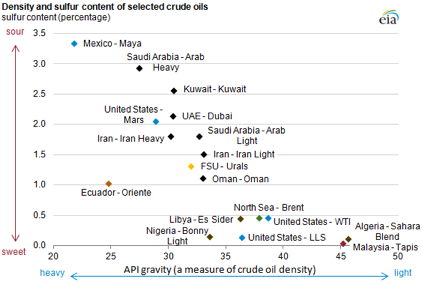
Even more importantly, the shale oil debate has largely ignored the fact that shale oil is not a perfect substitute for conventional crude oil, making comparisons across countries difficult. The quality of crude oil can be characterised mainly along two dimensions. One is the oil’s density (ranging fromlight to heavy) and is typically measured based on the American Petroleum Institute (API) gravity formula; the other is its sulphur content (with sweet referring to low-sulphur content and sour to high-sulphur content). Figure 1 provides an overview of how commonly quoted crude oil benchmarks (including West Texas Intermediate (WTI) and Brent oil in the North Sea) can be characterised along these dimensions. Shale oil consists of light sweet crude (at most 45 API), ultra-light sweet crude (about 47 API), and condensates (as high as 60API). Thus, not all shale oil is a good substitute for conventional light sweet crude oil such as the WTI or Brent benchmarks, and an aggregate analysis of the crude oil market tends to be misleading. In reality, the impact of shale has been far more complicated.

Figure 1. Classification of conventional crude oil benchmarks

Source: US Energy Information Administration.

Notes: MARS refers to an offshore drilling site in the Gulf of Mexico. WTI = West Texas Intermediate. LLS = Louisiana Light Sweet. FSU = Former Soviet Union. UAE = United Arab Emirates.

The US shale oil boom was preceded by a persistent and growing shortage of light sweet crude oil in world markets. US refiners responded to this trend by expanding their capacity to process heavy crudes that remained in abundant supply, becoming the world leader in this field. They were therefore taken by surprise when the US market was inundated with shale crude oil from the centre of the country after 2010. Not only was much of the refining structure ill-equipped to process this light sweet crude oil, but it proved difficult to ship the shale oil to those refineries on the coasts that would have been able to process it. With the development of shale oil in the interior of the country, large parts of the US oil pipeline infrastructure developed over the preceding 40 years had suddenly become obsolete, and rail and barge transport could not cope with increased demand. Moreover, exports of US shale oil that cannot be processed domestically were (and continue to be) prohibited by US law.

The resulting local excess supply of light sweet crude oil in the central US caused the WTI price of oil to fall below the Brent price. This discrepancy between domestic and global oil prices resulted from a breakdown of arbitrage between domestic and imported light sweet crude oil. There are signs that the US refining industry is gradually responding to these price differentials. Reconfiguring the US refining and transportation infrastructure, however, is a costly and slow process. For the time being, therefore, the evolution of the US price of oil is inextricably tied to improvements in the US refining, pipeline, and rail infrastructure.

In sharp contrast, US retail fuel prices have remained integrated with the world market in part because US refined products such as gasoline or diesel (unlike domestically produced crude oil) may be exported freely. As a result, the widely noted decline in US domestic oil prices relative to international benchmarks such as Brent, has not been passed on to the consumer in the interior of the country. This point is important because it removes the basis for any notion of a rebirth of US manufacturing on the basis of low-cost US gasoline and diesel fuel.

The beneficiaries of the US shale oil boom

Thus, the main beneficiary of the US shale oil revolution has been not gasoline consumers or, for that matter, domestic shale oil producers, but the US refining industry, which enjoys a competitive advantage compared to diesel and gasoline producers abroad because of its access to low-cost crude oil. In fact, refiners have every incentive to preserve the status quo and to prevent a lifting of the US ban on exports of domestically produced crude oil. An additional beneficiary of the shale oil revolution has been the transportation sector, notably the railroad industry, and the industries directly serving the oil sector. In contrast, the macroeconomic effects on real output and employment have been small, given the negligible share of the shale oil sector in the US economy. It is fair to say that there is no support for the notion that shale oil has been a game changer for the US economy. One area in which the shale oil revolution has made a difference is in reducing crude oil imports on the one hand, and increasing exports of refined products on the other, thus improving the US trade balance (and as a side-effect dampening the effect of foreign oil price shocks on the US economy). Of course, these improvements are small compared with the overall US trade deficit.

The (lack of) impact on the global price of oil

It may seem that the rapid decline in the global price of oil after mid-2014 may be attributable to sharp increases in US shale oil production, providing direct evidence of the impact of the US shale oil revolution on oil prices after all. Although shale oil is not being exported, it replaces US crude oil imports, reducing the demand for oil in global markets, as do US exports of refined products. Some observers have gone as far as suggesting that shale oil may have become a victim of its own success in that it caused a sharp drop in global oil prices. There is no credible support for this interpretation. Similar price declines also occurred in other industrial commodity markets at the same time, suggesting that the cause of the oil price decline has not been specific to the oil sector, but that it mainly reflects a weakening global economy in Asia as well as Europe, possibly amplified by the decision of many oil producers to preserve oil revenues by increasing oil production in response to falling oil prices. This view is also consistent with the comparatively small magnitude of US shale oil production on a global scale.

By : Lutz Kilian

References

International Energy Agency (2012), World Energy Outlook 2012, Paris: OECD/IEA.

Kilian, L (2014), “The Impact of the Shale Oil Revolution on U.S. Oil and Gasoline Prices”, CEPR Discussion Paper 10304.

January 15, 2015
by AEA in Publication

Global carbon taxation: Intuition from a back-of-the-envelope calculation

carbon_taxThe failure of markets to price carbon emissions appropriately leads to excessive fuel use and induces global warming. This column suggests a new, back-of-the-envelope rule for calculating the global carbon price. The authors find that fighting global warming requires a price of around $15 per ton of emitted CO2, or $0.13 per gallon of gasoline. The rule also highlights the importance of economic indicators, such as GDP, for climate policy.

The biggest externality on the planet is the failure of markets to price carbon emissions appropriately (Stern 2007). This leads to excessive fossil fuel use which induces global warming and all the economic costs that go with it. Governments should cease the moment of plummeting oil prices and set a price of carbon equal to the optimal social cost of carbon, where the social cost of carbon is the present discounted value of all future production losses from the global warming induced by emitting one extra ton of carbon. Our calculations suggest a price of $15 per ton of emitted CO2 or 13% per gallon gasoline. This price can be either implemented with a global tax on carbon emissions or with competitive markets for tradable emission rights and, in the absence of second-best issues, must be the same throughout the globe.

The most prominent integrated assessment model of climate and the economy is DICE (Nordhaus 2008, 2014). Such models can be used to calculate the optimal level and time path for the price of carbon. Alas, most people, including policymakers and economists, view these integrated assessment models as a ‘black box’ and consequently the resulting prescriptions for the carbon price are hard to understand and communicate to policymakers.

New rule for the global carbon price

This is why we propose a simple rule for the global carbon price, which can be calculated on the back of the envelope and approximates the correct optimal carbon price very accurately. Furthermore, this rule is robust, transparent, and easy to understand and implement. The rule depends on geophysical factors, such as dissipation rates of atmospheric carbon into oceanic sinks, and economic parameters, such as the long-run growth rate of productivity and the societal rates of time impatience and intergenerational inequality aversion. Our rule is based on the following premises.

  • First, the carbon cycle is much more sluggish than the process of growth convergence. This allows us to base our calculations on trend growth rates.
  • Second, a fifth of carbon emission stays permanently in the atmosphere and of the remainder 60% is absorbed by the oceans and the earth’s surface within a year and the rest has a half-time of three hundred years.
  • After three decades, half of the carbon has left the atmosphere. Emitting one ton of carbon thus implies that is left in the atmosphere after t years.
  • Third, marginal climate damages are roughly 2.38% of world GDP per trillion tons of extra carbon in the atmosphere.

These figures come from Golosov et al. (2014) and are based on DICE. It assumes that doubling the stock of atmospheric carbon yields a rise in global mean temperature of 3 degrees Celsius. Hence, the within-period damage of one ton of carbon after t years is

  • Fourth, the social cost of carbon is the discounted sum of all future within-period damages.

The interest rate to discount these damages r  follows from the Keyes-Ramsey rule as the rate of time impatience r  plus the coefficient of relative intergenerational inequality aversion (IIA) times the per-capita growth rate in living standards g (Foley et al. 2013). Growth in living standards thus leads to wealthier future generations that require a higher interest rate, especially if the intergenerational inequality aversion is large because current generations are then less prepared to sacrifice current consumption.

  • Fifth, it takes a long time to warm up the earth. We suppose that the average lag between global mean temperature and the stock of atmospheric carbon is 40 years.

We thus get the following back-of-the-envelope rule for the optimal social and price of carbon:

where r = p + (IIA – 1) x g Here the term in the first set of round brackets is the present discounted value of all future within-period damages resulting from emitting one ton of carbon, and the term in the second set of round brackets is the attenuation in the social cost of carbon due to the lag between the change in temperature and the change in the stock of atmospheric carbon.

Policy insights from the new rule

This rule gives the following policy insights:

  • The global price of carbon is high if welfare of future generations is not discounted much.
  • Higher growth in living standards g boosts the interest rate and thus depresses the optimal global carbon price if the intergenerational inequality aversion is larger than 1. As future generations are better off, current generations are less prepared to make sacrifices to combat global warming. However, if the aversion is less than 1, growth in living standards boosts the price of carbon.
  • Higher intergenerational inequality aversion implies that current generations are less prepared to temper future climate damages if there is growth in living standards and thus the optimal global price of carbon is lower.
  • The lag between temperature and atmospheric carbon and decay of atmospheric carbon depresses the price of carbon (the term in the second pair of brackets).
  • The optimal price of carbon rises in proportion with world GDP which in 2014 totalled 76 trillion USD.

The rule is easy to extend to allow for marginal damages reacting less than proportionally to world GDP (Rezai and van der Ploeg 2014). For example, additive instead of multiplicative damages resulting from global warming give a lower initial price of carbon, especially if economic growth is high, and a completely flat time path for the price of carbon. In general, the lower elasticity of climate damages with respect to GDP, the flatter the time path of the carbon price.

Calculating the optimal price of carbon following the new rule

Our benchmark set of parameters for our rule is to suppose trend growth in living standards of 2% per annum and a degree of intergenerational aversion of 2, and to not discount the welfare of future generations at all (g = 2%, IIA = 2, r = 0). This gives an optimal price of carbon of $55 per ton of emitted carbon, $15 per ton of emitted CO2, or $0.13 per gallon of gasoline, which subsequently rises in line with world GDP at a rate of 2% per annum.

Leaving ethical issues aside, our rule shows that discounting the welfare of future generations at 2% per annum (keeping g = 2% and IIA = 2) implies that the optimal global carbon price falls to $20 per ton of emitted carbon, $5.5 per ton of emitted CO2, or $0.05 per gallon gasoline. 

If society were to be more concerned with intergenerational inequality aversion and used a higher aversion of 4 (keeping g = 2%, r = 0), current generations would have to sacrifice less current consumption to improve climate decades and centuries ahead. This is why our rule then indicates that the initial optimal carbon price falls to $10 per ton of carbon. Taking a lower intergenerational inequality aversion of 1 and a discount rate of 1.5% per annum as in Golosov et al. (2014) pushes up the initial price of carbon to $81 per ton emitted carbon.

A more pessimistic forecast of growth in living standards of 1 instead of 2% per annum (keeping IIA = 2, r = 0) boosts the initial price of carbon to $132 per ton of carbon, which subsequently grows at the rate of 1% per annum. To illustrate how accurate our back-of-the-envelope rule is, we road-test it in a sophisticated integrated assessment model of growth, savings, investment, and climate change with endogenous transitions between fossil fuel and renewable energy and forward-looking dynamics associated with scarce fossil fuel (for details see Rezai and van der Ploeg 2014). Figure 1 below shows that our rule approximates optimal policy very well.

Figure 1. Calculating the social cost of carbon over time

The table below also confirms that our rule predicts the optimal timing of energy transitions and the optimal amount of fossil fuel to be left unexploited in the earth very accurately. Business as usual leads to unacceptable degrees of global warming (4 degrees Celsius), since much more carbon is burnt (1640 Giga tons of carbon) than in the first best (955 GtC) or under our simple rule (960 GtC). Our rule also accurately predicts by how much the transition to the carbon-free era is brought forward (by about 18 years). No wonder our rule yields almost the same welfare gain as the first best while business as usual leads to significant welfare losses (3% of world GDP).

Table 1. Transition times and carbon budget

Recent findings in the IPCC’s fifth assessment report support our findings. While it is not possible to translate their estimates of the social cost of carbon into our model in a straight-forward manner, scenarios with similar levels of global warming yield similar time profiles for the price of carbon.

Our rule for the global price of carbon is easy to extend for growth damages of global warming (Dell et al. 2012). This pushes up the carbon tax and brings forward the carbon-free era to 2044, curbs the total carbon budget (to 452 GtC) and the maximum temperature (to 2.3 degrees Celsius). Allowing for prudence in face of growth uncertainty also induces a marginally more ambitious climate policy, but rather less so. On the other hand, additive damages lead to a laxer climate policy with a much bigger carbon budget (1600 GtC) and abandoning fossil fuel much later (2077).

Conclusion

In sum, our back-of-the-envelope rule calculates the optimal global price of carbon and gives an accurate prediction of the optimal carbon tax. It highlights the importance of economic primitives, such as the trend growth rate of GDP, for climate policy. We hope that as the rule is easy to understand and communicate, it might also be easier to implement.

By : Armon Rezai, Rick van der Ploeg 

References

Dell, M, Jones, B and B Olken (2012), “Temperature shocks and economic growth: Evidence from the last half century”, American Economic Journal: Macroeconomics 4, 66-95.

Foley, D, Rezai, A and L Taylor (2013), “The social cost of carbon emissions”, Economics Letters121, 90-97.

Golosov, M, J Hassler, and P Krusell (2014), “Optimal taxes on fossil fuel in general equilibrium”,Econometrica, 82, 1, 41-88.

Nordhaus, W (2008), A Question of Balance: Economic Models of Climate Change, Yale University Press, New Haven, Connecticut.

Nordhaus, W (2014), “Estimates of the social cost of carbon: concepts and results from the DICE-2013R model and alternative approaches”, Journal of the Association of Environmental and  Resource Economists, 1, 273-312.

Rezai, A and F van der Ploeg (2014), “Intergenerational Inequality Aversion, Growth and the Role of Damages: Occam’s Rule for the Global Carbon Tax”, Discussion Paper 10292, CEPR, London.

Stern, N (2007), The Economics of Climate Change: The Stern Review, Cambridge University Press, Cambridge

November 12, 2014
by AEA in Publication

High Performance Polymers for Oil & Gas 2014

These proceedings cover all the presentations from the two day event which was guided by a team of industry gurus, bringing you a broad range of highly topical papers that addressed all of the different aspects to do with the latest developments and technologies that you need to know about in order to stay at the top of your game within this continuously developing market.


[gview file=”https://aea-al.org/wp-content/uploads/2014/11/Polymers.pdf” save=”1″]

October 23, 2014
by AEA in AL Legislation, Policy, Publication

Trade and Free Trade Agreements Albania

Trade and Free Trade Agreements

Foreign Trade Regulations

Albania applies a liberal trade regime while its foreign trade has been liberalized since 1990 and follows the guidelines set by the European Union and World Trade Organization. Albania has been a member of WTO since 2000 and applies WTO rules on import licensing. As a result of this liberalization and an on-going process of harmonization of Albanian customs rules with the EU system, imports and exports of commodities are not generally subject to special authorization requirements. Exceptions apply to quotas or control requirements imposed through different bilateral or multilateral agreements signed by Albania. Licenses are also required for specific commodities with restricted circulation within the country such as military or strategic goods, radioactive materials and psychotropic substances, drugs etc.

The country’s trade policies compilation subdued to some duties generated by its membership as well as to the need for adoption of country’s legislation in conformity with global trade rules. Albania committed to:

a. liberalize its tariff regime by employing a tariff reduction process (bound rates and sectorial initiatives);
b. to perform all commitments derived by the agreements on Technical Barriers to Trade (TBT) and Sanitary and Phytosanitary Standards (SPS);
c.Albanian Customs Code emphasizes that custom valuation will take place in compliance with the requirements of WTO;
d. Albania is a member of WIPO (World Intellectual Property Organization) since 1992 and it has recognized some international agreements in this area. Albania has committed to implement the entire TRIPS Agreement and the legislation regarding author’s copyrights. Albania has also signed the respective memorandum related to intellectual Property Regime.
Exports are not subject to any export taxes, fees or other barriers. Imports are not subject to any import duty taxes other than customs duties. Imports are subject to VAT and some items, such as tobacco, alcoholic beverages and fuel are also subject to an excise tax.

Trade Developments

Trade volume in 2011 rose by 23.9 % compare to 2010, with imports rising by 12.4% and exports by 20 %. During 2011 total imports amounted to 544,004 million ALL (3,867.09 million Euro million euro) and exports amounted to 197,459 million ALL (1,404.16 million euro).

The EU remains the main trading partner of Albania, providing 64.1 % of imports and receiving 72.5 % of Albania’s exports. In order of trade volume in 2011, Albania imports mainly from Italy, Greece, China, Germany and Turkey, and exports to Italy, Kosovo, Turkey, Greece, Spain and Germany. Italy and Greece represent respectively 47.7 % and 16.6 % of imports, and 73.3% and 7.1% of exports.

Almost 30 % of exports were realized by the group “Minerals, fuels, electricity”.
32% of exports and 9% of imports were realized by the group “Textiles and Shoes”.
The group “Machinery and equipments” represented 20% of imports.
The group “Construction materials and metals” represented 15% of imports and 21% of exports.


Import-export-by-merchandise


Free Trade Agreements

 Stabilization and Association Agreement

 As an important achievement toward EU integration, the Stabilization and Association Agreement includes the establishment of a free trade area between Albania and the EU in a 10 year time frame. The SAA was ratified on April 2009 and supersedes the Interim Agreement which is now an integral part of the SAA.

Central European Free Trade Agreement (CEFTA)

On December 19, 2006, all of Albania’s bilateral trade agreements with countries in the region were transformed into a multilateral one, the Central European Free Trade Agreement (CEFTA 2006), which includes eight countries: Albania, Macedonia, Montenegro, Kosovo, Moldova, Croatia, Serbia and Bosnia and Herzegovina.

CEFTA’s main objectives are, inter alia, to expand trade in goods and services and foster investment by means of fair, stable and predictable rules, eliminate barriers to trade between the Parties, provide appropriate protection of intellectual property rights in accordance with international standards and harmonize provisions on modern trade policy issues such as competition rules and state aid. It also includes clear and effective procedures for dispute settlement.

European Free Trade Association (EFTA)

On December 2009, Albania signed an FTA with the European Free Trade Association (EFTA). EFTA member states are Iceland, Liechtenstein, Norway and Switzerland.

The Free Trade Agreement between the Republic of Albania and the EFTA states focuses on the liberalization of trade in goods. Both EFTA and Albania will abolish all customs duties on industrial products, including fish and other marine products. Bilateral arrangements on agricultural products between the individual EFTA States and Albania also form part of the instruments establishing the free-trade area between both sides.

Free trade agreement with Turkey

Albania has also a Free Trade Agreement with Turkey, signed in 2006 and entered into force on May 2008. According to the agreement, no tariffs will be put on Albanian industrial goods exported to Turkey and tariffs for certain Turkish products will be reduced before they will eventually be exempted in five years.Regarding to agricultural products, the countries have granted each-other tariff quota.

Diagonal accumulation

Diagonal Diagonal accumulation (based on the principle which enables you importing countries, which after a certain degree of processing, goods originating them as their own). The application of diagonal cumulation between Albania, Croatia, Macedonia, Serbia and the EFTA States is foreseen by the Free Trade Agreements that these countries have signed with the EFTA States.

The U.S. Generalized System of Preferences (GSP) Program

The System of Preferences General (GSP) is a US trade program designed to promote economic growth in developing countries by providing preferential duty-free entry of up to 3,500 products from 128 countries including Albania & Kosovo.The purpose of the GSP program is to give these exports a competitive edge in the U.S. market.

U.S. companies and customers are especially interested in buying goods through the GSP program because the exports are not charged tariffs, upon entering the United States.

Many items are eligible for GSP duty-free treatment. These include most manufactured goods; inputs used in manufacturing; jewelry; many types of carpets; certain agricultural and fishery products; and many types of chemicals, marble, and minerals

October 23, 2014
by AEA in AL Legislation, Policy, Publication

Taxes in Albania

Taxes in Albania

Favorable Tax and Customs System

With the adoption of the new 2014 fiscal package Law no. 179/2013 on the 28th December 2013 the government has taken a number of initiatives such as:
• NO VAT on machinery worth over 500,000 dollars that will be used to increase the productivity.
• NO TAXES on Small Businesses with an annual turnover less than 2 million ALL. Small Business will pay a tax amount of 25 thousand ALL (177€) per year.
• Businesses with an annual turnover from 2 – 8 million ALL(€14,000.00-56,000.00 )will be subject to a tax rate of 7.5%
• NO VAT on medicines, health services, as of April 1st 2014.
• NO Excise on fuel used for the needs of oil producing companies.

 Legal and/or physic persons in the Republic of Albania are subject to the following taxes:

______________

Tax Tax rate
Corporate Profit Tax  15 %
Personal Income Tax 0- 30 000 ALL                  0 %30 001 – 130 000          + 13 % of the amount130 001 – and above        13 000 ALL + 23 % of the                                              amount
 VAT  20%
October 23, 2014
by AEA in Policy, Publication

Registration & Licensing in Albania

Capture1COMPANY REGISTRATION AND BUSINESS LICENSING

Two major initiatives taken by the Government of Albania which aim to improve the business climate are the establishment of the National Business Registration Center (NRC) and of National Licensing Center (NLC).  The legislation regarding business registration and licensing procedures is harmonized to EU standards with focus the reduction of administrative barriers for businesses operating in Albania.

Company Registration

The Commercial Law no. 9901 “On Entrepreneurs and Commercial Companies”) entered into force on 21. 05. 2008. This Law regulates the status of entrepreneurs, the founding and managing of companies, the rights and obligations of founders, partners, members, and shareholders, companies’ reorganization and liquidation.

According to the Commercial Law, the types of business entities are:

–          General Partnership Company – A company is a general partnership if it is registered as such, conducts its business under a common name and the liability of partners towards creditors is unlimited.

–          Limited partnership Company – A company is a limited partnership, if at least one partner’s liability is limited to the amount of his interest (limited partner), while the liability of other partners is not limited (general partners). General partners have the status of partners in a general partnership.

–          Limited liability company– A limited liability company is a company founded by natural or juridical persons who are not liable for the company’s commitments and which personally bear losses only to the extent of any unpaid parts of stipulated contributions. Members’ contributions constitute the company’s basic capital.

–          Joint stock Company – A Joint Stock Company is a company the basic capital of which is divided into shares and subscribed by founders. Founders are natural or juridical persons, which are not liable for the company’s commitments and which personally, bear losses only to the extent of any unpaid parts of the shares in the basic capital they subscribed.

–          Branches and Representatives. According the Law No. 9901 persons authorized to manage a company may establish branches and representatives.

–          Branches are places of business without legal personality. They have a degree of permanence, their own management, and enter into agreements on behalf of the company.

–          Representatives are places of business without legal personality and without a mangagement. They promote the business of the company and may also enter into agreements on behalf of the company.

–          Joint Ventures – According the Albanian Civil Code the joint ventures (simple company) are established by two or more persons, whether individuals or legal


entities, foreign or national, agreeing to engage in an economic activity in order to share profits deriving from them.


Registration in NRC

The registration of new business in Albania according to the Law no. 9723, dated 03.05.2007 “On National Registration Center” is done through NRC. The NRC is a central public institution, with legal personality, subordinated to the minister responsible for economy and its legal seat is in Tirana.

 Obligation to register

The Subjects obliged to register in the Commercial Register are:

  1. Physical persons exercising a commercial economic activity;
  2. Simple partnerships provided by the Civil Code;
  3. Commercial Companies;
  4. Branches and representation offices of foreign companies;
  5. Savings and Credit Companies and Unions;
  6. Cooperation Companies;
  7. Any other entity subject to registration in accordance with the Albanian law.

Application in NRC

The application for initial registration of new businesses may be done for 24 hours with a cost of 100 ALL at the service window at NRC’s office in Tirana, or in any other NRC service window located in a municipality office. An application may be done at any NRC service window, regardless of the applicant’s seat or location of activity. The on-line business registration is allowed.

Using a single application procedure, the NRC not only registers commercial companies in the Commercial Register but enrolls them as well with tax, social and health insurance authorities and the Labor Inspectorate.

Moreover, the principle “silence is consent” is applied; In case that NRC, within the mandatory term of 1 day from the presentation of the application for registration, does not perform the registration, notify the suspension of the application or does not notify the denial, the registration shall be considered as immediately accepted.

Documentation Required for Registration by the NRC

For registration of a new company in the National Registration Center the following documents are required:

1.         Application form

To start the registration, the applicant must complete the application form. The application form is specific to different types of applying entities. Applications form and the instructions for their completion can be retrieved at every service window of NRC or can be downloaded from the NRC website.  The applicant may fill out the form either at any NRC service window with the help of the service window clerk if necessary, or via the Internet, using the NRC’s “Apply On-Line” function.

2.         Accompanying documents

–          Original personal identification document (ID card), which the NRC service window clerk will verity, copy and scan, and return;

–          Other accompanying documents

The list of the accompanying documents for the initial registration is specific to different legal forms of companies. The applicant may find the list of the accompanying documents attached to the relevant application form.

For more detailed information about Company Registration, please refer to the NRC website at www.qkr.gov.al

Business Licensing


logo-300x148Based on Law no. 10081, dated February 23, 2009, which reforms the business licensing process in Albania, the National Licensing Center (NLC) has started it’ s activity as a central public institution, which is subordinate to the minister responsible for economic issues, since June 2009. This law aims at improving the business climate, through reduction of administrative barriers regarding free initiatives to conduct economic, commercial, or professional activities, or regarding the use of public goods, guaranteeing at the same time the safeguard of public interests, while carrying out the above-mentioned activities and using public goods.

With its one-stop-shop services and shortened, transparent and quick procedures, the NLC has reduced the administrative barriers to free enterprise, reduced the costs of business related to the licensing process and minimized the level of informality, thus improving considerably the business climate in Albania.

Licenses and permits, and/or respective subcategories which fall under the competence of the NLC are divided, into three groups:

The first group included those categories or subcategories that require only the applicant’s self-declarations, in order to evaluate whether criteria are properly fulfilled.

The second group included those categories or subcategories that besides the applicant’s self-declarations require also proof documents to be submitted by the applicant, at least for one of the criteria.

 The third group included those categories or subcategories for which assessment of criteria (at least for one of them) must be based, not only in what is provided for in paragraphs 2 and 3 of this article, but also on a process of inspection, testing, competition, interview, or any other assessment method.

Depending to their nature and requirements to which they are subject, not all licenses and permits are subject to the examination by the National Licensing Center. As a general rule, applications for obtaining an authorization are examined directly by the competent public authorities without intervention of the National Licensing Center. Authorization process may become part of the licensing process in the case of the license belonging to Group III, as well as, only when the authorizations requirements coincide with one or more licensing requirements.

Furthermore, the law regulates 12 licensing  areas, where licenses/permits are processed by/through the NLC or  without the involvement of NLC.  As regards to the areas where the licenses/permits are processed without the involvement of NLC, the licensing system is regulated by the sector related legislation.  Such licensing legislation exist in the following sectors :

–           Banking financial service ;

–           Non-banking financial services (insurance, securities, bondsof joint stock companies and local governance, collective investment enterprises, retirement funds etc.)

–           Broadcasting services ;

–           Services in energy sector (production, transmission, distribution, supplying and trading the electrical power ; transmission, distribution, supplying and trading of natural gas ; operation in the depositing premises of natural gas and operation in the NLG plants) ;

–           Air, maritime and road transport services ;

–           Gambling ;

–           Postal services ;

–           Concessions (law on concessions provides that certain economic activities are subject to a concession agreement , see factsheet no 1).

Licensing through NLC
Requests for licenses/permits or respective subcategories may be done at the service window at NLC’s office in Tirana, or in any other NLC service window located in a municipality office a cost of 100 ALL. An application may be done at any NLC service window, regardless of the applicant’s seat or location of activity.

Requests shall comprise filled out standard application forms and required enclosed documents. The applicant himself/herself or a person duly authorized may submit the request for application at the NLC service window. The NLC it’s not be entitled to require from applicants further documents or information, which are not included in the standard form.

The NLC review applications and take a decision within two working days from the request submission for group one and four working days for group two.  The NLC makes a preliminary examination of the requests for the third group and when there is no ground for rejection publish in the Register preliminary decisions for transition to the second phase of review process, and notified by electronic means, the other institutions that are involved in the criteria examination process, for their part of criteria, falling under their competence.

The assessment of fulfilment of licensing or permitting criteria is based accordingly on: applicant’s self-declarations, documents issued by other public bodies or private institutions, assessments made, preliminary inspections taken place, tests, contests, interviews, hearings or other adequate methods that have been employed.

The procedure to handle the applications for licenses or permits is clear, simple, transparent and is relied on the following:

a. ‘silent consent’ principle;

b. electronic communication and information means, including the possibility for on-line application;

c. the one-stop-shop model;

d. Integrated exchange of information and documents among public bodies.

For more detailed information about instructions for registration, please refer to the NRC website at www.qkl.gov.al

October 23, 2014
by AEA in Publication

The Handbook of Global Energy Policy

This is the first handbook to provide a global policy perspective on energy, bringing together a diverse range of international energy issues in one volume.

  • Maps the emerging field of global energy policy both for scholars and practitioners; the focus is on global issues, but it also explores the regional impact of international energy policies
  • Accounts for the multi-faceted nature of global energy policy challenges and broadens discussions of these beyond the prevalent debates about oil supply
  • Analyzes global energy policy challenges across the dimensions of markets, development, sustainability, and security, and identifies key global policy challenges for the future
  • Comprises newly-commissioned research by an international team of scholars and energy policy practitioners

[gview file=”https://aea-al.org/wp-content/uploads/2014/10/The-Handbook-of-Global-Energy-Policy.pdf” save=”1″]

July 31, 2014
by AEA in Publication

PV Calculator

Open now PV Calculator

PVCAL

1. Rentability and annual electricity production of a grid connected PV system
2. Knowing the PV power (Wp) which battery capacity (Ah) ?
3. Knowing the battery capacity (Ah) which PV power (Wp) ?
4. Knowing the electricity demand (Wh) which PV power and battery capacity (Wp, Ah) ?
Calculations serve as a guide and may vary depending on system quality, PV technology or ventilation (mounting system).
Rough calculation for reference data: inclination 30° and southern exposure of the system. Should there be any departure from the reference data, one should correct the results in accordance with the table below, decreasing the efficiency in per cents.
July 30, 2014
by AEA in Publication, Uncategorized

Solar Panel Orientation East/West

If the roof of your property is facing east/west then don’t worry it does not mean you cannot have solar panels. The system will still produce a good amount of electricity or hot water but you may have to think about the way you are going to set-up this type of system.

As you can see below there is a house that has solar panels on it that faces east/west. I have seen systems fitted like this and there is nothing to say it cannot be or should not be done this way, in some cases there may be no way round it.

Print

There has be research and documentation to show that splitting the system down is the way to go, especially if you are using electricity/hot water in the morning and later in the evening. In a 4kW system that had 16 panels this would mean putting 8 panels on one side of the roof and 8 panels on the other side (8 East/8 West). If it was a hot water system consisting of two panels we would put one on each roof.

This means that the system at any part of the day will be benefiting from direct sun light (if it is a clear day) as the sun travels around the building one side will always be getting direct irradiation from the sun. research has been conducted which shows that there is actually only a small reduction in overall power generation from East and West facing arrays. Power generation (depending upon roof incline) can be only 14% less per year, see the diagram below.

One thing to remember though in a situation like this with Solar photovoltaic s is to go for an inverter or inverters that will make use of this split in system. As you may know from reading the solar panel buyers guide is that there is a relationship between panels where they can effect each others performance. If a few solar panels are in a string together and one is shaded it will be producing less and this can effect the other panels.

When setting out a system like this you would really want to look at inverter types, if you use a single inverter it will probably best to have a duel inverter so it can process two string independently.

Print

  • 1
  • …
  • 3
  • 4
  • 5
  • 6
  • 7
  • …
  • 9

AEA – Albania Energy Association is a industry association dedicated to representing the interests of Albanian and West Balkan for energy producers and consumers. AEA works to advance the development and adoption of sustainable energy solutions in Albania and the Western Balkans, supporting the region’s transition toward a cleaner, more secure, and more competitive energy future. AEA is registered by decision of the Court of Tirana, DECISION NO. 3032, (VAT:L11827451K).

[email protected]

Address
Blv Zogu 1
Tirana
1057
ALBANIA

LinkedIn  |  Facebook
Events
May 25, 2022 Connecting Green Hydrogen Europe 2022
May 25, 2022 Energy Week Western Balkans 2022
Copyright © Albania Energy Association