AEA-Albania Energy Association
  • Main
  • About Us
  • Services
  • Sectors
  • News
  • EventsEvents
  • PublicationPublication
  • Contact Us
AEA-Albania Energy Association
  • Main
  • About Us
  • Services
  • Sectors
  • News
  • EventsEvents
  • PublicationPublication
  • Contact Us
AEA-Albania Energy Association
  • Home Page
  • About Us
  • Sectors
  • Our Services
  • News
  • Contact Us

Publication

June 18, 2016
by AEA in Publication

Introduction to Peak Oil – (Lecture Notes in Energy)

416kq3dD9bL._SX340_BO1,204,203,200_This book examines the physical and economic characteristics of the global oil resource to explain why peak oil has been so poorly understood. The author draws on information held in oil industry datasets that are not widely available outside of the specialist literature, and describes a number of methods that have been successfully used to predict oil peaks. In contrast to the widely-held view that ‘all oil forecasts are wrong’, these methods correctly predicted the current peak in global conventional oil production. Current oil forecasts are then compared to evaluate the expected dates for regional and global oil peaks for conventional oil, all-oils, and all-liquids. The dates of global peaks in the production of all-oil and all-liquids appear to be reasonably soon, while the oil price that is needed to support these global production levels continues to rise. The world faces serious constraints in its oil supply, which accounts for about one-third of total world energy use, and over 90% of the fuel used for transportation. Readers of this book will gain a thorough understanding of the critical, but poorly understood, phenomenon of peak oil that has already had significant impacts on society in terms of high oil prices, and which will place increasing constraints on mankind’s supply of energy and economic well-being in the coming years.

[embeddoc url=”https://aea-al.org/wp-content/uploads/2016/06/[email protected]” download=”all” viewer=”google”]

June 14, 2016
by AEA in Publication

Albania and China, a love story or necessity?

Long time relationship between China and Albania since the communism era during the dictatorship of Enver Hoxha.

Long time relationship between China and Albania since the communism era during the dictatorship of Enver Hoxha.

China Claus is coming to town! For better or for worse, Chinese companies are replacing traditional European investing partners — namely Italy and Turkey — and helping to develop a country in dire need of modernization, particularly if it wants to move from its European Union candidacy status to a full blown member in the foreseeable future.

But, like everything involving China, when the world’s No. 2 economy comes knockin’, they are trying to bring a few hundred Chinese personnel waiting to be let inside. Moreover, the companies investing in strategic assets are often government owned, which should raises eyebrows in the halls of power throughout Europe, particularly in Brussels.

There is concern among some leading Albanian politicians that when China invests, it does so to export its own labor into the foreign market. This is particularly worrisome in the case of Albania that has more than 17.1% unemployment rate, and where jobs are badly needed.

For now, China has become a leading trading partner for Albania, a small, mountainous Balkan state on the Adriatic Sea.  Chinese investments are relatively new there, so for companies like Geo-Jade Petroleum, this is a whole new world.

“China is an important economic partner to Albania, but we need to ensure we are getting a fair deal that generates economic growth…and creates more jobs here in Albania, for Albanians,” says Ilir Meta, the country’s former Prime Minister and now Speaker of Parliament since 2013. Meta has been involved in Balkan politics since the implosion of Yugoslavia in the 1990s and remains a popular and influential figure in the country decades later.

The Durres Port in Albania. China is in talks with the government to build an industrial park there. It already owns the country’s largest airport, is rebuilding an ancient Roman Empire road, and acquired rights to an oil field from Canadians.

The Durres Port in Albania. China is in talks with the government to build an industrial park there. It already owns the country’s largest airport, is rebuilding an ancient Roman Empire road, and acquired rights to an oil field from Canadians.

What is China up to in this small lower-middle income nation of over 3 million including a large diaspora? The second poorest in Europe after Moldova, it has an economy that’s smaller than many Chinese companies.

On June 6, the Albanian government said that it was ready to ink a deal with China State Construction (CSC) to build a 200 million euro, 16-mile stretch of road to neighboring Macedonia. The so-called Arber Road project has been partially built by the Albanians, but parts of it are still a cobbled stoned street that dates back to the Roman Empire, while most of the road is a two lane pothole riddled, slow moving, road that hinders efficient transportation and needs to be turned into a modern highway. The Chinese will pave the way into the 21st Century, creating an important transportation route for Albanian commerce.

In March, China’s Geo-Jade Petroleum, a publicly traded oil company listed in Shanghai, bought controlling rights in two Albanian oil fields then controlled by Canada-based Banker’s Petroleum for a cool $442.3 million.  Albania’s Patos-Marinza is the largest onshore oil field in Europe and several international companies have signed exploration contracts with the government, including Royal Dutch Shell in 2012.  Those two China deals alone account for nearly 5% of the country’s 2015 nominal GDP.

In April, state-owned asset manager China Everbright and Hong-Kong based Friedman Pacific Asset Management announced they were buying Tirana International Airport in a concession deal that has the Chinese co-owning Albania’s only commercial airport for the next 10 years. The move is consistent with China’s strategy of buying stakes in major transportation hubs along the Mediterranean, including Cosco’s April purchase of Greece’s Piraeus port and Shanghai International’s March 2015 successful bid to operate the new Haifa port in Israel for 25 years.

Within the first four months of 2016, China increased trade to become the second largest trading partner for Albania. In March, it accounted for 7.7% of exports up from 6.3% last year, surpassing old-time partners Greece and Turkey, and next-door neighbors in the Balkans. According to Santander Bank, foreign direct investment in Albania now accounts for 50% of its GDP. China’s newfound love for Albania, therefore, is a vital source of foreign capital.

Like every other developing country, Albania is busy rewriting the rule books in order to make it an attractive place for corporate investors. It’s adopted new tax policies that aim to reduce corruption and administrative difficulties. Bureaucratic procedures to obtain operating licenses have slowed down investment progress. Since 2013, FDI flows to the country have exceeded $1 billion, a trend that should continue, according to the United Nations Conference on Trade and Development.

Major investments include the Trans Adriatic Pipeline passing through Albania, putting it on the map of a European Commission energy project known as the Southern Gas Corridor. The pipeline’s biggest integrated oil and gas player from the West is BP, with a 20% stake. Azerbaijan’s Socar shares another 20%, along with natural gas pipelines manufacturer Snam S.p.A of Italy. The Commission is bank-rolling most of this in an effort to diversify fuel supply. Russia accounts for at least 30% of foreign oil and gas into the E.U. Other large projects include the Devoll River Cascade, a hydroelectric power plant being built by Norway’s Statkraft. Its most desirable sectors seeking investment: tourism, agriculture and manufacturing.

Tirana International Airport. A Chinese company won a bid to operate Albania’s largest port for the next 20 years. (Tirana Airport corporate photo. Used by permission.)

Tirana International Airport. A Chinese company won a bid to operate Albania’s largest port for the next 20 years. (Tirana Airport corporate photo. Used by permission.)

“Albania’s agriculture sector is rich and ripe for investment,” says Edmond Panariti, the country’s Agriculture Minister. “We want the E.U. and the U.S. to look at agribusiness, and place as much attention on this as the Chinese. This will help create Albanian jobs and stimulate our economy,” he says via email from his offices in Tirana. This month, China’s government cranked up the volume on its soft power by giving Albanian farmers a 1.3 million euro grant to buy new equipment.

For the investment-hungry countries of southeastern Europe, Chinese investments are a welcome complement to E.U. funds.  E.U. integration is the long-term goal, supported by a wide cross-party consensus in Albania. But when it comes to funding, some of these countries perceive Chinese cash as practically the only available way to overcome the following dilemma: access to large E.U. structural funds for candidate countries is not possible until they join the Union, but in order to make progress towards accession, countries need to improve infrastructure and transport links both within their borders and with neighbors, according to a report by the Central European Initiative, an intergovernmental forum based in Italy.

Balkan countries will continue to seek European funding for capex-intensive infrastructure projects of European importance that – so far – are not reliant on China. The Trans Adriatic Pipeline is one of those. As is the so-called “Peace Highway”, which will connect Albania with Serbia and Kosovo. But given the remaining financing gap from the multilateral development banks, the slow process of project approval, and other policy obstacles, China is often able to come in and present itself as an attractive alternative. They come in and offer streamlined approval processes with their companies, and Chinese state-backed financing to put the icing on the cake.

Albania remains one of the least developed countries in Europe. A fifth of its population lives under the national poverty line. Over the years, Albania has made incremental improvements and is now less dependent on foreign aid. 

China may be willing to throw caution to the wind. But many Western businesses cite high taxation, unfair competition from the state, and government bureaucracies as their biggest stumbling blocks to investing in Albania. A survey in 2015 had 70% saying taxes were unfavorable for their businesses. 

Risk averse Westerners are no match for swashbuckling Chinese, who are flush with cash and increasingly allowed to take capital out of China. Albania has become attractive to the Chinese, a country that’s starting to show its expertise in inking deals in the less developed world.

Albania is strategically positioned at a crossroad between east and west, with the major port of Durres linked to the Balkan hinterlands and the rest of Europe by rail. The economy is showing signs of improvement. Albania grew 2.3% last year. In Europe, that’s better than most.  The country’s credit rating is still subprime, but it was upgraded in February by Standard & Poor’s to B+.

Albania’s former Prime Minister and now Speaker of Parliament, Ilir Meta, says Albania is “an excellent opportunity” for foreign investors, not just the Chinese newcomers who can’t seem to get enough of it.

Albania’s former Prime Minister and now Speaker of Parliament, Ilir Meta, says Albania is “an excellent opportunity” for foreign investors, not just the Chinese newcomers who can’t seem to get enough of it.

For Parliamentary Speaker Meta, these are necessary growing pains to get the Balkans looking more like the Baltics, ex-Soviet economies that have escaped the gravitational pull of the planned economy black hole. Albania’s GDP per capita was $4,659 in 2013, making it lower than China’s. Albania GDP per capita has risen three-fold over the last decade, but of the six Balkan states that’s second to the last placed finisher: Kosovo.

On the bright side, there’s plenty of room for improvement. And they have examples from neighbor states like Bulgaria and Montenegro to show them, the Chinese, the Europeans and the Americans, that they might get their too.

Powered by international and U.S. development aid, Chinese financial muscle – and with the gates of E.U. opening in front of it – Albania’s future is better than it used to be. “We are in the final phase of endorsing in Parliament the judicial reform laws with quality, integrity and legitimacy that will change the public perception about how we fight against corruption and organized crime, and are creating a better, safer business climate for investors,” Meta says in an email interview from Albania. “I think it brings us closer to truly starting negotiations for EU accession. We play a big role in the region.  We just need to do more to raise the standard of living and that means developing sound economic policies that create jobs,” he says.

Map of the Trans-Adriatic Pipeline. Energy projects are of course a favorite of foreign investors. TAP’s biggest Western investor is BP. (Image from the Trans Adriatic Pipeline website)

Map of the Trans-Adriatic Pipeline. Energy projects are of course a favorite of foreign investors. TAP’s biggest Western investor is BP. (Image from the Trans Adriatic Pipeline website)


June 7, 2016
by AEA in Publication

Streamlining renewable energy investment process in Macedonia

images (1)Due to significant political and economic support for renewable energy technologies in Germany, Spain and other countries over the last twenty years, huge progress in terms of cost effectiveness has been made, mainly in wind and photovoltaic, said Bojan Reščec, RP Global’s Country Manager for Croatia and Western Balkan.He stressed the two segments are proving to be the cheapest form of electricity generation in an increasing number of markets, besides being the cleanest.

RP Global has commissioned its wind park Rudine in the country’s south in April, becoming the largest wind energy investor in the market. It has been directing its focus on Chile, Peru and Georgia. It also has important segments in Austria, Poland, France, Portugal and Spain. “When it comes to our diversification strategy, emerging markets are key, as well as markets with a reliable and trustworthy political framework,” Reščec stated. The company achieved income of EUR 30.55 million last year, on revenues of EUR 38.92 million and total assets of EUR 383.1 million.

How is the company structured? What are the power generation and other assets and where are they located?

RP Global is made up of an operative arm and a development arm, each with respective subsidiaries that are holding individual projects. The company’s headquarters are in Vienna, Austria, as well as Madrid, Spain, and it has operating assets in Portugal (21.5 MW in hydro), Poland (120 MW in wind) and Croatia (78 MW in wind), as well as operations and maintenance (O&M) contracts for three wind farms in France, and a hybrid solar mini-grid in Tanzania. Currently we have wind farms under construction in France with an overall capacity of 49.5 MW, as well as small hydropower plants in Portugal of 10 MW and Chile, 2.9 MW. RP Global has about 100 employees.

What are RP Global’s projects in plan or pipeline and what is its general vision?

The main objective is the further expansion of its current portfolio of generating assets. From a project pipeline of about 1 GW, the company aims to develop an operating portfolio of 300 MW to 400 MW by 2017, which represents an overall investment of EUR 500 million to EUR 700 million. RP Global strives for geographical diversification, concentrating on Western Europe and selected countries in the Central and Eastern Europe, as well as Latin America. The main criterion is a stable legal environment, as well as general political support for renewable energy.

We are now implementing projects in countries without incentive schemes; therefore we need to be competitive in the market, with latest technologies and lowest generation cost.

Planned projects in an advanced stage of development include further electrification of Tanzania’s rural areas, hydropower projects in Chile, Peru and Georgia, as well as a wind power pipeline in France. We are also constantly prospecting new countries, especially in South America and Africa, and are currently looking at investment potential in the Balkan region.

Is there an established practice for segments of operations that are outsourced in the sector where your company works? If so, do you have any specific edge or policy?

A very simple policy is to bring generation cost down in all areas – optimize the structure which will secure the maximum production from the operating assets on a long-term basis, reduce the loss of production caused by failures etc. We have our own O&M management teams, in Croatia we are outsourcing maintenance of the wind energy converters (WECs) through long-term service agreements with producers, periodical inspections, where specific experts are occasionally required, and spare parts storage with a local company, which enables us to monitor the plants 24/7 and react quickly in case of a failure. One day without production can cost us EUR 100,000 so the main criterion is short response time when service is needed.

More on outsourcing in development of green power facilities – what adjoining industries can you see emerging or grouping?

Energy storage is something we will have to deal with; battery storage in the power sector can be employed in a variety of ways over multiple time periods. Decentralized generation (frequently based on photovoltaic) is another area RP Global is looking at. In general, we would also like to see more local content and products in the countries we are investing in to broaden the macroeconomic relevance of the sector in our markets.

Since renewables still depend on state incentives limited by time, how does RP Global envisage the viability for its portfolio or the overall sectors where it operates, beyond current power purchase agreements (PPAs)? Will sustainable energy become mainstream?

With generation cost decreasing rapidly, sustainable energy is becoming “mainstream” and we are adjusting our approach accordingly. RP Global has always strived to find the best sites and to get the very best from them using the most appropriate technology and optimizing the sites. We are now implementing projects in countries without incentive schemes; therefore we need to be competitive in the market, with latest technologies and lowest generation cost. This will be the target not only after PPAs or feed-in tariffs in operating plants expire, but also for our future projects. Our task is to find the technology and sites which will enable us to offer the produced electricity for a lower price. Croatia will adopt an auction system soon, so we have to be ready if we want to implement more projects in the future and we would certainly like to do so.

What is the life cycle like for a small hydropower plant and wind park?

Small hydropower plants have a significantly longer life span; current technology allows for over 50 years without the need for reconstruction. The life span of a wind power plant is usually calculated with 25 years, some producers even achieve beyond 25 years, but as long as the technology is being constantly improved, one might want to repower an existing wind farm sooner than originally foreseen. However, we are taking care of our operating assets, keeping them in good shape thus ensuring a long life cycle.

Did the endeavor of fulfilling procedural requirements simplify over time and what is the situation in the markets where you work? What existing or potential policies would you rate as prudent for the society or different levels of government?

Sadly, not really. Some procedures were simplified, but there is still more than enough room for significant improvements. A decision to give renewable energy the status of strategic interest for the country would be helpful in many ways.

In Croatia, we have been waiting to continue our activities for quite some time, because we have still not received a clear message from decision makers.

What are the effects of the new green energy legislation in Croatia? What is the situation with necessary by-laws?

As you know, the former government adopted the Law on Renewable Energy Sources and Highly Efficient Cogeneration in 2015 and drafted some necessary by-laws, but failed to sign them. The new government is determined to promote renewable energy, but we were recently informed that another public hearing will be held for the enactment on renewable energy sources so, as an investor in Croatia, we have been waiting to continue our activities for quite some time, because we have still not received a clear message from decision makers. We have now been invited to be involved in the procedures more than before, but still – we need answers to some vital questions. We would like to invest more in Croatia if the legal framework motivates us to do so.

 By Darko Janevski, Renewable Energy Specialist

January 18, 2016
by AEA in Publication

LNG in Europe: An Overview of European Import Terminals in 2015

20140405_EBM952Introduction

This report (click here to review the report) focuses on a specific aspect of the liquefied natural gas (LNG) supply chain: the import facility. LNG import facilities are the final destination of LNG carriers and where LNG is returned to a gaseous state so that it can be fed into gas transmission and distribution grids. 

This report provides an overview of the LNG import terminals in Europe today: existing, under construction and planned. It also looks at how Europe’s existing import terminals are adapting to reflect changes in the global LNG market. 

Demand for LNG in Europe

Declining North Sea gas reserves, increased production costs, and the deregulation of European gas and electricity markets all combined to create new opportunities for LNG in Europe.

Even though Europe’s gas demand is decreasing, its dependence on gas imports is increasing. The European Union (EU) imports approximately 53% of the energy it consumes, at a cost of more than €1 billion per day. On average, the EU’s 28 member states import about 66% of their natural gas, and eight of them have 100% gas import dependency, with Russia as the single source of imported gas (by pipeline) for Finland, Estonia, Latvia, the Czech Republic and Bulgaria. Russia supplies approximately 33% of Europe’s gas, and such a strong dependence on a single external supplier poses an ever-increasing threat to the security of Europe’s gas supply, as evidenced by the confrontation between the Ukrainian government and Gazprom. The share of LNG in total gas supplies across the EU increased from 28% to 32% between 2009 and 2011, and then decreased to 19% in 2013. 

Europe’s prosperity is ultimately contingent upon a stable, abundant and competitively priced supply of energy to the region. The EU Commission (the EU’s executive body) sees the import of LNG as essential in achieving its objective of diversifying sources of energy supply to its member states, and as an important part of the EU’s future energy mix. LNG is more flexible than pipeline gas, and in the context of decreasing European gas demand, reduces demand for pipeline gas.

Europe’s LNG Regasification Capacity 

All of Europe’s LNG terminals are import facilities, with the exception of those in (non-EU) Norway and Russia, which export LNG. There are currently 23 large-scale LNG import terminals in Europe. Of these 23 terminals, 21 are in EU countries (and therefore subject to EU regulation) and two are in Turkey (which is a candidate for EU membership).

Europe’s existing regasification terminals show a balanced distribution along Europe’s coastline, with most of them situated in northwest and southwest Europe. The current LNG-receiving countries in Europe are Belgium, France, Greece, Italy, Lithuania, the Netherlands, Portugal, Spain, Turkey and the UK. Lithuania became the most recent European importing country, and Poland will be Europe’s next LNG-receiving country.

In 2014, total regasification capacity in Europe’s 23 large-scale LNG terminals was 201 billion cubic meters (bcm), which is sufficient to cover approximately 40% of Europe’s gas demand. Four new European LNG import terminals are currently under construction in France (Dunkerque), Poland (Świnoujście) and Spain (Tenerife and Gran Canaria). With the addition of these terminals, the annual regasification capacity in Europe will increase to 221 bcm a year from 2019. 

Average capacity utilization rates in European regasification terminals have fallen dramatically since 2009, having decreased from 53% in 2010 to 25% in 2013 and 2014. The Council of European Energy Regulators (CEER) estimates that 137 bcm of regasification capacity in the EU were not used in 2013. The primary reasons for low utilization rates are stagnant demand for natural gas in Europe due to subsidized renewables, the continued supply of cheap coal, and higher demand and prices in Asia and South America that have driven LNG elsewhere. Further, in recent years it has generally been more cost-effective for many European market participants to meet demand by reducing the portion of gas they import through LNG, and increasing supply from other sources. However, after three years of decline, LNG imports into Europe increased in the last quarter of 2014, as the price difference between Asia and Europe almost vanished.

The role played by LNG is different across European countries, depending mainly on supply characteristics, geographical situation, capacity of import terminals, level of gas demand, alternative sources of supply and downstream market development. Spain’s LNG terminals account for the highest regasification capacity in Europe (six operational terminals), followed by the UK (three operational terminals) and France (three operational terminals).

Planned European LNG Import Terminals

In seeking to create an integrated and secure EU energy market, the EU Commission has drawn up a list of 248 projects of common interests (PCIs) for the energy sector. The PCIs include 12 possible LNG import terminals to be located in Croatia, Estonia, Greece, France, Ireland, Latvia, Poland and Sweden.

There are currently 20 large-scale LNG import terminals being considered in Europe, all of which would be located within the EU, except the planned terminals in Ukraine, Russia (within the Russian exclave of Kaliningrad Oblast, which sits between Poland and Lithuania), Albania and Turkey – the latter two countries being candidates for EU membership. Eight of the planned terminals will represent the first large-scale LNG import terminal for Albania, Croatia, Estonia, Ireland, Latvia, Malta, Romania and Ukraine. Seven of the planned terminals – Albania, Croatia, Greece, Ireland, Malta, Romania, Ukraine and the UK – will be floating facilities. In October 2015, Gasum announced that it had canceled the proposed Finngulf LNG project in Finland, citing insufficient domestic gas demand to support the project.

In addition, there are numerous plans for expansion of existing terminals or terminals currently under construction, including in Belgium, Croatia, France, Greece, Ireland, Italy, the Netherlands, Poland, Spain, Turkey and the UK.

Regulation of European Import Terminals

The European Commission has introduced three successive directives designed to facilitate competition, create a single Europewide gas market, and provide a clear and stable regulatory environment for Europe’s gas sector. In Directive 2009/73/EC of the European Parliament and of the council (the “Third Gas Directive”), the European Commission introduced further measures requiring member states to provide open access to gas infrastructure (including LNG terminals) on fair, transparent and nondiscriminatory terms. The conditions and tariffs of third-party access (TPA) to regulated LNG terminals must be published by terminal operators, as well as approved by the national regulator.

Like its predecessor, the Third Gas Directive anticipates a system of regulated third-party access to LNG-receiving terminals and requires LNG terminals in the EU to provide transparent and non-discriminatory access arrangements. Developers of new import facilities and existing import facilities for which new capacity is being developed may obtain an exemption from these TPA requirements from the national regulator if the project satisfies certain criteria. So far, exemptions from the TPA regime have been granted to five of the EU’s operating LNG regasification terminals: three in the United Kingdom (Grain LNG, Dragon LNG and South Hook LNG), one in Italy (Rovigo) and one in the Netherlands (Gate). Where a TPA exemption has been granted, the owner of the LNG terminal can negotiate contracts directly with its primary shippers/customers; however, the national regulator monitors anti-hoarding mechanisms and ensures that shippers have access to a sufficiently transparent secondary market. The number of active LNG shippers is higher in terminals subject to regulated TPA than in TPA-exempt terminals. 

The European Commission is looking at how the existing regulatory framework applies to the new services being offered at many of Europe’s import terminals to ensure that any barriers to the further development of new services and the use of new technologies are removed. Overall, existing EU regulations have accommodated the development of effective congestion management procedures (CMPs) and functioning secondary capacity markets at the EU’s LNG import terminals. 

Evolving Use of Europe’s LNG Terminals 

Europe’s LNG import terminals have demonstrated that they are able to respond to prevailing global LNG market dynamics and low rates of regasification capacity utilization. Many of them have adapted, or are adapting, their facilities to provide new services to customers, which increases the flexibility of LNG. These new services often allow LNG to be moved to other markets, and include (i) ship reloading – the transfer of LNG from the terminal into a vessel (including smaller ships); (ii) transshipment – the direct transfer of LNG from one vessel to another; (iii) bunkering – the loading of LNG on bunkering ships for supply to LNG-fueled ships; (iv) truck loading – the loading of LNG on tank trucks, which transport LNG in smaller quantities; and (v) cooling down and gassing up – making use of LNG to cool down and gas up ships. Rail loading (the loading of LNG onto railcars) is not yet offered in Europe but could be a future option. 

The table below shows the services offered at the EU’s operational LNG terminals in 2013 (in addition to regasification).

january-2016-article-2-table.(1)

[1] Source: CEER Status Review on monitoring access to EU LNG terminals in 2009-2013

 
Conclusion

From a security-of-supply perspective, more LNG import capacity in Europe is attractive compared to gas imports by pipeline. The EU Commission’s support for developing additional regasification capacity in Europe is likely to encourage investment in additional capacity. However, the continued growth of LNG in Europe will inevitably be influenced by trends in the global LNG market. If global LNG prices continue to remain low and to converge, it could result in increased LNG supply to Europe and consequently higher utilization rates in Europe’s existing terminals.

by King & Spalding
[embeddoc url=”https://aea-al.org/wp-content/uploads/2016/01/lng-in-europe-v5.pdf” download=”all” viewer=”google”]
January 18, 2016
by AEA in Publication

Turkey’s Role in Energy Security through Eastern Partnership

Turkey Oil and Gas Pipeline-01_0

Turkey is located between the rich hydrocarbon reserves in the Caspian region and the European markets and thus sits at the intersection of the most feasible energy transit lines. Yet, geopolitics is not the only reason why Turkey is relevant to the EU’s energy interests in the Caspian. Turkey also has significant political capital and economic ties in the Caspian region that the EU can capitalize on to achieve its long-term energy policy objectives.

Despite the fact that the EU and Turkey have a shared interest in energy security, there are at least two major obstacles that have so far prevented the EU and Turkey from effectively coordinating on energy policy. First, the dissimilar and at times incompatible energy interests of the EU members undermine the EU’s capacity to implement a common external energy policy. Unable to speak in one voice, the EU sends mixed signals to its regional partners, including Turkey. Similarly, Turkey tends to prioritize its own short-term national energy interests over the long-term benefits from cooperation with the EU. The prevalence of national interests over communal ones thus generates a credible commitment problem between the EU and Turkey, where parties are unable to make binding promises for cooperation. For the EU and Turkey to establish a working partnership on energy issues, they should arrive at a common understanding whereby each actor not only values long-term cooperation over short-term interests but also trusts that the other side will do the same. Second, the commitment issue is aggravated by the apparently mismatched perspectives that the EU and Turkey adopt on the political implications of energy cooperation. Turkish decision makers hold that Turkey’s position as an energy corridor merits tangible political benefits, most notably concrete progress in Turkey’s accession talks. Even though most EU officials acknowledge that Turkey could be a strategic asset for European energy security, few go so far as to establish a direct issue-linkage between energy and membership. The discordance of the EU’s and Turkey’s expectations regarding the political payoffs of energy cooperation undermines the mutual trust that is required for long-term partnership.

The EaP was introduced as a joint Polish-Swedish initiative in May 2008. The initiative was conceived as a venue for dialogue and cooperation between the EU and the former Soviet states of Armenia, Azerbaijan, Belarus, Georgia, Moldova, and Ukraine. The Joint Declaration of the Prague Eastern Partnership Summit, signed on 7 May 2009, stated that the “main goal of the Eastern Partnership is to create the necessary conditions to accelerate political association and further economic integration between the European and interested partner countries” (European Union, 2009). Through the implementation of Association Agreements, the EaP aims to facilitate the social, economic, and political transformation in the six partner states.

The EaP is a multi-dimensional directive, yet energy security has been at the core of the partnership since its inception. The Prague Declaration says, “The eastern partnership aims to strengthen energy security through cooperation with regard to long term stable and secure energy supply and transit, including through better regulation, energy efficiency and more use of renewable energy sources” (European Union, 2009). Energy security is one of the four thematic platforms of the EaP, along with democracy and good governance, economic integration and contacts with people. Two of the six flagship initiatives of the EaP are also energy-related. One of these initiatives concerns the integration of regional energy markets and raising the profile of renewable energy in partner states, whereas the other initiative directly involves the diversification of energy import routes. On 8 May 2009, the very next day following the EaP Summit, the Southern Corridor Summit was held in Prague, where European Commission officials as well as the presidents of Azerbaijan, Georgia, and Turkey, expressed their “political support to the realization of the Southern Corridor as an important and mutually beneficial initiative” (EU at the UN, 2009). Jose Manuel Barroso, President of the European Commission, speaking at the summit, underlined that diversification was indeed a priority: “The context of this summit is very clear. Our strategic priority in the EU is to enhance energy security in particular by diversifying the EU’s energy sources and energy routes”.

At the core of the EU’s diversification strategy is the development and integration of multiple pipeline systems under the general framework of the Southern Gas Corridor, which would carry gas to Europe primarily from the Caspian region (possibly from Turkmenistan, Iran, and the Middle East as well), bypassing transit networks owned or controlled by Russia. This grand energy strategy can be traced back to the establishment of INOGATE (Interstate Oil and Gas transport to Europe) in 1995. INOGATE was later expanded through the signing of umbrella agreements in 2001 when 21 countries agreed to cooperate on pipeline development. Through conferences in Baku in 2004 and in Astana in 2006, INOGATE evolved into the primary institutional framework of regional cooperation on energy security and integration of markets. The next major step in building the institutional framework of a European energy policy was the signing of Energy Community Treaty, which entered into force in July 2006, establishing an Energy Community among the EU members as well as Albania, Bosnia and Herzegovina, Kosovo, Montenegro, Macedonia, Serbia, Moldova, and Ukraine. Yet another landmark was the Treaty of Lisbon in 2007, which included an article on energy policy, calling for solidarity among Member States. In February 2010, the European Commission established a new DirectorateGeneral for Energy, further indicating the significance attached to the issue. The EaP’s energy agenda should thus be considered the latest step in the evolution of EU’s long-standing efforts to resolve the energy security problem.

How severe is the energy security problem of the EU? Europe is an energy-poor region. It possesses only 0.4 per cent of the world’s proved oil reserves but consumes 15.9 per cent. Similarly, 0.9 per cent of world’s natural gas reserves are in Europe while European consumption constitutes 13.9 per cent of the global consumption (BP, 2012). Not only are the hydrocarbon reserves limited but also production is falling. Total energy production in the EU declined by 13 per cent over the last 20 years. Natural gas production in Europe is in decline. Since 2001, EU-28’s natural gas production decreased by 38 per cent while consumption was reduced by only about 7 per cent. This unfavorable supply and demand structure inevitably led to greater import dependency. Europe’s total energy import dependency rose from 47.1 per cent in 2001 to 53.4 per cent in 2012. Europe imports 90 per cent of its oil and 42 per cent of its solid fuels, yet gas dependency is the most alarming. Gas import dependency jumped from 48.8 per cent in 2001 to 65.8 per cent in 2012 (Eurostat, 2014).

EU is following a multifaceted energy security strategy (European Commission, 2014a,b). The union is committed to reducing primary energy consumption by 20 per cent by 2020 (European Commission, 2011). The energy saving measures are helpful but ultimately insufficient to compensate for the decline in production. In 2012, natural gas consumption in Europe declined 9.9 per cent while production fell by 11.4 per cent. It is possible that part of the decline in energy consumption over the past few years is due to the contraction of the European economy since 2008. With economic restoration over the next decade, energy demand will likely increase, unless policy changes produce significant changes in the structure of energy consumption.

Indeed, projections for EU’s natural gas demand for the two decades indicate significant variations based on policy environment and expectations regarding macro-economic performance. According to Eurogas’ Base Case, which assumes no significant departure from current policy and market conditions, EU-27’s natural gas demand will increase from 438 mtoe (million tonnes of oil equivalent) in 2010 to 471 mtoe in 2035 (Eurogas, 2013, p. 3) In the Environmental Case, which assumes a growing share of renewables and a restoration of economic growth in Europe, demand for natural gas will rise to 527 mtoe by 2035, a 20 per cent increase over the 2010 baseline. Only under the Slow Developments Case, which assumes that gas would become less competitive in Europe, will demand decline to 394 mtoe by 2035 (Eurogas, 2013, p. 3). Thus, barring a significant change in policy and market conditions, natural gas will likely remain a key source of energy for Europe over the next two decades.

Similarly, a report published by Fitch Ratings in August 2014 confirmed that Europe will continue to depend on Russian gas supplies “for at least the next decade and potentially much longer” (Fitch Ratings, 2014). According to Fitch Rating’s projections, European gas demand will grow slightly until the mid-2020s and after that, demand growth will once again accelerate as gas-fired electricity generation replaces coal and nuclear capacity. European shale gas, the report indicates, will not be a viable option for another decade when production reaches a critical volume. Even then, shale gas production would most likely be just enough to compensate for the decline in domestic conventional gas production in Europe. The best the EU can hope for, the report concludes, is to avoid significantly increasing gas purchases from Russia. (Fitch Ratings, 2014).

Thus, energy import dependency will likely continue to be a major issue for Europe. Dependency, particularly on a single supplier, is considered a source of economic and political vulnerability in international relations (Waltz, 1970). Dependent countries are highly vulnerable to supply disruptions whether they are of technical or political nature. The 2006 and 2009 gas shortages in Ukraine and 2007 crisis involving Belarus served as bitter reminders that import dependency threatens the material well-being and security of ordinary citizens. Import dependency has negative consequences on the foreign policy capabilities of the dependent country as well. The potential cost of aggravating an energy supplier casts the dependent actor into an involuntarily cooperative role. Foreign policy implications of energy dependency are particularly relevant when the energy exporters are keen on using their market power as a weapon over importers and transit countries (Gereben, 2013; Stegen, 2011). Ukraine Crisis in 2014 evidenced the extent to which energy dependence constrains EU foreign policy.

Given the political and economic costs of energy dependency, the EU has no choice but to seek to diversify its energy suppliers and import routes. The EU has a few alternative natural gas suppliers, including Iraq, Iran and most recently Eastern Mediterranean but none of these alternatives appears to be as readily accessible as the Caspian reserves in the near future. Iraqi natural gas reserves rank 12th in the world (EIA, 2013) but given various infrastructure issues and the continuing political turmoil in the country, Iraq’s natural gas export capacity is currently limited. Importing natural gas from Iran has long been on the agenda of the EU and the most recent problems with the availability of Russian gas have once again brought the issue to the forefront (The Telegraph, 2014). Most European countries are looking forward to the normalization of relations with Tehran, as evidenced most recently by UK’s plans to reopen its embassy in Tehran (Foreign & Commonwealth Office, 2014). With a treasury badly damaged by the international sanctions, Iran too would be most interested in selling its gas to Europe, arguably more so than selling to Pakistan (Forbes, 2014). While Iranian natural gas reserves, estimated to be the second largest in the world, constitute a viable alternative for Europe, accessing these reserves poses a challenge in the short term. Even if the ongoing negotiations between P5+1 and Iran ultimately succeed in lifting the sanctions on Iranian energy trade, Iran’s South Pars gas reserves require significant development and investment over the next decade. Once developed and rendered available for international trade, Iranian natural gas will likely be transported to Europe via the proposed Persian Pipeline (Iran-Europe pipeline) or possibly a re-animated Nabucco pipeline, both of which are projected to pass through Turkey. Recently discovered gas in the Eastern Mediterranean would also be a welcome addition to Europe’s energy portfolio yet given the disputes over maritime borders in the region (Eissler & Arasıl, 2014), the enduring Cyprus problem and the diminishing of hostilities between Turkey and Israel since the escalation of Turkey-Russia border spat on downing of latter’s Su-24 in Syria (in 2015), it is getting quite clear that Eastern Mediterranean gas may be available for European consumptionin a significant quantities in the future. Though, fingers are crossed.

Given the various political and economic limitations of bringing online the natural gas from Iraq, Iran and the East Mediterranean in the near term, the Caspian region—estimated to hold six per cent of the world’s proven reserves and well-endowed with foreign investment—currently appears to be the most politically and economically feasible option for European diversification strategy.

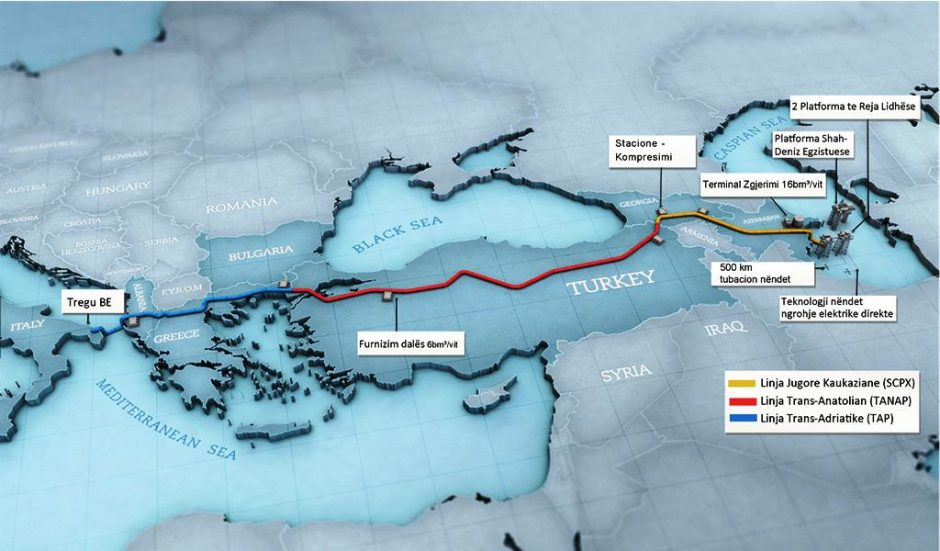
The Southern Gas Corridor linking Caspian reserves to European markets consists of several existing and projected pipelines. The Baku-Tbilisi-Erzurum (BTE) gas pipeline carries gas from Shah Deniz gas field in the Azerbaijani sector of the Caspian Sea to Turkey since late 2006. The current capacity of the pipeline is 8 bcma (billion cubic meters per annum) but with the completion of the phase II of the Shah Deniz project it can be scaled up to 25 bcma. BTE currently supplies Georgia and Turkey but it can be linked to other projects like the Trans-Anatolian Pipeline (TANAP) which will initially carry about 16 bcma of gas from Georgian-Turkish border to Turkish-European border. Depending on the gas flow, the capacity of the pipeline can later be increased up to 60 bcma.

There are several options to further transport the Caspian gas from Turkish territory to European markets. The primary existing route is the Turkey-Greece Inter-connector, which carries up to 12 bcma of natural gas. A key aspect of this project is the extension across Greece to Italy, which will carry Caspian gas deeper into Europe. A few additional routes to transport Caspian gas from Turkey to Europe have been considered. Nabucco West, the revised version of the defunct Nabucco project, was planned to start from the Turkish-Bulgarian border and transport gas from Shah Deniz Gas field phase II via Bulgaria, Romania, Hungary to Austria. Yet Shah Deniz Consortium partners rejected Nabucco West in 2013 and opted for the Trans-Adriatic Pipeline (TAP) instead. The main supply source of TAP will be the gas extracted from phase II of the Shah Deniz field, which will be carried through Turkish territory via BTE and TANAP. TAP is planned to start at Greece, cross Albania and the Adriatic to reach Italy.

Turkey thus sits at the intersection of the pipelines that constitute the Southern Gas Corridor. Turkey’s relevance to the EU’s energy policy with respect to Eastern Partnership, however, is not limited to Turkey’s fortunate geopolitical position. Secure and reliable access to Caspian hydrocarbon reserves requires not only a network of pipelines but also regional political stability and cooperation between supplier and transit states. Turkey, with its long-standing economic ties in the Caspian region can potentially act as an intermediary between the EU and the partner countries. Turkey has also been willing to contribute to the resolution of the several “frozen conflicts” throughout the region by acting as an interlocutor between the EU and other relevant parties.

Ankara has a standing policy of promoting interdependence among the three South Caucasus states in order to expand their trade and energy ties with Turkey. Georgia is not only a transit corridor of Azerbaijan’s gas, but also a major trade route for Turkish exports to Central Asia. Turkey also has considerable investments in Azerbaijan, Georgian and Abkhazian economies. Pending on the normalization of relations with Armenia and the opening of the Turkish-Armenian border, economic relations with Armenia also hold great promise for Turkey. Turkey can also help the EU in its capacity building efforts in the Caspian region. Turkish state-owned energy companies TPAO and BOTAS are partners in many pipeline projects in the region. Turkey has also recently shown a great deal of interest in investing in upstream development projects in the region. TPAO for instance signed in May 2014 a 1.5 billion USD deal to acquire French Total’s 10 per cent stake in Azerbaijan’s Shah Deniz project. In addition to Shah Deniz, TPAO owns shares in the two major fields in Azerbaijan, ACG (6.75 %) and Alov (9 %). Turkey has a strong presence on the ground and Turkish private sector accumulated expertise that is critical for secure and long-term cooperation.

Lastly, Turkey due to its historic ties to the region has considerable political capital in the Caspian, particularly in Azerbaijan, with which Turkey has sustained a very close relationship since its independence. Turkey also cooperated with the US in its efforts to help Georgia build a new state after independence. Given the difficulties that the EU has experienced in politically reaching out to its Caspian partners over the last decade, the EU can benefit from Turkey’s role as a regional interlocutor between Europe and the Caspian partners.


It is evident that the EU and Turkey can both benefit from extending their cooperation on regional energy issues. Despite the commonality of interests, however, EU-Turkey energy cooperation has so far failed to meet mutual expectations. The next section examines how the prevalence of national interests over communal ones and the opposing views on the Turkish and European sides regarding the political implications of energy partnership undermine the ability of these two actors to commit to a more extended form of energy cooperation.

About The Author:

Tolga Demiryol is assistant professor of Political Science in the School of Economics and Administrative Sciences at Istanbul Kemerburgaz University in Turkey. Tolga Demiryol received his Ph.D. in Political Science from the University of Virginia in 2010. Dr. Demiryol specializes in international political economy and security. His recent research focuses on the geopolitics of energy. 

Publication Details:

Baltic Journal of European Studies. Volume 4, Issue 2, Pages 50–68, ISSN (Online) 2228-0596, DOI: 10.2478/bjes-2014-0015, November 2014

This work is an abstract form of author’s original work, titled “The Eastern Partnership and the EU-Turkey Energy Relations”which is licensed under Creative Commons 3.0

December 14, 2015
by AEA in Publication

Rusia, BE-ja dhe diplomacia e gazsjellësit Kaspik

Harta TANAP-TAP-2Gjatë viteve të fundit, dëshmojmë një përkeqësim të rëndë të marrëdhënieve energjitike, ndërmjet Rusisë dhe Bashkimit Evropian (BE-së). Çështja mbi gazin, është një çështje tepër e rëndësishme, e lidhur ngushtë me përpjekjet e vazhdueshme nga ana e Rusisë për të ri-kalibruar strategjinë e gazsjellësit Euro-aziatik, si dhe orvatjet nga ana tjetër e BE-së për krijuar rrugë të reja furnizimi. Rajoni i Detit Kaspik, tashmë është shndërruar në pikën kyçe të këtyre diskutimeve të nxehta, në fazën e mosmarrëveshjeve serioze, ndërmjet Rusisë dhe BE-së. Ndërkohë që, Azerbaixhani dhe Turkmenistani konsiderohen si partnerë jetik të mundshëm të konsumatorëve Evropian të energjisë, Rusia angazhohet me politikat e saj më agresive, në mbrojtje të interesave të saj kombëtare në rajon. Rivaliteti i vazhdueshëm Rusi- BE, mbi projektet alternative të furnizimit me gaz, jo vetëm që e thellon boshllëkun e marrëdhënieve Bruksel-Moskë, por gjithashtu ka përcjellë ndikimin e saj, ndaj strategjive mbi energjinë të vendeve Kaspike, duke u përpjekur të mos shndërrohet në një fushë-beteje ndërmjet dy aktorëve kryesor.

Konflikti i vazhdueshëm në Ukraninë, si dhe shqetësimet e ngritura, lidhur me sigurinë e furnizuesve të gazit Rus drejt tregut Evropian, kanë përshkallëzuar tensionet ndërmjet Rusisë dhe BE-së, duke arritur nivelin e tyre më të lartë në këto vitet e fundit. Natyra bashkëkohore e marrëdhënieve BE-Rusi mbi energjinë, është rezultati i një kombinimi të ndërlikuar faktorësh gjeopolitikë dhe ekonomikë, të cilët janë të lidhur, ngushtësisht me përfitime të mëdha dhe sigurinë kombëtare. Në thelb të mosmarrëveshjeve aktuale mbi energjinë është një konkurrencë e fortë për qiradhënien e burimeve, ndërmjet prodhuesve të energjisë, konsumatorëve dhe vendeve tranzite ku tek kjo e fundit përfshihet edhe Shqipëria. Ndërlikimet gjeopolitike, aksesi ndaj tregut, modernizimi ekonomik dhe sovraniteti kombëtar, janë disa ndër çështjet kyçe, të cilat kanë ndikuar në politizimin e marrëdhënieve BE-Rusi. Në vijimësi të vënies së sanksioneve nga Perëndimi kundër Rusisë, marrëdhëniet mbi energjinë janë bërë edhe më të ngurta, duke mbyllur të gjitha rrugët e mundshme për të rifituar besimin e humbur nga të dyja palët.
Megjithëse, si Brukseli dhe Moska e kanë mbështetur zyrtarisht de-politizimin e çështjeve mbi energjinë, të dyja palët kanë këndvështrime të kundërta, sesi sektori duhet të organizohet në tërësi. BE-ja kërkon të integrojë Rusinë në sistemin e tregut, ndërkohë që Moska refuzon politikat e vlerave Evropiane, si dhe kundërshton regjimin ekzistues ndërkombëtar të tregtisë energjitike. Nxjerrja e sanksioneve kundër Rusisë, ka rezultuar, si rrjedhojë në një sfidë për politik-bërësit Evropian. Gjithësesi, qasjet e ndryshme dhe interesat kontradiktore, i kanë vënë si Rusinë dhe BE-në përpara rrezikut të konfrontimit, e cila ka gjasa të përçojë një ndikim negativ, lidhur me sigurinë e sektorit energjitik për të dy palët.

Realitetet Aktuale të Bllokimit të Energjisë BE- Rusi

BE-ja, duke qenë se është e përfshirë në liberalizimin e tregut energjitik, aktualisht është duke u përballur me një hendek serioz, ndërmjet zvogëlimit të burimeve vendase dhe kërkesës në rritje të energjisë. Megjithëse, BE-ja përpiqet të promovojë tregtinë e lirë të energjisë përtej kufijve të saj, politikat Evropiane mbi energjitikën mbizotërohen nga interesat kombëtare, duke penguar krijimin e një qëndrim të përbashkët dhe të orientuar strategjikisht ndaj BE-së lidhur me organizimin e tregut energjitik.

Deri më tani, interesat brenda BE-së i kanë penguar Vendet Anëtare, për të formuluar një politikë kohezive dhe të integruar mbi energjinë. Nga ana tjetër, Rusia, ka ndjekur një qasje të ndryshme, lidhur me globalizimin e tregut energjitik, duke kundështuar rolin vetëm të një eksportuesi të thjeshtë të energjisë. Politikat mbi energjinë të zhvilluara nga Rusia, dominohen nga objektivat kyçe strategjik, lidhur me trendet e gjeopolitikës dhe ekonomisë globale, si dhe ndryshimet sociale dhe politike. Kremlini paraqet fuqimisht forcën e tij gjeopolitike, dhe shpesh përdor metoda të ashpra, me qëllim garantimin e interesave strategjik Rus. Megjithatë, mundësia e  një rivaliteti vijon të jetë i lartë, për shkak se projektet kryesor mbi investimet dhe rrugët  e tubacioneve gazsjellës, kanë ndryshuar ndjeshëm pozicionet ekzistuese të pushtetit.

Qysh prej nisjes së krizës në Ukrainë, drejtuesit e Kremlinit, e kanë rishikuar dukshëm strategjinë mbi tubacionet e gazit të Rusisë. Ndërkohë që, Rusia dominon tregjet e energjisë Evropiane prej mëse shumë vitesh, strategjia e energjisë Ruse, ka pasur ndikimin e saj mbi shumë shtete Evropiane dhe jo-Evropiane, në lidhje me kërkesën, furnizimin dhe tranzitin. Rrugë të reja alternative për gazin dhe naftën, janë gjithësesi jetike për Moskën. Në këtë kuadër, Rusia drejtohet nga Azia, aty ku bashkëpunimi energjitik me Kinën, dukshëm është intensifikuar gjatë viteve të fundit, duke sjellë sfida të reja për konsumatorët Evropian. Me qëllim rivendosjen e statusit të super-fuqisë, Presidenti Vladimir Putin, është i përqëndruar në përdorimin e burimeve natyrale të pamata në vend. Vizioni i ri i Kremlinit, lidhur me tregun global të energjisë, është të rrisë vetë-besimin Rus, nëpërmjet një sërë alternativash të mundshme në Euro-azi.

Nga ana tjetër BE-ja, është duke bërë çdo përpjekje, për të zvogëluar varësinë e saj ndaj Rusisë, duke shumëfishuar burimet e saj të furnizimit me gaz natyral. Megjithëse, disa alternativa janë duke u marrë aktualisht në konsidertë ndaj furnizuesit Rus të gazit, ka shumë pak gjasa që BE-ja të zvogëlojë dukshëm importet e saj të energjisë nga Rusia, në një të ardhme të afërt. Vetë fakti, që Rusia zotëron furnizuesit më të mëdhenj të energjisë në aspektin global dhe tashmë ka një infrastrukturë domethënëse në vend, e shpjegon shumë qartë, pse disa prej kompanive më të mëdha të energjisë në Evropë, ngurrojnë të zhvendosen tërësisht nga status quo-ja. Nuk është çudi, pse këta të fundit kanë interesa të larta financiare, për të mbajtur një furnizim të qëndrueshm të gazit nga Rusia. Megjithatë, BE-ja po përpiqet që të zhvillojë projekte të reja alternative mbi energjinë. Furnizimi me gaz natyral për në tregun Evropian nga rajoni i detit Kaspik dhe në një kohë tjetër zonat gas mbajtëse të Iranit, janë parë për një kohë të gjatë si qëllimi i BE-së, ndaj një përpjekje për të lehtësuar ndopak varësinë Ruse.

Pjesët kryesore të Enigmës Kaspike

Vendet Anëtare të BE-së e kanë njohur rëndësinë gjeopolitike të gjirit Kaspik, duke konsideruar Azerbaixhanin dhe Turkmenistanin si një korridor strategjik, i cili lidh Evropën jugore me Kaukazin dhe Azinë Qendrore.Ndërkohë që jemi në dijeni, të potencialit të pasur që ofrohet nga burimet hidrokarbure të Kaspikut, BE-ja ka realizuar në të njëjtën kohë projekte me investime të reja, të cilat do të ndikojnë në sigurinë dhe qëndrueshmërinë e furnizuesve botëror të energjisë në të ardhmen. Mëse e vërtetë, tashmë që, Azerbaixhani dhe Turkmenistani janë shndëruar në palët kyçe të rajonit të Kaspikut dhe të dy vendet zënë një vend të veçantë në strategjinë e BE-së, lidhur me shumëllojshmërinë e furnizimit me gaz.

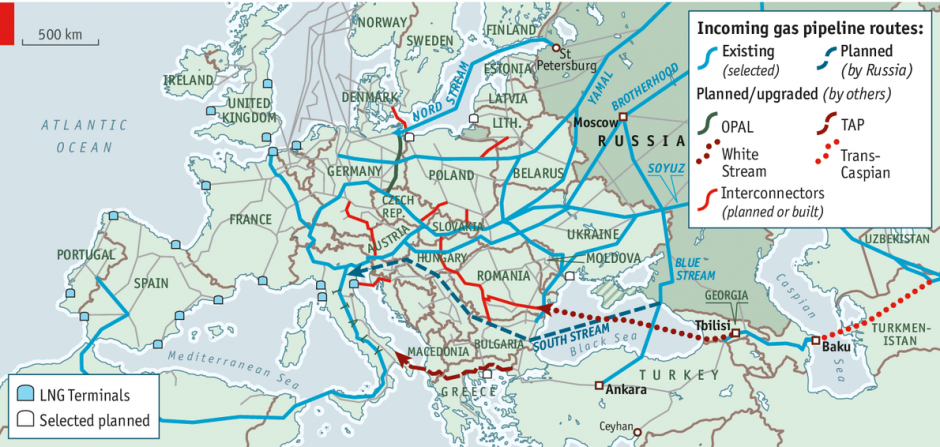
Brukseli ka rritur marrëdhëniet me Bakun dhe Ashgabatin, me qëllim aksesin ndaj depozitave të energjisë në Detin Kaspik dhe zvogëlimin e varësisë së Evropës, ndaj importeve të energjisë Ruse. Në vijimësi, BE-ja ka nisur bisedime të drejtpërdrejta mbi projekte ndërkombëtare, të cilat do të mundësojnë furnizimin e konsiderueshëm të energjisë nga gjiri Kaspik drejt tregut Evropian. Gazsjellësi Trans-Anatolian (TANAP) dhe gazësjellësi Trans-Adriatik (TAP) si rezultat, do të japin Korridorin e Gazit Jugor kaq të dëshiruar, e ashtuquajtura si “Rruga e Re e Fildishtë”, për linjat e transportit të energjisë, ndërmjet gjirit Kaspik dhe BE-së. Sapo kjo lidhje jetësore, të fillojë zbatimin në dekadën e ardhshme, do të mundësojë ndaj BE-së importin e gazit natyral nga Azerbaixhani, Turkmenistani dhe mundësisht nga Irani. Përveç kësaj, Brukseli ka nisur një fushtë aktive prapagande për projektin e tubacioneve të gazsjellësit Trans-Kaspik, e i ri-prezantaur kohët e fundit në axhendën e BE-së, për çështjet e energjisë. Tubacioni Trans-Kaspik, do të jetë pjesë e projektit TANAP, i cili është duke u ndërtuar nga Azerbaixhani dhe Turqia. Me shumë gjasa, tubacioni Trans-Kaspik, do të thellojë më tepër aksin lindje-perëndim të marrëdhënieve mbi energjinë, ndërmjet Azerbaixhanit, Gjeorgjisë, Turkmenistanit, Turqisë dhe Vendeve Anëtare në BE.

Pavarësisht kësaj, energjia mbetet një ndër sfidat kryesore për Azerbaixhanin dhe Turkmenistanin, lidhur me politikat vëndase dhe të jashtme, jo vetëm ndaj BE-së, por edhe ndaj vëndeve të tjera, veçanërisht Rusisë. Rrjedhja e plotë e gazit Kaspik në Evropë, parashikon një qëndrueshmëri në këto dy vende, veçanërisht e parë në planin afat-mesëm. Proçeset vendimmarrëse si në Baku dhe Ashgabat(Turkmenistan), shpesh lidhen me zgjidhjen e ekuacioneve rajonale të gjeo-politikës dhe gjeo-ekonomisë. Në realitet, rrugët e tubacioneve TANAP, TAP dhe Trans-Kaspik, janë projekte me risk zero. Disa prej çështjeve të mundshme, lidhur me këto projekte, përfshijnë risqet që kanë të bëjnë më furnizimin, ndërtimin, statusin ligjor të Detit Kaspik dhe çështjet mjedisore, të cilat tashmë janë diskutuar nga ana e Moskës dhe Teheranit.

Furnizimi me gaz natyror, duke rritur ndërvarësinë midis furnitorëve dhe konsumatorëve, e shndërron situatën politikisht më të ndjeshme. Eksporti i burimeve hidrokarbureve nga Deti Kaspik ndaj Evropës, si rezultat do të sfidohet ndaj faktorëve të veçantë, si për shembull interesat gjeo-politke të fqinjve të fuqishëm, duke konkurruar projektet e tubacioneve të gazit, ndryshimet lidhur me rrugët e furnizimit dhe problemet teknike. Për shembull, pengesa kryesore e TAP-it nuk është shtyrja e datës së inagurimit të këtij projekti me një vit më shumë, deri në 2021, por janë kushtet e reja, të cilat janë shtruar në tavolinë nga qeveria Greke.

Direkt pas zgjedhjeve, kryeministri Grek Alexis Tsipras, nisi të fliste për politikat e tubacioneve të gazit. Më 3 shkurt 2015, Greqia deklaroi se do të mbështeste ndërtimin e tubacioneve të TAP-it, përgjatë gjithë territorit të saj, por përfitimet që do t’i sillte Athinës, mund të ishin të pamjaftueshme dhe nisën diskutimet për t’u rishikuar. Në vijim të njoftimit për fillimin e Turkish Stream, Greqia e gjen veten në një pozicion gjeografik strategjik, lidhur me garantimin e energjisë ndaj BE-së. Që atëherë, të dyja tubacionet e gazsjellësit (TAP dhe Turkish Stream) kanë nisur garën, se cila do të ishte e para për të kaluar nga Turqia në Greqi, duke përfituar avantazhet. Në të vërtetë, Tsipras është duke përdorur kartën e tij të fortë, ndaj sigurisë së energjisë në BE. Ai po përdor pozicionin gjeografik të Greqisë, për të vendosur një tarifë më të lartë për TAP-in, megjithëse marrëveshjet nga ri-negociatat do të shkaktojnë hatërmbetje tek qeveria e tij.

Në të njëjtën kohë, projekti i tubacionit të gazsjellësit Trans-Kaspik mund të jetë i zbatueshëm, vetëm nëse Azerbaixhani dhe Turkmenistani do të shfaqin dëshirën për të irrituar Moskën. Kjo varët nga aftësia e të dy vendeve, për t’i rezistuar presionit që mund të vijë nga çdo drejtim, veçanërisht nga Rusia dhe Irani, të cilët në mënyrë të vazhdueshme kanë ngritur për diskutim statusin e pazgjidhshëm të Detit Kaspik, me arsyetimin se ndërtimi i gazsjellësit do të dëmtojë mjedisin e Detit Kaspik.

Gjatë shqyrtimit të politikave shumëdimensionale mbi energjinë, Baku dhe Ashgabat kanë marrë gjithë masat ndaj një sfide me interes të ekulibruar, duke shmangur  në të gjitha mënyrat çdo lloj konflikti të drejtpërdrejtë me Mokën, në lidhje me materializimin e Korridorit të Gazit Jugor. Nisur edhe nga shqetësimet politike, as presidenti i Azerbaixhanit Ilham Aliyev dhe as Presidenti i Turkmenistanit Gurbanguly Berdimuhamedov, nuk mund të ushtrojnë presion më të fortë, sesa ai i ushtruar nga BE-ja, në lidhje me rrugën e tubacionit gazjellës Trans-Kaspik-TAP-TANAP. Të dy Baku dhe Ashgabat janë gati të nisin me implementimin e projektit, por nuk po shohin mbështetjen e mjaftueshme politike, nga ana e BE-së dhe kanë dyshimet, në lidhje me gatishmërinë e BE-së për të kundështuar Moskën, në lidhje me zbatimin e këtyre nismave ndërkombëtare. Si rrjedhojë, efekti i presionit të madh të ushtruar nga Rusia, varet në mënyrë direkte nga rezistenca e frontit të bashkuar të BE-së.

Në mënyrë paradoksale, BE-ja po përpiqet të krijojë një union mbi energjinë, i cili ka për qëllim, miratimin e sa më shumë marrëveshjeve transparente mbi gazin, me qëllim zbehjen e ndikimit Rus. Pavarësisht angazhimeve të fuqishme për të arritur krijimin e një tregu të përbashët energjie, BE-ja deri më tash nuk ka arritur të mundësojë një zgjidhje gjithëpërfshirëse ndaj shumicës së interesave kombëtare konfliktual të Vendeve Anëtare. Për më tepër, mungesa e një integrimi  fleksibël, aq shumë të nevojshëm në tregun Evropian të energjisë, i ka dhënë Rusisë më tepër hapësirë për të mavoruar ndaj politikave të tubacioneve gazsjellëse Euroaziatike. Moska po përdor disa taktika të mënçura, duke sugjeruar edhe dhënien e aksioneve ndaj kompanive Evropiane, të përfshira në investimet e projekteve të ndryshme. Rusia, gjithashtu, përdor pushtetin e saj politik për të dekurajuar disa prej shteteve  bregdetare të rajonit të Kaspikut, për të mos mbështetur planet e BE-së për shumëfishimin e furnizuesve të gazit.

Nga ana tjetër, për shkak të mungesës së infrastrukturës së përshtatshme, Azerbaixhani dhe Turkmenistani, nuk i përmbushin dot plotësisht kërkesat e BE-së, si dhe  nuk ofrojnë aternativa të besueshme ndaj gazit Rus, në një afat të shkurtër kohor. Në planin afatgjatë, megjithëse rrugët e reja duke shmangur Rusinë janë duke u zhvilluar, kapacitetet e eksportit të këtyre dy vendeve bregdetare Kaspike, janë të pamjaftushme për t’u shndërruar në aktorë të fuqishëm lojë, për garantimin e energjisë ndaj BE-së. Përveç kësaj, Korridori Jugor i Gazit mund të sjellë konkurrencë për të gjitha vendet e BE-së dhe të mpijë Rusinë si “armë energjitike”.

Në të njëjtën kohë, Rusia ende mund të kërkojë të shfrytëzojë avantazhet ndaj kostove të saj, duke mbajtur larg tregut Evropian konkurruesit. Moska mund të vazhdojë të shes gazin me çmime të ulta, ndërsa sfiduesit e rinj, si për shembull tubacioni i gazsjellësit nga Turkmenistani, duhet të ofrojnë një çmim më të lartë që të kenë përfitime. Asnjëri prej vendeve, qoftë Azerbaixhani qoftë Turkmenistani nuk do të kenë avantazhe të ngjashme, dhe si rrjedhojë projektet e gazjellësit TANAP, TAP dhe Trans-Kaspik, nuk mund të zëvendësojnë aksionet e Rusisë në tregun e BE-së për gazin natyral. Duke marrë parasysh situatën aktuale financiare globale, shoqëruar me çmimet e ulta të naftës dhe të gazit, është e vështirë të konsiderohet transformimi i rajonit të Detit Kaspik në një nyje traziti për BE-në në të ardhmen.

Siguria e Energjisë së BE-së e mbërthyer midis Manovrës së re të Rusisë dhe Problemeve të Mbartura 

Fusha e shahut shumë-dimensionale, e gazit natyror të Rusisë është lehtësisht e kuptueshme, teksa Moska ka shumë interesa ekonomike dhe gjeopolitike në gjirin e Detit të Zi dhe Kaspik. Ndërkohë që vendet e etura për energji të Evropës Jugore dhe Lindore, po përpiqen që të promovojnë TANAP dhe TAP, me shpresën e përshpejtimit të integrimit të tyre në sistemin energjitik Evropian, Rusia vazhdon të transmetojë sinjale të ndryshme, lidhur me linja të ndryshme të transportit të gazit. Pavarësisht, dozës së rëndë me sanksione nga Perëndimi, Moska ka çuar përpara qëllimin, për të ndërtuar një tubacion me Turqinë, duke pasur një kontroll potencial ndaj nyjës së gazit në kufirin Turko-Grek, për shitjet që do t’i bëhen Evropës.

Rusia dhe Turqia janë partnerë strategjik kyç për shumë vite. Që prej ardhjes në pushtet të Vladimir Putin dhe Rexhep Tayyip Erdogan përpara 15 vitesh, të dyja shtetet kanë krijuar një bashkëpunim të ngushtë, jo vetëm në sektorin e energjisë, por edhe në fusha të tjera, atë të tregtisë, turizmit, ndërtimit, prokurimit të armatimeve dhe investimeve të kapitalit. Inicativa më e fundit e Rusisë, e njohur edhe si “Turkish Stream”, paraqet mundësinë e bllokimit të të gjitha burimeve alternative të gazi, që vijnë nga Turqia për në BE. Nëse, Moska dhe Ankaraja miratojnë marrëveshjen e implementimit të këtij projekti, Turkish Stream paraqet ndërlikim serioze për disa prej Vendeve Anëtare të BE-së, në lidhje me shumëfishimin e furnizuesve të energjisë për në tregun Evropian. Në rast se, projeti implementohet në një afat të shkurtër, gjigandi Rus i energjisë Gazprom, lehtësisht mund të ulë çmimet e gazit krahasuar me kostot e larta të gazit Kaspik në tregun Turk dhe atë Evropian.

Turkish Stream, është një strategji e menduar dhe kalibruar më së miri, nga ana e Presidenit Putin, duke pasqyruar llogaritjet e reja gjeopolitike nga ana e Kremlinit si aksioneri më i madh në lojën Euroaziatike.

Ndërkaq, politika e Presidentit Putin, në lidhje me furnizimin e energjisë, në tregun Evropian duket e sigurt. Moska tashmë sfidon haptazi blerësit e së ardhmës të gazit nga Azerbaixhani, veçanërisht ndaj konsumatorëve, të cilët janë të lidhur direkt me projektin Turkish Stream. Në mungesë të një sfide Evropiane, më të bashkërenduar ndaj sigurisë së energjisë, koncepti i ri i Rusisë, lidhur me gazin ka për qëllim, të ndërtojnë fillimisht Turkish Stream dhe më pas, të pres për ndërtimin e infrastrukturës në Evropë. Ka të gjitha gjasat, se kjo lëvizje, do t’i mundësojë Moskës fitoren dhe t’i sjell shqetësime BE-së, lidhur me zgjidhjen e çështjeve aq të diskutueshme, të cilat mund të përcillen nga ana e konsumatorëve Evropian.

Megjithatë, mbetet interesant fakti se, disa prej vendeve bregdetare Kaspike, janë në gjendje të përdorin shkathtësinë e tyre, lidhur me çështjen e eksporti të energjisë. Për shembull,gjatë viteve të fundit, autoritetet drejtuese në Baku, kanë arritur të mbajnë një qëndrim diplomatik të ekulibruar, pavarësisht interesave gjeopolitike konkurruese, në gjirin e Detit të Zi-Kaspik, duke qenë se Azerbaixhani ofron furnizimin me energji jo vetëm, ndaj Turqisë dhe BE-së, por gjithashtu, edhe ndaj Rusisë dhe Iranit. Azerbaixhani nuk e konsideron Turkish Stream, si një projekt rival për Korridorin e Gazit Jugor. Në fakt, kapaciteti i Turkish Stream mund të përdoret nga Azerbaixhani, duke përdorur mundësinë e transportimit, falë zgjerimit të tubacionit gazsjellës Rusi-Turqi, nëpër territorin e Evropës, duke furnizuar me sasi shtesë të gazit natyror në të ardhmen. 

Në të njëjtën kohë, Irani vendi i dytë në botë, që zotëron rezervat e gazit natyror pas Rusisë, do të rishikojë rrugët e ndryshme të eksportit për në Evropë, tani që sanksionet ndërkombëtare janë duke u hequr. Teherani, gjithashtu, mund të shfrytëzojë tubacionin e Turkish Stream, nëpërmjet njërës prej rrugëve të mundshme, nga ku gazi i Iranit në të ardhmen, mund të përçohet pranë konsumatorit Evropian. Paralelisht, marrëveshja më e fundit mbi programin bërthamore të firmosur në korrik e quajtuar P5+1, ka hapur mundësi të reja për zgjerimin e lidhjeve ekonomike ndërmjet Iranit dhe vendeve të tjera fqinje të Kaspikut. Në mënyrë të veçantë, Irani është duke kërkuar për rrugë të reja bashkëpunimi më të ngushtë me Azerbaixhanin, lidhur me eksportin e energjisë. Pasi ti jenë hequr sanksionet deri në Korrikun e 2016, Irani do të jetë në gjendje të përdor, tubacionin Baku-Tbilis-Ceyahan, me qëllim eksportin e naftës së vendit të tij dhe gjithashtu, do t’i bashkohet TANAP, për të transportuar gazin në Evropë në të ardhmen.

Megjithatë, ekzistojnë një sërë arsyesh, përse Irani ka pak gjasa që të eksportojë gazin e vendit të tij në Evropë në një afat të mesëm. Për shkak të situatës shqetësuese, mbi sigurinë në Turqi, ku infrastruktura mbi energjinë, përfshirë këtu, edhe tubacionin e gazit Iran-Turqi, është sulmuar në mënyrë të vazhdueshme nga organizatat terroriste, transportimi i gazit nga Irani për në tregun Evropian do të ishtë një zgjedhje jo e mirë për Teheranin. Pavarësisht se, Irani gëzon burime të shumta të gazit dhe nafës, investime të konsiderueshme dhe një tekonologji e re është e nevojshme, për të përpunuar rezervat e mëdha të energjisë në vend. E fundit por jo më pak e rëndësishme, ka të bëjë me distancat e gjata dhe kostot e larta të tranzitit, Evropa për momenin nuk është përparësia kyçe e Iranit, duke qenë se Irani është i përqëndruar, kryesisht në eksportin e gazit natyror ndaj vendeve fqinje.

Në mënyrë të spikatur, pasiguritë lidhur me Turkish Stream dhe Korridorin e Gazit Jugor, mund të vendosin mbi fatin e rrugëve, që do të ndjekin tubacionet. Megjithatë, mbetet për t’u parë, nëse të dy projektet do të pësojnë fatin e South Stream dhe Nabuccos. Gjithësesi, një gjë është tashmë e qartë: gjithëçka që ndodh sot me politikat mbi gazsjellësit në Euro-Azi, varet nga kërkësa e BE-së për energji në të ardhmen dhe lëvizjet strategjike të Rusisë.

Nga Erlet Shaqe

October 13, 2015
by AEA in Publication

The Economic and Geopolitical Benefits of Free Trade in Energy Resources

Given its abundance of natural resources and the recent growth in domestic energy production, the United States is in a position to export far more energy than American trade laws currently allow. Free trade is imperative to a free society, as it fosters economic growth and improves human well-being. Policymakers should treat energy like any other good or service that is traded freely around the world by allowing U.S. producers to export more energy. Providing more energy choices to both producers and consumers will generate jobs, expand the economy, and provide important geopolitical benefits to the rest of the world by increasing global energy supplies and reducing the ability of any one nation or organization to use its control of energy resources for strategic purposes. Congress and the Administration should remove government-imposed barriers to energy exports.

America’s Abundance of Natural Resources

America has an abundance of natural resources, including sufficient energy reserves to provide Americans with affordable and reliable energy well into the future. With its plentiful reserves of coal, natural gas, and oil, the United States is already a global leader in energy production and has the potential to be a major supplier to the rest of the world.

As a result of innovative, safe, advanced drilling technologies, domestic oil production has skyrocketed. In January 2006, companies in the U.S. supplied just over 5 million barrels of oil per day to the global market.[1] In June 2015, producers contributed nearly 9.3 million barrels per day (bpd).[2] In 2012, the amount of oil produced in the U.S. surpassed the amount that it imports.[3] The United States is now not only the world’s largest oil producer, overtaking Saudi Arabia, but also the largest producer of petroleum and natural gas hydrocarbons.[4]

Nearly 1.3 trillion barrels of technically recoverable oil lie beneath U.S. soil and off America’s coasts—enough to fuel more than 90 million cars and nearly 3.5 million homes for more than 50 years.[5]America’s technically recoverable resources represent only a fraction of the total oil reserves, which amount to more than 3.7 trillion barrels.[6] The U.S. alone has more than five times the amount of recoverable oil than Saudi Arabia.[7] Proven reserves continue to add to this known wealth of oil as increased exploration and technological developments make recoverable oil more viable.

The U.S. also holds an abundance of coal and natural gas. Coal generates nearly 40 percent of America’s electricity generation. Just 1 million tons of coal could yield enough energy to power 190,000 homes annually. With more than 480 billion short tons of coal recoverable with today’s technology, the United States can provide electricity for over 500 years at current consumption rates.

Furthermore, technological advancements have significantly increased the amount of recoverable natural gas in the United States. With more than 2,200 trillion cubic feet of recoverable natural gas, the U.S. has enough natural gas to meet America’s current consumption needs for nearly a century.

Oil in the Global Market. Both crude oil and gas prices at the pump[8] in the United States are tied to the global market price, as oil is a globally traded commodity. The reference price for crude oil trading is set through benchmarks, the three main benchmarks being West Texas Intermediate (WTI), Brent Crude, and Dubai Crude. A large part of the reason why many different benchmarks exist is that different qualities of crude exist in the market. Extracting a barrel of oil in Texas is not the same as a barrel extracted from Saudi Arabia. Crude can range from very light to very heavy, depending on its density,[9] and sweet to sour, depending on its sulfur content.[10] Light, sweeter crudes sell at a premium compared to heavy, sour crudes because refiners can process them more cheaply.

While different grades of crude oil exist, it is largely a fungible product. However, market and government-imposed constraints, such as the crude oil ban or transportation limitations, can fragment the market. For instance, WTI and Brent Crude have historically priced closely to one another with the difference stemming mostly from transportation costs, but the spread has grown between the two benchmarks over the past few years. The combination of a Libyan supply disruption that affected the Brent benchmark and the dramatic increase in U.S. production caused a buildup of inventories and a bottleneck in Cushing, Oklahoma, where WTI is priced, which resulted in WTI trading as low as $23 below Brent in February 2013.[11] Additional pipeline infrastructure and increased rail deliveries of crude helped relieve that bottleneck and narrow the price differential to around $3 today.[12] Opening exports would allow U.S. companies to compete in the international markets where similar crudes have higher prices. The overall increase in global supply would reduce the price of Brent and decrease the price at the pump.

Because of the interconnectedness of the oil markets, the U.S.—whether as a net importer or net exporter—will not be able to insulate Americans from price volatility. Just as U.S. self-sufficiency in food production cannot prevent problems in other parts of the world from affecting domestic U.S. food prices, a supply disruption in another part of the world can still cause pain at the pump in America. Greater oil supplies on the global market, however, will help to insulate consumers from price volatility and supply disruptions. The liberalization of markets provides more energy diversity and choice, incentivizes production, generates innovation, and establishes competitive prices.

The free flow of crude oil would also better match global refining capabilities, resulting in more economically and environmentally efficient outcomes. The shale oil production occurring in the United States produces light sweet crude; in fact, light crude production increased by 3 million bpd between 2008 and 2013. This rise has increased the share of light crude from 50 percent to more than 70 percent in terms of total oil production.[13] There has also been a substantial increase in ultra-light hydrocarbon known as “lease condensate.” Refiners across the country are equipped to process a range of crudes, which presents challenges given the glut of light crude production. Gulf Coast refineries are set up largely to handle medium and heavy crudes from Venezuela, Mexico, Canada, and the Middle East. For the past 20 years, well before the onslaught of light crude production in the U.S., companies, primarily in the Gulf Coast region, invested $100 billion in refining capabilities to handle heavier crude imports.[14]

Refineries that are already set up to process light crude have almost entirely reduced their imports from West African countries that extract similar grades of oil, and a number of companies have made investments to handle more light crude.[15] Over the past four years, light oil imports decreased by two-thirds.[16] In addition to displacing light crudes, refiners have switched from medium and heavy to light when economical, and have expanded refining capabilities to process more light crudes.

However, these shifts have constraints[17] and are unlikely to keep up with American crude production; if the refining market is saturated, oil companies will stall or shut in production. In some areas of the country, this is already occurring. The discouragement of production brought on by an artificially restricted market will decrease global supplies of oil, and keep prices higher than they otherwise would be. On the other hand, allowing crude oil exports to flow freely to where markets can already process the crude would increase supply and increase overall market efficiency. There will always be lags in infrastructure buildup, but reducing artificial constraints will minimize those lags and allow better planning and improved efficiency for mid-stream (transportation) and downstream (processing) activities.

Energy Sources Not Different, but Treated So. Natural resources should be no different from wheat, corn, or any other good that U.S. companies trade around the world, yet the law treats it differently. Congress enacted the laws primarily restricting crude oil exports—the Energy Policy and Conservation Act of 1975 and the Export Administration Act of 1979[18]—in response to the 1973 Arab oil embargo.[19]Refined petroleum products are not subject to export restrictions and, consequently, have increased dramatically.

The Department of Commerce’s Bureau of Industry and Security (BIS) outlines the scenarios in which the agency will approve license applications for exporting crude oil. Currently, companies have significantly limited opportunities for exporting crude oil. Under its Short Supply Control regulations, the BIS automatically grants export licenses to crude oil produced in Alaska’s Cook Inlet, crude transported through the Trans-Alaska Pipeline, re-exported crude from foreign nations, exports in connection with refining or exchanging Strategic Petroleum Reserve oil, exports consistent with certain international agreements, and small amounts of heavy Californian crude. Additionally, companies can export American crude oil to Canada so long as the consumption occurs in Canada. The industry has been taking advantage of this as exports of crude to Canada increased tenfold over the past decade, from 30,000 bpd in 2005 all the way up to 331,000 bpd in 2014.[20] The BIS will review other applications on a case-by-case basis.

The BIS recently approved a U.S. crude oil swap with Mexico—another tool that the federal government can employ to exempt companies from the crude oil ban. Mexico’s state-owned oil company Pemex applied to swap 100,000 bpd of heavier Mexican crude oil for the light sweet crude oil produced in the U.S. in January 2015. The BIS approved the swap in August 2015; the export licenses will be valid for one year. As the Obama Administration’s Energy Information Administration points out, the swap will provide increased market efficiency, benefiting both the economy and the environment:

The swaps, which are provided for under longstanding regulations governing U.S. crude oil exports, are expected to be both economically and environmentally beneficial to both parties because of differences in crude oil qualities as well as differences in each country’s petroleum refineries. The swaps will allow a greater degree of operational efficiency in both Mexico and the United States while allowing for increased supply of lower-sulfur gasoline from Mexican refineries.[21]

While the swap is a welcome step, the BIS has also rejected potential exchanges[22] with countries in Asia and Europe, demonstrating the arbitrariness of the federal government’s role in determining where producers may send their oil.[23] The mutually beneficial exchanges enjoyed between Mexican and U.S. producers should be available to everyone, not just to those the government determines to be worthy.

When it comes to natural gas exports, no ban on exporting liquefied natural gas (LNG) exists but the federal government does have an unnecessarily obtrusive role. To export natural gas, a company must liquefy the gas at a liquefaction plant at –162 degrees Celsius. The LNG is then shipped from an export terminal and delivered to a re-gasification import terminal to be stored or distributed by pipeline at the recipient location. In order to export LNG, companies must obtain approval from both the Federal Energy Regulatory Commission (FERC) and the Department of Energy (DOE). A facility is automatically authorized if the recipient country has a free trade agreement (FTA) with the U.S. In the absence of such an agreement, the DOE can deny a permit if it deems the volume of natural gas exports not to be in the public’s interest. The decision to export natural gas should be a business decision, not a political one. The U.S. trades regularly with a number of non-FTA countries.

The United States is also an important supplier of coal to the world, exporting more than 27.5 million short tons in 2014.[24] The top importers of U.S. coal are spread across the globe—the Netherlands, the United Kingdom, Germany, Italy, Turkey, India, Brazil, Canada, Mexico, Japan, and South Korea.[25] Coal export terminals should undergo the proper environmental review and permitting process; however, opponents to U.S. coal production want the Army Corps of Engineers to consider a cumulative, programmatic environmental impact statement (EIS). This comprehensive review would assess the environmental effects and greenhouse gas emissions not only from the actual terminal, but also from the mining, rail transportation, and end use of the coal. Adding these extra layers of regulatory review would create more fodder for groups who want the coal to stay in the ground, setting a dangerous precedent for exports of goods and services that environmental activists feel have too large an environmental footprint.

The Economic and Geopolitical Benefits of Energy Free Trade

Free trade is a fundamental component of economic growth by providing consumers with more choices, better products, and lower cost. The ability to buy foreign products that other countries produce more efficiently frees up American labor and capital to be more productive in other areas, growing the economic pie and increasing prosperity for all. Opening markets for both import and export fosters innovation as companies face more competition and face challenges to retain or expand their market share. The result is innovative ideas, higher-quality products at competitive prices, and an improved standard of living. The trading of goods and services freely around the world is largely responsible for lifting hundreds of millions of people out of poverty. Companies in foreign countries that specialize in making a product at a lower cost create opportunities for Americans to import it and thus pay less for it. Further, when markets are open to imports and exports, opportunities grow, thereby increasing potential for more wealth, investment, and jobs. The increased profitable exchange of goods and services greatly benefits businesses and consumers alike.

As is the case for many other countries around the world, the United States benefits from free trade because of private property rights. When individuals produce something, it is their property and, so long as there is no threat to national security and there is no violation of the rule of law, they should be able to do what they like with their own property. Individuals, in large part, have owned and had the ability to produce America’s natural resources—which is a primary reason why the U.S. is a global energy leader.[26]Individuals extract and sell the energy sources, and the market should determine where it goes.

Americans stand to benefit from a more efficient global oil market through lower prices and an increase in economic activity. Two studies, one from Resources for the Future (RFF) and a second by ICF International commissioned by the American Petroleum Institute (API), found that lifting the crude export ban would lower gasoline prices. The RFF projects that market efficiencies would reduce gas prices from 3 cents to 7 cents per gallon, while the API study estimates that American consumers would save up to 2.3 cents per gallon on gas, heating oil, and diesel fuels.[27] The Government Accountability Office (GAO) reviewed four economic studies on lifting restrictions on crude oil exports and found that gas prices could decrease anywhere from 1.3 cents to 13 cents per gallon.[28] The Energy Information Administration conducted its own study, concluding that “[p]etroleum product prices in the United States, including gasoline prices, would be either unchanged or slightly reduced by the removal of current restrictions on crude oil exports.”[29]

Although the price impact at the pump may seem marginal, the direction is clear: Prices will fall, and, not only do the savings add up over time, so do the widely expanded economic benefits. The ICF study concludes that opening the U.S. market to crude exports will save American consumers an estimated $5.8 billion over a 20-year period, increase America’s gross domestic product by over $38 billion, and add more than 300,000 jobs by 2020.

Exporting LNG would benefit the American economy tremendously by expanding market opportunities. If the disparity between domestic and foreign prices of natural gas is large enough, opportunities for American companies to export LNG should prove to be plentiful even with the costs of transport tankers and liquefaction plants and the competition from other exporting countries. NERA Consulting, which conducted an economic analysis of LNG exports for the Energy Department in 2012, reiterated its positive economic findings in an updated study. The benefits would include tens of billions of dollars in export revenue, tens of billions of dollars in increased gross domestic product (GDP), and tens of thousands of new jobs.[30] Notably, the study found that the higher the volume of exports, the greater the economic benefits would be.

Removing restrictions on energy exports would improve national security and geopolitical conditions around the world by reducing any one nation’s ability to manipulate energy supplies for political or economic influence. The 2014 crisis in Crimea revolving around Russia’s invasion of Ukraine demonstrates how liberalizing global energy markets could be an effective geopolitical tool. Much of Russia’s power in the region derives from its control of energy supplies and distribution systems. Although the Organization of Petroleum Exporting Countries’ (OPEC) influence on the global market is often overblown,[31] opening markets would provide a diversity of suppliers and greater energy supplies for the global oil market.

Moreover, additional supplies in an open market can significantly reduce the leverage of those countries or organizations that want to choke off supplies in a restricted market. If a glut of oil or any other natural resource is available on the open market from a variety of suppliers, the ability to cut off supplies and manipulate prices for political gain is greatly diminished. The incentive to lower costs and provide supplies at competitive prices, however, is enhanced.

The Geopolitical Repercussions of U.S. Energy Exports by Region

Europe. Freely exporting energy resources with Europe will diversify the energy supply and strengthen U.S. relationships with North Atlantic Treaty Organization (NATO) allies. The U.S. is committed by the 1949 North Atlantic Treaty to defend the 26 European members of NATO—energy security is a key component. If the U.S. pursues policies rooted in economic freedom, increasing domestic energy production and lifting government-imposed restrictions on energy exports would help both the U.S. economy and Europe.

Much of Russia’s power in Europe is the result of its control of energy supplies and distribution systems. Diminishing Russia’s economic leverage in the region should be a key component of America’s commitment to transatlantic security. This could be accomplished to a large extent simply by liberalizing global energy markets. The U.S. has antiquated and unnecessary limitations on exporting LNG and crude oil, and Congress should make lifting these restrictions a priority.

More than half of Europe’s energy resources come from countries outside the European Union (EU), and this proportion has been generally rising over the past decade. Many European countries could be doing more do produce energy within their borders; however, anti-market policies generally prevent resource development. Government ownership of mineral resources, bans on hydraulic fracturing, and heavily subsidized renewable energy sources have increased costs for Europeans, both as taxpayers and energy consumers. Furthermore, Germany’s phaseout of nuclear power drove electricity rates higher and created energy poverty in parts of the country.[32]

The potential for U.S. exports to Europe is great. Currently, the EU imports more than 90 percent of its crude oil and approximately two-thirds of its natural gas needs.[33] Together, this amounts to a total import bill of more than $1.2 billion per day. To satisfy the EU’s energy demands, Russia has become one of Europe’s main suppliers—especially for natural gas. From a geopolitical and security standpoint, European dependence on Russian energy comes with risks for Europe and the U.S. Concerns about the security of supply from Russia have been further heightened by the war in Ukraine and Russia’s aggressive behavior in the Baltic region and in the South Caucasus.

Russia has used oil and gas as a strategic weapon in the past. Russia cut off gas supplies to Ukraine in 2006, from 2008 to 2009, and in 2014, and threatened to do so again in early 2015. Ukraine is an important transit country for Russian gas, and the 2009 gas dispute between Russia and Ukraine left many European countries with severe shortages. While this event served as a much-needed wakeup call for Europe, little has been done in practice to reduce this dependence on Russia.

As Europe looks for energy alternatives to Russian energy resources, it should be cautious about what kind of role Iran might play if the Iranian nuclear agreement reached in July 2015 comes into force. Iran has identified nearly 50 new oil and natural gas projects worth $185 billion once international sanctions are lifted. At least some of these projects will send Iranian oil and natural gas into Europe via the network of pipelines in the South Caucasus and Turkey.

The Iranian minister of information and communications technology, Mahmoud Vaezi, has publicly said that he hopes Tehran might soon export energy to Europe.[34] Some in Europe will be keen to import Iranian oil and gas and might even see Iran as a credible alternative to Russia. Nothing in the past 35 years has shown that Iran can be a trusted partner. Europe should avoid the temptation to import Iranian oil and gas absent any further liberalization of supply diversity or as a substitute for dependence on Russia, because any degree of dependence on Tehran will further weaken Europe’s energy security. Access to American energy supplies would provide more energy choices and increased regional diversity.

Moreover, the U.S. should not back an energy chapter in the Transatlantic Trade and Investment Partnership (TTIP). The treaty is likely a vehicle for the promotion of increased government promotion of politically preferred green energy policies. The United States does not need a treaty to achieve free trade of energy resources with other countries. The United States and European governments should adopt the appropriate free-market energy policies to establish supply diversity and reduce dependence on Russian energy.

Controlling the Flow. Moscow has long sought to control the flow of oil and gas to Europe and has never liked pipelines transporting oil and gas to Europe that bypass Russian territory. The Kremlin’s mentality is: If Europe is not buying oil and gas from Russia, it should not be buying it from anywhere else, either. To this end, where Europe is able to import from other sources, Russia has shown it can easily pose an indirect threat to supply. Some of these indirect threats posed by Russia to Europe’s energy supply in recent years have included:

  • Russia’s reluctance to agree to the delineation of the Caspian Sea, which has resulted in the continuous blocking of the construction of a trans-Caspian natural gas pipeline. Were such a pipeline ever realized, it would allow Turkmenistan to export gas to Europe, providing a major alternative to Russian gas.
  • In July 2015, Russia moved the administrative boundary fence dividing the Russian-occupied region of South Ossetia and the rest of Georgia—thereby placing more Georgian territory under Russian control. The new fence also places a 1-mile segment of the BP-operated Baku-Supsa pipeline inside Russian-occupied territory.[35]
  • Russia continues to arm both Armenia and Azerbaijan in the ongoing Nagorno–Karabakh conflict in the South Caucasus. The Baku–Tbilisi–Ceyhan pipeline and the South Caucasus Pipeline, carrying oil and gas, respectively, from the Caspian to the Mediterranean, pass within miles of the current cease-fire line.

The Baltic Example. A good example of the energy problems faced by Europe is found in the Baltic region. The Baltic States (Estonia, Latvia, and Lithuania) are heavily dependent on Russia for energy. In 2014, Estonia, Latvia, and Lithuania imported 100 percent of their natural gas from Russia.[36] The Russian state-owned gas company Gazprom was once the sole provider of natural gas to the Baltic states, and they paid some of the highest prices for gas in Europe. For instance, in 2014 Lithuania paid 36 percent more for Russian natural gas than Germany paid.[37]

The Baltics are aggressively seeking ways to end Gazprom’s monopoly on their gas supply. One significant development in the Baltic region is Lithuania’s 10-year lease of an offshore LNG vessel that accepts LNG imports. It is docked year-round in the port of Klaipeda.[38] If it were to ever reach full capacity, the terminal could supply 80 percent of the natural gas needs of all the Baltic states.[39] The implementation of the import terminal was not the most competitive and cost-effective, as state-owned companies largely drove the project to completion and taxed Lithuanian citizens in order to pay for it.[40]Nevertheless, the desire to diversify is strong in the Baltic states. Moving forward, empowering private companies to diversify, provide choice, and build economically viable infrastructures will best meet Baltic states’ energy needs at competitive prices.

In February 2015, a Lithuanian natural gas import company signed a memorandum of understanding with an American company, Delfin LNG LLC, which is building a liquefaction and export facility in Louisiana.[41] However, export of American LNG has not yet received regulatory approval, and the new American LNG export terminal is not expected to start construction until 2019.[42] While the time frame to permit and build the facility is a multi-year process, Delfin’s application represents the problem with the DOE’s involvement in trading natural gas to non-FTA countries. Delfin filed its application for Long-term Multi-Contract Authority to Export LNG to Non-Free Trade Agreement Countries in November 2013 and those contracts are still under DOE review.[43] The DOE’s review is a completely meaningless hurdle but prohibits companies from planning and investing if their economic viability is dependent on the DOE’s determination that the company can export to non-FTA countries. Still, the signed memorandum indicates a level of interest in U.S. LNG exports.

Attempts at Diversification. Across Europe various pipeline projects are in the works. Companies are constructing interconnector systems to make it easier to move oil and natural gas throughout Europe. One region that is adding to its oil and gas infrastructure is the South Caucasus—making the region even more important for Europe’s energy diversity. This will especially be the case if a trans-Caspian natural gas pipeline becomes a reality.

Construction started this year on the Trans-Anatolian Natural Gas Pipeline (TANAP). The TANAP pipeline will run from Azerbaijan to Turkey. It will then link up with the Trans-Adriatic Pipeline (TAP). Construction for TAP also started this year and once completed will run from the Turkish–Greek border to Italy via Albania and the Adriatic Sea. Both the TANAP and TAP are expected to be completed by 2018 and will link up with the existing South Caucasus Pipeline (which connects Turkey to the Azerbaijani gas fields in the Caspian Sea, through Georgia). Together, all three pipelines will form the so-called Southern Gas Corridor.

Russia will also be competing against these new pipelines. Russia announced earlier this year that its South Stream project is cancelled and will be replaced with a so-called Turkish Stream pipeline. This new pipeline will supposedly bring Russian gas across the Black Sea to Turkey to then link up with TAP. All of these projects reaffirm Turkey’s desire to serve as a regional energy hub, but pipelines running through Turkish territory have been susceptible to terrorist attack, especially by the Kurdish PKK.

A Role for the U.S. As Europe looks for new sources of oil and gas it is clear that the U.S. offers the most potential. While there are many tools at America’s disposal when dealing with Russia and helping Europeans remain secure, one must not discount the impact that free markets and free trade can ultimately have on the situation.

To truly diminish the power that a nation garners from its control of energy markets and supplies, however, the U.S. needs to lead a broad liberalization of global energy markets. This means not only encouraging private-sector development around the world, but also allowing market-driven increases in production in the U.S.

By increasing energy supplies to the global market and diversifying global supplies, these reforms also would diminish the ability of any nation, including Russia, to use energy as a weapon to impose its will in the future.

India. Securing adequate energy supplies for its rapidly expanding and modernizing economy is a key foreign policy goal of the Indian government. India is the third-largest energy consumer in the world (behind China and the U.S.), and demand for coal, oil, and natural gas is quickly outpacing domestic production. India has been slow to invest in oil and gas exploration and will thus remain dependent on foreign energy resources for the foreseeable future. Its growing thirst for energy will increasingly impact its international relationships and drive its geopolitical goals.

It is estimated that India spends around $330 million daily on energy imports, sourcing most of its oil and natural gas import requirements from the Middle East. India has become one of the largest importers of LNG in Asia, purchasing more than 10 million tons in 2014, and projected to increase to more than 24 million tons per year by 2020.[44] The uptick in India’s LNG imports follows changes in government regulations that now allow the use of imported gas in power generation and fertilizer production.

India currently buys most of its imported LNG from Qatar, but is likely to re-engage in negotiations with Iran over a long-term LNG supply deal following the U.S. Congress’s passage of the nuclear deal with Iran. In 2008, India and Iran scrapped an earlier LNG deal in part due to U.S. pressure on India to strictly adhere to sanctions policy on Iran. Indian officials have asked the Obama Administration to remove barriers to U.S. exports.[45]

India’s internal demand for oil is set to increase from 224 metric tons in 2014 to 310 metric tons by 2030, while its gas requirement is expected to double within the same time frame. India imported nearly 200 metric tons of oil in 2014 (or nearly 90 percent of its total oil consumption).

Coal is likely to remain India’s primary source of energy in the near term, however. Coal now makes up 44 percent of India’s total energy consumption and the most recent Five-Year Plan (2012–2017) calls for more than 80 percent of additional electrical capacity to come from coal. India was self-sufficient in coal production 25 years ago, but now relies on imports to fulfill about 30 percent of its coal needs. Most Indian coal imports come from Indonesia (60 percent), Australia (17 percent), and South Africa (14 percent).

With the recent slowdown in China’s economy, in contrast with the relatively positive outlook for India’s economic growth over the next few years (its GDP is now growing at around 7.5 percent), energy exporters Russia and Iran will increasingly seek to make energy deals in India. India has already expressed interest in a gas pipeline proposed by Russia.

By placing arbitrary and time-delaying restrictions on U.S. LNG exports, the U.S. is missing both an economic and geopolitically important opportunity to help fulfill India’s growing LNG needs. The U.S. has an interest in seeing India prosper and expand its economy so that it is increasingly capable of contributing to security and stability in the Asia–Pacific region. Furthermore, supplying LNG to India would alleviate New Delhi’s need to turn to Iran and Russia or other countries whose geostrategic interests often diverge from those of the U.S.

Cooperating with India to secure its energy future will help solidify the strategic partnership between Washington and New Delhi and thus advance broader U.S. national security goals that include ensuring that no single country dominates the Asia–Pacific region.

Northeast Asia. The United States has long been the one of the world’s top oil producers, usually ranking among the top five. With the fracking revolution, however, and other new forms of oil production, the United States is now in a position to be an influential global energy exporter. While it is unlikely to eclipse Saudi Arabia in sheer volume of exports, the ability of the United States to meet some of the oil demands of key allies in the western Pacific would mark a shift in regional security dynamics.

At present, China, Japan, South Korea, and Taiwan are among the top oil importers in the world.[46] In particular, resource-poor Japan is heavily dependent upon imported energy for both power generation and transportation. While Japan has sought to diversify its energy consumption among oil, natural gas, and coal, imported energy represents 95 percent of energy consumption. The end of domestic Japanese coal production, as well as the decision to shut down Japan’s nuclear power plants in the wake of the Fukushima disaster, have only exacerbated this dependence.[47]

For Japan, but also South Korea and Taiwan, the most important source of imported energy remains the Middle East, with over half of all imported oil coming from there. This creates a dual set of vulnerabilities; not only are these states dependent on this politically volatile region for energy, but the import flow requires that a chain of very large crude carriers (VLCC) transit the Indian Ocean, the Malacca Strait, and the South China Sea (and the East China Sea in the cases of Korea and Japan) to sustain their economies.

Should the United States allow the export of oil and LNG, this would likely adjust some of these vulnerabilities. In the first place, and most obviously, it would reduce, at least marginally, global dependence upon the Middle East as the physical source of oil. This, in turn, would mean that regional instability would not necessarily rebound through the global system as quickly; right now, the closure of the Strait of Hormuz would likely generate an immediate “oil shock” that would have enormous global impacts in short order, even with record low oil prices.[48] The most effective response to any oil shock would be open markets that provide more supplies from different regions of the world. A larger American share of the global oil market would reduce, at least somewhat, the impact of instability in the Middle East.

In addition, a larger American role in the global energy markets would allow Japan, South Korea, and Taiwan to diversify the physical sources of their oil, which in turn would reduce the vulnerability of those imports. Indeed, Japan has already expanded its imports of Russian crude oil in 2015, with the added benefit of a shorter transit time.[49] It is important to recognize the limited impact that such diversification is likely to have, however, since Japan alone imports at least 4.6 million barrels of oil per day.[50] Over one-third, or some 1.2 million bpd, comes from Saudi Arabia.[51] Consequently, American oil exports are unlikely to wholly supplant Middle East suppliers. Nonetheless, a greater American supply would likely ease Japanese dependence on the Gulf region.

This, in turn, would reduce some of the vulnerability of East Asia’s sea lanes of communications (SLOCs). As in World War II, Japan is wholly reliant on the free movement of shipping on the world’s sea lanes for its economic and national survival, a situation that is duplicated for South Korea and Taiwan. The current fuel SLOCs for these players must pass along the East Asian littoral, which is dominated by China. Diversifying its fuel SLOCs would reduce their vulnerability to the People’s Liberation Army Navy (PLAN), whose capabilities are steadily improving.

Moreover, by moving them from a largely north-south orientation to incorporate an east-west component would also complicate PLAN targeting, since it would require it to range farther afield into the central Pacific, rather than compelling the U.S. Navy to operate closer to the Chinese coast. This would remove American forces from the pressures of confronting China’s anti-access/area denial capabilities, such as the recently unveiled DF-21D “carrier killer” anti-ship ballistic missile. Instead, it would require Chinese surface, subsurface, and air platforms to venture into the central Pacific or close to Japan and South Korea in order to blockade those nations, in the event of conflict.

Latin America. Traditionally, the U.S. oil sector has been heavily reliant on the Latin America/Caribbean region. The U.S. is still a net importer of crude oil and petroleum products although that figure has dropped to only 27 percent in 2014, the lowest amount of net imports since 1985.[52] More than half of U.S. imports come from the Western Hemisphere.[53] The largest suppliers of Western Hemisphere imports are Canada (28 percent); Mexico (10 percent); and Venezuela (9 percent). In comparison, Persian Gulf countries Bahrain, Iraq, Kuwait, Qatar, Saudi Arabia, and the United Arab Emirates supply 29 percent.

The removal of restrictions on crude oil exports directly benefits U.S. national security and strategic objectives in the region. First, it would reduce the liability on the U.S. and regional partners posed by Venezuela. Initiated by the late Hugo Chavez, the country’s 21st-century socialist movement has altered the once U.S.-friendly region. Utilizing its vast oil wealth, Venezuela funded various initiatives to expand the cadre of nations adopting their anti-American authoritarianism. Various schemes, such as oil shipments to the Cuban government and funding leftist candidates throughout the region, have undermined the United States. Of all the programs, the Petrocaribe initiative has bought Venezuela the most influence. Ten countries are part of the program in which Venezuela sells oil at preferential rates and loan terms. For countries such as “Jamaica, Guyana, Nicaragua and Haiti, the value of preferential Venezuelan financing for oil imports is more than 10% of government revenue and equivalent to around 4% of GDP.”[54] Petrocaribe member states are facing an uncertain future. Earlier this year, Venezuela was forced to cut nearly half of its subsidized shipments of crude oil to Petrocaribe.[55] Should Venezuela make further cuts, countries that are closer to the U.S. are increasingly vulnerable.

There is also the possibility for increased hostility against the U.S. and regional allies. The plummeting price of oil combined with socialist economic policies has destroyed the Venezuelan economy and the ruling party’s base of support. The International Monetary Fund holds that Venezuela’s budgetary expenditures need the global price of oil to hold at $117.50 per barrel. Currently, it is less than $50 and not projected to increase.[56] The annual inflation in Venezuela is hovering near 200 percent, scarcity is dire, and government approval ratings are low.[57] The Venezuelan government has long deflected attention from its economic situation. In the past few weeks, it has escalated tensions with Colombia on the shared border. Venezuelan fighter jets have begun to patrol the area and have even crossed into Colombian airspace unauthorized. The possibility for increased Venezuelan aggression is tempered by the country’s commercial dependence on the U.S. The U.S. is the fourth-largest recipient of Venezuelan crude oil and contains the closest refineries for its heavy crude oil.

Lifting of the oil export ban would have a positive impact on the U.S. and on Mexico’s energy sectors and boost their overall economies. Mexico is the third-largest crude oil supplier to the U.S. and a top trade and investment partner of the U.S. Positive movement is already being seen in this area. In August of this year, the Department of Commerce approved the licensing for export oil swaps. This comes after Mexico petitioned the U.S. for swaps of Mexico’s heavy crude in exchange for the U.S.’s high-quality light oil. The two countries can swap up to 100,000 bpd, currently 1 percent of U.S. output.[58]

While this shift is a positive development for both Mexico and the U.S., a total lifting of the ban is needed to reap the full benefits. Currently, 52 percent of the oil that Mexico extracts is heavy crude, and Mexican refineries are running at 60 percent capacity, meaning that there is a substantial market share on which the U.S. is missing out.[59] American producers should have the opportunity to fill that void should it be economically viable.

The Middle East and North Africa (MENA). Lifting the ban on U.S. oil exports would have little immediate impact on the Middle East, given the huge amount of oil produced there relative to the small amount the U.S. is likely to export. In 2014, Middle Eastern countries produced an average of 27.8 million barrels of oil per day, about 30 percent of total global oil production of 93 million bpd. U.S. oil exports would likely flow primarily to East Asia and Western Europe, which are major oil-importing regions, rather than to the Middle East, which is the world’s leading oil-exporting region.

Nevertheless, lifting the oil export ban could yield important benefits by putting downward pressure on world oil prices, increasing the flexibility and efficiency of the world oil market and improving the ability of oil-importing states to adjust to oil-supply disruptions. To the degree that U.S. oil exports help lower world oil prices, Middle East oil exporters would be hurt less than most other oil exporters because of their relatively low production costs. However, low-cost producers, such as Saudi Arabia, Kuwait, and the United Arab Emirates, would have a competitive advantage over Iran, which would be handicapped by its reliance on older, more mature oilfields that are suffering from declining yields due to poor maintenance, lack of access to modern technology, lack of investment, and the lingering effects of international sanctions.

Iran, traditionally a price hawk within OPEC because of its relatively large population and oil revenue needs, has repeatedly called for oil production cuts to prop up prices, but Saudi Arabia has opted to maintain high production rates to retain its global market share. Iran was projected to require oil prices of $140 per barrel to balance its budget in late 2014, compared to Saudi Arabia, which needed an oil price of about $80 per barrel to balance its budget.

Riyadh can rely on its huge oil reserves, about $700 billion in foreign exchange reserves, and low production costs to wear down and squeeze out other oil producers as prices fall. The Saudis also have offset the loss of about 1.9 million bpd from disruptions caused by conflicts in Iraq, Libya, Syria, and Yemen. The Saudi oil production strategy is not only aimed at maintaining its prime market share at the expense of Iran and other rival oil exporters, but ultimately at undermining the competitiveness of U.S. shale oil producers, who have much higher production costs.

U.S. oil exports also could help balance the world oil market in the event of future oil disruptions. U.S. oil exports to Israel, in particular, could enhance Israel’s energy security by diversifying its sources of oil imports at a time when it faces growing hostility from proliferating Islamist forces in the region. Israel currently imports oil from Russia, Azerbaijan, the Kurdistan Regional Government in northern Iraq, and Kazakhstan, among other sources, but some of these imports are threatened by terrorist attacks against pipelines in Turkey and Iraq.

Recommendations for Congress

With enormous oil and natural gas reserves, the U.S. is positioned to remain a global energy power well into the future if Congress adopts free-market policies that open domestic and international markets and reduce regulations that choke off resource development. To that end, Congress should:

  • Lift the ban on crude oil exports. While U.S. crude oil exports have increased, they are still significantly limited. The Department of Commerce should change the definition of allowable exports, and the President should determine that exports are in the national interest. Those solutions, however, still place the decision at the hands of the government, not the market. Ultimately, Congress should end the ban.
  • Lift restrictions on LNG-recipient countries. The distinction that exports to FTA countries are in the “public interest” while others are not is on the whole an arbitrary one. There are numerous non-FTA nations with which the U.S. trades regularly. Natural gas should be no different and should be treated as any other good traded around the world.
  • Remove all decision rights from the Department of Energy and prohibit any federal agency from determining natural gas exports based on public interest. It should not be up to the Department of Energy, FERC, or any federal agency, to determine which amount of natural gas exports is in the public interest. Energy producers should be able to capture economic opportunities from LNG-recipient nations if they believe it is in their interest. If the Department of Energy was sincere in its role to protect the public interest, it would have accepted its own analysis that exporting as much LNG as possible is an overall benefit to economic welfare. The Department of Energy’s authorization requirement is a pointless obstacle and should be removed immediately.
  • Empower state regulators to manage the environmental review and permitting process of the export facility while allowing FERC to stay involved. States already have the authority to veto LNG terminals. Rather than take an advisory role to FERC, states should play a dominant role in authorizing the construction of the terminal. A state’s environmental review and permit approval would satisfy the federal permits necessary to build an LNG terminal.[60] The state permit approval would satisfy all other necessary approvals required under the National Environmental Policy Act. A state regulator can use FERC technical or safety expertise as necessary. Export applicants would also need to meet Coast Guard security standards and the requirements under the Maritime Transportation Security Act, as well as the Department of Transportation’s Office of Pipeline Safety requirements.[61]
  • Prevent threats to coal exports. Congress should prevent cumulative programmatic environmental impact statements for coal exports. Such analyses would adversely affect exports of coal and set a dangerous precedent that could be used to halt many other major economic activities that environmental activists perceive as a threat to environmental safety.

Open Markets Will Increase Global Prosperity and Improve Geopolitics

After a severe global oil supply shock during the 1970s, the United States imposed an almost blanket ban on the export of crude oil. Today, that oil ban remains largely intact, in addition to onerous export restrictions of liquefied natural gas to countries with which the U.S. has no bilateral free trade agreements—which means that Washington, not the marketplace, determines which projects move forward. When the ban on crude exports was imposed in the 1970s, the goal of the legislation was to conserve domestic oil reserves and discourage foreign oil imports after the oil embargo against the U.S. That rationale has done little, if anything, to help the United States, but a lot to restrict opportunities and grow the economy. Contrary to conventional wisdom, removing the crude export ban would not jeopardize U.S. national security. To the contrary, freely trading energy resources and technologies would strengthen national security and improve relationships with allies across the globe.


References

[1] U.S. Energy Information Administration, “Monthly Crude Oil and Natural Gas Production,” August 31, 2015, http://www.eia.gov/petroleum/production/ (accessed September 10, 2015).

[2] Ibid.

[3] U.S. Energy Information Administration, Annual Energy Outlook 2014: Early Release Overview, December 16, 2013, Table 1. “Comparison of projections in the AEO2014 and AEO2013 Reference cases, 2011–2040,” http://www.eia.gov/forecasts/aeo/er/pdf/0383er%282014%29.pdf (accessed September 30, 2015).

[4] U.S. Energy Information Administration, “U.S. Remained World’s Largest Producer of Petroleum and Natural Gas Hydrocarbons in 2014,” April 7, 2015, http://www.eia.gov/todayinenergy/detail.cfm?id=20692(accessed September 10, 2015).

[5] Energy Tomorrow, “Undiscovered Technically Recoverable Resources,”http://energytomorrow.org/energy-101/energy-demands/undiscovered-technically-recoverable-resources(accessed September 30, 2015).

[6] Institute for Energy Research, “North American Energy Inventory,” December 2011,http://www.energyforamerica.org/wp-content/uploads/2012/06/Energy-InventoryFINAL.pdf (accessed September 30, 2015).

[7] Ibid.

[8] Spot gasoline prices are linked to the world price, but several factors cause differences, such as refinery configuration and regulations, federal and state taxes, inventories, and weather.

[9] The American Petroleum Institute gravity (API gravity) is a formula used to measure petroleum’s density to water.

[10] U.S. Energy Information Administration, “Today in Energy: Crude Oils Have Different Quality Characteristics,” July 16, 2012, http://www.eia.gov/todayinenergy/detail.cfm?id=7110 (accessed April 21, 2014).

[11] Ingrid Pan, “Why the WTI-Brent Oil Spread Traded Below $4 Per Barrel,” Market Realist, April 15, 2014, http://marketrealist.com/2014/04/wti-brent-oil-spread-traded-4-per-barrel/ (accessed September 10, 2015).

[12] “Energy and Oil: Crude Oil & Natural Gas,” Bloomberg, http://www.bloomberg.com/energy (accessed September 10, 2015).

[13] Roger Diwan, “The Unbearable Lightness of US Crudes: When Will the Levee Break?” presentation at “Crude Oil Exports: Market Drivers and Near-Term Implications,” event at the Center for Strategic and International Studies, video, February 10, 2014, http://csis.org/multimedia/video-crude-oil-exports(accessed April 21, 2014).

[14] Jim Efstathiou Jr., “Oil Supply Surge Brings Calls to Ease U.S. Export Ban,” Bloomberg, December 17, 2014, http://www.bloomberg.com/news/2013-12-17/oil-supply-surge-brings-calls-to-ease-u-s-export-ban.html (accessed April 21, 2014).

[15] Clifford Krauss, “Domestic Crude Oil Drives a Cautious Refining Revival,” The New York Times, March 3, 2014, http://www.nytimes.com/2014/03/04/business/energy-environment/oil-boom-is-driving-a-revival-in-refining.html?_r=0 (accessed April 21, 2014).

[16] ICF International, “The Impacts of U.S. Crude Oil Exports on Domestic Crude Production, GDP, Employment, Trade, and Consumer Costs,” submitted to the American Petroleum Institute, March 31, 2014, http://www.api.org/news-and-media/news/newsitems/2014/mar-2014/~/media/Files/Policy/LNG-Exports/LNG-primer/API-Crude-Exports-Study-by-ICF-3-31-2014.pdf (accessed April 21, 2014), and Energy Information Administration, “Tight Oil-Driven Production Growth Reduces Need for U.S. Oil Imports,” April 7, 2014, http://www.eia.gov/todayinenergy/detail.cfm?id=15731 (accessed April 21, 2014).

[17] Since many refineries are set up to handle medium and heavy crudes, so long as these crudes are available, refiners will likely stay equipped to handle them. Further, some refineries are co-owned with foreign-owned companies and have destination clauses which will also curtail displacement. See Diwan, “The Unbearable Lightness of US Crudes.”

[18] Although the Export Administration Act of 1979 expired, Administrations have used the International Emergency Economic Powers Act (IEEPA) to extend export restrictions. In 2001, President George W. Bush issued Executive Order 13222, which continued export control regulations. For more information, see “Presidential Documents–Executive Order 13222: Continuation of Export Control Regulations,” Federal Register, Vol. 66, No. 163 (August 22, 2001), p. 44025, http://www.gpo.gov/fdsys/pkg/FR-2001-08-22/pdf/01-21338.pdf (accessed October 1, 2015).

[19] Neelesh Nerurkar, “U.S. Oil Imports and Exports,” Congressional Research Service, April 4, 2012,http://www.fas.org/sgp/crs/misc/R42465.pdf (accessed April 21, 2014), and Bureau of Land Management, “Mineral Leasing Act of 1920 as Amended,”http://www.blm.gov/pgdata/etc/medialib/blm/ut/vernal_fo/lands___minerals.Par.6287.File.dat/MineralLeasingAct1920.pdf(accessed April 21, 2014).

[20] U.S. Energy Information Administration, “Petroleum & Other Liquids: U.S. Exports to Canada of Crude Oil,” August 31, 2015, http://www.eia.gov/dnav/pet/hist/LeafHandler.ashx?n=PET&s=MCREXCA2&f=A (accessed September 10, 2015).

[21] U.S Energy Information Administration, “Crude Oil Swaps with Mexico Could Provide Economic and Environmental Benefits,” September 10, 2015, http://www.eia.gov/todayinenergy/detail.cfm?id=22872(accessed September 10, 2015).

[22] The BIS defines crude oil exchanges and crude oil swaps differently. The BIS will allow an exchange if it results in (1) greater quantities and higher quality of imported crude, or if the imported petroleum products are equal to or greater than the products that would have been refined in the U.S.; (2) if economic and technological reasons prevent the crude from being used in the U.S.; or (3) when the exchange terminates if U.S. petroleum supplies are interrupted or threatened. A swap, on the other hand, occurs with an “adjacent foreign state” and has less defined criteria. See 15 CFR 754.2(b)(2).

[23] Timothy Gardner, “U.S. Approves Landmark Crude Oil Export Swaps with Mexico,” Reuters, August 14, 2015, http://www.reuters.com/article/2015/08/14/us-usa-oil-exports-exclusive-idUSKCN0QJ1RI20150814 (accessed September 30, 2015).

[24] U.S. Energy Information Administration, “Coal Quarterly Report (Abbreviated),” January–March 2015, Table 7. U.S. Coal Exports, http://www.eia.gov/coal/production/quarterly/pdf/t7p01p1.pdf(accessed October 1, 2015).

[25] Ibid.

[26] Resources do exist on federally owned land, but the private sector leases that land, and pays for the right to own and sell the resources.

[27] ICF International, “The Impacts of U.S. Crude Oil Exports on Domestic Crude Production, GDP, Employment, Trade, and Consumer Costs,” and Stephen P. A. Brown, Charles Mason, Alan Krupnick, and Jan Mares, “Crude Behavior: How Lifting the Export Ban Reduces Gasoline Prices in the United States,” Resources for the Future Issue Brief, February 2014, http://www.rff.org/RFF/Documents/RFF-IB-14-03-REV.pdf (September 10, 2015).

[28] Frank Rusco, “Crude Oil Export Restrictions: Studies Suggest Allowing Exports Could Reduce Consumer Fuel Prices,” testimony before the Committee on Agriculture, U.S. House of Representatives, U.S. Government Accountability Office, July 8, 2015, http://www.gao.gov/assets/680/671235.pdf(accessed October 1, 2015).

[29] U.S. Energy Information Administration, “Petroleum & Other Liquids: Effects of Removing Restrictions on U.S. Crude Oil Exports,” September 1, 2015, http://www.eia.gov/analysis/requests/crude-exports/ (accessed September 10, 2015).

[30] Nera Economic Consulting, “Updated Macroeconomic Impacts of LNG Exports from the United States,” March 14, 2014,http://www.nera.com/content/dam/nera/publications/archive2/PUB_LNG_Update_0214_FINAL.pdf(accessed September 28, 2015).

[31] Nicolas D. Loris, “Why Congress Should Pull the Plug on the Strategic Petroleum Reserve,” Heritage Foundation Backgrounder No. 3046, August 20, 2015,http://www.heritage.org/research/reports/2015/08/why-congress-should-pull-the-plug-on-the-strategic-petroleum-reserve.

[32] “Germany’s Energy Poverty: How Electricity Became a Luxury Good,” Spiegel Online International, September 4, 2013, http://www.spiegel.de/international/germany/high-costs-and-errors-of-german-transition-to-renewable-energy-a-920288.html (accessed October 1, 2015).

[33] “Energy Security Strategy,” The European Commission, May 2014,https://ec.europa.eu/energy/en/topics/energy-strategy/energy-security-strategy (accessed August 27, 2015).

[34] Temkin Jafarov, “Iran Ready to Export Gas to Europe via Azerbaijan, Says Minister,” Trend News Agency, August 21, 2015, http://en.trend.az/business/energy/2425924.html (accessed August 27, 2015).

[35] “Russian Troops Demarcate Part of Georgian Oil Pipeline,” RFE/RL’s Georgian Service, July 14, 2015, http://www.rferl.org/content/russian-troops-demarcate-georgian-oil-pipeline/27126985.html(accessed August 27, 2015).

[36] David Yanofsky, “The EU Countries that Depend the Most on Gasprom’s Russian Gas,” Quartz, April 22, 2015, http://qz.com/388148/the-eu-countries-that-depend-the-most-on-gazproms-russian-gas/(accessed June 23, 2015).

[37] Milda Seputyte, “Lithuania Grabs LNG in Effort to Curb Russian Dominance,” Bloomberg Business, October 27, 2014, http://www.bloomberg.com/news/articles/2014-10-27/lithuania-grabs-lng-in-effort-to-curb-russian-dominance (accessed June 23, 2015).

[38] Kounteya Sinha, “Lithuania to Now Survive Without Russian Gas,” The Times Of India, October 27, 2014, http://timesofindia.indiatimes.com/world/uk/Lithuania-to-now-survive-without-Russian-gas/articleshow/44950490.cms (accessed June 23, 2015).

[39] Ibid.

[40] Erik Brattberg and Luka Oreskovic, “European LNG: Political Wish but Economic Pipedream?”Financial Times, June 16, 2015, http://blogs.ft.com/beyond-brics/2015/06/16/european-lng-political-wish-but-economic-pipedream/ (accessed October 2, 2015).

[41] “Lithuania Moves to Replace Russian Gas with U.S. Supplies,” The Moscow Times, February 27, 2015, http://www.themoscowtimes.com/article/516655.html (accessed June 23, 2015).

[42] Ibid.

[43] U.S. Department of Energy, “Delfin LNG LLC,” October 30, 2014,http://www.fossil.energy.gov/programs/gasregulation/authorizations/2013_applications/Delfin_LNG_LLC_13-147-LNG.htm (accessed October 1, 2015).

[44] “India to Double LNG Imports to 24 mtpa by 2020: Moody’s,” Business Standard, May 6, 2015,http://www.business-standard.com/article/economy-policy/india-to-double-lng-imports-to-24-mtpa-by-2020-moody-s-115050601048_1.html (accessed October 1, 2015).

[45] “India to Talk Sanctions, LNG Imports During Obama Visit–Oil Officials,” Reuters, January 16, 2015,http://www.reuters.com/article/2015/01/16/india-usa-energy-idUSL3N0UV4CZ20150116 (accessed October 1, 2015).

[46] U.S. Energy Information Administration, “Frequently Asked Questions: What Countries Are the Top Net Importers of Oil?” last updated June 18, 2015, http://www.eia.gov/tools/faqs/faq.cfm?id=709&t=6(accessed October 1, 2015).

[47] Federation of Electric Power Companies of Japan (FEPC), “Japan’s Energy Supply Situation and Basic Policy,” http://www.fepc.or.jp/english/energy_electricity/supply_situation/ (accessed October 1, 2015).

[48] William W. Beach et al., “The Global Response to a Terror-Generated Energy Crisis,” Heritage Foundation Center for Data Analysis Report No. 08-11, November 10, 2008,http://www.heritage.org/research/reports/2008/11/the-global-response-to-a-terror-generated-energy-crisis.

[49] “Japan’s 2015 Crude Imports from Russia May Hit Record High,” Reuters, March 11, 2015,http://www.reuters.com/article/2015/03/11/russia-crude-japan-idUSL4N0W82XD20150311 (accessed October 1, 2015).

[50] U.S. Energy Information Administration, “Frequently Asked Questions: What Countries Are the Top Net Importers of Oil?”

[51] U.S. Energy Information Administration, “Japan Is the Second Largest Net Importer of Fossil Fuels in the World,” Today in Energy, November 7, 2013, http://www.eia.gov/todayinenergy/detail.cfm?id=13711 (accessed October 1, 2015).

[52] Energy Information Administration, “Frequently Asked Questions: How Much Petroleum Does the United States Import and From Where?” last updated September 14, 2015,http://www.eia.gov/tools/faqs/faq.cfm?id=727&t=6 (accessed October 1, 2015).

[53] Energy Information Administration, “How Dependent Are We on Foreign Oil?” Energy in Brief, May 10, 2013.

[54] “Single Point of Failure,” The Economist, October 4, 2014,http://www.economist.com/news/americas/21621845-venezuelas-financing-programme-leaves-many-caribbean-countries-vulnerable-single-point (accessed September 22, 2015).

[55] John Otis, “Venezuela’s Allies Break Oil Habit,” The Wall Street Journal, May 1, 2015,http://www.wsj.com/articles/venezuelas-allies-break-oil-habit-1430536886 (accessed September 22, 2015).

[56] Thomson Reuters, “US Oil Settles Up $2, or 4.48%, at $46.68 a Barrel,” Reuters, September 21, 2015, http://www.cnbc.com/2015/09/20/oil-prices-edge-up-as-us-drilling-declines.html (accessed September 22, 2015).

[57] “Director of Datanalisis Reveals That Popularity of Mature Drops to 22%,” El Universal, January 2, 2015, http://www.eluniversal.com/nacional-y-politica/150102/director-de-datanalisis-revela-que-popularidad-de-maduro-cae-a-22 (accessed September 22, 2015).

[58] Timothy Gardner, “U.S. Approves Landmark Crude Oil Export Swaps with Mexico,” Reuters, August 14, 2015, http://www.reuters.com/article/2015/08/14/us-usa-oil-exports-exclusive-idUSKCN0QJ1RI20150814 (accessed September 22, 2015).

[59] Sergio Meana, “Mexico Produces 2,247 Million Barrels of Oil a Day and Therefore Is the Tenth Largest Producer of Crude Oil in the World. Then, Why Are You Looking for Importing the Precious Black Gold in the United States?” El Financiero, May 9, 2015, http://www.elfinanciero.com.mx/economia/por-que-mexico-necesita-importar-petroleo.html (accessed September 22, 2015).

[60] Federal Energy Regulatory Commission, “Laws and Regulations: States’ Rights in Authorization of LNG Facilities,” June 28, 2010, http://ferc.gov/industries/gas/indus-act/lng/state-rights.asp (accessed February 2, 2013).

[61] U.S. Department of Transportation, Pipeline & Hazardous Materials Safety Administration, “Siting LNG Plants,” http://primis.phmsa.dot.gov/comm/LNG_Siting.htm (accessed October 1, 2015).

October 8, 2015
by AEA in Publication

GEOTHERMAL ENERGY RESOURCES IN ALBANIA

Introduction: Energy Supply in Albania

Even for a country like Albania where over 95% of electricity and 20-23% of total primary sources are provided by hydro, use of other renewables is important because improves security of energy supply and energy sector sustainability. If we add to these positive facts reduction of foreign trade deficit for any net importer country – and Albania is such a country – it is clear why an analysis of the status of RE development in comparison with other similar countries is important too.

Worldwide, in the last decade, most of the debate concerning the promotion of renewable sources was focused on the financial support schemes and on improving grid access conditions for renewable electricity. No doubt, these are essential issues which will continue to be in the center of policy makers’ attention now and in the future. However, during the last few years, “the importance of” identifying and “tackling non-financial and non-technical barriers to renewable electricity has attracted attention of analysts” and governments.

According to the most recent energy balance for Albania issued by International Energy Agency (IEA) – for 2008 – from a total net consumption of primary energy sources of 2088 ktoe only a equivalent of 333 ktoe are generated by hydro and other RE sources, so a share of 15.9 %. The biomass contribution in TPES was about 10%.

  1. Geothermal energy in Albania in general as well as in main parts of Korca Prefecture in particular

Geothermal resource consists of underground layers or springs that contain water with a temperature level which is enough to gain useful forms of energy. Usually, the water is heated through the highest temperatures in the earth core. The water temperate level can be used in the buildings for heating in low temperature directly or with the help of heat pumps. In case of very high temperatures or when the water is in the form of steam, electricity is produced. Here, focus is on the utilization of geothermal resources for heating purposes, where it is expected that most resources are on a moderate temperature level, i.e. they need to be ‘thermally treated’ by heat pumps.

Albanidet represent the main geological structures laid out in Albanian territory in general as well as in main parts of Korca in Particular. They are localized between Dinaridëve in the north and Helenidëve in the south. Together they form Dinarik Branch of Mediterranean Alpine Belt. In the depth up to 500 m, the temperature is 12-15°C and over  500 m is 21-41°C. In the depth  6000 m in the center of the sedimental ponds the temperature goes up to 105.8°C. In this pond geothermal gradient is about 18.7 mK/m.in the south direction, in the  Ofiolitik belt the gradient has maximum values abot  32.2 mK/m. Geothermal situation of  Albanideve offers two direction for geothermal energy using, which up to now is not used.

First, thermal sources in low enthalpy and maximum temperature up to 80°C. These are natural resources in Albanian territory from the south part of Albania near the border Albania-Greece , even in north-east part. Second, using the deep vertical wells. A considerable number of abounded gas and oil wells may be used for geothermal purposes. Actually, Albania is in the study phase for the possibilities of the exploitation of Geothermal Energy.           

2 Methods use for the study

Geothermal studies made in Albania have been oriented in the studies of trying to know the distribution of geothermal fields and sources of thermal waters and wells.  Also it is calculated the geothermal gradient and the density of hot water discharge from those natural geothermal resources. There have been made measurements for temperatures in 145 m deep wells and shalow ones, in mines in different levels.

The temperature in the wells has been registered in regular intervals. Absolut mistake from the measurements is 0.3°C. The measurements have been carried out in the sustainable regime of wells filled with water and clay. The collected data have been registered and processed, using analyses of the first and second grade. There have been founded even the chemical components of the water. It has been assessed the hydrology compound of the resources and wells.

For any country, energy renewable sources development is important because helps country to fulfill at least 2 of its strategic objectives: security of supply and sustainability. However, Albania is a special case because its electricity generation is done in large majority using hydro big and medium sized power plants. Also, about 10-13% of the Total Primary Energy Sources (TPES) of the country – including imports – are provided by biomass, especially wood for fire.

However, the country’s reliance on hydropower makes it vulnerable to changes in hydrologic conditions, as witnessed during a period of drought in 2007, 2011and this reduced dramatically the electricity security of supply. In this respect, the World Bank organized a conference to analyze increased risk of bad hydrology as effect of climate change in Albania[2]. Even if the next following 3 years (2008, 2009, 2010) recorded normal hydrological conditions, the threat still remains, since it is almost clear that power generation from hydro on ongoing year (2011) is lower than average. Another difficulty is the continuing delay of hydro power plants equipment rehabilitation that carries to the reduction of their energy availability.

On the other hand, Albania has important imports of energy which vary – depending on yearly conditions – between 30 and 60% of TPES. Renewable energy can be a solution for reducing this strategic dependence on imports and improve not only security of energy supply but also country’s economic and political macro security by decreasing country’s budget deficit. Finally, development of renewable energy projects attracts foreign investment and generates new jobs for a Albania with lower level of income per capita.

According to the most recent energy balance for Albania issued by International Energy Agency (IEA) – for 2008 – from a total net consumption of primary energy sources of 2088 ktoe only a equivalent of 333 ktoe are generated by hydro and other RE sources, so a share of 15.9 %. The biomass contribution in TPES was about 10%.

  1. Geothermal energy in Albania in general as well as in main parts of Korca Prefecture in particular

Geothermal resource consists of underground layers or springs that contain water with a temperature level which is enough to gain useful forms of energy. Usually, the water is heated through the highest temperatures in the earth core. The water temperate level can be used in the buildings for heating in low temperature directly or with the help of heat pumps. In case of very high temperatures or when the water is in the form of steam, electricity is produced. Here, focus is on the utilization of geothermal resources for heating purposes, where it is expected that most resources are on a moderate temperature level, i.e. they need to be ‘thermally treated’ by heat pumps.

Albanidet represent the main geological structures laid out in Albanian territory in general as well as in main parts of Korca in Particular. They are localized between Dinaridëve in the north and Helenidëve in the south. Together they form Dinarik Branch of Mediterranean Alpine Belt. In the depth up to 500 m, the temperature is 12-15°C and over  500 m is 21-41°C. In the depth  6000 m in the center of the sedimental ponds the temperature goes up to 105.8°C. In this pond geothermal gradient is about 18.7 mK/m.in the south direction, in the  Ofiolitik belt the gradient has maximum values abot  32.2 mK/m. Geothermal situation of  Albanideve offers two direction for geothermal energy using, which up to now is not used. 

First, thermal sources in low enthalpy and maximum temperature up to 80°C. These are natural resources in Albanian territory from the south part of Albania near the border Albania-Greece , even in north-east part. Second, using the deep vertical wells. A considerable number of abounded gas and oil wells may be used for geothermal purposes. Actually, Albania is in the study phase for the possibilities of the exploitation of Geothermal Energy.           

2 Methods use for the study

Geothermal studies made in Albania have been oriented in the studies of trying to know the distribution of geothermal fields and sources of thermal waters and wells.  Also it is calculated the geothermal gradient and the density of hot water discharge from those natural geothermal resources. There have been made measurements for temperatures in 145 m deep wells and shalow ones, in mines in different levels.

The temperature in the wells has been registered in regular intervals. Absolut mistake from the measurements is 0.3°C. The measurements have been carried out in the sustainable regime of wells filled with water and clay. The collected data have been registered and processed, using analyses of the first and second grade. There have been founded even the chemical components of the water. It has been assessed the hydrology compound of the resources and wells.

Geothermal studies have been layed out in all Albanian territory. In the west part, where the oil and gas reserves are located, the temperature is registered in 120 wells. In the north-east and south-east part have been studied about 25 drilling and 8 thermal water resources. Also chemical analyses has been carried out.

3 Results

Results of geothermal studies have been shown in the maps and geothermal sections. Temperature maps have been collected in different level up to 5000m depth. Also have been created geothermal gradient maps and hot flow density for Albania in general as well as in main parts of Korca in particular. In the following, author has prepared three important maps which are the basic parameters of geothermal energy for Albania in general and for Korca in particular.

Figure 1-Heat Flow Density Map

Figure 1-Heat Flow Density Map

Figure 2 - Geothermal Thematic Map

Figure 2 – Geothermal Thematic Map

Figure 3- Temperature Map at the depth 100 m

Figure 3- Temperature Map at the depth 100 m

4          Geothermal areas and their reservoirs

There are a lot of thermal wells and sources with low enthalpy in Albania in general as well as in main parts of Korca in particular. The temperature of the water goes up to 60°C. These thermal water resources are located mainly in the regions with tectonic fracture. The water moves through carbonic rocks in several km deepth. The water of these sources contains salt, bromium jodur, absorbed gas and some organic substances. In most of oil and gas wells there are several thermal water sources which come out with a temperature of interval of 32-65.5°C.

Table 1: Geothermal resources and their main characteristics  

N° of wells location Temperature in °C salt  mg/l Flow l/s
1 Llixha Elbasan 60 0.3 15
2 Peshkopi 5-43 9 14-17
3 Kranë-Sarandë  34 <10
4 Langareci-Përmet 6-31 30-40
5 Shupal-Tiranë 29.5 >10
6 Sarandoporo-Leskovik(Korca Prefecture) 26.7 >10
7 Tervoll- Gramsh 24 >10
8 Mamurras-Tiranë 21 26 >10

Geothermal water resources and wells are located in three spaces (zones). Krujë, Ardenicës,and Korca area (including the Peshkopia). Also there are even separated resources. Geothermal reservoirs are located in sismic active belts locations. Thermal waters contain high free CO2, which varies from 0.004 – 0.5425 g/l for example:

  • 0.004 g/l in geothermal well of Ardenica.
  • 0.0783 g/l thermal resources of Mamurras.
  • 0.196 g/l thermal resources of Llixhas.
  • 5425 g/l thermal resources of Korca area (including Peshkopi).
Figure 5- Geothermal Energy of Permet-Leskovik zone

Figure 5- Geothermal Energy of Permet-Leskovik zone

Figure 4- Geothermal Clinics of Elbasan

Figure 4- Geothermal Clinics of Elbasan

  • Geothermal Space of Kruja (second zone) has the biggest geothermal resources in Albania, with a total length 180 Km and width of 4.5 Km, identifying 5.9 x 10⁸ – 5.1 x 10⁹ The geothermal zone starts in Adriatic Sea, in the north-west part of Tirana and keep going in the south-east part in Greek territory.
  • Thermal spaces of Ardenica (first zone) is concentrated in the coastline. The water comes out from the wells with a temperature 32-38°C, and flow 15-18 l/s. The thickness of water layers in Ardenica is about 900 m, starting from 1095-1955 m. Water sand layers has a thickness which goes from some cm up to 15-20 m.
  • Geothermal spaces of Peshkopia-Elbasan-Korca-Leskovik Areas (including Peshkopia) (third zone) is located in the north-east part of Albania, 2 Km in the east part of Peshkopia and continue up to Leskovik. There are located some thermal resources near of each other. Flow is 14-17 l/s. Water temperature is 43.5°C.

From above mentioned analyze results that the status of geothermal regime of the surface is of such a levels that allows exploitation of their heat for heating or conditioning spaces of offices, hospitals, libraries, schools, theaters and cinemas, aero ports, even houses. The heat of these layers has caused the heating of waters of the zone.

Table 2: Main data of geothermal wells

N°

Name Temperature në °C Salt  mg/l Flow l/s
1 Kozani – 8

Part of Peshkopia—Elbasan-Korca-Leskovik belt

65.5 4.6 4.5
2 Ishmi 1/b 64 19.3 3.5
3 Galigati 2 45-50 5.7 0.9
4 Bubullima 5 48-50 35
5 Ardenica 3 38 15-18 15-18
6 Ardenica 12 32
7 Semani 1 35 5 5
8 Verbasi 2 29.3 1-3 1-3

Temperatures of water layers have been calculated of 145-250°C. Surface temperature is calculated from 30°C to 65.5°C. The flow is about  3.5-15 l/s.

Pusi Kozani 8 (Part of Peshkopia—Elbasan-Korca-Leskovik belt geothermal resources)

Pusi Kozani 8 (Part of Peshkopia—Elbasan-Korca-Leskovik belt geothermal resources)

Pusi Kozani – 8 (Part of Peshkopia—Elbasan-Korca-Leskovik belt geothermal resources)

From hot water may be produced several chemical elements like jodine, brom, clorand other natural salts, necessary for preparation of different medicaments. Sulfhidrytes and CO2 may be produced from these waters.

Based on geothermal energy capacities in Albania and also world experience according to the exploitation of this source of energy, it has to be stressed that there are possibilities in Albania in general as well as in main parts of Korca in particular for building new businesses in some directions by utilizing the geothermal resources:

Cascade and integral using of the heat of geothermal waters.  Since the zones where these resources are located are urban areas in general the use of thermal waters becomes more easy. Up to now some of the thermal waters in Albania are used for medical support (Peshkopi-Elbasan-Korce-Leskovik, Bilaj of Fushkrujes). But these waters may be used also for curative purposes for different deaseses.

a) geothermal ecotourism. It has to be mentioned that in Italy geothermal complexes are visited by 2.5 milion turist /year. It may have be constructed hotels with hot water pools, with sauna, intertainment bars also in Albania especially on Peshkopi-Elbasan-Korce-Leskovik and Bilaj of Fushkruje. 

b) Modern medical clinics: in order to attract tourists who like to use geothermal water building up modern clinics will be good business for the areas of Peshkopi-Elbasan-Korce-Leskovik, Bilaj of Fushkruja

c) Heating of greenhouses and the development of     acquaculture

d) Releasing of useful minerals and salts.


5. TECHNOLOGIES FOR USING GEOTHERMAL ENERGY
5.1 SPACE HEATING
The wells are constructed in the garden of the houses in a distance of 8 m from each other, they are 65m deep and have hot probe made by four plastic pipes, with a diameter of 25mm, in which circulates a containing of 75% water and 25% glikopropilen (which prevent freezing). The space between the hole and probe is filled with a mixture of the cement and clay. Specific average of the location of the probe is 50W/m. Land temperature in in the deep is 10°C.

Geothermal Systems

Geothermal Systems

Figure 8: System with heating pump connected to the land

Figure 8: System with heating pump connected to the land

The system consists:

  1. Absorbing heat ground and serving as artificial “geothermal resources” through vertical wells.
  2. The heat is absorbed from the ground in a constant temperature and it is transported through fluid in a heating pump.

After that, it is returned to the hot probe, in order to help the circulation in the well.

5.2 CASCADE USING OF GEOTHERMAL ENERGY


Diagram shows the scheme of regional heating with distributing cascade of hot water from 90°C/70°C to 60°C/45°C and finally 45°C/30°C, which is an injected temperature.


  1. ENVIRONMENTAL IMPACT OF GEOTHERMAL ENERGY

To evaluate the environmental impact of geothermal energy the following figures 9 and 10 are given:

Comparing of the emission of CO2 emitted by a Geothermal THPP and a TPP using conventional fuel like (gas, wood, coal).


ÄComparing of the amount of dangerous gases (gr/kWh) through a system with solar fuel and heating pumps water/water, which work with geothermal energy.

Figure 9: CO2 emissions per unit of electricity generation (g/kWh) (for steam geothermal, combine cycle (natural gas-gas&steam turbine); natural gas-steam turbine; natural gas-gas turbine; oil steam turbine; wood-steam turbine; coal-steam turbine)

Figure 9: CO2 emissions per unit of electricity generation (g/kWh) (for steam geothermal, combine cycle (natural gas-gas&steam turbine); natural gas-steam turbine; natural gas-gas turbine; oil steam turbine; wood-steam turbine; coal-steam turbine)

Figure 10: Gases emissions for heating pumps and district heating

Figure 10: Gases emissions for heating pumps and district heating

October 6, 2015
by AEA in Publication

When hydropower isn’t green: hydroelectric emissions

thumbnailimage.imgHydropower is often considered a clean energy source, free of climate-warming carbon dioxide emissions. But although dams have been demonized for disrupting fish migrations and flooding valleys inhabited by families for generations, this so-called renewable form of energy has largely escaped scrutiny for its climate impacts. After all, how could the atmosphere be harmed by letting a river flow through a few energy-generating turbines encased within a 50-foot wall of concrete and steel?

Hydropower is the world’s leading form of renewable energy, accounting for more than 16 percent of global electricity generation. But dam enthusiasts who tout hydro’s climate credentials may not like the news about its emissions numbers.

Studies conducted over the past decade have shown that greenhouse gases, such as carbon dioxide and methane, are produced by hydroelectric systems in potentially huge amounts.

In some cases, emissions from hydropower can even exceed those that would have been produced from burning conventional fossil fuels instead. For example, a 2014 study finds that the Curuá-Una Reservoir in Brazil emitted 3.6 times more greenhouse gases than would have been emitted had the electricity come from oil.

How hydroelectric dams produce greenhouse gases

When a dam is built for energy generation, the land upstream of the impoundment is flooded. The more than 45,000 large dams built around the world cover a combined area the size of Montana (Barros et al., 2011). For many, within their depths lies former forest land.

As the submerged trees, grasses, shrubs and soil decompose, microbes convert the carbon stored in the vegetation into gas that can bubble up to the surface and escape to the atmosphere. Carbon trapped within the soil percolates out in the form of carbon dioxide.

Age matters. Studies show that younger reservoirs may be bigger emitters than older ones, because most carbon is released from drowned vegetation within the first several years of flooding.

Location matters, too. Emissions seem to be highest from dams built in the tropics, presumably because higher temperatures give decomposer microbes the metabolic boost to do their work.

Methane matters

Methane is of particular concern. The gas is made anywhere methanogenic (methane-producing) bacteria can thrive without oxygen — so, in the guts of pigs and people, peat bogs and permafrost. Unfortunately, methane is also 25 times more potent a planet warmer than carbon dioxide over 100 years. And warm, tropical places can produce more of it.

Methane has plenty of opportunities to escape during the hydropower process: It bubbles up from the oxygen-free muck that accumulates at the bottom of reservoirs. It is churned out in the spray coming off spinning turbines. For miles, it wafts off the newly agitated surface of the river downstream from a dam.

So much methane is produced that studies suggest more than 20 percent of what humans are responsible for may come from dams, which may be releasing up to 104 teragrams of the gas annually. (This may be more than all the methane produced per year from burning fossil fuels, according to NASA.)

Lack of information or regulatory failure?

Of course, impacts from big hydro projects go beyond greenhouse gas emissions to include altered land use, the collapse of migratory fish populations and the displacement of people. Coastal erosion can occur downstream from reservoirs when sediment becomes trapped behind dam impoundments, preventing the silty particles from reaching the sea where they build and stabilize coastlines.

Despite large hydro’s detrimental impacts on life, land and atmosphere, many nations fail to include emissions associated with dams in their total greenhouse gas reporting. This gap in information makes hydro emissions difficult to track — and to regulate.

Most hydropower is concentrated in Asia, but more than 150 countries employ the technology for at least some of their energy. The Worldwatch Institute reports that “in 2008, four countries — Albania, Bhutan, Lesotho and Paraguay — generated all their electricity from hydropower,” and “15 countries generated at least 90 percent of their electricity from hydro.”

Moreover, when nations have made steps to report hydro emissions, the international hydroelectricity industry has attempted to muddy the waters by downplaying the amount of carbon degassing from their projects.

Take down the dams?

Before you think tearing down all dams is the answer, consider this: Taking down a large dam may actually release more greenhouse gases from the newly exposed, carbon-rich soil than were produced throughout the entire life of the dam.

For example, decommissioning Arizona’s Glen Canyon Dam in the United States, which provides power from Lake Powell, would theoretically produce nine times more methane following takedown than all the methane produced during Glen Canyon’s 100-year operation.

What is the solution?

What many believe would be a good first step is for the Intergovernmental Panel on Climate Change, the world’s foremost scientific authority on the subject, to ask all participating nations to report greenhouse gas emissions from hydroelectric reservoirs. Can that happen with so many questions left unanswered?

More research on the climate impacts of hydropower is needed, in more places and at all stages of big dams’ lifecycles. Until then, policymakers may be overlooking a potentially significant contributor to climate change, perhaps difficult to calculate but ever present, hidden at the bottom of a placid reservoir.

September 17, 2015
by AEA in Publication

Completing Europe – From the North-South Corridor to Energy…Full Report

This significant document highlights a critical element in the process of addressing Europe’s weaknesses: infrastructure development across Central Europe in the energy, transportation and telecommunications sectors. The study is structured around these three dimensions, without forgetting, of course, the required financial investments. Download Full Report

[embeddoc url=”https://aea-al.org/wp-content/uploads/2015/09/Completing-Europe_Report.pdf” download=”all” viewer=”google”]

  • 1
  • 2
  • 3
  • 4
  • …
  • 9

AEA – Albania Energy Association is a industry association dedicated to representing the interests of Albanian and West Balkan for energy producers and consumers. AEA works to advance the development and adoption of sustainable energy solutions in Albania and the Western Balkans, supporting the region’s transition toward a cleaner, more secure, and more competitive energy future. AEA is registered by decision of the Court of Tirana, DECISION NO. 3032, (VAT:L11827451K).

[email protected]

Address
Blv Zogu 1
Tirana
1057
ALBANIA

LinkedIn  |  Facebook
Events
May 25, 2022 Connecting Green Hydrogen Europe 2022
May 25, 2022 Energy Week Western Balkans 2022
Copyright © Albania Energy Association